
 100% FREE ACCESS
12th Standard CBSE Syllabus & Materials
12th Standard CBSE
CBSE 12th Economics Government Budget and the Economy Previous year Question Papers Study Material - QB365 Set A
NEW12th Standard CBSE
CBSE 12th Computer Science Interface Python with MySQL - New Previous year Question Papers Study Material - QB365 Set A
NEW12th Standard CBSE
CBSE 12th Computer Science Database Concept - New Previous year Question Papers Study Material - QB365 Set A
NEW12th Standard CBSE
CBSE 12th Computer Science Data Communication - New Previous year Question Papers Study Material - QB365 Set A
NEW12th Standard CBSE
CBSE 12th Computer Science Data Structures - New Previous year Question Papers Study Material - QB365 Set A
NEW12th Standard CBSE
CBSE 12th Computer Science Functions - New Previous year Question Papers Study Material - QB365 Set A

Published on: 07/03/2026
Download CBSE Class 12th Standard CBSE Physics question papers, sample papers, important questions, and previous year solved papers in PDF format. Get free study materials, NCERT solutions, and exam preparation resources for Class 12th Standard CBSE Physics
Questions + Answers key
Take MCQ Physics Test
1.
Check that the ratio ke2/G me mp is dimensionless. Look up a Table of Physical Constants and determine the value of this ratio. What does the ratio signify?
2.
Coulomb’s law for electrostatic force between two point charges and Newton’s law for gravitational force between two stationary point masses, both have inverse-square dependence on the distance between the charges and masses respectively.
(a) Compare the strength of these forces by determining the ratio of their magnitudes
(i) for an electron and a proton and
(ii) for two protons.
(b) Estimate the accelerations of electron and proton due to the electrical force of their mutual attraction when they are 1 Å (= 10-10 m) apart? (mp = 1.67 x 10⁻²⁷ kg, me = 9.11 x 10⁻³¹ kg)
3.
An uncharged comb after combing hair, when brought near the paper bits attracts them. Answer the following:
(a) Does the mass of comb/paper bit get changed?
(b) Is paper bit still uncharged?
(c) What is the difference between the charging of a comb and the charging of the paper bits?
4.
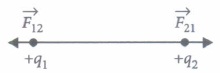
Write Coulomb's law in vector form. Also show that it obeys Newton's third law of motion.
5.
What will happen, if the field were not uniform?
6.
What is the force between two small charged spheres having charges of 2 x 10⁻⁷C and 3 x 10⁻⁷C placed 30 cm apart in air?
7.
Two point charges + 8q and- 2q are located at X=0 and x=L, respectively. The point on X-axis at which net electric field is zero due to these charges, is
8L
4L
2L
L
8.
The SI unit of electric flux is
\(\frac{\text { volt }}{\text { metre }}\)
\(\frac{\text { newton }}{\text { coulomb }}\)
\(\frac{\text { newton } \times \text { metre }^{2}}{\text { coulomb }}\)
\(\text { volt } \times \text { metre }^{2}\)
9.
A force of 2.25 N acts on a chrage of 15 x 10-4 C. The intensity of electric field at that point is
150 NC-1
15 NC-1
1500 NC -1
1.5 NC-1
10.
Two charges + 1 \(\mu\) Cand +4\(\mu\) C are situated at a distance in air. The ratio of the forces acting on them is
1 : 4
4 : 1
1 : 1
1 : 16
11.
SI unit of electrical permittivity is
N-m 2C-2
Am -2
NC-1
C2N-1m-2
12.
Number of electrons present in a negative charge of 8 C is ____________
5 x10¹⁹
2.5 x 10¹⁹
12.8 x 10¹⁹
1.6 x 10¹⁹
13.
A glass object is charged to +3 nC by rubbing it with a silk cloth. In this rubbing process, have protons been added to the object or have electrons been removed from it?
14.
Which is bigger, a coulomb of charge or a charge on an electron?
15.
What is the basic cause of quantisation of charge?
16.
What does q1 + q2 = 0 signify in electrostatics ?
17.
Consider three charged bodies A , B and C. If A and B repel each other and A attracts C, then what is nature of the force between B and C?
18.
Coulomb's law states that the electrostatic force of attraction or repulsion acting between two stationary point charges is given by
\(F=\frac{1}{4 \pi \varepsilon_{0}} \frac{q_{1} q_{2}}{r^{2}}\)
where F denotes the force between two charges q1 and q2 separated by a distance r in free space, Eo is a constant known as permittivity of free space. Free space is vacuum and may be taken to be air practically.
If free space is replaced by a medium, then Eo is replaced by (Eok) or (EoEr)where k is known as dielectric constant or relative permittivity.
(i) In coulomb's law, F = \(k \frac{q_{1} q_{2}}{r^{2}}\), then on which of the following factors does the proportionality constant k depends?
| (a) Electrostatic force acting between the two charges |
| (b) Nature of the medium between the two charges |
| (c) Magnitude of the two charges |
| (d) Distance between the two charges |
(ii) Dimensional formula for the permittivity constant Eo of free space is
| \(\text { (a) }\left[\mathrm{ML}^{-3} \mathrm{~T}^{4} \mathrm{~A}^{2}\right]\) | \(\text { (b) }\left[M^{-1} L^{3} T^{2} A^{2}\right]\) |
| \(\text { (c) }\left[\mathrm{M}^{-1} \mathrm{~L}^{-3} \mathrm{~T}^{4} \mathrm{~A}^{2}\right]\) | \(\text { (d) }\left[M L^{-3} T^{4} A^{-2}\right]\) |
(iii) The force of repulsion between two charges of 1 C each, kept 1 m apart in vaccum is
| \(\text { (a) } \frac{1}{9 \times 10^{9}} \mathrm{~N}\) | \(\text { (b) }\left[M^{-1} L^{3} T^{2} A^{2}\right]\) |
| \(\text { (c) } 9 \times 10^{7} \mathrm{~N}\) | \(\text { (d) } \frac{1}{9 \times 10^{12}} \mathrm{~N}\) |
(iv) Two identical charges repel each other with a force equal to 10 mgwt when they are 0.6 m apart in air. (g = 10 ms-2). The value of each charge is
| (a) 2 mC | (b) 2 x10⁻⁷ mC | (c) 2 nC | (d) 2\(\mu \)C |
(v) Coulomb's law for the force between electric charges most closely resembles with
| (a) law of conservation of energy | (b) Newton's law of gravitation |
| (c) Newton's 2nd law of motion | (d) law of conservation of charge |
1.
The given ratio is
\(\frac{k e^{z}}{G m_{c} m_{p}}\)
Where,
G = Gravitational constant
Its unit is N m2 kg−2.
me and mp = Masses of electron and proton.
Their unit is kg.
e = Electric charge.
Its unit is C.
k = A constant
\(=\frac{1}{4 \pi \in_{0}}\)
∈0 = Permittivity of free space
Its unit is N m2 C−2.
therefore, unit of the given ratio \(\frac{k e^{2}}{G m_{c} m_{p}}=\frac{\left[N m^{2} C^{-2}\right]\left[c^{-2}\right]}{\left[N m^{2} k g^{-2}\right][k g][k g]}=m^{0} L^{0} T^{0}\)
Hence, the given ratio is dimensionless.
e = 1.6 x 10⁻¹⁹ C
G = 6.67 x 10⁻¹¹ N m2 kg-2
me= 9.1 x 10⁻³¹ kg
mp = 1.66 x 10⁻²⁷ kg
Hence, the numerical value of the given ratio is
\(\frac{k e^{2}}{G m_{c} m_{p}}=\frac{9 \times 10^{9} \times\left(1.6 \times 10^{-19}\right)^{2}}{6.67 \times 10^{-1} \times 9.1 \times 10^{-3} \times 1.67 \times 10^{-22}} \approx 2.3 \times 10^{39}\)
This is the ratio of electric force to the gravitational force between a proton and an electron, keeping distance between them constant.
2.
(a) (i) The electric force between an electron and a proton at a distance r apart is:
\(F_{e}=-\frac{1}{4 \pi \varepsilon_{0}} \frac{e^{2}}{r^{2}}\)
where the negative sign indicates that the force is attractive. The corresponding gravitational force (always attractive) is:
\(F_{G}=-G \frac{m_{p} m_{e}}{r^{2}}\)
where mp and me are the masses of a proton and an electron respectively
\(\left|\frac{F_{e}}{F_{G}}\right|=\frac{e^{2}}{4 \pi \varepsilon_{0} G m_{p} m_{e}}=2.4 \times 10^{39}\)
(ii) On similar lines, the ratio of the magnitudes of electric force to the gravitational force between two protons at a distance r apart is :
\(\left|\frac{F_{e}}{F_{G}}\right|=\frac{e^{2}}{4 \pi \varepsilon_{0} G m_{p} m_{p}}=1.3 \times 10^{36}\)
However, it may be mentioned here that the signs of the two forces are different. For two protons, the gravitational force is attractive in nature and the Coulomb force is repulsive . The actual values of these forces between two protons inside a nucleus (distance between two protons is ~ 10-15 m inside a nucleus) are Fe ~ 230 N whereas FG ~ 1.9 x 10⁻³⁴ N.
The (dimensionless) ratio of the two forces shows that electrical forces are enormously stronger than the gravitational forces.
(b) The electric force F exerted by a proton on an electron is same in magnitude to the force exerted by an electron on a proton; however the masses of an electron and a proton are different. Thus, the magnitude of force is
\(|\mathbf{F}|=\frac{1}{4 \pi \varepsilon_{0}} \frac{e^{2}}{r^{2}}=8.987 \times 10^{9} \mathrm{Nm}^{2} / \mathrm{C}^{2} \times\left(1.6 \times 10^{-19} \mathrm{C}\right)^{2} /\left(10^{-10} \mathrm{~m}\right)^{2}\)
= 2.3 × 10⁻⁸ N
Using Newton’s second law of motion, F = ma, the acceleration that an electron will undergo is
a = 2.3 x 10⁻⁸ N / 9.11 x 10⁻³¹ kg = 2.5 x 10²² m/s2
Comparing this with the value of acceleration due to gravity, we can conclude that the effect of gravitational field is negligible on the motion of electron and it undergoes very large accelerations under the action of Coulomb force due to a proton.
The value for acceleration of the proton is
2.3 x 10⁻⁸ N / 1.67 x 10⁻²⁷ kg = 1.4 x 10¹⁹ m/s2.
3.
(a) Yes, by negligible amount.
(b) Yes.
(c) The charging of comb is due to charging by friction. The charging of paper bits is due to charging by induction.
4.
For like charges, \(\vec{F}_{12}=\frac{1}{4 \pi \varepsilon_{0}} \frac{q_{1} q_{2}}{r^{3}} \vec{r} 21\)
where \(\vec{F}_{12}\) is the force experienced by the 1st charge due to 2nd one and \(\overrightarrow{r_{21}}=\vec{r}_{1}-\vec{r}_{2}\)
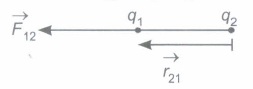
Similarly, \(\overrightarrow{F_{21}}=\frac{1}{4 \pi \varepsilon_{0}} \frac{q_{1} q_{2}}{r^{3}} \overrightarrow{r_{12}}, \overrightarrow{r_{12}}=\overrightarrow{r_{2}}-\overrightarrow{r_{1}}\)
\(\because \ \overrightarrow{r_{12}}=-\overrightarrow{r_{21}}\)
\(\overrightarrow{F_{12}}=-\overrightarrow{F_{21}}\)
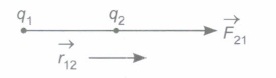
∴ Newton's third law is obeyed by the Coulomb's law.
5.
If the field is non-uniform, the net force will be non-zero.
6.
Repulsive force of magnitude 6 x 10⁻³ N
Charge on the first sphere, q1 = 2 x 10⁻⁷ C
Charge on the second sphere, q2 = 3 x 10⁻⁷ C
Distance between the spheres, r = 30 cm = 0.3 m
Electrostatic force between the spheres is given by the relation,
\(F=\frac{q_{1} q_{2}}{4 \pi \in_{0} r^{2}}\)
Where, ∈0 = Permittivity of free space
\(\frac{1}{4 \pi \in_{0}}=9 \times 10^{9} N m^{2} C^{-2}\)
\(F=\frac{9 \times 10^{9} \times 2 \times 10^{-7} \times 3 \times 10^{-7}}{(0.3)^{2}}=6 \times 10^{-3} N\)
Hence, force between the two small charged spheres is 6 x 10⁻³ N. The charges are of same nature. Hence, force between them will be repulsive.
7.
(c)
2L
8.
(c)
\(\frac{\text { newton } \times \text { metre }^{2}}{\text { coulomb }}\)
9.
(c)
1500 NC -1
10.
(c)
1 : 1
11.
(d)
C2N-1m-2
12.
(a)
5 x10¹⁹
13.
Electrons have been removed from the object.
14.
We know that, q = ne
\(\Rightarrow 1=\mathrm{n} \times 1.6 \times 10^{-19}\) (given, q = 1C)
\(\text { i.e. } n=\frac{1}{1.6 \times 10^{-10}} \simeq 6 \times 10^{18}\)
So, a coulomb of charge is bigger than the charge on an electron.
15.
The basic cause of quantisation of charge is only the integral number of electrons which is transferred from one body to another, i.e. ± ne.
16.
The charges q1 and q2 are equal and opposite.
17.
It is also attractive in nature.
18.
(i) (b): The proportionality constant k depends on the nature of the medium between the two charges.
(ii) (c): \({ As, }\left[\varepsilon_{0}\right]=\frac{1}{4 \pi F} \cdot \frac{q_{1} q_{2}}{r^{2}} =\frac{[\mathrm{AT}]^{2}}{\left[\mathrm{M} \mathrm{L} \mathrm{T}^{-2}\right]\left[\mathrm{L}^{2}\right]} \)
\(=\left\lfloor\mathrm{M}^{-1} \mathrm{~L}^{-3} \mathrm{~T}^{4} \mathrm{~A}^{2}\right]\)
(iii) (b)
(iv) (d): \(F=\frac{1}{4 \pi \varepsilon_{0}} \frac{q_{1} q_{2}}{d^{2}}\)
\(\therefore\left(10 \times 10^{-3}\right) \times 10=\frac{\left(9 \times 10^{9}\right) \times q^{2}}{(0.6)^{2}}\)
\(\text { or } \ q^{2}=\frac{10^{-1} \times 0.36}{9 \times 10^{9}}=4 \times 10^{-12}\)
\(\text { or } \ q=2 \times 10^{-6} \mathrm{C}=2 \mu \mathrm{C}\)
(v) (b)

12th Standard CBSE Syllabus & Materials
12th Standard CBSE
CBSE 12th Computer Science Python Revision Tour I - New Previous year Question Papers Study Material - QB365 Set A
NEW12th Standard CBSE
CBSE 12th Business Studies Planning Important Questions And Answers Study Material - QB365 Set A
NEW12th Standard CBSE
CBSE 12th Business Studies Business Environment Important Questions And Answers Study Material - QB365 Set A
NEW12th Standard CBSE
CBSE 12th Business Studies Principles of Management Important Questions And Answers Study Material - QB365 Set A



NCERT Books

Syllabus

Exam Pattern

Sample Question Papers

Previous year Question Papers

Important Notes

MCQ Practice test

NCERT Exemplers

Case study Questions

Image Based Questions

Passage based Questions

HOT Questions

Value Based Questions

Model Questions Papers
NCERT ( Book Back ) Questions

Assertion and Reason
Important Questions And Answers

CBSE 12th Standard CBSE Subjects
CBSE Standards








