
 100% FREE ACCESS
12th Standard CBSE Syllabus & Materials
12th Standard CBSE
CBSE 12th Economics Government Budget and the Economy Previous year Question Papers Study Material - QB365 Set A
NEW12th Standard CBSE
CBSE 12th Computer Science Interface Python with MySQL - New Previous year Question Papers Study Material - QB365 Set A
NEW12th Standard CBSE
CBSE 12th Computer Science Database Concept - New Previous year Question Papers Study Material - QB365 Set A
NEW12th Standard CBSE
CBSE 12th Computer Science Data Communication - New Previous year Question Papers Study Material - QB365 Set A
NEW12th Standard CBSE
CBSE 12th Computer Science Data Structures - New Previous year Question Papers Study Material - QB365 Set A
NEW12th Standard CBSE
CBSE 12th Computer Science Functions - New Previous year Question Papers Study Material - QB365 Set A

Published on: 07/03/2026
Download CBSE Class 12th Standard CBSE Physics question papers, sample papers, important questions, and previous year solved papers in PDF format. Get free study materials, NCERT solutions, and exam preparation resources for Class 12th Standard CBSE Physics
Questions + Answers key
Take MCQ Physics Test
1.
Deduce an expression for the electric potential due to an electric dipole at any point on its axis. Mention one contrasting feature of electric potential of a dipole at a point as compared to that due to a single charge.
2.
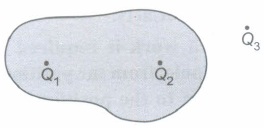
Three charges Q1, Q2 and Q3 are placed inside and outside a closed Gaussian surface as shown in the figure.
Answer the following:
(a) Which charges contribute to the electric field at any point on the Gaussian surface?
(b) Which charges contribute to the net flux through this surface?
(c) If Q1 = -Q2, will electric field on the surface be zero?
3.
A hemispherical surface lies as shown in an uniform electric field region. Find the net electric flux through the curved surface if electric field is
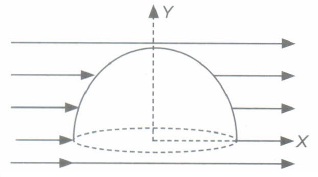
(a) along x-axis, and
(b) along y-axis.
4.
The equivalent capacitance of the combination between points A and B in the given figure is 4μF.

(i) Calculate the capacitance of the capacitor C.
(ii) Calculate the charge on each capacitor if a 12V battery is connected across terminals A and B.
(iii) What will be the potential drop across each capacitor?
5.
A parallel plate capacitor is charged to a potential difference V by a DC source. The capacitor is then disconnected from the source. If the distance between the plates is doubled, state with reason, how the following will change?
(i) Electric field between the plates
(ii) Capacitance
(iii) Energy stored in the capacitor.
6.
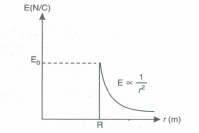
Using Gauss's law deduce the expression for the electric field due to a uniformly charged spherical conducting shell of radius R at a point (i) outside, and (ii) inside the shell. Plot a graph showing variation of electric field as function of r > R and r < R (r being the distance from the centre of the shell)
7.
(a) A point charge (+ Q) is kept in the vicinity of an uncharged conducting plate. Sketch electric field lines between the barge and the plate.
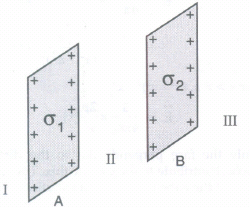
(b) Two infinitely large plane thin parallel sheets having surface charge densities \(\sigma\)1 and \(\sigma\)2 (\(\sigma\)1 > \(\sigma\)2) are shown in the figure. Write the magnitudes and directions of the fields in the regions marked II and III
8.
Three capacitors of 1\(\mu F\), 2\(\mu F\) and 3\(\mu F\) are joined in series.
(i) How many times will the capacity become when they are joined in parallel?
(ii) Determine the charge supplied by the battery of 100 V to the maximum resultant capacitor among both the arrangement.
9.
A hollow charged conductor has a tiny hole cut into its surface. Show that the electric field in the hole is \(\left( \frac { \sigma }{ 2{ \varepsilon }_{ 0 } } \right) \hat { n } \), where \(\hat { n } \) is the unit vector in the outward normal direction and \(\sigma \) is the surface charge density near the hole.
10.
Figure shows three point charges, +2q, -q and +3q. Two charges +2q and -q are enclosed within a surface S. What is the electric flux due to this configuration through the surfaces S?

11.
Two capacitors of capacitance of \(6\mu F \ and \ 12\mu F\) are connected in series with a battery. The voltage across the \(6\mu F\) capacitor is 2V. Compute the total battery voltage.
12.
A spherical Gaussian surface encloses a charge of \(8.85\times10^{-8}C\)
(i) Calculate the electric flux passing through the surface
(ii) If the radius of Gaussian surface is doubled, how would the flux change?
13.
Two charges +30\(\mu \ C\) and -30\(\mu \ C\) are placed 1 cm apart. Calculate electric field at an axial point at a distance of 20 cm from the centre of dipole.
14.
Eight identical point charges of q coulomb each are placed at the corners of a cube of each side 0.1 m. Calculate electric field at the centre of the cube. Calculate the field at the centre when one of the corner charges is removed.
15.
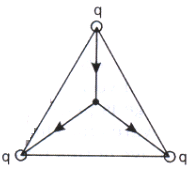
Three equal charges of + qC each placed at the three corners of an equilateral triangle. Find the total force experienced by a unit charge placed at the centroid of the triangle.
16.
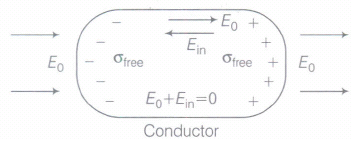
(i) Explain, using suitable diagram, the difference in the behaviour of a
(a) conductor
(b) dielectric in the presence of external electric field. Define the terms polarisation of a dielectric and write its relation with susceptibility.
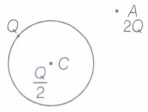
(ii) A thin metallic spherical shell of radius R carries a charge Q on its surface. A point charge Q/2 is placed at its centre C and an another charge +2Q is placed outside the shell at a distance x from the centre as shown in figure. Find
(a) the force on the charge at the centre of the shell and at point A,
(b) the electric flux through the shell.
1.
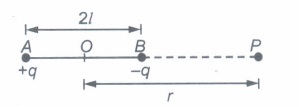
Potential at P due to charge at A is
\(V_{P A}=\frac{k q}{r+l}\)
Potential at P due to charge at B is
\(V_{P B}=-\frac{k q}{r-l}\)
Net potential at P is
\( V_{P} =V_{P A}+V_{P B}=k q\left[\frac{1}{r+l}-\frac{1}{r-l}\right] \)
\(=k q\left[\frac{r-l-r-l}{r^{2}-l^{2}}\right]=-\frac{k q(2 l)}{r^{2}-l^{2}} \)
\(V_{P} =-\frac{k p}{r^{2}-l^{2}} \ [\therefore p=q(2 l)]\)
In case \(r \gg l, V_{P}=-\frac{k p}{r^{2}}, \text { i.e. } V_{P} \propto \frac{1}{r^{2}}\) whereas due to a single charge potential at a point is \(V \propto \frac{1}{r}\)
2.
(a) All three charges Q1, Q2 and Q3 will contribute to the electric field.
(b) Only the enclosed charges, i.e. Q1 and Q2.
(c) No, the electric field will exist on the surface.
3.
(a) Since, the number of field lines entering the hemisphere is equal to number of field lines leaving. Hence, the net electric flux through it is zero.
(b) As no charge is enclosed, therefore net electric flux is given by
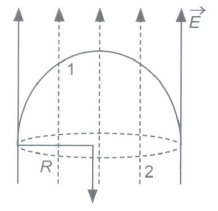
\(\phi=\phi_{1}+\phi_{2}=0\)
where \(\phi_{1}\) = Electric flux through the curved surface area
\(\phi_{2}\) = Electric flux through the plane surface area
\(\therefore \ \phi_{1}=-\phi_{2}\)
\(\Rightarrow \phi_{1}=-E \cdot \pi R^{2} \cos 180^{\circ}=E \cdot \pi R^{2}\)
4.
According to the question,
Capacitors of 20μFand C are connected in series.
(i) The equivalent capacitance
\((4\mu F)=\frac { (20\mu F)\times C }{ 20+C } \)
(20 + C) = 5C 4C = 20
∴ C = 5μF
(ii) Charge on capacitor (equivalent)
q = (4μF) x 12 = 48μC
same charge 48μC lies on both the capacitors
(iii) Potential drop across 20 μFcapacitor
\({ V }_{ 1 }=\frac { q }{ { C }_{ 1 } } =\frac { 48\mu C }{ 20\mu F } =2.4V\)
Potential drop across 5μFcapacitor
\({ V }_{ 2 }=\frac { q }{ { C }_{ 2 } } =\frac { 48\mu C }{ 5\mu F } =9.6V\)
5.
After disconnection from battery and doubling the separation between two plates
(i) Charge on capacitor remains same.
i.e, CV = C'V'
\(\Rightarrow CV=\left( \frac { C }{ 2 } \right) V'\Rightarrow V'=2V\)
∵ Electric field between the plates
\(E'=\frac { V' }{ d' } =\frac { 2V }{ 2d } \)
\(E'=\frac { V }{ d } =E\)
⇒ Electric field between the two plates remains same.
(ii) Capacitance reduces to half of original value as
C ∝ \(\frac { 1 }{ d } \Rightarrow C'=\frac { C }{ 2 } \)
(iii) Energy stored in the capacitor before disconnection from battery
\({ U }_{ 1 }=\frac { { q }^{ 2 } }{ 2C } \)
Now, energy stored in the capacitor after disconnection from battery
\({ U }_{ 2 }=\frac { { q }^{ 2 } }{ 2(C') } =\frac { { q }^{ 2 } }{ 2\times \left( \frac { C }{ 2 } \right) } =\frac { { q }^{ 2 } }{ C } \)
\(\Rightarrow { U }_{ 2 }=2\left( \frac { { q }^{ 2 } }{ 2C } \right) =2{ U }_{ 1 } \ { U }_{ 2 }=2{ U }_{ 1 }\)
Energy stored in capacitor gets doubled to its initial value.
6.
Electric field due to a uniformly charged thin spherical shell :
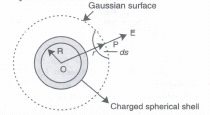
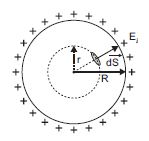
(i) When point P lies outside the spherical shell :Suppose that we have to calculate electric field at the point P at a distance r (r > R) from its centre. Draw the Gaussian surface through point P so as to enclose the charged spherical shell. The Gaussian surface is a spherical shell of radius r and centre O.
Let \(\overrightarrow{E}\) be the electric field at point P, then the electric flux through area element is \(\overrightarrow{ds}\) given by
\(d\phi = \overrightarrow{E}.\overrightarrow{\Delta S}\)
Since \(\Delta\)S is also along normal to the surface,
\(d\phi = E ds\)
\(\therefore\) Total electric flux through the Gaussian surface is given by,
\(\phi = \oint_s Eds = E\oint_s ds\)
Now \(\oint_s ds = 4\pi r^2\)
\(\phi = E \times 4\pi r^2\)................(i)
Since the charge enclosed by the Gaussian surface is q1 according to Gauss theorem,
\(\phi = \frac{q}{\epsilon_0}\) .......................(ii)
From equations (i) and (ii),we obtain
\(E\times4\pi r^2 = \frac{q}{\epsilon_0}\)
\(E = \frac{1}{4\pi\epsilon_0}\frac{q}{r_2}\) ( for ( r > R ) )
(ii) When point P lies inside the spherical shell : In such a case, the Gaussian surface encloses no charge. According to Gauss law,
\(E\times4\pi r^2 = 0\)
i.e., E = 0 (r < R)
Graph showing the variation of electric field as a function of r :
7.
.png)
(i) Fot region II,
\(E_{II} = \frac{1}{2\pi\epsilon_0}(\sigma_1-\sigma_2)\)
towards tight side/from sheet A to sheet B
(ii) For region III,
\(E_{III} = \frac{1}{2\pi\epsilon_0}(\sigma_1+\sigma_2)\)
towards tight side/away from the two sheets
8.
(i) Given, C1 = 1\(\mu F\) C2 = 2\(\mu F\) C3 = 3\(\mu F\)
The combined capacity (Cs) in series combination is given by
\(\frac { 1 }{ { C }_{ s } } =\frac { 1 }{ { C }_{ 1 } } +\frac { 1 }{ { C }_{ 2 } } +\frac { 1 }{ { C }_{ 3 } } =\frac { 1 }{ 1 } +\frac { 1 }{ 2 } +\frac { 1 }{ 3 } =\frac { 11 }{ 6 } \)
\(\Rightarrow { C }_{ s }=\frac { 6 }{ 11 } \mu F\)
The combined capacity (Cp) in parallel combination is given by
Cp = C1 + C2 +C3 = 1 + 2 + 3 = 6\(\mu F\)
\(\Rightarrow { C }_{ p }=11{ C }_{ s }\)
(ii) As, \({ \ C }_{ p }>{ C }_{ s }\)
\(\therefore \) The charge supplied by 100 V battery
\({ q }_{ p }={ C }_{ p }V=6\mu F\times 100=6\times { 10 }^{ -6 }\times 100\)
\(\\ { q }_{ p }=6\times { 10 }^{ -4 }C\)= 600 \(\mu\)C
9.
Surface density near the hole = \(\sigma \)
Unit vector = \(\hat { n } \) (normal directed outwards)

Let P be the point on the hole. The electric field at point P closed to the surface to conductor, according to Gauss' theorem.
\(\oint { E.dS=\frac { q }{ { \varepsilon }_{ 0 } } } \)
where, q is the charge near the hole.
\(EdS\cos { \theta } =\frac { \sigma dS }{ { \varepsilon }_{ 0 } } (\because \sigma =q|dS\therefore q=\sigma dS,where\quad dS=area)\)
\(\therefore\) Angle between electric field and area vector is 00
\(\therefore \ E \ dS=\frac { \sigma \ dS }{ { \varepsilon }_{ 0 } } \)
\(\Rightarrow \ E=\frac { \sigma }{ { \varepsilon }_{ 0 } } \Rightarrow E=\frac { \sigma }{ { \varepsilon }_{ 0 } } \hat { n } \)
This electric field due to the filled up hole and the field due to the rest of the charged conductor. The two fields inside the conductor are equal and opposite.
So, there is no electric field inside the conductor. Outside the conductor, the electric fields are equal in the same direction.
So, the electric field at point P due to each part
\(=\frac { 1 }{ 2 } =E=\frac { \sigma }{ { 2\varepsilon }_{ 0 } } \hat { n } \)
10.
Electric flux through the closed surface S is
\( { \phi }_{ S }=\frac { \Sigma q }{ { \varepsilon }_{ 0 } } =\frac { +2q-q }{ { \varepsilon }_{ 0 } } =\frac { q }{ { \varepsilon }_{ 0 } }\)
\( \\ \Longrightarrow { \ \ \phi }_{ S }=\frac { q }{ { \varepsilon }_{ 0 } } \)
Charge +3q is outside the closed surface S, therefore, it would not be taken into consideration in applying Gauss' theorem
11.
As capacitors are connected in series, charge on each capacitor must be same.
Charge on \(6\mu F\) capacitor = charge on 12\(\mu C\) capacitor
\(6\times 10^{-6}\times 2=12\times 10^{-6}\times V_2\)
\(V_2={6\times 2\over 12}=1 volt\)
Total battery voltage = V1 + V2 = 2 + 1
= 3V
12.
\((i)\phi_E={q\over \epsilon_o}={8.85\times 10^{-8}\over 8.85\times 10^{-12}}=10^4Nm^2C^{-1}\)
(ii) flux will remain the same as charge enclosed by the surface is same as in case (i)
13.
As r >> a, so E = \(2\overrightarrow { P } \over 4\pi\epsilon_or^3\)
= \(9\times10^9\times 2\times 30\times 10^{-6}\times 10^{-2}\over (20\times10^{-2})^3\)
= \(6.25\times 10^5 NC\)
14.
Length of each side a = 0.1 m = 10 cm
distance of the centre of the cube from each corner,
\(r={a\sqrt3\over2}={10\sqrt3\over 2}=5\sqrt3\)
= \(5\sqrt3\times10^{-2}m\)
When identical point charges +q each are at the eight corners of the cube, net field intensity at the centre is zero (cancelling out in four pairs). When one of the corner charges is removed, three pairs of E values cancel. Due to charge on the seventh corner,
\(E={1\over 4\pi\epsilon_o}{q\times 1\over r^2}=9\times 10^9{q\over (5\sqrt3\times10^{-2})^2}\)
= \((1.2\times 10^{12}q)NC^{-1}\)
15.
Zero, because equal forces are inclined at angle of \(120°\) so resultant is Zero.
16.
(i) (a) When a capacitor is placed in an external electric field, the free charges present inside the conductor redistribute themselves in such a manner that electric field within the conductor. This happens until a static situation is achieved,i.e. when the two fields cancel each other and the net electrostatic field in the conductor becomes zero.
(b) In contrast to conductors, dielectrics are non-conducting substance, i.e. they have no charge carriers.Thus, in a dielectric, free movement of charges in not possible.It turns out that the external field induces dipole moment by stretching molecules of the dielectric.
The collective effect of all the molecular dipole moments is the net charge on the surface of the dielectric which produces a field that opposes the external field. However, the opposing field is so induced, that does not exactly cancel the extent of the effect depends on the nature of dielectric.
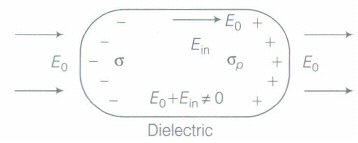
Both polar and non-polar dielectrics develop net dipole moment in the presence of an external field. The dipole moment per unit volume is called polarisation and is denoted by P for linear isotropic dielectrics.
P = XE
Where, X is constant of proportionality and is called electric susceptibility of the electric slab.
(ii) (a) At point C, inside the shell. Electric field inside a spherical shell is zero.
Thus, the force experienced by charge at centre C will also be zero.
\(\because \) Fc = qE (Einside the shell = 0)
\(\therefore \) Fc = 0
At point A, | FA | = 2Q \(\left[ \frac { 1 }{ { 4\pi \varepsilon }_{ 0 } } .\frac { 3Q/2 }{ { x }^{ 2 } } \right] \\.\)
\( F \ = \ \frac { { 3Q }^{ 2 } }{ { { 4\pi \varepsilon }_{ 0 } }{ x }^{ 2 } } ,\) away from shell
Electric flux through the shell,
\(\Phi =\frac { 1 }{ { \varepsilon }_{ 0 } } \) x magnitude of charge enclosed by shell
\(=\frac { 1 }{ { \varepsilon }_{ 0 } } \times \frac { Q }{ 2 } \Rightarrow \Phi =\frac { Q }{ { 2\varepsilon }_{ 0 } } \)

12th Standard CBSE Syllabus & Materials
12th Standard CBSE
CBSE 12th Computer Science Python Revision Tour I - New Previous year Question Papers Study Material - QB365 Set A
NEW12th Standard CBSE
CBSE 12th Business Studies Planning Important Questions And Answers Study Material - QB365 Set A
NEW12th Standard CBSE
CBSE 12th Business Studies Business Environment Important Questions And Answers Study Material - QB365 Set A
NEW12th Standard CBSE
CBSE 12th Business Studies Principles of Management Important Questions And Answers Study Material - QB365 Set A



NCERT Books

Syllabus

Exam Pattern

Sample Question Papers

Previous year Question Papers

Important Notes

MCQ Practice test

NCERT Exemplers

Case study Questions

Image Based Questions

Passage based Questions

HOT Questions

Value Based Questions

Model Questions Papers
NCERT ( Book Back ) Questions

Assertion and Reason
Important Questions And Answers

CBSE 12th Standard CBSE Subjects
CBSE Standards








