
 100% FREE ACCESS
12th Standard CBSE Syllabus & Materials
12th Standard CBSE
CBSE 12th Economics Government Budget and the Economy Previous year Question Papers Study Material - QB365 Set A
NEW12th Standard CBSE
CBSE 12th Computer Science Interface Python with MySQL - New Previous year Question Papers Study Material - QB365 Set A
NEW12th Standard CBSE
CBSE 12th Computer Science Database Concept - New Previous year Question Papers Study Material - QB365 Set A
NEW12th Standard CBSE
CBSE 12th Computer Science Data Communication - New Previous year Question Papers Study Material - QB365 Set A
NEW12th Standard CBSE
CBSE 12th Computer Science Data Structures - New Previous year Question Papers Study Material - QB365 Set A
NEW12th Standard CBSE
CBSE 12th Computer Science Functions - New Previous year Question Papers Study Material - QB365 Set A

Published on: 02/11/2025
Download CBSE Class 12th Standard CBSE Physics question papers, sample papers, important questions, and previous year solved papers in PDF format. Get free study materials, NCERT solutions, and exam preparation resources for Class 12th Standard CBSE Physics
Questions + Answers key
Take MCQ Physics Test
1.
100 J of work is done in moving an electric charge of magnitude 4 C from a place A, where potential is -10 V to another place B where potential is V volt. Find the value of V.
2.
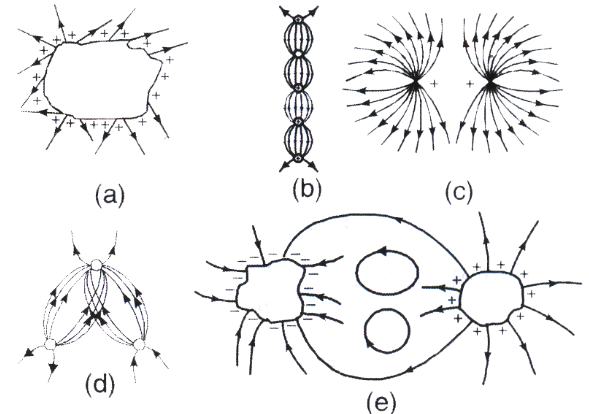
Which of the following figures cannot possibly represent electrostatic field lines?
3.
why does a motor take more current when we start it?
4.
When current in a coil changes with time, how is the back e.m.f. induced in the coil related to it?
5.
The relation between dielectric constant K and electric susceptibility x of a material is
K = x
K = 1 + x
x = K + 1
\(K^2=(1+x)(1-x)\)
6.
When a number of capacitors are connected in series between two points, all the capacitors possess same
Capacity
potential
charge
none of the above
7.
When a conductor is held in an electric field, the field inside the conductor is always
positive
negative
constant
zero
8.
For an LCR circuit, the power transferred from the driving source to the driven oscillator from the driving source tothe driven oscillator is P = I2Z cos \(\phi \).
Here, the power factor cos \(\phi \ge 0,\ P\ge 0\)
The driving force can given no energy to the oscillator (P = 0) in some cases
The driving force can not syphon out (P<0) the energy out of oscillator
The driving force can take away energy out of the oscillator
9.
The number of electric lines of force radiating from a closed surface in vacuum is \(1.13\times 10^{11}\). The charge enclosed by the surface is
1 C
\(1\mu C\)
0.1 C
0.1\(\mu C\)
10.
Electric dipole moment is
scalar
neither scalar vector
a vector directed from -q to +q
a vector directed from +q to -q
11.
The peak value of 220 V a.c. is
220V
\(\frac { 220 }{ \sqrt { 2 } } V\)
440V
\(220\sqrt { 2 } V\)
12.
Which of the following does not have the dimension of time?
RC
\(\frac { L }{ R } \)
\(\frac { R }{ L } \)
\(\sqrt { LC } \)
13.
Choose the quality whose SI unit is not ohm.
Resistance
Reactance
Capaciatnce
Impedance
14.
A wire of length 2m moves with a speed of 5m/s perpendicular to a magnetic field of induction 0.1 Wb/m2. The e.m.f. induced in the wire is
1 V
10 V
5 V
2 V
15.
A particle of mass 10-3 kg and charge 5 \(\mu\)Centers into a uniform electric field of 2 x 10⁵ NC-1, moving with a velocity of 20 ms-1 in a direction opposite to that of the field. Calculate the distance it would travel before coming to rest.
16.
A 110 V d.c. source replaces an a.c. source such that heat produced is same in the two cases. What is the rms value of alternating voltage sources.
17.
Electric field intensity at a point B due to a point charge Q kept at point A is 24NC-1 and electric potential at B due to the same charge is 12 JC-1 Calculate the distance AB and magnitude of charge.
18.
A 60 V-10 W electric lamp is to be run on 100 V-60Hz mains. Calculate the inductance of the choke coil to achieve the same result, calculate its value.
1.
Given, WAB = 100 J, q = 4C, VA =- 10 V, VB = V = ?
Since, WAB = q(VB - VA )
\(\Rightarrow \) 100 = 4(V +10) \(\Rightarrow \) V = 15 V
2.
Only (c) is right; the rest cannot represent electrostatic field lines.
(a) is wrong because field lines must be normal to a conductor.
(b) is wrong because lines of force cannot start from a negative charge.
(d) is wrong because lines of force cannot intersect each other.
(e) is wrong because electrostatic field lines cannot form closed loops.
3.
When we start the motor, there is no back emf as the motor is at rest. So, a large current flows through the coil. As the motor rotates, the back emf increases and intake of current decreases.
4.
The back emf in the coil opposes the change in the current as per Lenz's law.
5.
(b)
K = 1 + x
6.
(c)
charge
7.
(d)
zero
8.
(b)
The driving force can given no energy to the oscillator (P = 0) in some cases
9.
(a)
1 C
10.
(c)
a vector directed from -q to +q
11.
(d)
\(220\sqrt { 2 } V\)
12.
(c)
\(\frac { R }{ L } \)
13.
(c)
Capaciatnce
14.
(a)
1 V
15.
Here, m = 10- 3 kg, q = 5 x 10⁻⁶ C,
E = 2 x 10⁵ N/C , u = 20 m/s, v = 0
As it enters opposite to the field, so particle will retard.
Acceleration ,
\(a=\frac{qE}{m}\)
= \(\frac{5\times10^{-6}\times2\times10^5}{10{-3}}\)
= 103 m/s2
Using, v2 = u2 - 2as
0 = (20)2 -2 x 1000 x s
or s = \(\frac{400}{2000}\)
= \(\frac{1}{5}\)
= 0.2 m
16.
As heat produced is the same, rms voltage of a.c. source = d.c. voltage = 110 V
17.
Here, \(E={Q\over 4\pi\epsilon_or^2}=24NC^{-1}\)
\(V={Q\over 4\pi\epsilon_or}=12JC^{-1}\)
Dividing, we get \({V\over E}=r={12\over 24}=0.5m=AB\)
From V = \({Q\over 4\pi\epsilon_or};Q=4\pi\epsilon_or\times V\)
\(Q={1\over 9\times 10^9}\times0.5\times 12=0.667\times 10^{-9}C\)
18.
\(Here, \ { E }_{ v }=60V, \ P=10W\)
\(R=\frac { { E }_{ v }^{ 2 } }{ P } =\frac { 60\times 60 }{ 10 } =360\Omega \)
\(Current \ through \ the \ lamp,\)
\({ I }_{ v }=\frac { { E }_{ v } }{ R } =\frac { 60 }{ 360 } =\frac { 1 }{ 6 } A\)
\(Let \ L \ be \ the \ inductance \ of \ the \ choke \ required.\)
\( \therefore \ \ Z=\frac { { E }_{ v } }{ { I }_{ v } } =\frac { 100 }{ 1/6 } =600\Omega \)
\( From \ \ { R }^{ 2 }+{ X }_{ L }^{ 2 }={ Z }^{ 2 }\)
\({ X }_{ L }=\sqrt { { Z }^{ 2 }-{ R }^{ 2 } } =\sqrt { { \left( 600 \right) }^{ 2 }-{ \left( 360 \right) }^{ 2 } } =480\Omega \)
\({ X }_{ L }=\omega L=2\pi vL=480\)
\(L=\frac { 480 }{ 2\pi v } =\frac { 480 }{ 2\times 3.14\times 60 } \)
\(L=1.274 \ H\)
\(To \ achive \ the \ same \ result \ resistance \ required\)
\({ R }^{ ' }=Z-R=600-360=240\Omega \)

12th Standard CBSE Syllabus & Materials
12th Standard CBSE
CBSE 12th Computer Science Python Revision Tour I - New Previous year Question Papers Study Material - QB365 Set A
NEW12th Standard CBSE
CBSE 12th Business Studies Planning Important Questions And Answers Study Material - QB365 Set A
NEW12th Standard CBSE
CBSE 12th Business Studies Business Environment Important Questions And Answers Study Material - QB365 Set A
NEW12th Standard CBSE
CBSE 12th Business Studies Principles of Management Important Questions And Answers Study Material - QB365 Set A



NCERT Books

Syllabus

Exam Pattern

Sample Question Papers

Previous year Question Papers

Important Notes

MCQ Practice test

NCERT Exemplers

Case study Questions

Image Based Questions

Passage based Questions

HOT Questions

Value Based Questions

Model Questions Papers
NCERT ( Book Back ) Questions

Assertion and Reason
Important Questions And Answers

CBSE 12th Standard CBSE Subjects
CBSE Standards








