
 100% FREE ACCESS
12th Standard CBSE Syllabus & Materials
12th Standard CBSE
CBSE 12th Economics Government Budget and the Economy Previous year Question Papers Study Material - QB365 Set A
NEW12th Standard CBSE
CBSE 12th Computer Science Interface Python with MySQL - New Previous year Question Papers Study Material - QB365 Set A
NEW12th Standard CBSE
CBSE 12th Computer Science Database Concept - New Previous year Question Papers Study Material - QB365 Set A
NEW12th Standard CBSE
CBSE 12th Computer Science Data Communication - New Previous year Question Papers Study Material - QB365 Set A
NEW12th Standard CBSE
CBSE 12th Computer Science Data Structures - New Previous year Question Papers Study Material - QB365 Set A
NEW12th Standard CBSE
CBSE 12th Computer Science Functions - New Previous year Question Papers Study Material - QB365 Set A

Published on: 02/11/2025
Download CBSE Class 12th Standard CBSE Physics question papers, sample papers, important questions, and previous year solved papers in PDF format. Get free study materials, NCERT solutions, and exam preparation resources for Class 12th Standard CBSE Physics
Questions + Answers key
Take MCQ Physics Test
1.
A parallel plate capacitor, each with plate area A and separation d is charged to a potential difference V. The battery used to charge it remains connected. A dielectric slab of thickness d and dielectric constant K is now placed between the plates.
What change if any will take place in
(i) charge on plates?
(ii) electric field intensity between the plates?
(iii) capacitance of the capacitor?
Justify your answer in each case.
2.
(i) Write the expression for the force F acting on a particle of mass m and charge q moving with velocity v in a magnetic field B. Under what conditions will it move in
(a) a circular path and
(b) a helical path?
(ii) Show that the kinetic energy of the particle moving in magnetic field remains constant.
3.
In an electric circuit, there is a capacitor of reactance 100 \(\Omega \)connected across the source of 220V. Find the displacement current.
4.
A magnetic field of flux density 1.0 \(Wb{ m }^{ -2 }\) acts normal to a 80 turn coil of 0.01 \({ m }^{ 2 }\) area. Find the induced e.m.f. in the coil, if it is removed from the field in 0.1 s.
5.
What is an ideal inductor?
6.
A silver wire has a resistance of 2.1\(\Omega\) at 27.5oC and a resistance of 2.7\(\Omega\) at 100oC. Determine the temperature coefficient of resistivity of silver.
7.
A point charge +q, is placed at a distance from an isolated conducting plane. The field at a point P on the other side of the plane is
directed perpendicular to the plane and away from the plane
directed perpendicular to the plane but towards the plane
directed radially away from the point charge
directed radially towards the point charge
8.
A proton and an \(\alpha \)-particle moving with same velocity enter into a uniform magnetic field, acting normal to the plane of their motion. The ratio of radii of the circular paths described by the proton and \(\alpha \)-particle is
1 : 2
1 : 4
1 : 16
4 : 1
9.
Out of the following, choose the wrong statement :
A transformer cannot work on d.c.
A transformer cannot change the frequency of a.c.
A transformer can produce a.c. power
In a transformer, when a.c. voltage is raised n times, the alternating current reduces to 1/n time.
10.
Current carrying wire produces
Only electric field
Only magnetic field
Both electric and magnetic field
None of the above
11.
Electric field due to an electric dipole is
spherically symmetric
cylindrically symmetric
asymmetric
none of the above
12.
Choose the quality whose SI unit is not ohm.
Resistance
Reactance
Capaciatnce
Impedance
13.
A plane electromagnetic wave of wave intensity.\(6 \ W/{ m }^{ 2 }\) strikes a small mirror of an area \(30 \ c{ m }^{ 2 }\) held perpendicular to the approaching wave. The momentum transferred in \(kg \ ms^{ -1 }\) by the wave to the mirror each second will be
\(1.2\times { 10 }^{ -10 }\)
\(2.8\times { 10 }^{ -9 }\)
\(3.6\times { 10 }^{ -8 }\)
\(4.8\times { 10 }^{ -7 }\)
14.
Choose the wrong statement:
When ever the amount of magnetic flux linked with a circuit changes, an e.m.f. is induced in the circuit.
The induced e.m.f. lasts so long as the change in magnetic flux continues
Large the amount of magnetic flux linked with a circuit, greater is the e.m.f. induced in it.
The direction of induced e.m.f. is given by Lenz's Llaw.
15.
An EM wave of intensity I falls on a surface kept in vacuum and experts radiation pressure kept in vacuum and experts radiation pressure p on it. Which of the following are true?
Radiation pressure is I/c if the wave is totally absorbed
Radiation pressure is I/c if the wave is totally reflected
Radiation pressure is 2I/c if the wave is totally reflected
Radiation pressure is in the range I/c
16.
The thickness of air layer between two coatings of a spherical capacitor is 2 cm. The capacitor has same capacitance as the sphere of 1.2m diameter. Find the radii of its surfaces.
17.
The instantaneous current from an a.c. source is I = 5 sin 100\(\pi \) t. What is the frequency of a.c? What is the rms value of current?
18.
(a) State Ohm's law.
(b) Define resistance. Give its SI unit.
19.
What is the ratio of speed of infrared and ultraviolet rays in vacuum?
20.
Two 120V light bulbs, one of 25W and another of 200W are connected in series. One bulb burnt out almost instantaneously? Which one was burnt and why?
21.
Does the strength o electric field due to an infinite plane sheet of charge depend upon the distance of the observation point from the sheet of charge?
22.
Distinguish between kilowatt and kilowatt hour.
23.
Give one important point of distinction between magnetism and electricity.
24.
Define the unit of electric potential.
25.
An electromagnetic wave consists of oscillating electric and magnetic field. what is the phase relationship between these fields?
26.
Why is induced emf called back e.m.f. ?
1.
On introduction of dielectric slab to fill the gap between plates of capacitor completely when capacitor is connected with battery.
(i) The potential difference V between capacitors is same due to connectivity with battery and hence, charge q' becomes K times of original charge as
q' = C'V' = (KC) (V) = K(CV) = Kq
q' = Kq
(ii) Electric field intensity continue to be the same as potential difference and separation between two plates remain unaffected as
\(E=\frac { V }{ d } \)
(iii) The capacitance of capacitor becomes K times of original capacitor.
\(\therefore \ C'=KC=\frac { K{ \varepsilon }_{ 0 }A }{ d } \)
2.
(i) Force acting on the particle, F = Bqv
In vector form, F = q(v x B)
where, B is uniform magnetic field and v is velocity with particle which is moving.
From this equation, it is clear that direction of force is perpendicular to the plane containing both v and B. In other words, force acts perpendicular to both v and B. When velocity becomes perpendicular to force, the path of the object becomes circular.
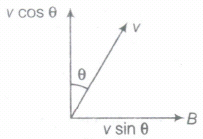
In this case, B is assumed to act perpendicular to v. In case, B is not perpendicular to v, a component of v remains perpendicular to v. It creates circular path. The component of v parallel to B will create linear path. Here, circular path is due to v cosθ and linear path is due to v sinθ. Both when combined gives helical path.
(ii) Since, force always adjusts itself in a direction which becomes perpendicular to velocity, so only direction of velocity is changes not the magnitude. Hence, the kinetic energy of the, particle always remains constant.
3.
Since, displacement current = conduction current.
Therefore,
Id = \(\frac { V }{ X_{ c } } \) = \(\frac { 220 }{ 100 } \)
\(\Rightarrow \) Id = 2.2A
4.
\(B=1 \ Wb{ m }^{ -2 }; \ n=80; \ A=0.01{ m }^{ 2 }; \ dt=0.1s; \ e=?\)
\(e=\frac { d\phi }{ dt } =\frac { nAB }{ dt } \)
or \(e=\frac { 80\times 0.01\times 1 }{ 0.1 } =8V.\)
5.
An ideal inductor is a coil consisting of large number of turns wound in such a way that magnetic flux linked with it due to current passing through it is confined to a small region only. The ohmic resistance of such a coil is zero.
6.
Temperature, T1 = 27.5°C
Resistance of the silver wire at T1, R1 = 2.1 Ω
Temperature, T2 = 100°C
Resistance of the silver wire at T2, R2 = 2.7 Ω
Temperature coefficient of silver = α
It is related with temperature and resistance as
\(\alpha=\frac{R_{2}-R_{1}}{R_{2}\left(T_{2}-T_{1}\right)}\)
\(=\frac{2.7-2.1}{2.1(100-27.5)}=0.0039^{\circ} \mathrm{C}^{-1}\)
Therefore, the temperature coefficient of silver is 0.0039°C−1.
7.
(a)
directed perpendicular to the plane and away from the plane
8.
(a)
1 : 2
9.
(c)
A transformer can produce a.c. power
10.
(b)
Only magnetic field
11.
(b)
cylindrically symmetric
12.
(c)
Capaciatnce
13.
(a)
\(1.2\times { 10 }^{ -10 }\)
14.
(c)
Large the amount of magnetic flux linked with a circuit, greater is the e.m.f. induced in it.
15.
(a)
Radiation pressure is I/c if the wave is totally absorbed
16.
Here, \({4\pi \epsilon_oab\over b-a}=4\pi\epsilon_oR\)
\({ab\over b-a}=R\)
As b - a = 2 cm R = \({1.2\over 2}m=60cm\)
\({ab\over 2}=60 \ or \ ab=120\)
As \((b+a)^2=(b-a)^2+4ab=(2)^2+4\times 120=484\)
b + a = 22
2 + a + a = 22
a = 10 cm, b = 12 cm
17.
\(Here,\ I=5sin\ 100\pi t\)
\( Compare\ with\ I={ I }_{ 0 }sin\ \omega t\)
\({ I }_{ 0 }=5A,\ \omega =2\pi v=100\pi\)
\(v=\frac { 100\pi }{ 2\pi } =50 \ Hz\)
\(\ { I }_{ v }=\frac { { I }_{ 0 } }{ \sqrt { 2 } } =\frac { 5 }{ \sqrt { 2 } } =\frac { 5\sqrt { 2 } }{ 2 } =3.54A\)
18.
It states that current flowing through a conductor is proportional to the potential difference across its two ends provided the physical conditions of the conductor remain unchanged.
If V is the potential difference between two ends of a conductor and I is the current flowing through it, then
\(V\alpha I\)
\(V=RI\)
Where R is the constant of proportionality and is called the resistance of the conductor. Its value depends upon
(i) Shape of the conductor
(ii) Length of conductor
(iii) Nature of the material
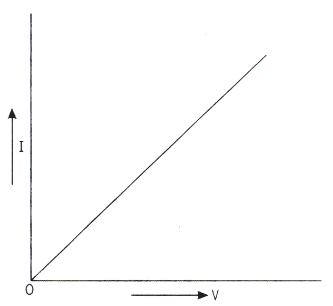
If a graph is plotted between V and I, the graph will be a straight line passing through the origin.
(b) Resistance is the property of a material by virtue of which it opposes the flow of current through it and quantitatively it is given by,
\(R=\frac { V }{ I }\)
\( =\frac { Potential \ difference }{ Current } \)
definition of ohm
Hence a conductor has a resistance of one ohm if a current of one ampere flows through it when a potential difference of one volt is maintained across its two ends.
19.
Same as velocity of light
20.
\(Pα 1/R (i.e) \)25 watts
21.
No, the electric field due to an infinite plane sheet of charge does not depend upon the distance of the observation point from the plane sheet of charge.
22.
Kilowatt is the unit of power. 1 kilowatt = 100 watt. Kilowatt hour is the unit of electric energy, where
1 kilowatt hour = 1000 watt x 1 hour
= 1000 watt x 60 x 60 second
= 3.6 x 10⁶ J
23.
Whereas in electricity, an isolated charge exists; in magnetism, an isolated magnetic pole does not exist.
24.
The S.I unit of electric potential is volt. The electric potential at a point is said to be 1 volt when 1J of work is done in moving a positive charge of 1 coulomb from infinity to that point against the electrostatic force.
25.
oscillating electric and magnetic field of an electromagnetic wave are in the same phase
26.
Induced emf is called back emf as it opposes the growth as well as decay of current in the circuit.

12th Standard CBSE Syllabus & Materials
12th Standard CBSE
CBSE 12th Computer Science Python Revision Tour I - New Previous year Question Papers Study Material - QB365 Set A
NEW12th Standard CBSE
CBSE 12th Business Studies Planning Important Questions And Answers Study Material - QB365 Set A
NEW12th Standard CBSE
CBSE 12th Business Studies Business Environment Important Questions And Answers Study Material - QB365 Set A
NEW12th Standard CBSE
CBSE 12th Business Studies Principles of Management Important Questions And Answers Study Material - QB365 Set A



NCERT Books

Syllabus

Exam Pattern

Sample Question Papers

Previous year Question Papers

Important Notes

MCQ Practice test

NCERT Exemplers

Case study Questions

Image Based Questions

Passage based Questions

HOT Questions

Value Based Questions

Model Questions Papers
NCERT ( Book Back ) Questions

Assertion and Reason
Important Questions And Answers

CBSE 12th Standard CBSE Subjects
CBSE Standards








