
 100% FREE ACCESS
12th Standard CBSE Syllabus & Materials
12th Standard CBSE
CBSE 12th Economics Government Budget and the Economy Previous year Question Papers Study Material - QB365 Set A
NEW12th Standard CBSE
CBSE 12th Computer Science Interface Python with MySQL - New Previous year Question Papers Study Material - QB365 Set A
NEW12th Standard CBSE
CBSE 12th Computer Science Database Concept - New Previous year Question Papers Study Material - QB365 Set A
NEW12th Standard CBSE
CBSE 12th Computer Science Data Communication - New Previous year Question Papers Study Material - QB365 Set A
NEW12th Standard CBSE
CBSE 12th Computer Science Data Structures - New Previous year Question Papers Study Material - QB365 Set A
NEW12th Standard CBSE
CBSE 12th Computer Science Functions - New Previous year Question Papers Study Material - QB365 Set A

Published on: 07/03/2026
Download CBSE Class 12th Standard CBSE Physics question papers, sample papers, important questions, and previous year solved papers in PDF format. Get free study materials, NCERT solutions, and exam preparation resources for Class 12th Standard CBSE Physics
Questions + Answers key
Take MCQ Physics Test
1.
A coil of area 100 is kept at an angle of 30° with a magnetic field of 10 T. The magnetic field is reduced to zero in 10s. The induced emf in the coil is
5√3 V
50√3 V
5.0 V
50.0 V
2.
There is a pair of concentric and coplanar conducting loops of radii R1 and R₂ such that R₂ = 0.01 R1. To which of the following is the mutual inductance M for this pair directly proportional?
1/R12
R12
1/R1
R1
3.
A rectangular, a square, a circular and an elliptical loop, all in the X-Y plane, are moving out of a uniform magnetic field with a constant velocity vi. The magnetic field is directed along the negative Z-axis direction. The induced emf, during the passage of these loops, out of the field region, will not remain constant for
any of the four loops
the circular and elliptical loops
the rectangular, circular and elliptical loops
only the elliptical loops
4.
The direction of induced current in the loop abc is
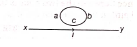
along abc if I decreases
along acb if I increases
along abc if I is constant
along abc if I increases
5.
A coil of resistance 400Ω is placed in a magnetic field. If the magnetic flux Φ linked with the coil varies with times t (see) as Φ = 50t2 + 4, the current in the coil at t = 2 sec is
0.5 A
0.1 A
2 A
1 A
6.
In a coil of resistance 10π, the induced current developed by changing magnitude of change in flux through the coil is weber is
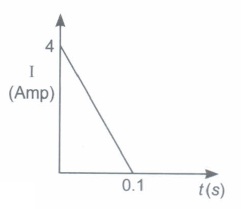
8
2
6
4
7.
While keeping area of cross-section of a solenoid same, the number of turns and length of solenoid are both doubled. The self-inductance of the coil will be
halved.
doubled.
1/4 times the original value
unaffected.
8.
The self-inductance of a coil having 500 turns is 50 mH. The magnetic flux through the cross-sectional area of the coil, while current through it is 8 mA, is found to be
4 x 10⁻⁴ Wb
0.04 Wb
4 μ Wb
40 m Wb
9.
The self-inductance L of a solenoid of length I and area of cross-section A, with a fixed number of turns N increases as
I and A increase
I decreases and A increases
I increases and A decreases
both I and A decrease.
10.
In a coil of self-induction 5 H, the rate of change of current is 2 As-1. Then emf induced in the coil is
10V
-10V
5V
-5V
11.
The current flows from A to B is as shown in the figure. The direction of the induced current in the loop is
clockwise.
anticlockwise.
straight line.
no induced e.m.f. produced.
12.
Lenz's law of electromagnetic induction is as per law of conservation of
energy.
momentum angular.
charge.
electromotive force.
13.
A coil of 100 turns carries a current of 5 mA and creates a magnetic flux of 10-5 weber. The inductance is
0.2 mH
2.0 mH
0.02 mH
0.002 H
14.
A coil having 500 sq. loops of side 10 cm is placed normal to magnetic flux which increases at a rate of 1 T/s. The induced emf is
0.1 V
0.5 V
1V
5V
15.
When current in a coil changes from 5 A to 2 A in 0.1 s, average voltage of 50 V is produced. The selfinductance of the coil is
1.67 H
6 H
3 H
0.67 H
16.
Same as question 4 except the coil A is made to rotate about a vertical axis (Figure). No current flows in B if A is at rest. The current in coil A, when the current in B (at t = 0) is counterclockwise and the coil A is as shown at this instant, t = 0, is
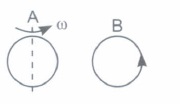
constant current clockwise.
varying current clockwise
varying current counterclockwise
constant current counterclockwise
17.
A loop, made of straight edges has six corners at A (0, 0, 0), B (L, 0, 0), C (L, L, 0), D(0, L, 0), E (0, L, L) and F (0, 0, L). A magnetic field \(B={ B }_{ 0 }\left( \hat { i } +\hat { k } \right) T\) is present in the region. The flux passing through the loop ABCDEFA (in that order) is.
\({ B }_{ 0 }{ L }^{ 2 }Wb\)
\(2{ B }_{ 0 }{ L }^{ 2 }Wb\)
\(\sqrt { 2 } { B }_{ 0 }{ L }^{ 2 }Wb\)
\(4{ B }_{ 0 }{ L }^{ 2 }Wb.\)
18.
The self-induced emf in a coil of 0.4 H self-inductance when current in it is changing at the rate of 50 As-1, is
8 x 10⁻⁴ V
8 x 10⁻³ V
20V
500V
19.
If the number of turns in a coil becomes doubled, then it self-inductance will become
double
halved
four times
unchanged
20.
Eddy currents are generated in
insulator
conductor
Both (a) and (b)
Neither (a) nor (b)
21.
An electron moves along the line PQ which lies in the same plane as a circular loop of conducting wire as shown in figure. What will be the direction of the induced current in the loop?
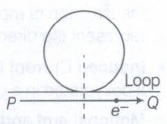
Anti-clockwise
Clockwise
Alternating
Non-current will be induced
22.
A rectangular loop and a circular loop are moving out of a uniform magnetic field region in the given figure to a field-free region with a constant velocity v. In which loop do you expect the induced emf to be constant during the passage out of the field region?
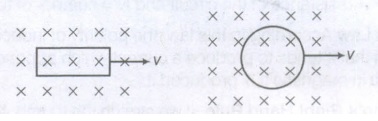
Rectangular loop
Circular loop
Both (a) and (b)
Neither (a) nor (b)
23.
A 50 turns circular coil has a radius of 3 cm, it is kept in a magnetic field acting normal to the area of the coil. The magnetic field B increased from 0.10 T to 0.35 T in 2 ms-1, The average induced emf in the coil is
1.77V
17.7V
177V
0.177V
24.
The direction of induced current is decided by
Lenz's law
Fleming's left hand rule
Biot-Savart's law
Ampere's law
25.
The magnitude of the induced emf in a circuit is equal to the time rate of change of magnetic flux through the circuit, is statment of
Fleming's right hand rule
Fleming's left hand rule
Felming's third law
Faraday's law of electromagnetic induction
26.
What will happen with the galvanometer when the tapping key K is pressed?
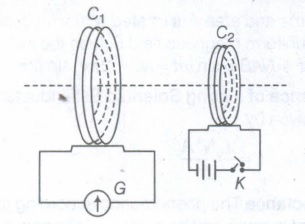
A momentary deflection
A long time deflection
No deflection
None of the above
27.
A square of side L metres lies in the xy-plane in a region, where the magnetic field is given by B \(=B_{0}(2 \hat{\mathbf{i}}+3 \hat{\mathbf{j}}+4 \hat{\mathbf{k}}) \mathrm{T}\), where Bo is constant. The magnitude of flux passing through the square is
\(2 B_{0} L^{2} \mathrm{~Wb}\)
\(3 B_{0} L^{2} \mathrm{~Wb}\)
\(4 B_{0} L^{2} \mathrm{~Wb}\)
\(\sqrt{29} B_{0} L^{2} \mathrm{~Wb}\)
28.
The effective area of the coil exposed to the magnetic field lines changes with time, the flux at any time is
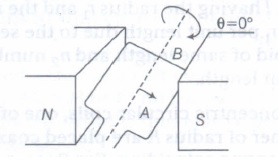
\(\phi_{B}=B A \cot \omega t\)
\(\phi_{B}=B A \cos \omega t\)
\(\phi_{B}=B A \tan \omega t\)
\( \phi_{B}=B A \sec \omega t\)
29.
If a medium of relative permeability \(\mu\)r had been present instead of air, the mutual inductance would be
\(M=\mu_{r} \mu_{0} n_{1} n_{2} \pi r_{1} l\)
\(M=\mu_{0} n_{1} n_{2} \pi r_{1}^{2} l\)
\(M=\mu_{r} n_{1} n_{2} \pi r_{1}^{2} l\)
\(M=\mu_{r} \mu_{0} n_{1} n_{2} \pi r_{1}^{2} l\)
30.
The self-inductance of a coil is 2 mH. The rate of flow of current in it is 103 A/S. The induced electromotive force in the coil is
1V
2V
3V
4V
31.
A horizontal straight wire 20 m long extending from east to west is falling with a speed of 5.0 ms-1 at right angles to the horizontal component of the earth's magnetic field 0.30 x 10⁻⁴ Wbm-2. The instantaneous value of the emf induced in the wire will be
6.0 mV
3 mV
4.5 mV
1.5 mV
32.
The instantaneous magnetic flux linked with a coil is given by φ = (5t3 - 100t + 300) Wb. The emf induced in the coil at time t = 2 s is
-40V
40V
140V
300V
33.
Current in the coil is larger
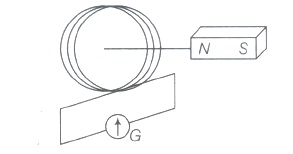
when the magnet is pushed towards the coil faster
when the magnet is pulled away the coil faster
Both (a) and (b)
Neither (a) nor (b)
34.
A physicist works in a laboratory where the magnetic field is 2T. She wears a necklace enclosing area 0.01m2 in such a way that the plane of the necklace is normal to the field and is having a resistance R = 0.01\(\Omega \). Because of power failure, the field decays to 1 T in time 10-3 s. Then what is the total heat produced in her necklace?
10 J
20 J
30 J
40 J
35.
A coil having n turns and resistance R is connected with a galvanometer of resistance 4R. This combination is moved in time t seconds from a magnetic flux \({ \phi }_{ 1 }\) Weber to \({ \phi }_{ 2 }\) Weber. The induced current in the circuit is :
\(\frac { { \phi }_{ 2 }-{ \phi }_{ 1 } }{ 5Rnt } \)
\(\frac { -n\left( { \phi }_{ 2 }-{ \phi }_{ 1 } \right) }{ 5Rt } \)
\(\frac { -\left( { \phi }_{ 2 }-{ \phi }_{ 1 } \right) }{ Rnt } \)
\(\frac { -n\left( { \phi }_{ 2 }-{ \phi }_{ 1 } \right) }{ Rt } \)
36.
A conducting circuit loop is placed in a uniform magnetic field of induction B tesla with its plane normal to the field. Now, the radius of the loop starts sharinking at the rate dr/dt. The induced emf at the instant when the radius is R is:
\(\pi rB\left( \frac { dr }{ dt } \right) \)
\(2\pi rB\left( \frac { dr }{ dt } \right) \)
\(\pi r^{ 2 }\left( \frac { dr }{ dt } \right) \)
\(\left( \frac { \pi r^{ 2 } }{ 2 } \right) ^{ 2 }\left( \frac { dr }{ dt } \right) \)
37.
In a uniform magnetic field of induction B, a wire in the form of semicirclr of radius r rotates about the diameter of the circle with angulat frequency. The axis of rotation is perpendicular to the field. If the total resistance of the circuit is R, then the mean power generated per period of rotation is
\(\frac { B\pi { r }^{ 2 }\omega }{ 2R } \)
\(\frac { \left( B\pi { r }^{ 2 }\omega \right) ^{ 2 } }{ 8R } \)
\(\frac { \left( B\pi { r }\omega \right) ^{ 2 } }{ 2R } \)
\(\frac { \left( B\pi { r^{ 2 } }\omega \right) ^{ 2 } }{ 8R } \)
38.
A circular coil expands radially in a region of magnetic field and no electromotive force is produced in the coil. This can be because
the magentic field is constant
the magnetic field is in the same plane as the circular coil and it may or may not vary
the magnetic field has a perpendicular componet whose magnitude is decreasing suitably
there is a constant magnetic field in the perpendicular direction.
39.
An e.m.f. is produced in a coil, which is not connected to an external voltage source. This can be due to
the coil being in a time varying magnetic field
the coil moving in a time varying magnetic field
the coil moving in a constant magnetic field
the coil is stationary in external spatially varying magnetic field, which does not change with time
40.
A wire of length 2m moves with a speed of 5m/s perpendicular to a magnetic field of induction 0.1 Wb/m2. The e.m.f. induced in the wire is
1 V
10 V
5 V
2 V
41.
The magnetic flux linked with a coil is \(\phi \) = (3t-2t+1) milliweber. The e.m.f. induced in the coil at t = 1sec is
4V
4\(\times\)10-3V
6V
4\(\times\)103V
42.
Out of the following, choose the correct relation
1henry = \(\frac{1\ volt}{1\ ampere}\)
1henry = \(\frac{1\ amp}{1\ volt}\)
1 henry = \(\frac{1volt}{1\ amp/sec}\)
1 henry = \(\frac{1volt}{1\ amp\ .\ sec}\)
43.
Amount of charge induced in a circuit of resistance R is given by
\(dQ=(d\phi )\times R\)
\(dQ=\frac { d\phi }{ R } \)
\(dQ={ R }^{ 2 }d\phi \)
\(dQ=\frac { d\phi }{ R^{ 2 } } \)
44.
Choose the wrong statement:
When ever the amount of magnetic flux linked with a circuit changes, an e.m.f. is induced in the circuit.
The induced e.m.f. lasts so long as the change in magnetic flux continues
Large the amount of magnetic flux linked with a circuit, greater is the e.m.f. induced in it.
The direction of induced e.m.f. is given by Lenz's Llaw.
45.
The cause of induced e.m.f. is
magnetic flux
magnetic field
area
change in magnetic flux
46.
SI unit of magnetic flux is
henry
weber
coulomb
volt
47.
In the relation \(\phi \) = BA cos \(\theta \), \(\theta \) is angle........
which normal to surface area makes with the direction of magnetic field
which magnetic field makes with the surface
which is never constant
none of the above
48.
49.
50.
Assertion (A) : Lenz's law violates the principle of conservation of energy.
Reason (R) : Induced emf always opposes the change in magnetic flux responsible for its production.
(a) Both Assertion and Reason are true and Reason is the correct explanation of Assertion.
(b) Both Assertion and Reason are true but Reason is not the correct explanation of Assertion.
(c) Assertion is true but Reason is false.
(d) Assertion is false but Reason is true.
51.
Assertion (A) : The resistance of a coil for direct current is 5 ohms. An alternating current is sent through it. The resistance will remain same
Reason (R) : The resistance of a coil does not depend upon nature of current.
Codes:
(a) Both A and R are true and R is the correct explanation of A
(b) Both A and R are true but R is NOT the correct explanation of A
(c) A is true but R is false
(d) A is false and R is also false
52.
Assertion (A) : When number of turns in a coil doubled, coefficient of self inductance of the coil becomes four times.
Reason (R) : Coefficient of self inductance is proportional to the square of number of turns.
Codes:
(a) Both A and R are true and R is the correct explanation of A
(b) Both A and R are true but R is NOT the correct explanation of A
(c) A is true but R is false
(d) A is false and R is also false
53.
Assertion (A) : Self-inductance is called the inertia of electricity.
Reason (R) : Self-inductance is the phenomenon, according to which an opposing induced e.m.f is produced in a coil as a result of change in current or magnetic flux linked with the coil
Codes:
(a) Both A and R are true and R is the correct explanation of A
(b) Both A and R are true but R is NOT the correct explanation of A
(c) A is true but R is false
(d) A is false and R is also false
54.
Assertion (A) : Changing magnetic flux can produce induced e.m.f ..
Reason (R) : Faraday established induced e.m.f experimentally
Codes:
(a) Both A and R are true and R is the correct explanation of A
(b) Both A and R are true but R is NOT the correct explanation of A
(c) A is true but R is false
(d) A is false and R is also false
55.
Assertion (A) : An induced current is developed when the number of magnetic lines of force associated with conductor is changed.
Reason (R) : An induced current developJn a conductor moved in a direction parallel to the magnetic field.
Codes:
(a) Both A and R are true and R is the correct explanation of A
(b) Both A and R are true but R is NOT the correct explanation of A
(c) A is true but R is false
(d) A is false and R is also false
56.
Assertion (A) : An induced emf is generated when magnet is withdrawn from the solenoid.
Reason (R) : The relative motion between magnet and solenoid induces emf
Codes:
(a) Both A and R are true and R is the correct explanation of A
(b) Both A and R are true but R is NOT the correct explanation of A
(c) A is true but R is false
(d) A is false and R is also false
1.
(a)
5√3 V
2.
(d)
R1
3.
(b)
the circular and elliptical loops
4.
(c)
along abc if I is constant
5.
(a)
0.5 A
6.
(b)
2
7.
(b)
doubled.
8.
(a)
4 x 10⁻⁴ Wb
9.
(b)
I decreases and A increases
10.
(b)
-10V
11.
(a)
clockwise.
12.
(a)
energy.
13.
(c)
0.02 mH
14.
(d)
5V
15.
(a)
1.67 H
16.
(a)
constant current clockwise.
17.
(b)
\(2{ B }_{ 0 }{ L }^{ 2 }Wb\)
18.
(c)
20V
19.
(c)
four times
20.
(b)
conductor
21.
(a)
Anti-clockwise
22.
(a)
Rectangular loop
23.
(b)
17.7V
24.
(a)
Lenz's law
25.
(d)
Faraday's law of electromagnetic induction
26.
(a)
A momentary deflection
27.
(c)
\(4 B_{0} L^{2} \mathrm{~Wb}\)
28.
(b)
\(\phi_{B}=B A \cos \omega t\)
29.
(d)
\(M=\mu_{r} \mu_{0} n_{1} n_{2} \pi r_{1}^{2} l\)
30.
(b)
2V
31.
(b)
3 mV
32.
(b)
40V
33.
(c)
Both (a) and (b)
34.
(a)
10 J
35.
(b)
\(\frac { -n\left( { \phi }_{ 2 }-{ \phi }_{ 1 } \right) }{ 5Rt } \)
36.
(b)
\(2\pi rB\left( \frac { dr }{ dt } \right) \)
37.
(d)
\(\frac { \left( B\pi { r^{ 2 } }\omega \right) ^{ 2 } }{ 8R } \)
38.
(b)
the magnetic field is in the same plane as the circular coil and it may or may not vary
39.
(b)
the coil moving in a time varying magnetic field
40.
(a)
1 V
41.
(b)
4\(\times\)10-3V
42.
(c)
1 henry = \(\frac{1volt}{1\ amp/sec}\)
43.
(b)
\(dQ=\frac { d\phi }{ R } \)
44.
(c)
Large the amount of magnetic flux linked with a circuit, greater is the e.m.f. induced in it.
45.
(d)
change in magnetic flux
46.
(b)
weber
47.
(a)
which normal to surface area makes with the direction of magnetic field
48.
49.
50.
(d) Assertion is false but Reason is true.
Lenz's law is based on conservation of energy and induced emf always opposes the cause of it, change in magnetic flux.
51.
(d): Both assertion and reason are false. When an alternating current is sent through the coil then effective resistance of the coil will be \(\sqrt{R^{2}+(\omega L)^{2}}\) while it was only R for direct current i.e., effective resistance of coil will increases for A.C.
52.
(a): The coefficient of self inductance of the coil is given by \(L=\frac{\mu_{0} N^{2} A}{l}\)
where N is number of turns, 1 is length of the coil and
A is area of coil, so \(L \propto N^{2}\)
53.
(a): Self-inductance of a coil is its property by virtue of which the coil opposes any change in the current flowing through it. It is because, the induced emf produced opposes the change in current. For this reason, self induction is called inertia of electricity
54.
(b): E.m .f. induces, when there is change in magnetic flux. The magnitude of induced e.m.f depends upon the rate at which the magnetic flux changes. When magnetic flux is steady or constant no e.m.f is induced. Faraday did experiment in which, there is relative motion between the coil and magnet, the flux linked with the coil changes and e.m.f induces.
55.
(a): An induced current develop in a conductor cannot moved in a direction parallel to magnetic field. This is because when the conductor moved in a direction parallel to magnetic field, amount of flux linked with the conductor does not change. Thus the induced current develops only when conductor cuts the lines of magnetic force. The direction of flow of induced current can also be found by applying Fleming's right hand rule, when the direction of motion of conductor inside the magnetic field and the direction of magnetic field action on it are known.
56.
(a): According to Faraday's law of electromagnetic induction, induced emf will be generated in the solenoid because of the relative motion between magnet and solenoid.

12th Standard CBSE Syllabus & Materials
12th Standard CBSE
CBSE 12th Computer Science Python Revision Tour I - New Previous year Question Papers Study Material - QB365 Set A
NEW12th Standard CBSE
CBSE 12th Business Studies Planning Important Questions And Answers Study Material - QB365 Set A
NEW12th Standard CBSE
CBSE 12th Business Studies Business Environment Important Questions And Answers Study Material - QB365 Set A
NEW12th Standard CBSE
CBSE 12th Business Studies Principles of Management Important Questions And Answers Study Material - QB365 Set A



NCERT Books

Syllabus

Exam Pattern

Sample Question Papers

Previous year Question Papers

Important Notes

MCQ Practice test

NCERT Exemplers

Case study Questions

Image Based Questions

Passage based Questions

HOT Questions

Value Based Questions

Model Questions Papers
NCERT ( Book Back ) Questions

Assertion and Reason
Important Questions And Answers

CBSE 12th Standard CBSE Subjects
CBSE Standards








