
 100% FREE ACCESS
12th Standard CBSE Syllabus & Materials
12th Standard CBSE
CBSE 12th Economics Government Budget and the Economy Previous year Question Papers Study Material - QB365 Set A
NEW12th Standard CBSE
CBSE 12th Computer Science Interface Python with MySQL - New Previous year Question Papers Study Material - QB365 Set A
NEW12th Standard CBSE
CBSE 12th Computer Science Database Concept - New Previous year Question Papers Study Material - QB365 Set A
NEW12th Standard CBSE
CBSE 12th Computer Science Data Communication - New Previous year Question Papers Study Material - QB365 Set A
NEW12th Standard CBSE
CBSE 12th Computer Science Data Structures - New Previous year Question Papers Study Material - QB365 Set A
NEW12th Standard CBSE
CBSE 12th Computer Science Functions - New Previous year Question Papers Study Material - QB365 Set A

Published on: 07/03/2026
Download CBSE Class 12th Standard CBSE Physics question papers, sample papers, important questions, and previous year solved papers in PDF format. Get free study materials, NCERT solutions, and exam preparation resources for Class 12th Standard CBSE Physics
Questions + Answers key
Take MCQ Physics Test
1.
An e.m.f. of 0.5 V is developed in the secondary coil, when current in primary coil changes from 5.0 A to 2.0 A in 300 millisec. Calculate the mutual inductance of two coils.
2.
An aircraft with a wingspan of eastward direction at a constant altitude in the northern hemisphere, where the vertical component of earth's magnetic field is 1.75\(\times\)10-5T. Find the e.m.f. that develops between the tips of the wings.
3.
A railway track running north south has two parallel rails 1.0m aprt. Calculate the e.m.f. induced between the rails when a train passes at a speed of 90 km h-1. Horizontal component od earth's magnetic field at that place is 0.3\(\times\)10-4 T and angle of dip is \({ 60 }^{ \circ }\).
4.
A rectanglar loop of area 20cm 30cm is held in a magnetic field of 0.3 T with its plan inclined at
(i) \({ 30 }^{ \circ }\) to the field
(ii) parallel to the field. Find magnetic flux linked with the coil in each case.
5.
Show that Lenz's law is a direct consequence of law of conservation of energy.
6.
Magnetic flux of 5 microweber is linked with a coil when a current of 1mA flows through it. What is self-inductance of the coil?
7.
A coil has an inductance of 0.03 H. Calculate the e.m.f. induced when current in the coil changes at a rate of \(200A{ s }^{ -1 }\)
8.
A 30cm long conductor moves normal to a uniform magnetic field of 0.05 T at \(20 \ { ms }^{ -1 }\). Calculate the induced e.m.f.
9.
The magnetic flux through a coil perpendicular to its plane is varying according to the relation \(\phi =\left( 5{ t }^{ 3 }+4{ t }^{ 2 }+2t-5 \right) Wb\). Calculate the induced current through the coil at t = 2s, if the resistance of the coil is \(10\Omega .\)
10.
A magnetic field of flux density 1.0 \(Wb{ m }^{ -2 }\) acts normal to a 80 turn coil of 0.01 \({ m }^{ 2 }\) area. Find the induced e.m.f. in the coil, if it is removed from the field in 0.1 s.
11.
Mention any two useful applications of eddy currents.
12.
State the Faraday's law of electromagnetic induction.
13.
On what factors does the magnitude of the emf induced in the circuit due to magnetic flux depend?
14.
A long straight current carrying wire passes normally through the centre of circular loop. If the current through the wire increases, will there be an induced emf in the loop? Justify.
15.
Define self-inductance of a coil Write its S.I. unit
16.
Self-induction is called the inertia of electricity Why?
17.
A light metal disc on the top of an electromagnet is Thrown up as the current is switched ON. Why? Give reason.
18.
How is the mutual inductance of a pair of coil affected when a thin iron sheet is placed between the two coils, Other factor remaining the same?
19.
Can a straight wire act as an inductor?
20.
An electromagnet has stored 648 J of magnetic energy, when a current of 9 A exists in its coils. What average e.m.f. is induced if the current is reduced to zero in 0.45 s?
21.
An inductor is connected in series with a bulb to an a.c. source. What happens to brightness of bulb when number of turns in the inductor is reduced?
22.
In year 1820 Oersted discovered the magnetic effect of current. Faraday gave the thought that reverse of this phenomenon is also possible i.e., current can also be produced by magnetic field. Faraday showed that when we move a magnet towards the coil which is connected by a sensitive galvanometer. The galvanometer gives instantaneous deflection showing that there is an electric current in the loop.
Whenever relative motion between coil and magnet takes place an emf induced in coil. If coil is in closed circuit then current is also induced in the circuit. This phenomenon is called electromagnetic induction.
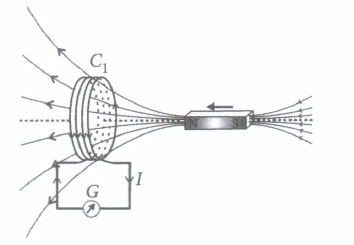
(I) The north pole of a long bar magnet was pushed slowly into a short solenoid connected to a galvanometer. The magnet was held stationary for a few seconds with the north pole in the middle of the solenoid and then withdrawn rapidly. The maximum deflection of the galvanometer was observed when the magnet was
| (a) moving towards the solenoid | (b) moving into the solenoid |
| (c) at rest inside the solenoid | (d) moving out of the solenoid. |
(ii) Two similar circular loops carry equal currents in the same direction. On moving the coils further apart, the electric current will
| (a) remain unaltered | (b) increases in one and decreases in the second |
| (c) increase in both | (d) decrease in both |
(iii) A closed iron ring is held horizontally and a bar magnet is dropped through the ring with its length along the axis of the ring. The acceleration of the falling magnet is
| (a) equal to g | (b) less than g | (c) more than g | (d) depends on the diameter of the ring and length of magnet |
(iv) Whenever there is a relative motion between a coil and a magnet, the magnitude of induced emf set up in the coil does not depend upon the
| (a) relative speed between the coil and magnet | (b) magnetic moment of the coil |
| (c) resistance of the coil | (d) number of turns in the coil |
(v) A coil of metal wire is kept stationary in a non-uniform magnetic field
| (a) an emf and current both are induced in the coil | (b) a current but no emf is induced in the coil |
| (c) an emf but no current is induced in the coil | (d) neither emf nor current is induced in the coil |
23.
Currents can be induced not only in conducting coils, but also in conducting sheets or blocks. Current is induced in solid metallic masses when the magnetic flux threading through them changes. Such currents flow in the form of irregularly shaped loops throughout the body of the metal. These currents look like eddies or whirlpools in water so they are known as eddy currents. Eddy currents have both undesirable effects and practically useful applications. For example it causes unnecessary heating and wastage of power in electric motors, dynamos and in the cores of transformers.
(I) The working of speedometers of trains is based on
| (a) wattless currents | (b) eddy currents |
| (c) alternating currents | (d) pulsating currents |
(ii) Identify the wrong statement
| (a) Eddy currents are produced in a steady magnetic field |
| (b) Induction furnace uses eddy currents to produce heat. |
| (c) Eddy currents can be used to produce braking force in moving trains |
| (d) Power meters work on the principle of eddy currents. |
(iii) Which of the following is the best method to reduce eddy currents?
| (a) Laminating core | (b) Using thick wires |
| (c) By reducing hysteresis loss | (d) None ofthese |
(iv) The direction of eddy currents is given by
| (a) Fleming's left hand rule | (b) Biot-Savart law |
| (c) Lenz's law | (d) Ampere-circuital law |
(v) Eddy currents can be used to heat localised tissues of the human body. This branch of medical therapy is called
| (a) Hyperthermia | (b) Diathermy |
| (c) Inductothermy | (d) none of these |
1.
\(Here,\ \ e=0.5V,\)
\(dI=2.0-5.0=-3.0A\)
\(dt=300 \ millisec=3\times { 10 }^{ -1 }s,\ M=?\)
\(From \ |e|=M\frac { dI }{ dt } , \ M=\frac { |e| \ dt }{ dt } =\frac { 0.5\times 3\times { 10 }^{ -1 } }{ 3 } =0.05H\)
2.
Here, wingspan, l = 40m, Speed, v = 1080 km hr-1
= \(\frac { 1080\times 1000 }{ 60\times 60 } { ms }^{ -1 }\)= 300ms-1. B = 1.75\(\times\)10-5 T, e = ?
As e = Blv
\(\therefore \) e = 1.75\(\times\)10-5\(\times\)40\(\times\)300 = 0.21 volt
3.
\(Here, \ l=1.0m, \ e=? \ u=90km \ h^{ -1 }=\frac { 90\times 1000 }{ 60\times 60 } =25{ ms }^{ -1 }\)
\(H=0.3\times { 10 }^{ -4 }T,\ \delta ={ 60 }^{ \circ }\)
\(Magnetic\ field\ intercepted\ is\)
\(V=H\ tan\ \delta =0.3\times { 10 }^{ -4 }\sqrt { 3 } T\)
\(e=V/v=0.3\times { 10 }^{ -4 }\sqrt { 3 } \times 1.0\times 25\ =1.3\times { 10 }^{ -3 } \ V\)
4.
\(Here,\ A=20\times 30cm^{ 2 }\)
\(=600\times { 10 }^{ -4 }{ m }^{ 2 }=6\times { 10 }^{ -2 }{ m }^{ 2 }\ B=0.3T\)
\({ \theta }_{ 1 }=\left( { 90 }^{ \circ }-{ 30 }^{ \circ } \right) =60^{ \circ };\quad { \theta }_{ 2 }={ 90 }^{ \circ }-{ 0 }^{ \circ }={ 90 }^{ \circ }\)
\({ \phi }_{ 1 }=BA \ cos{ \theta }_{ 1 }=0.3\times 6\times { 10 }^{ -2 }cos \ { 60 }^{ \circ } \ =0.9\times { 10 }^{ -2 }Wb\)
\({ \phi }_{ 2 }=BA \ cos \ { \theta }_{ 2 }=0.3\times 6\times { 10 }^{ -2 }cos \ { 90 }^{ \circ }=Zero\)
5.
No, Lenz's law does not violate the principle of conservation of energy. When we move a magnet (say N-pole) towards a coil, the end of coil nearer to the magnet acquires the same polarity (N-pole) and hence opposes the motion of magnet Fig. So work has to be done against this force of repulsion in moving the magnet close to the coil. Similarly, when the magnet (say N-pole) is moved away from the coil, the end of coil nearer to the magnetic pole acquires opposite polarity (S-pole) and pulls the magnet towards it and again work has to be done against the force of attraction in taking the magnet away from the coil.
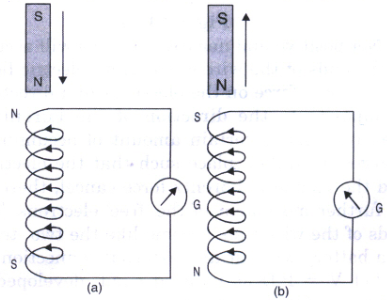
It is this mechanical work done by outside agency, on the magnet which is sorted in the coil in the form of electrical energy. Hence Lenz's law obeys the law of conservation of energy.
6.
5 mH
7.
Given \(L=0.03H\)
\(\frac { dI }{ dt } =200A{ s }^{ -1 }\)
\(e=?\)
Since \(e=L\frac { dI }{ dt } \)
\(e=0.03\times 200=6V\)
8.
Given \(l=30cm=0.3m\)
\(B=0.05T\)
\(\upsilon =20{ ms }^{ -1 }\)
\(\therefore \) Induced e.m.f.
\(e=Bl\upsilon =0.05\times 0.3\times 20=3 \ V\)
9.
Given \(\phi =5{ t }^{ 3 }+4{ t }^{ 2 }+2t-5,\quad t=2s,\)
\(R=10\Omega \)
\(\therefore \) Magnitude of induced e.m.f.
\(e=\left| e \right| =\frac { d\phi }{ dt } \)
or \(e=\frac { d }{ dt } \left[ 5{ t }^{ 3 }+4{ t }^{ 2 }+2t-5 \right] \)
\(=15{ t }^{ 2 }+8t+2\)
\(=15\times 4+8\times 2+2\)
or \(e=78V\)
\(\therefore \) \(I=\frac { e }{ R } =\frac { 78 }{ 10 } =7.8A\)
10.
\(B=1 \ Wb{ m }^{ -2 }; \ n=80; \ A=0.01{ m }^{ 2 }; \ dt=0.1s; \ e=?\)
\(e=\frac { d\phi }{ dt } =\frac { nAB }{ dt } \)
or \(e=\frac { 80\times 0.01\times 1 }{ 0.1 } =8V.\)
11.
(i) Magnetic brake.
(ii) Magnetic furnace.
12.
On the basis of his experiment, Faraday gave the following two laws:
First law Whenever magnetic flux linked with a circuit changes, an emf closed (and hence a current) is induced in it which lasts, so long as change in flux continuous.
Second law The emf induced in loop or closed circuit is directly proportional to the rate of change of magnetic flux linked with the loop \( \text { i.e. } e \propto \frac{-d \phi}{d t} \text { or } e=-N \frac{d \phi}{d t}\)
13.
The magnitude of the emf induced in the circuit due to magnetic flux depends on the time rate of change of magnetic flux through the circuit.
\(|\varepsilon|=\frac{\Delta \phi}{\Delta t}\)
14.
The magnetic field created by straight current carrying wire is circular along the perimeter of circular loop. Hence, change in magnetic flux associated with the coil is zero due to increase of current through the wire.
As, induced emf (e) \(\infty\) rate of change of magnetic flux (\(\phi_{B}\)) So, induced emf=0
Hence, a change in current of wire will not create any emf in the loop.
15.
Self inductance of a coil is numerically equal to the flux linked with the coil when the current through the coil is 1A
16.
Self-induction of the coil is the property by virtue of which it tends to maintain the magnetic flux linked with it and opposes any change in the flux by inducing a current in it. This property of a coil is analogous to mechanical inertia. This is why self-induction is called the inertia of electricity.
17.
When the current begins to grow through the electromagnet. This sets up eddy current in the disc begins to increase. This sets up eddy current in the disc in the same direction as that of the electromagnetic current.
Thus, if the upper surface of electromagnet acquires N-polarity, the lower surface of the disc also acquires N- polarity. As same magnetic poles repel each other, the light metallic disc is thrown up.
18.
As we know the mutual inductance M is directly proportional to the relative permeability of space, \(\mu\) So, it will increase on placing a thin iron sheet between the two coils.
19.
A straight wire cannot act as an inductor as the magnetic flux linked with the wire of negligible area of cross-section is zero. The wire has to be in the form of a coil to serve as an inductor.
20.
\(Here, \ E=648 \ J,I=9,e=?,\)
\(dI=9-0=9A,dt=0.45s\)
\(From \ E=\frac { 1 }{ 2 } { LI }^{ 2 }\)
\(648=\frac { 1 }{ 2 } { L(9) }^{ 2 }; \ L=\frac { 648\times2 }{ 9\times9 } =16H\)
\(As \ e=\frac { LdI }{ dt } \therefore e=\frac { 16(9) }{ 0.45 } =320V\)
21.
Current through the bulb
\({ I }_{ \upsilon }=\frac { { E }_{ \upsilon } }{ Z } =\frac { { E }_{ \upsilon } }{ \sqrt { { R }^{ 2 }+{ X }_{ L }^{ 2 } } } ,where\quad { X }_{ L }=\omega L\)
\(As\quad L\propto { N }^{ 2 },\) therefore, on decreasing number of turns, L decreases; Z decreases. \({ I }_{ \upsilon }\) increases. Hence brightness of bulb increases.
22.
(i) (d) : More rapid is the movement of bar magnet, more is the deflection observed in the galvanometer
(ii) (c) : Two circular loops carrying current in the same direction will attract each other. If they are now separated, induced currents will try to keep status quo, by increasing the current in both the coils.
(iii) (b): Acceleration of the magnet will not be equal to g. It will be less than g. This is because, as the magnet falls, amount of magnetic flux linked with the ring changes.
An induced emf is developed in the ring which opposes the downward motion of the magnet.
(iv) (c) : The magnitude of induced emf set up in the coil does not depend upon the resistance of the coil whereas induced current set up in the coil depend upon the resistance of the coil.
(v) (d) : As long as a coil of metal is kept stationary in a magnetic field, even if it is non-uniform, unless it is changing with respect to time, there will be no induced emf or current in the coil.
23.
(i) (b) : The working of speedometers is based on eddy currents.
(ii) (a)
(iii) (a): To reduce the eddy currents in the metal armature of motors, wire is wrapped around a number of thin metal sheets called lamination.
(iv) (c) : Eddy currents also oppose the change in magnetic flux, so their direction is given by Lenz's law.
(v) (c)

12th Standard CBSE Syllabus & Materials
12th Standard CBSE
CBSE 12th Computer Science Python Revision Tour I - New Previous year Question Papers Study Material - QB365 Set A
NEW12th Standard CBSE
CBSE 12th Business Studies Planning Important Questions And Answers Study Material - QB365 Set A
NEW12th Standard CBSE
CBSE 12th Business Studies Business Environment Important Questions And Answers Study Material - QB365 Set A
NEW12th Standard CBSE
CBSE 12th Business Studies Principles of Management Important Questions And Answers Study Material - QB365 Set A



NCERT Books

Syllabus

Exam Pattern

Sample Question Papers

Previous year Question Papers

Important Notes

MCQ Practice test

NCERT Exemplers

Case study Questions

Image Based Questions

Passage based Questions

HOT Questions

Value Based Questions

Model Questions Papers
NCERT ( Book Back ) Questions

Assertion and Reason
Important Questions And Answers

CBSE 12th Standard CBSE Subjects
CBSE Standards








