
 100% FREE ACCESS
12th Standard CBSE Syllabus & Materials
12th Standard CBSE
CBSE 12th Economics Government Budget and the Economy Previous year Question Papers Study Material - QB365 Set A
NEW12th Standard CBSE
CBSE 12th Computer Science Interface Python with MySQL - New Previous year Question Papers Study Material - QB365 Set A
NEW12th Standard CBSE
CBSE 12th Computer Science Database Concept - New Previous year Question Papers Study Material - QB365 Set A
NEW12th Standard CBSE
CBSE 12th Computer Science Data Communication - New Previous year Question Papers Study Material - QB365 Set A
NEW12th Standard CBSE
CBSE 12th Computer Science Data Structures - New Previous year Question Papers Study Material - QB365 Set A
NEW12th Standard CBSE
CBSE 12th Computer Science Functions - New Previous year Question Papers Study Material - QB365 Set A

Published on: 02/11/2025
Download CBSE Class 12th Standard CBSE Physics question papers, sample papers, important questions, and previous year solved papers in PDF format. Get free study materials, NCERT solutions, and exam preparation resources for Class 12th Standard CBSE Physics
Questions + Answers key
Take MCQ Physics Test
1.
Ajit had a high tension tower erected erected on his farm land. He kept complaining to the authorities to remove it as it was occupying a large portion of his land. His uncle who was a teacher, explained to him the need for erecting these towers for efficient transmission of power. As Ajit realized its significance, he stopped complaining.
Read the above passage and answer the following questions:
(a) Why is it necessary to transport power at high voltages?
(b) A low power factor implies larger power los. Explain.
(c) Write two values each, displayed by Ajit and his uncle.
2.
The electron in a hydrogen atom circles around the proton with a speed of 2.18 x 10⁶ ms-1 in an orbit of radius 5.3 x 10⁻¹¹ m. Calculate (a) the equivalent current (b) magnetic field produced at the proton. Give charge on electron is 1.6 x 10⁻¹⁹ C and \({ \mu }_{ o }=4\pi \times { 10 }^{ -7 }Tm{ A }^{ -1 }.\)
3.
If the effective value of current in 50Hz a.c.circuit is 5.0 A, what is
(i) peak value of current
(ii) mean value of current over half a cycle
(iii) value of current 1/3000s after it was zero?
4.
A plane electromagnetic wave in the visible region is moving along z-direction. The frequency of the wave is 6 x 10¹⁴ Hz, and the electric field at any point is varying simusoidally with time with an amplitude of 2 V m-1. Calculate
(i) average energy density of the electric field and
(ii) average energy density of the magnetic field.
5.
A parallel plate capacitor \(C=0.2\mu F\) connected across an a.c. source of angular frequency 400 rad s-1 . The value of conduction current is 2 mA. Find the rms value of the voltage from the source and the displacement current in the region between the two plates.
6.
Deduce Ohm's law from the concept of a conductor of drift velocity.
7.
Figure shows a potentiometer with a cell of 2.0V and internal resistance 0.40\(\Omega\) maintaining a potential drop across the resistor wire AB. A standard cell which maintains a constant e.m.f. of 1.02V (for very moderate currents upto a few mA) gives a balance point at 67.3 cm length of the wire. To ensure very low currents drawn from the standard cell a very high resistance of 600k\(\Omega\) is put in series with it, which is shorted close to the balance point. The standard is then replaced by a cell of unknown e.m.f. E and the balance point found similarly, turns out to be at 82.3 cm length of the wire.
(a) What is the value o E?
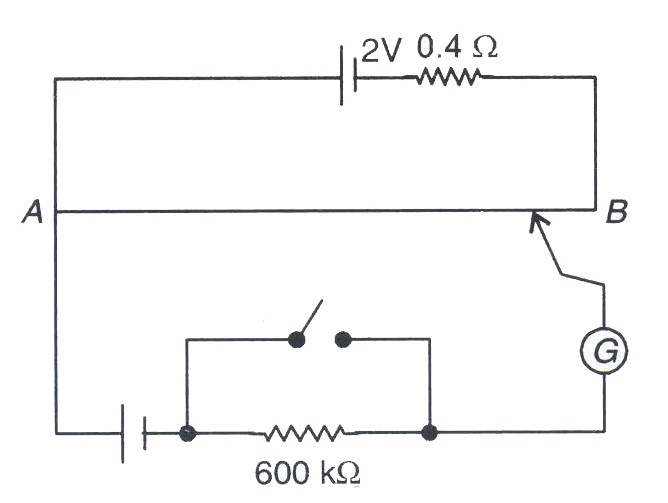
(b) What purpose does the high resistance of 600k\(\Omega\) have?
(c) Is the balance point affected by this high resistance?
(d) Is the balance point affected by the internal resistance of the driver cell?
(e) Would the method work in the above situation if the driver cell of the potentio-meter had an e.m.f of 1.0V instead of 2.0V?
(f) Would the circuit work cell for determining an extremely small e.m.f. say of the order of a few mV (such as the typical e.m.f. of a thermo-couple)? If not, how will you modify the circuit?
8.
plot a graph showing the variation of coulomb's force(F) versus 1 / r2, where r is the distance between the two charges of each pair of charges(1 \(\mu \)C, 2 \(\mu \)C) and (1\(\mu \)C - 3\(\mu \)C). Interpret the graphs obtained.
9.
An electromagnet has stored 648 J of magnetic energy, when a current of 9 A exists in its coils. What average e.m.f. is induced if the current is reduced to zero in 0.45 s?
10.
Can the terminal potential differences of a cell exceed its e.m.f?
11.
In a parallel plate capacitor with air between the plates, each plate has an area of 6\(\times\)10-3m2 and the distance between the plates is 3 mm. Calculate the capacitance if this capacitor. If this capacitor is connected to a 100 V supply, what is the charge on each plate of the capacitor?
12.
Two point electric charges of values q and 2q are kept at a distance d apart from each other in air.A third charge Q is to be kept along the same line in such a way that the net force acting on q and 2q is zero. Calculate the position of charge Q in terms of d.
13.
A bar magnet 30 cm long is placed in the magnetic meridian with its north towards south of the earth. If the neutral point is obtained 30 cm from the magnet, find magnetic dipole moment and pole strength of the magnet.
14.
An electron is travelling along the X-direction. It encounters the magnetic field in the Y-direction. Its subsequent motion will be
straight line along X-direction
a circle in the X-Z plane
a circle in the YZ plane
a circle in the XY plane
15.
Electric field due to a single charge is
asymmetric
cylindrically symmetric
spherically symmetric
None of the above
16.
In which of the following appliances, Fleming's right hand rule for direction of induced current is not applicable?
a.c.generator
d.c.generator
induction motor
transformer
17.
The unity of the electric and magnetic waves was found by maxwell from
(i) Gauss's law in electrostatics
(ii) Gauss's law in magnetism
(iii) Faraday's law of electromagnetic induction
(iv) Ampere's law with displacement current
(i) and (iii) only
(iii) and (iv) only
all
velocity of light also
18.
Electrons are transferred from the material whose ............. is ....... to the material whose ............ is ...............
1.
(i) Power has to be transported at high voltage to reduce the energy loses and also the cost of transmission.
(ii) As P = EvIv cos\(\phi \) . To transmit a given power P at a given Ev, if cos \(\phi \) is small, Iv has to be increases. Therefore. Power loss = \({ I }_{ v }^{ 2 }R\) will increase.
(iii) Ajit understood the necessity of high tension tower which did not affect his land adversely. His uncle made practical use of his knowledge by inviting Ajit that high tension tower are essential and they cause no harm to the farmland.
2.
Here, v=2.18 x 10⁶ ms-1,
r=5.3 x 10⁻¹¹ m, e=1.6 x 10⁻¹⁹ C.
(a) Time period of revolution of electron is given by,
\(T=\frac { 2\pi r }{ v } =\frac { 2\pi \times 5.3\times { 10 }^{ -11 } }{ 2.18\times { 10 }^{ 6 } } =1.528\times { 10 }^{ -16 }s\)
Equivalent current, \(I=\frac { charge }{ time } =\frac { e }{ T } \)
\(=\frac { 1.6\times { 10 }^{ -19 } }{ 1.528\times { 10 }^{ -16 } } =1.05\times { 10 }^{ -3 }A\)
\((b)B=\frac { { \mu }_{ o } }{ 4\pi } \frac { 2\pi I }{ r } =\frac { { 10 }^{ -7 }\times 2\pi \times 1.05\times { 10 }^{ -3 } }{ 5.3\times { 10 }^{ -11 } } \)
=12.4 T
3.
\(Here, \ { I }_{ v }=5.0A, \ v=50Hz\)
\((i) \ { I }_{ 0 }=\sqrt { 2 } { I }_{ v }=1.414\times 5.0=7.07A\)
\((ii) \ { I }_{ m }=\frac { 2 }{ \pi } { I }_{ 0 }=\frac { 2 }{ 3.14 } \times 7.07=4.5A\)
\((iii) \ From \ I={ I }_{ 0 } \ sin \ \omega t={ I }_{ 0 }sin2\pi \ vt\)
\(=7.07sin2\pi \times 50\times \frac { 1 }{ 300 } =\frac { 7.07\sqrt { 3 } }{ 2 } =6.12A\)
4.
Here, v = 6 x 10¹⁴ Hz, E0 = 2 V m-1
(i) Average energy density of the electric field
\({ u }_{ E }=\frac { 1 }{ 4 } { \epsilon }_{ 0 }{ E }_{ 0 }^{ 2 }=\frac { 1 }{ 4 } \times \left( 8.85\times { 10 }^{ -12 } \right) \times { 2 }^{ 2 }\)
\(=8.85\times { 10 }^{ -12 }J{ m }^{ -3 }\)
(ii) Average energy density of magnetic field
\({ u }_{ B }=\frac { { B }_{ 0 }^{ 2 } }{ 4{ \mu }_{ 0 } } =\frac { 1 }{ 4 } \frac { { \left( { E }_{ 0 }/c \right) }^{ 2 } }{ { \mu }_{ 0 } } =\frac { 1 }{ 4 } \frac { { E }_{ 0 }^{ 2 } }{ 4{ \mu }_{ 0 }{ c }^{ 2 } } \)
\(=\frac { 1 }{ 4 } \times \frac { { 2 }^{ 2 } }{ \left( 4\pi \times { 10 }^{ -7 } \right) \times { \left( 3\times { 10 }^{ 8 } \right) ^{ 2 } } } \)
\(=8.85\times { 10 }^{ -12 }J{ m }^{ -3 }\)
5.
Here, \(C=0.2\mu F=0.2\times { 10 }^{ -6 }F\)
\(=2\times { 10 }^{ -7 }F,\)
\(\omega =400 \ rad/s, \ { I }_{ rms }=2mA=2\times { 10 }^{ -3 }A\)
\({ V }_{ rms }={ I }_{ rms }\times { X }_{ C }\)
\(={ I }_{ rms }\times \frac { 1 }{ { \omega C } } =\left( 2\times { 10 }^{ -3 } \right) \times \frac { 1 }{ 400\times \left( 2\times { 10 }^{ -7 } \right) } \)
= 25 V.
Displacement current = conduction current
= 2 mA
6.
Since drift velocity \({ v }_{ d }\) and current, I flowing in a conductor are related by the relation:
\({ v }_{ d }=\frac { I }{ neA } ....(1)\)
Also drift velocity in terms of average relaxation time τ is given by\(\)
\({ v }_{ d }=\frac { eE\tau }{ m } .......(2)\)
From (1) and (2), we have
\(\frac { eE\tau }{ m } =\frac { I }{ neA } \)
\(or \ \frac { E }{ I } =\frac { m }{ n{ e }^{ 2 }A\tau }\)
\(or \ \frac { V }{ lI } =\frac { m }{ n{ e }^{ 2 }A\tau }\)
\(or \ \frac { V }{ I } =\frac { ml }{ n{ e }^{ 2 }A\tau }........(3)\)
The R.H.S. of Eq(3) is constant
\(\frac { V }{ I } = \ Constant\)
This is Ohm′s law
\(But \ \frac { V }{ I } =R, \)the resistance of the conductorSo Eq(3) becomes
\(R=\frac { ml }{ n{ e }^{ 2 }A\tau }\)
\(But\quad R=\rho \frac { l }{ A }\)
\(\therefore \ \rho \frac { l }{ A } =\frac { ml }{ n{ e }^{ 2 }A\tau }\)
\( \rho =\frac { m }{ n{ e }^{ 2 }A\tau } \)
7.
(a) E = 1.25V
8.
According to Coulomb's law, the magnitude of force acting between two stationary point charges is given by
\(F=\left( \frac { q_{ 1 }q_{ 2 } }{ 4\pi \varepsilon _{ 0 } } \right) \left( \frac { 1 }{ r^{ 2 } } \right) \)
For give q1 q2 , \(F\propto \quad \frac { 1 }{ r^{ 2 } } \)
Slope of \(F-\frac { 1 }{ r^{ 2 } } \), graph depends on q1, q2 is higher for second pair
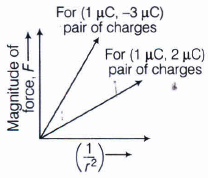
\( \therefore \) slope of \(F-\frac { 1 }{ r^{ 2 } } \) graph corresponding to second pair
(1\(\mu \)C- 3\(\mu \)C) is greater.higher the magnitude of product of charges q1 and q2, higher will be the slope.
9.
\(Here, \ E=648 \ J,I=9,e=?,\)
\(dI=9-0=9A,dt=0.45s\)
\(From \ E=\frac { 1 }{ 2 } { LI }^{ 2 }\)
\(648=\frac { 1 }{ 2 } { L(9) }^{ 2 }; \ L=\frac { 648\times2 }{ 9\times9 } =16H\)
\(As \ e=\frac { LdI }{ dt } \therefore e=\frac { 16(9) }{ 0.45 } =320V\)
10.
Yes, when cell itself is being charged, because terminal potential difference,
\(V=ϵ−(−Ir)=ϵ+Ir.\)
11.
Given,
The area of plate of the capacitor, A = 6 x 10⁻³ m2
Distances between the plates, d = 3mm = 3 x 10⁻³ m
Voltage supplied, V = 100V
Capacitance of a parallel plate capacitor is given by, \(C=\frac{\epsilon \times A}{d}\)
Here,
ε = permittivity of free space = 8.854 x10⁻¹² N-1 m -2 C-2
\(C=\frac{8.854 \times 10^{-12} \times 6 \times 10^{-3}}{3 \times 10^{-3}}=17.81 \times 10^{-12} \mathrm{~F}=17.71 \mathrm{pF}\)
Therefore, each plate of the capacitor is having a charge of
q = VC = 100 x 17.81 x 10-12 C = 1.771 x 10⁻⁹ C
12.
\(\frac { d }{ 1+\sqrt { 2 } } ,\frac { \sqrt { 2d } }{ 1+\sqrt { 2 } } \)
13.
When magnet is placed with its north pole pointing south, neutral point is obtained on its axial line. Therefore, at neutral point
\({ B }_{ axia }={ B }_{ 0 }\)
\(or\quad \frac { { \mu }_{ 0 } }{ 4\pi } \times \frac { 2Md }{ { \left( { d }^{ 2 }-{ l }^{ 2 } \right) }^{ 2 } } ={ B }_{ 0 }\)
\(\\ or \ M=\frac { 4\pi }{ { \mu }_{ 0 } } \times \frac { { B }_{ 0 }{ \left( { d }^{ 2 }-{ l }^{ 2 } \right) }^{ 2 } }{ 2d }\)
\( =\ \frac { 1 }{ { 10 }^{ -7 } } \times \frac { 0.34\times { 10 }^{ -4 }\times { \left( { 0.30 }^{ 2 }-{ 0.15 }^{ 2 } \right) }^{ 2 } }{ 2\times 0.30 }\)
\( =2.582{ Am }^{ 2 }\)
If m is pole strength of the magnet, then
\(m=\frac { M }{ 2l } =\frac { 2.582 }{ 0.30 } =8.606Am\)
14.
(b)
a circle in the X-Z plane
15.
(c)
spherically symmetric
16.
(d)
transformer
17.
(c)
all
18.
()
work function; lower, work function ; higher

12th Standard CBSE Syllabus & Materials
12th Standard CBSE
CBSE 12th Computer Science Python Revision Tour I - New Previous year Question Papers Study Material - QB365 Set A
NEW12th Standard CBSE
CBSE 12th Business Studies Planning Important Questions And Answers Study Material - QB365 Set A
NEW12th Standard CBSE
CBSE 12th Business Studies Business Environment Important Questions And Answers Study Material - QB365 Set A
NEW12th Standard CBSE
CBSE 12th Business Studies Principles of Management Important Questions And Answers Study Material - QB365 Set A



NCERT Books

Syllabus

Exam Pattern

Sample Question Papers

Previous year Question Papers

Important Notes

MCQ Practice test

NCERT Exemplers

Case study Questions

Image Based Questions

Passage based Questions

HOT Questions

Value Based Questions

Model Questions Papers
NCERT ( Book Back ) Questions

Assertion and Reason
Important Questions And Answers

CBSE 12th Standard CBSE Subjects
CBSE Standards








