
 100% FREE ACCESS
12th Standard CBSE Syllabus & Materials
12th Standard CBSE
CBSE 12th Economics Government Budget and the Economy Previous year Question Papers Study Material - QB365 Set A
NEW12th Standard CBSE
CBSE 12th Computer Science Interface Python with MySQL - New Previous year Question Papers Study Material - QB365 Set A
NEW12th Standard CBSE
CBSE 12th Computer Science Database Concept - New Previous year Question Papers Study Material - QB365 Set A
NEW12th Standard CBSE
CBSE 12th Computer Science Data Communication - New Previous year Question Papers Study Material - QB365 Set A
NEW12th Standard CBSE
CBSE 12th Computer Science Data Structures - New Previous year Question Papers Study Material - QB365 Set A
NEW12th Standard CBSE
CBSE 12th Computer Science Functions - New Previous year Question Papers Study Material - QB365 Set A

Published on: 02/11/2025
Download CBSE Class 12th Standard CBSE Physics question papers, sample papers, important questions, and previous year solved papers in PDF format. Get free study materials, NCERT solutions, and exam preparation resources for Class 12th Standard CBSE Physics
Questions + Answers key
Take MCQ Physics Test
1.
(a) Define the term 'drift velocity' of charge carriers in a conductor. Obtain the expression for the current density in terms of relaxation time.
(b) A 100 V battery is connected to the electric network as shown. If the power consumed in the 2\(\Omega\) resistor is 200 W, determine the power dissipated in the 5\(\Omega\) resistors.
.png)
2.
(i) A voltage V = V0 \(sin\ \omega t\) applied to a series L-C-R circuit derives a current I = I0 \(sin\ \omega t\) in the circuit. Deduce the expression for the average power dissipated in the circuit.
(ii) For circuits used for transporting electric power, a low power factor implies large power loss in transmission. Explain.
(iii) Define the term wattless current.
3.
A wire of resistance \(5.0 \ \Omega\) is used to wind a coil of radius 5 cm. The wire has a diameter 2.0 mm and the specific resistance of its material is 2.0 x 10⁻⁷ \(\Omega m\). Find the number of turns in the coil.
4.
A long straight wire carrying a current of 20 A is placed in an external uniform magnetic field of 3 x 10⁻⁴ T parallel to the current. Find the magnitude of the resultant field at a point 2.0 cm away from the wire.
5.
Two charges \(+20\mu C\) and \(-20\mu C\) are held 1cm apart. Calculate the electric field at a point on the equatorial line at a distance of 50cm from the centre of the dipole.
6.
A series LCR circuit is connected to an a.c. source of 220V-50hz. If the readings of voltages across resistor, capacitor and inductor are 65 V, 415 V and 204 volt respectively; and R = 100\(\Omega \), calculate
(i) current in the circuit
(ii) value of L
(iii) value of C and
(iv) capacitance required to produce resonance with the given inductor L.
7.
Two co-axial circular coils of radii 50cm and 5cm are separated by a distance of 50 cm and carry currents 3A and 2A respectively. Calculate the mutual inductance of the two coils.
8.
What are the uses of electromagnetic waves?
9.
A heating element using nichrome connected to a 230 V supply draws an initial current of 3.2 A which settles after a few seconds to a steady value of 2.8 A. What is the steady temperature of the heating element if the room temperature is \({ 27.0 }^{ \circ }C\)? Temperature coefficient of resistance of nichrome averaged over the temperature range involved is \(1.70\times { 10 }^{ -4\circ }{ C }^{ -1 }\)?
10.
In a cyclotron a charged particle
undergoes acceleration all the time
speeds up between the dees because of the magnetic field.
speeds up in a dee
slows down within a dee and speeds up between dees.
11.
Electric field due to an electric dipole is
spherically symmetric
cylindrically symmetric
asymmetric
none of the above
12.
The split ring arrangement is used by \(\eta \) =
a.c. generator
d.c generator
choke coil
transformer
13.
A plane electromagnetic wave propagating along \(x\)direction can have the following Paris of E and B:
\({ E }_{ x }.B_{ Y }\)
\({ E }_{ y }.B_{ z }\)
\({ B }_{ x }.E_{ y }\)
\({ E }_{ x }.B_{ y }\)
14.
Draw a circuit diagram of a potentiometer. State its working principle. Derive the necessary formula to describe how it is used to compare the emfs of the two cells.
15.
Write the expression in a vector form for the Lorentz magnetic force F due to a charge moving with velocity v in a magnetic field B. What is the direction of the magnetic force?
16.
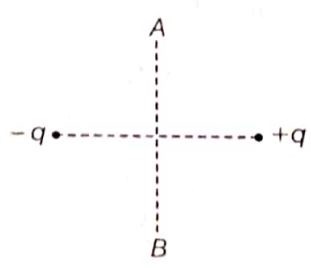
A charge q is moved from a point A above a dipole of dipole moment p to a point B below the dipole in equatorial plane without acceleration. Find the work done in this process.
17.
An infinite number of charges, each of q coulomb, are placed along X-axis at x = 1m, 3 m, 9 m and so on. Calculate the electric field at the point x = 0, due to these charges if all the charges are of the same sign.
18.
Give an example each of a molecular solid and an ionic solid
19.
Consider a magnet surrounded by a wire with an ON/OFF switch in the figure. If the switch is thrown from the OFF position (open circuit) to the ON position (closed circuit), will a current flow in the circuit? Explain.
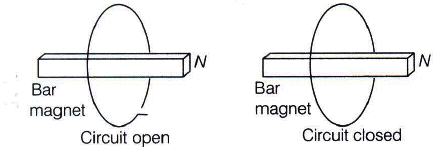
The magnetic flux linked with a uniform surface area A in a uniform magnetic field is given by \(\phi \) = B.A = BA cos \(\theta \) .So flux linked will change, only when either B or A or the angle between B and A change.
20.
How can you justify that a current carrying wire produces magnetic field?
21.
Define the term 'drift velocity' of charge carriers in a conductor and write its relationship with the current flowing through it.
22.
Explain the principle and working of a cyclotron with the help of a schematic diagram. Write the expression for cyclotron frequency.
23.
A system has two charges qA = 2.5 x 10⁻⁷ C and qB = -2.5 x 10⁻⁷C located at points A (0, 0, -15 cm) and B (0, 0+15 cm), respectively What are the total charge and electric dipole moment of the system?
24.
A circuit using a potentiometer and battery of negligible internal resistance is set up as shown to develop a constant potential gradient along the wire AB. Two cells of emf's E1 and E2 are connected in series as shown in combinations (1) and (2).
The balance points are obtained, respectively at 400 cm and 240 cm from the point A. Find
(i) E1/ E2
(ii) balancing length for the cell E1 only.
1.
(a) Drift velocity: The average velocity gained by free electrons, when a unit electric field is applied across the conductor.
\(I=neAv_d\)
\(=neA\frac{eI}{m}\tau\)
\(\therefore \) Current density \(J=\frac{I}{A}=\frac{ne^2 Be}{m}\)
(a) P = I2R
Current flowing through the resistance 2\(\Omega\)
\(l=\sqrt{\frac{200}{2}}=10A\)
∴ Potential drop across the 2\(\Omega\) resistors = 20V Therefore potential across parallel combination of 40\(\Omega\) and 10\(\Omega\) = 80V
Current through 5\(\Omega\); I = \(\frac{80}{10}A=8A\)
∴ Power dissipated in the 5\(\Omega\) resistor = (8)2 x 5W
= 320W
2.
(i) Average power delivered by an AC circuit is
\({ P }_{ av }={ V }_{ rms }{ I }_{ rms }cos\phi \)
where is minimum, the power delivered is minimum and hence, power dissipated will be maximum for the circuit.
3.
Here,
R = \(5.0 \ \Omega\);
r1 = 5 x 10⁻² m;
D = 2.0 x 10⁻³ m;
\(\rho= 2.0 \times 10^{-7} \ \Omega m\).
R = \(\frac{\rho l}{\pi D^2/4}\)
or l = \(\frac{R \pi D^2}{4 \rho}\)
Let n be the number of turns in the coil. Then total length of the wire used, l = \(2 \pi r_1 n\)
or n = \(\frac{l}{2 \pi r_1}=\frac{R \pi D^2}{4 \rho \times 2 \pi r_1}=\frac{RD^2}{8 \rho r_1}\)
= \(\frac{5.0 \times (2.0 \times 10^{-3})^2}{8 \times (2.0 \times 10^{-7})\times (5 \times 10^{-2})^2}\)
= 250
4.
Here, I = 20 A, B2 = 3 x 10⁻⁴ T,
r = 2.0 x 10⁻² m
Magnetic field due to a straight wire carrying current is
\({ B }_{ 1 }=\frac { { \mu }_{ o } }{ 4\pi } \frac { 2I }{ r } ={ 10 }^{ -7 }\times \frac { 2\times 20 }{ 2.0\times { 10 }^{ -2 } } =2\times { 10 }^{ -4 }\quad T\)
This magnetic field will act perpendicular to magnetic field B2(= 3 x 10⁻⁴T). Therefore, the magnitude of the resultant magnetic field
\(B=\sqrt { { B }_{ 1 }^{ 2 }+{ B }_{ 2 }^{ 2 } } =\sqrt { { \left( 2\times { 10 }^{ -4 } \right) }^{ 2 }+{ \left( 3\times { 10 }^{ -4 } \right) }^{ 2 } } \)
= 3.6 x 10⁻⁴ T
5.
\(Here, q=\pm20\mu C=\pm20\times10^{-6}C\)
\(2a=1 cm=10^{-2}m, r=50cm={1\over 2}m\)
As 2a<<r, therefore, intensity on equatorial line of short dipole is
\(E={1\over 4\pi\epsilon_o}{P\over r^3}={q\times 2a\over 4\pi\epsilon_or^3}\)
\(={9\times 10^9\times 20\times10^{-6}\times10^{-2}\over(1/2)^3}\)
\(E=1.44\times 10^4N/C\)
6.
\(Here, \ { E }_{ v }=200V,\ v=50hz,\ R=100\Omega ,\ { V }_{ R }=65V,\ { V }_{ C }=415V,\ { V }_{ L }=204V\)
(i) If Iv is current in the circuit, then
\({ V }_{ R }={ I }_{ V }\times R; \ 65={ I }_{ V }\times 100, \ { I }_{ V }=0.65A\)
\( (ii) \ { V }_{ L }={ I }_{ V }{ X }_{ L }; \ { X }_{ L }=\frac { { V }_{ L } }{ { I }_{ v } } =\frac { 204 }{ 0.65 } =313.85\Omega\)
\({ X }_{ L }=\omega L=2\pi vL=313.85\)
\(L=\frac { 313.85 }{ 2\pi v } =\frac { 313.85 }{ 3.14\times 50 } =1.0H\)
\( (iii) \ { V }_{ C }={ I }_{ v }{ X }_{ C }, \ { X }_{ C }=\frac { { V }_{ C } }{ { I }_{ v } } =\frac { 415 }{ 0.65 } =638.5\Omega \)
\({ X }_{ C }=\frac { 1 }{ \omega C } =\frac { 1 }{ 2\pi vC } ; \ C=\frac { 1 }{ 2\pi v \ { X }_{ c } } =\frac { 1 }{ 2\times 3.14\times 50\times 638.5 } =4.99\times { 10 }^{ -6 }F\)
(iv) Let C′ be the capacitance that would produce resonance with L= 1.0H, then
\( v=\frac { 1 }{ 2\pi \sqrt { LC' } } ; \ C'=\frac { 1 }{ 4{ \pi }^{ 2 }{ v }^{ 2 }L } =\frac { 1 }{ 4\times \left( 3.14 \right) ^{ 2 }\times \left( 50 \right) ^{ 2 }\times 1 } =10.1\times { }^{ }F=10.1\mu F\)
7.
\(Here, \ R=50cm=0.5m,\)
\(r=5cm=5\times { 10 }^{ -2 }m\)
\(x=50cm=0.5m, \ { I }_{ 1 }=3A, \ { I }_{ 2 }=2A, \ M=?\)
\(\\ { M }^{ \ \ }=\frac { { \mu }_{ 0 } }{ 5\pi } \times \frac { 2{ \pi }^{ 2 }{ R }^{ 2 }{ r }^{ 2 } }{ \left( { R }^{ 2 }+{ x }^{ 2 } \right) ^{ 3/2 } } =\frac { { 10 }^{ -7 }\times 2\left( 3.14 \right) ^{ 2 }\left( { 0.5 } \right) ^{ 2 }\left( { 5\times 10 }^{ -2 } \right) ^{ 2 } }{ \left[ { 0.5 }^{ 2 }+{ 0.5 }^{ 2 } \right] ^{ 3/2 } } \)
\(M=3.48\times { 10 }^{ -9 }H\)
8.
Uses of electromagnetic waves
Following are some important uses of electromagnetic waves:
1. Radio waves. Radio waves are electromagnetic waves and are used in radio and television communication systems.
2. Microwaves. Microwaves are used in radar and other communication systems.
3. Infrared radiations. Infrared rays are used in:
(a) solar water heater and solar cooker.
(b) weather forecasting
(c) taking photographs during fog, smoke etc.
(d) dehydrating fruits.
(e) the treatment of muscular strain.
(f) greenhouse to keep the plants warm.
4. Ultraviolet rays. ultraviolet rays are used:
(a) for checking mineral samples by making use of its property of causing fluorescence and also used for the study of molecular structure.
(b) for sterilizing the surgical instruments because U.V.-rays destroy bacteria.
(c) in food preservations
(d) in detection of invisible writing
5. X-rays. X-rays are used:
(a) in surgery
(b) in radiotherapy.
(c) in medical diagnosis to detect the fracture in bones etc.
(d) in detective departments to detect gold, diamond etc concealed in bags etc without opening them.
(e) in scientific research to study the crystal structure etc.
6. \(\gamma \)-rays. Gamma rays are used to get information of structure of atomic nucleus.
9.
Given, potential difference = 230 V
Initial current at 27°C = I27°C = 3.2 A
Final current at t°C = It°C = 2.8 A
Room temperature = 27°C
Temperature coefficient of resistance, \(\alpha=1.70 \times 10^{-4}{ }^{\circ} \mathrm{C}^{-1}\)
Resistance at 27°C, R27°C\(=\frac{V}{I_{27^{\circ} \mathrm{C}}}=\frac{230}{3.2}=\frac{2300}{32} \Omega\)
Resistance at t°C, Rt°C = \(\frac{V}{I_{t^{\circ} \mathrm{C}}}=\frac{230}{2.8}=\frac{2300}{28} \Omega\)
Temperature coefficient of resistance
\(\begin{aligned} \alpha & =\frac{R_t-R_{27}}{R_{27}(t-27)} \end{aligned}\)
\(\begin{aligned} \Rightarrow 1.70 \times 10^{-4} & =\frac{\frac{2300}{28}-\frac{2300}{32}}{\frac{2300}{32}(t-27)} \\ \end{aligned}\)
\(\begin{aligned} \text { or } \quad t-27 & =\frac{82.143-71.875}{71.875 \times 1.70 \times 10^{-4}}=840.347 \end{aligned}\)
or t = 840.3 + 27 = 867.3 °C
Thus, the steady temperature of heating element is 867.3 °C
10.
(a)
undergoes acceleration all the time
11.
(b)
cylindrically symmetric
12.
(b)
d.c generator
13.
(b)
\({ E }_{ y }.B_{ z }\)
14.
The circuit diagram of the potentiometer, is as shown here
.jpg)
The potential drop, V, across a length 1of a uniform wire, is proportional to the length 1of the wire.(or \(V\propto l\) for a
uniform wire)
Derivation: From the figure, connect points 1 and 3 together with balance point at \({ N }_{ 1 }\) point where A\({ N }_{ 1 }\) = \({ l }_{ 1 }\) Now connect points 2 and 3 together with balance point at point \({ N }_{ 2 }\) where A\({ N }_{ 2 }\) = \({ l }_{ 2 }\), Next let the points 2 and 3 be connected together.Let the balance point be at the point N2 where We then have and
\({ \varepsilon }_{ 1 }=k{ l }_{ 1 }\)
\({ \varepsilon }_{ 2 }=k{ l }_{ 2 }\)
\(\frac { { \varepsilon }_{ 1 } }{ { \varepsilon }_{ 2 } } =\frac { { l }_{ 1 } }{ { l }_{ 2 } } \)
15.
The expression in vector form is given by F = q(vxB).
The direction of the magnetic force is in the direction of (v x B), i.e. perpendicular to the plane containing v and B.
16.
As, A and B are points on the equatorial plane of dipole
VA = VB = 0
Net potential = VA + VB = 0
Work done, W=\(\frac{V}{q},\) as V = 0, W = 0
So, the work done by the process will be zero.
17.
According to principle of superposition of electric fields, E (electric field) at a point due to system of three charges,
E = \({{1}\over{4\pi{\epsilon}_{0}}}=\left[{{q}\over{{ r }_{ { 1 }^{ p } }^{ 2 }}}\hat{r}_{{1}_{p}} +{{{q}_{2}}\over{{ r }_{ { 2 }^{ p } }^{ 2 }}}\hat{r}_{{2}_{p}}+{{{q}_{3}}\over{{ r }_{ { 3 }^{ p } }^{ 2 }}}\hat{r}_{{3}_{p}} \right]\)
= \({ { q }\over{ 4\pi{\epsilon}_{0} } }\times{ { 9 }\over{ 8 } }\) [ using \({S}_{\infty}={ { a }\over{ 1 -r } }\) ] = \({ { 1 }\over{ 4\pi{\epsilon}_{0} } }.{{9q}\over{8}}{NC}^{-1}\)
18.
Examples of Molecular solid : Solid \(\mathrm{SO}_2, \mathrm{NH}_3, I_2\)
Examples of Ionic solid : NaCI,ZnS,CuCI
19.
When the switch is thrown from the OFF position (open circuit) to the ON position (closed circuit), then neither B nor A and the angle between B and A does not change.Thus, no change in magnetic flux linked with coil occur, hence no electromotive force is produced and consequently, no current will flow in the circuit.
20.
It can be justified by placing a magnetic needle around current carrying wire, which shows deflection of needle.
21.
Drift velocity is the average velocity with which the free electrons get drifted towards the positive end of the conductor under the influence of an external electric field applied.
The relation between current I and drift velocity vd is I = nAevd
Where n is the number density of electrons in a conductor of area of cross-section A and e is the charge on an electron.
22.
Principle of Cyclotron The cyclotron works on the principle that a positively charged ion 'can be accelerated to high kinetic energy by making it pass again and again smaller value of same oscillating electrical field by making use of strong perpendicular magnetic field. Also, the frequency of charge particle must be equal to the frequency of oscillating electrical field. Expression for cyclotron frequency, \(f=\frac{qB}{2\pi m}\)
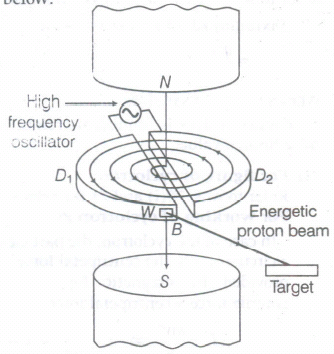
Working Let initially positively charged is accelerated towards D2 and enter into it. Now, the charged particle experiences magnetic Lorentz force due to a strong normal magnetic field. It performs circular motion. The time taken by the charge particle to complete half revolution is equal to half of time period of AC oscillator between two dees.
The charge d particle again accelerated towards D1 as D2 acquires positive and d negative polarity. Thus, the charge particle is brought again and again in the small region of oscillating electrical field by strong normal magnetic field. The charged particle repeatedly passes through oscillating electrical field. It traversed on spiral path and finally having radius of its circular path becomes equal to the radius of dees and finally comes out through window W and strikes to the target.
23.
Two charges qA and qB are located at points A(0, 0 -15cm) and B(0, 0, 15 cm) on Z-axis. They form an electric dipole.
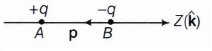
Total charge, q = qA + qB = 2.5 x 10⁻⁷ -2.5 x 10⁻⁷
q = 0
Also AB = 15 + 15 = 30 cm or AB = 30 x 10-2 m
Electric dipole moment,
p = Either charge x BA
= 2.5 x 10-7 x (30 x 10-2) (-k)
= -7.5 x 10⁻⁸ k C-m
24.
(i) In combination 1, net emf of combination is E = E1 + E 2, whereas for combination 2 net emf is E2 - E1
E1 - E2 = Kl1
where, K = potential gradient
l1 = 400 cm
For combination2, E2 - E1 = Kl2
where, l2 = 240 cm
\(\therefore \ \ \frac { E1+E2 }{ E1-E2 } =\frac { Kl1 }{ Kl2 } =\frac { 400 }{ 240 } =\frac { 5 }{ 3 } \Longrightarrow \frac { E1+E2 }{ E2-E1 } =\frac { 5 }{ 3 } \)
Applying componendo and dividendo theorem, we get
\(\therefore \ \ \frac { E1+E2 }{ E1-E2 } =\frac { Kl1 }{ Kl2 } =\frac { 400 }{ 240 } =\frac { 5 }{ 3 } \Longrightarrow \frac { E1+E2 }{ E2-E1 } =\frac { 5 }{ 3 } \)
\(\frac { E2 }{ E1 } =\frac { 8 }{ 2 } \Longrightarrow \frac { E1 }{ E2 } =\frac { 1 }{ 4 } \) ..... (iii)
(ii) \(\therefore \frac { E1 }{ E2 } =\frac { 1 }{ 4 } \Rightarrow E1=E(say)\)
Then, E2 = 4E
\(\Rightarrow\) E1+ E2 = K x 400\(\Rightarrow\) 5E = K X 400
\(K=\frac { 5E }{ 400 } =\frac { E }{ 80 }\)
Now, balancing length for E1 is l1
\(\therefore \ \ E2=Kl1\Rightarrow E=\frac { E }{ 80 } Xl1\Rightarrow l1=80cm\)

12th Standard CBSE Syllabus & Materials
12th Standard CBSE
CBSE 12th Computer Science Python Revision Tour I - New Previous year Question Papers Study Material - QB365 Set A
NEW12th Standard CBSE
CBSE 12th Business Studies Planning Important Questions And Answers Study Material - QB365 Set A
NEW12th Standard CBSE
CBSE 12th Business Studies Business Environment Important Questions And Answers Study Material - QB365 Set A
NEW12th Standard CBSE
CBSE 12th Business Studies Principles of Management Important Questions And Answers Study Material - QB365 Set A



NCERT Books

Syllabus

Exam Pattern

Sample Question Papers

Previous year Question Papers

Important Notes

MCQ Practice test

NCERT Exemplers

Case study Questions

Image Based Questions

Passage based Questions

HOT Questions

Value Based Questions

Model Questions Papers
NCERT ( Book Back ) Questions

Assertion and Reason
Important Questions And Answers

CBSE 12th Standard CBSE Subjects
CBSE Standards








