
 100% FREE ACCESS
12th Standard CBSE Syllabus & Materials
12th Standard CBSE
CBSE 12th Economics Government Budget and the Economy Previous year Question Papers Study Material - QB365 Set A
NEW12th Standard CBSE
CBSE 12th Computer Science Interface Python with MySQL - New Previous year Question Papers Study Material - QB365 Set A
NEW12th Standard CBSE
CBSE 12th Computer Science Database Concept - New Previous year Question Papers Study Material - QB365 Set A
NEW12th Standard CBSE
CBSE 12th Computer Science Data Communication - New Previous year Question Papers Study Material - QB365 Set A
NEW12th Standard CBSE
CBSE 12th Computer Science Data Structures - New Previous year Question Papers Study Material - QB365 Set A
NEW12th Standard CBSE
CBSE 12th Computer Science Functions - New Previous year Question Papers Study Material - QB365 Set A

Published on: 02/11/2025
Download CBSE Class 12th Standard CBSE Physics question papers, sample papers, important questions, and previous year solved papers in PDF format. Get free study materials, NCERT solutions, and exam preparation resources for Class 12th Standard CBSE Physics
Questions + Answers key
Take MCQ Physics Test
1.
A galvanometer of resistance \(25\Omega \) is connected to a battery of 2 volt along with a resistance in series. When the value of this resistance is \(3000\Omega ,\) a full scale deflection of 30 units is obtained in the galvanometer. In order to reduce this deflection 10 20 units, the resistance in series will be
\(4514\Omega \)
\(5413\Omega \)
\(2000\Omega \)
\(6000\Omega .\)
2.
When an AC voltage of 220V is applied to the capacitor C
the maximum voltage between plates is 220V
the current is in phase with he applied voltage
The charge on the plates is in phase with the applied voltage
power delivered to the capacitor is zero
3.
A circular coil of n turns and radius r carries a current I. The magnetic field at the centre is
\(\frac { { \mu }_{ o }nI }{ r } \)
\(\frac { { \mu }_{ o }nI }{ 2r } \)
\(\frac { { 2\mu }_{ o }nI }{ r } \)
\(\frac { { \mu }_{ o }nI }{ 4r } \)
4.
The number of electric lines of force radiating from a closed surface in vacuum is \(1.13\times 10^{11}\). The charge enclosed by the surface is
1 C
\(1\mu C\)
0.1 C
0.1\(\mu C\)
5.
At a particular point, electric field depends upon
Source charge Q only
test charge qo only
both Q and q0
neither Q nor qo
6.
The power factor of an a.c. circuit is given by cos \(\phi \)=
\(\frac { R }{ Z } \)
\(\frac { Z }{ R } \)
\(\frac { R }{ { X }_{ L } } \)
\(\frac { R }{ { X }_{ C } } \)
7.
Choose the wrong statement:
When ever the amount of magnetic flux linked with a circuit changes, an e.m.f. is induced in the circuit.
The induced e.m.f. lasts so long as the change in magnetic flux continues
Large the amount of magnetic flux linked with a circuit, greater is the e.m.f. induced in it.
The direction of induced e.m.f. is given by Lenz's Llaw.
8.
The velocity of light in vacuum can be changed by changing
frequency
amplitude
wavelength
none of these
9.
A linearly polarized electromagnetic wave given as \(E={ E }_{ 0 }\overset { \wedge }{ i } cos \ (kz-wt)\) incident wall at \(z=a\) . Assuming that the material of the wall os optically inactive, the reflected wave will be given as
\(\overset { \rightarrow }{ { E }_{ r } } ={ E }_{ 0 }\overset { \wedge }{ i } cos(kz-wt)\quad \)
\(\overset { \rightarrow }{ { E }_{ r } } ={ E }_{ 0 }\overset { \wedge }{ i } cos(kz+wt)\quad \)
\(\overset { \rightarrow }{ { E }_{ r } } ={ -E }_{ 0 }\overset { \wedge }{ i } cos(kz+wt)\quad \)
\(\overset { \rightarrow }{ { E }_{ r } } ={ -E }_{ 0 }\overset { \wedge }{ i } sin(kz+wt)\quad \)
10.
The vertical component of earth’s magnetic field at a given place is \(\sqrt { 3 } \) times its horizontal component. If the total intensity of earth’s magnetic field at a place is 0.4 G , find the value of horizontal component of earths field and angle of dip.
11.
Find the dimension of 1/2\(\varepsilon \)0E2
12.
Two closely spaced equipotential surfaces A and B with potentials V and V + 8 Y, (where 8 V is the change in V), are kept 81 distance apart as shown in the figure. Deduce the relation between the electric field and the potential gradient between them. Write the two important conclusions concerning the relation between the electric field and electric potentials.
.png)
13.
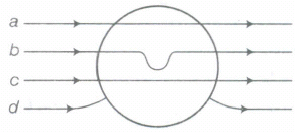
A metallic sphere is placed in a uniform electric field as shown in the figure. Which path is followed by electric field lines and why?
14.
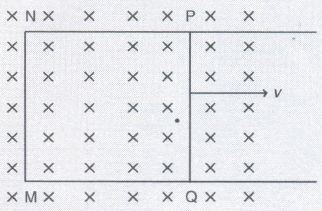
A rectangular loop PQMN with movable arm PQMN of length 10 em and resistance 2 \(\Omega\) is placed in a uniform magnetic field of 0.1 Tesla perpendicular to the plane of the loop as shown in the figure. The resistance, pf the arms MN, NP, and MQ are negligible. Calculate the
(i) emf induced in the arm PQ and
(ii) current induced in the loop when arm PQ is moved with velocity 20 m/s.
15.
An electric lamp having a coil of negligible inductance connected in series with a capacitor and an AC source is glowing with certian brightness. How does the brightness of the lamp change on reducing the (i) capacitance, and (ii) the frequency? Justify your answer.
16.
Two point charges q1 and q2 are located at r1 and r2 respectively in an external electric field E. Obtain the expression for the total work done in assembling this configuration.
17.
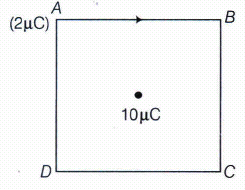
What is the work done in moving a 2\(\mu \)C point charge from corner A to corner B of a square ABCD, when a 10\(\mu \)C charge exists at the centre of the square?
18.
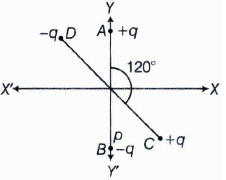
Two small identical dipoles AB and CD, each of dipole moment p are kept at an angle of 1200 as shown in the figure.
What is the resultant dipole moment of this combination? If this system is subjected to electric field (E) directed along positive X-direction of the torrque acting on this?
19.
A dipole with its charges, -q and +q, located at the points(0, -b,0) and (0, +b, 0) is present in a uniform electric field E. The equipotential surfaces of this field are planes parallel to the YZ- planes
(i) What is the direction of the electric field E?
(ii) How much torque would the dipole experience in this field?
20.
A short magnet oscillates with a time period 0.1 s at a place, where horizontal magnetic field is \(24 \ \mu \)T.
A downward current of 18 A is established in a vertical wire 20cm East of the magnet. What will be the new time period of the oscillator?
21.
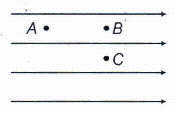
For a uniform electric field given as shown below, at what point will the electric potential be maximum?
22.
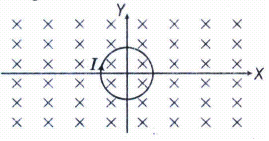
A conducting loop carrying a current I is placed in a uniform magnetic field, pointing into the plane of the paper as shown in the figure,then the loop will have a tendency to expand. Explain.
23.
An arbitrary surface encloses a dipole. What is the electric flux through this surface?
24.
Write two applications of capacitors in electrical circuits?
25.
What is the basic difference between magnetic and electric lines of force ?
26.
By which ways, the x-rays and y-rays can be distinguished?
27.
A rectangular loop an area \(20cm\times 30cm\) is placed in magnetic field of 0.3T with its plane
(i) normal to the field
(ii) inclined 30\(^{0}\) to the field and
(iii) parallel to the field.
Find the flux linked with the coil in each case.
28.
(i) How is the electric field due to a charged parallel plate capacitor affected, when a dielectric slab is inserted between the plates fully occupying the intervening region?
(ii) A slab of material of dielectric constant K has the same area as the plates of a parallel plate capacitor but has thickness \(\frac{1}{2}\) d, where d is the separation between the plates. Find the expression for the capacitance when the slab is inserted between the plates.
29.
A step-up transformer is operated on a 2.5 kV line. It supplies a load with 20 A. The ratio of the primary winding to the secondary is 10:1. If the transformer is 90% efficient, calculate
(i) the power output
(ii) the voltage and
(iii) the currrent in the secondary.
30.
A 40 ohm resistor, 3 mH inductor and \(2\ \mu F\) capacitor are connected in series to a 110 V, 5000 Hz a.c. source. Calculate the value of current in the circuit.
31.
The self inductance of an inductance coil having 100 turns is 20 mH. Calculate the magnetic flux through the cross section of the coil corresponding to a current of 4 milliampere. Also, find the total flux.
32.
Electric field intensity at any point is the ................ experienced by ............ placed at that point.
33.
A hollow cylindrical box of length 1 m and area of cross-section 25 cm2 is placed in a three dimensional coordinate system as shown in the figure. The electric field in the region is given by E = 50 x \(\widehat { i }\), where E is in NC-1 and x is in metre. Find
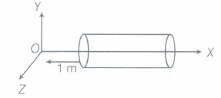
(i) net flux through the cylinder and
(ii) charge enclosed by the cylinder.
1.
(a)
\(4514\Omega \)
2.
(c)
The charge on the plates is in phase with the applied voltage
3.
(b)
\(\frac { { \mu }_{ o }nI }{ 2r } \)
4.
(a)
1 C
5.
(a)
Source charge Q only
6.
(a)
\(\frac { R }{ Z } \)
7.
(c)
Large the amount of magnetic flux linked with a circuit, greater is the e.m.f. induced in it.
8.
(d)
none of these
9.
(b)
\(\overset { \rightarrow }{ { E }_{ r } } ={ E }_{ 0 }\overset { \wedge }{ i } cos(kz+wt)\quad \)
10.
Tan \(\eth \) = V/H = \(\sqrt { 3 } \)
\(\eth \) = 60
As V = \(\surd 3H\) and
B2 = V2 + H2 = 3H2 + H2 = 4H2
(0.4)2 = 4H2 therefore
H = 0.2 G
11.
ML-1T-2
12.
Work done in moving a unit positive charge along distance \(\delta l\)
\(\left| { E }_{ l } \right| \delta ={ V }_{ A }-{ V }_{ B\\ }\)
\(=V-(V+\delta V)\)
\(=-\delta V\)
\(\left| { E }_{ l } \right| =-\frac { \delta V }{ \delta l } \)
Electric field is in the direction in which the potential decreases the steepest.
(ii) The magnitude of electric field is given by the change in the magnitude of potential per unit displacement, normal to the equipotential surface at the point.
13.
Path d is followed by electric field lines. Electric field intensity inside the metallic sphere will be zero, therefore, no electric lines of force exist inside the sphere. Also, electric field lines are always perpendicular to the surface of the conductor.
14.
emf induced
e = Blv
= 0.1 x 10 x 10-2 x 20 V
= 0.2 volt
(ii) Current in the loop
\(i=\frac{e}{R} \)
\(=\frac{0.2}{2}A=0.1A\)
15.
\({ X }_{ c }=\frac { 1 }{ \omega C } =\frac { 1 }{ 2\pi vC } \)
AsC decreases, Xc will increase. Hence brightness will decrease.
(ii)
\({ X }_{ c }=\frac { 1 }{ \omega C } =\frac { 1 }{ 2\pi vC } \)
As frequence (v) decreases, Xc will increase. Hence brightness will decrease
16.
Work done in bringing the charge q1 from infinity to position r1
W1 = q1 V(r1)
Work done in bringing charge q2 to the position r2
W2 = q2 V(r2) + \(\frac{q_1q_2}{4\pi\epsilon_0r_{12}}\)
Hence, total work done in assembling the two charges
W = W1 +W2
= q1V(r1) + q2V(r2) + \(\frac{q_1q_2}{4\pi\epsilon_0r_{12}}\)
17.
Work done, W = q x \triangleV
But \( \triangle V = 0\) as the two diagonally opposite points are at the same potential due to 10 \muC charge.
\(\therefore W = 2 \mu C x 0 = 0\)
Work done W = 0
18.
Consider the figure, |PA| = PC = P
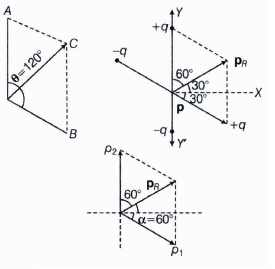
The magnitude of resultant PR ,
\({ P }_{ R }=\sqrt { { { p }_{ 1 } }^{ 2 }+{ { p }_{ 2 } }^{ 2 }+2{ p }_{ 1 }{ p }_{ 2 }\cos { \theta } } \)
\(=\sqrt { { p }_{ 2 }+{ p }_{ 2 }+2{ p }^{ 2 }\cos { \theta } } \)
\(=\sqrt { { 2p }^{ 2 }(1+\cos { \theta } } \)
\(=\sqrt { 2{ p }^{ 2 }\times 2{ cos }^{ 2 }\frac { \theta }{ 2 } } =2p \ cos\frac { \theta }{ 2 } \)
\(\tan\alpha =\frac { { p }_{ 2 }sin\theta }{ { p }_{ 1 }+{ p }_{ 2 }cos\theta } =\frac { psin{ 120 }^{ 0 } }{ p+pcos{ 120 }^{ 0 } } \)
\(=\frac { p\sqrt { 3/2 } }{ p } =\sqrt { 3 }\)
\(p-\frac { p }{ 2 } \)
\(|{ P }_{ R }|=2pcos\frac { \theta }{ 2 } =2pcos\frac { { 120 }^{ 0 } }{ 2 } =2p\times \frac { 1 }{ 2 } =p\)
\({ P }_{ R } \ will \ subtend \ an \ angle \ of \ { 30 }^{ 0 } \ with \ X \ axis.\)
Now torque acting on the system.
\(\tau ={ P }_{ R }\times E={ p }_{ R }Esin\theta =\frac { 1 }{ 2 } { p }E\)
The torque will work to align the dipole in the direction of electric field E.
19.
(i) The direction of electric field is perpendicular to their equipotential surface. So, the direction of electric field is along X-axis as its length should be perpendicular to equipotential surface lying in YZ- plane.
(ii) Length of the dipole - 2b
As dipole's axis is along the Y-axis.
\(\therefore \) Electric dipole moment,
p = q (2b)\(\overset { \wedge }{ j } \)
Electric field, E = E\(\overset { \wedge }{ i } \)
\(\because \) \(\tau \) = p x E
= q(2b)\(\overset { \wedge }{ j } \) x E\(\overset { \wedge }{ i } \)
= +2 qbE \((\overset { \wedge }{ j } \times\overset { \wedge }{ i } )\)
= 2 qbE (-\(\overset { \wedge }{ k } \))
\(\therefore \) Torque, |\(\tau \)| = 2 qbE.
20.
Initially,
\(T=2\pi \sqrt { \frac { I }{ 3{ B }^{ ' } } } and \ finally, \ { T }^{ ' }=2\pi \sqrt { \frac { I }{ m(B+{ B }^{ ' } } } \)
where, B' = horizontal magnetic field = \(24\mu \)T
and B = magnetic field due to downward conductor
\(=\frac { { \mu }_{ 0 } }{ 4\pi } .\frac { 2i }{ a } \quad =18\mu \)T
\(\therefore \frac { { T }^{ ' } }{ T } =\sqrt { \frac { { B }^{ ' } }{ B+{ B }^{ ' } } } \Rightarrow \frac { { T }^{ ' } }{ 0.1 } =\sqrt { \frac { 24 }{ 18+24 } } \Rightarrow { T }^{ ' }=0.076\)s
21.
Potential is maximum at A as potential decreases in the direction of field or we can say that VA > VB = VC
22.
We can see that magnetic field is perpendicular to paper and current in the loop is in clockwise direction. So, by Fleming's left hand rule, force on each element of the loop is radially outwards, so loop will have a tendency to expand.
23.
If any arbitrary surface encloses a dipole, then the net charge is zero because the total charge on the dipole is zero (dipole consists oftwo equal and opposite charges). According to Gauss' law,
\(\text { total flux }=\frac{1}{\varepsilon_0} \times \text { charge enclosed }=\frac{1}{\varepsilon_0} \times(0)=0 \Rightarrow \phi=0\).
24.
(i) Capacitors are used in radio circuits for tuning purposes.
(ii) Capacitors are used in power supplies for smoothing the rectified current.
25.
Magnetic lines of force are closed, continuous curves, but electric lines of force are continuous loop which are not closed.
26.
Bt the method of production and the energy they posses.
27.
Here, A = \(20cm\times 30cm\)
= \(6\times { 10 }^{ -2 }{ m }^{ -2 }\)
B = 0.3T
Let \(\theta \) be the angle made by field B with the normal to the plane of the coil.
(i) Here, \(\theta \) = 90\(^{0}\)- 90\(^{0}\) = 0\(^{0}\)
So, flux, \(\phi \)= BA cos\(\theta \)
\(\phi =0.3\times 6\times { 10 }^{ -2 }\times cos{ 0 }^{ \circ }\)
\(=1.8\times { 10 }^{ -2 }Wb\) (1)
(ii) Here, \(\theta \) = 90\(^{0}\)- 30\(^{0}\)
= 60\(^{0}\)
\(\phi =0.3\times 6\times { 10 }^{ -2 }\times cos{ 60 }^{ \circ }\\ \phi =0.9\times { 10 }^{ -2 }Wb\)
(iii) Here, \(\theta \) = 90\(^{0}\)
\(\phi =0.3\times 6\times { 10 }^{ -2 }\times cos{ 90 }^{ \circ }\\ \phi =0\)
28.
(i) The total charge of the capacitor remains conserved on introduction of dielectric slab. Also, the capacitance of capacitor increases to K times of original values.
\(\therefore \\ \) CV = C' V '= (KC) V' \(\Rightarrow V'=\frac { V }{ K } \)
\(\therefore \\ \) New electric field,
\(E'=\frac { V' }{ d } =\left( { \frac { { V }/{ K } }{ d } } \right) =\left( \frac { V }{ d } \right) \frac { 1 }{ k } =\frac { E }{ K } \)
\(\therefore \\ \) On introduction of dielectric medium, new electric field E' becomes \(\frac { 1 }{ K } \) times of its original value (decrease).
(ii) The thickness of dieletric slab is \(\frac{d}{2}, \text { i.e. } t=\frac{d}{2}\)
The capacitance of a capacitor due to dielectric slab,
\(\begin{aligned}
C & =\frac{\varepsilon_0 A}{d-t+\frac{t}{K}}
\end{aligned}\)
\(\begin{aligned}
=\frac{\varepsilon_0 A}{d-\frac{d}{2}+\frac{d}{2 K}}=\frac{2 \varepsilon_0 A}{d\left(1+\frac{1}{K}\right)}
\end{aligned}\)
29.
Given, input voltage, Vp = 2.5 x 10³ V
Input current, IP = 20 A
Also, \(\frac { { N }_{ p } }{ { N }_{ s } } =\frac { 10 }{ 1 } \Rightarrow \frac { { N }_{ s } }{ { N }_{ p } } =\frac { 1 }{ 10 } \)
Percentage efficiency \(=\frac { Output\ power }{ Input\ power } \times 100\)
\(\Rightarrow \frac { 90 }{ 100 } =\frac { Output\ power }{ { V }_{ p }{ I }_{ p } } \)
(i) Output power \(=\frac { 90 }{ 100 } \times ({ V }_{ p }{ I }_{ p })\)
\(=\frac { 90 }{ 100 } \times(2.5\times{ 10 }^{ 3 }V)\times(20A)\)
\(=4.5\times{ 10 }^{ 4 }W\)
(ii) \(\therefore \ \frac { { V }_{ s } }{ { V }_{ p } } =\frac { { N }_{ s } }{ { N }_{ p } } \Rightarrow { V }_{ s }=\frac { { N }_{ s } }{ { N }_{ p } } \times { V }_{ p }\)
\(Voltage,\ { V }_{ s }=\frac { 1 }{ 10 }\times 2.5\times{ 10 }^{ 3 }V=250V\)
(iii) \({ V }_{ s }{ I }_{ s }=4.5\times { 10 }^{ 4 } \ W\)
\(Current,{ I }_{ s }=\frac { 4.5\times{ 10 }^{ 4 } }{ { V }_{ s } } =\frac { 4.5\times10^{ 4 } }{ 250 } =180 \ A\)
30.
Here, \(R=40\Omega ,\ L=3\ mH=3\times 10^{ -3 }H\)
\(\ C=2\ \mu F=2\times 10^{ -6 }F,\ E_{ v }=110V,\ v=5000\ Hz\)
\(X_{ L }=\omega L=2\pi vL=2\times 3.14\times 5000\times 3\times 10^{ -3 }\)
\(=94.2\Omega \)
\(X_{ C }=\frac { 1 }{ \omega C } =\frac { 1 }{ 2\pi vC }\)
\(=\frac { 1 }{ 2\times 3.14\times 5000\times 2\times 10^{ -6 } } =15.92\Omega\)
\(Z=\sqrt { R^{ 2 }+(X_{ L }-X_{ C })^{ 2 } }\)
\(=\sqrt { 40^{ 2 }+(94.2-15.92)^{ 2 } } =87.9\Omega \)
\(I_{ v }=\frac { E_{ v } }{ Z } =\frac { 110 }{ 87.9 } =1.25 \ A\)
31.
\(8 \times { 10 }^{ -5 }Wb;8 \times { 10 }^{ -3 }Wb\)
\(Here,n=100,L=20mH=20 \times { 10 }^{ -3 }H;\)
\( i=4 \ mA=4 \times { 10 }^{ -3 }A\)
Magnetic flux through the cross section of coil
\(Here,n=100,L=20mH=20 \times { 10 }^{ -3 }H;\)
\(Li=20 \times { 10 }^{ -3 } \times 4 \times { 10 }^{ -3 }=8 \times { 10 }^{ -5 }Wb\)
\(Total \ magnetic \ flu \times =nLi=100 \times 8 \times { 10 }^{ -5 }\)
\(=8 \times { 10 }^{ -3 }Wb\)
32.
()
force; unit positive charge.
33.
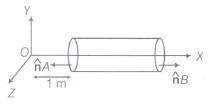
Given, E = 50 x \(\widehat { i } \)
and \(\triangle\)S = 25 cm2
= 25 \(\times\) 10-4 m2
As the electric field is only along the X-axis, so flux will pass only through the cross-section of cylinder.
Magnitude of electric field at cross-section A,
EA = 50 \(\times\) 1 = 50 N C-1
Magnitude of electric field at cross-section B,
EB = 50 \(\times\) 2 = 100 NC-1
The corresponding electric fluxes are
\({ \phi }_{ A }\) = E A . \(\triangle\)S = 50 \(\times\) 25 \(\times\) 10-4 \(\times\) \(cos180^{o}\)
= -0.125 N-m2 C-1
\({ \phi }_{ B }\) = E B . \(\triangle\)S = 100 \(\times\) 25 \(\times\) 10-4 \(\times\) \(cos0^{o}\)
= 0.25 N - m2 C-1
So, the net flux through the cylinder,
\(\phi\) = \({ \phi }_{ A }\) + \({ \phi }_{ B }\) = -0.125 + 0.25
= 0.125 N - m2 C-1
(ii) Using Gauss' law,
\(\oint\) E. dS = \(\frac { q }{ { \varepsilon }_{ 0 } }\) [\(\therefore\) \(\oint\)E . dS = \(\phi\)]
\(\Rightarrow\) 0.125 = \(\frac { q }{ { 8.85\times { 10 }^{ -12 } } } \)
\(\Rightarrow\) q = 8.85 \(\times\) 0.125 \(\times\) 10-12
= 1.1 \(\times\) 10-12 C .

12th Standard CBSE Syllabus & Materials
12th Standard CBSE
CBSE 12th Computer Science Python Revision Tour I - New Previous year Question Papers Study Material - QB365 Set A
NEW12th Standard CBSE
CBSE 12th Business Studies Planning Important Questions And Answers Study Material - QB365 Set A
NEW12th Standard CBSE
CBSE 12th Business Studies Business Environment Important Questions And Answers Study Material - QB365 Set A
NEW12th Standard CBSE
CBSE 12th Business Studies Principles of Management Important Questions And Answers Study Material - QB365 Set A



NCERT Books

Syllabus

Exam Pattern

Sample Question Papers

Previous year Question Papers

Important Notes

MCQ Practice test

NCERT Exemplers

Case study Questions

Image Based Questions

Passage based Questions

HOT Questions

Value Based Questions

Model Questions Papers
NCERT ( Book Back ) Questions

Assertion and Reason
Important Questions And Answers

CBSE 12th Standard CBSE Subjects
CBSE Standards








