
 100% FREE ACCESS
12th Standard CBSE Syllabus & Materials
12th Standard CBSE
CBSE 12th Economics Government Budget and the Economy Previous year Question Papers Study Material - QB365 Set A
NEW12th Standard CBSE
CBSE 12th Computer Science Interface Python with MySQL - New Previous year Question Papers Study Material - QB365 Set A
NEW12th Standard CBSE
CBSE 12th Computer Science Database Concept - New Previous year Question Papers Study Material - QB365 Set A
NEW12th Standard CBSE
CBSE 12th Computer Science Data Communication - New Previous year Question Papers Study Material - QB365 Set A
NEW12th Standard CBSE
CBSE 12th Computer Science Data Structures - New Previous year Question Papers Study Material - QB365 Set A
NEW12th Standard CBSE
CBSE 12th Computer Science Functions - New Previous year Question Papers Study Material - QB365 Set A

Published on: 07/03/2026
Download CBSE Class 12th Standard CBSE Physics question papers, sample papers, important questions, and previous year solved papers in PDF format. Get free study materials, NCERT solutions, and exam preparation resources for Class 12th Standard CBSE Physics
Questions + Answers key
Take MCQ Physics Test
1.
It was Rajat's turn to talk about the great Indian scientist front of the class and he chose Jagadish Chandra Bose.
Although more famous as a biologist, Jagadish Chandra Bose was a great physicist as well. He ca n rightly be called the inventor of wireless telegraphy. Through Marconi invented the wireless, Bose had already demonstrated its functioning in public in the year 1895, a year before Marconi's patent for the telegraph. He was the first to fabricate the device that generated radio wave-length (25 mm to 5 mm). He was a great scientist, who selflessly dedicated his finding to the further development of science. An inventor can make lakhs of rupees by just one or two inventions. Bose has invented many instruments used by many industries. When he was offered money for these, he did not accept it. He felt that knowledge was not anybody's personal property. He permitted anyone and everyone to use the fruits of his work. The whole class including his teacher applauded.
(a) Give two properties of the e.m.w produced by Bose.
(b) What values of Bose impressed you from the above passage?
2.
The terminology of different parts of the electromagnetic spectrum is given in the text. Use the formula E = hv (for energy of a quantum of radiation: photon) and obtain the photon energy in units of eV for different parts of the electromagnetic spectrum. In what way are the different scales of photon energies that you obtain related to the sources of electromagnetic radiation?
3.
Suppose that the electric field amplitude of an electromagnetic wave is E0 = 120 N/C and that its frequency is n = 50.0 MHz.
(a) Determine, B0 ,ω, k, and ⋌.
(b) Find expressions for E and B.
4.
How are em waves produced by oscillating charges? Draw a sketch of linearly polarized em waves propagating in the Z-direction. Indicate the directions of the oscillating electric and magnetic fields.
5.
Name the parts of the electromagnetic spectrum which is
(a) suitable for radar system used in aircraft navigation
(b) used to treat muscular strain
(c) use as a diagnostic tool in medicine
Write in brief, how these waves can be produced.
6.
The amplitude of the magnetic field part of a harmonic electromagnetic wave in vacuum is B0 = 510 nT. What is the amplitude of the electric field part of the wave?
7.
A radio can tune in to any station in the 7.5 MHz to 12 MHz band. What is the corresponding wavelength band?
8.
A plane electromagnetic wave of frequency 25 MHz travels in free space along the x-direction. At a particular point in space and time, \( { E } =6.3 \hat { j } \)V/m. What is B at this point?
9.
A plane electromagnetic wave travels in vacuum along z-direction. What can you say about the directions of its electric and magnetic field vectors? If the frequency of the wave is 30 MHz, what is its wavelength?
10.
A plane em wave of frequency 40 mHz travel in free space in the x-direction. At some point, at some instant, the electric field \(\overset { \rightarrow }{ E } \) has its maximum value at \(750 \ NC^{ -1 }\) in y-direction.
(a) What is the period of the wave?
(b) What is the value of magnitude and direction of magnetic field in 2-direction?
(c) What is the angular frequency of the em wave?
11.
Radio waves are produced by
accelerated motion of electrons in oscillating circuits.
sudden deceleration of fast moving electrons by metal target
heating of certain substances at particular temperature
de excitation of electron from higher energy orbital to lower one.
12.
Which radiations are used in treatment of muscle ache?
Infrared
Ultraviolet
Microwave
X-rays
13.
The structure of solids is investigated by using
cosmic rays
X-rays
\(\gamma \text { -rays }\)
infrared rays
14.
In electromagnetic wave if ue and um are mean electric and magnetic energy densities respectively, then
\( \boldsymbol{u}_{e}=\boldsymbol{u}_{m} \)
\( u_{e}>u_{m} \)
\( \boldsymbol{u}_{e}<\boldsymbol{u}_{m} \)
\( u_{e}^{2}=\frac{1}{2} u_{m}^{2}\)
15.
In electromagnetic waves the phase difference between electric and magnetic field vectors are
zero
\(\frac{\pi}{4}\)
\(\frac{\pi}{2}\)
π
16.
The largest wavelength of electromagnetic wave is
X-rays
radio waves
ultraviolet rays
infrared rays
17.
If E and B represent electric and magnetic field vectors of the electromagnetic wave, the direction of propagation of electromagnetic wave is along
E
B
B x E
E x B
18.
One requires 11eV of energy to dissociate a carbon monoxide molecule into carbon and oxygen atoms. The minimum frequency of the appropriate electromagnetic radiation to achieve the dissociation lies in
visible region
infrared region
ultraviolet region
microwave region
19.
The speed of electromagnetic wave in vacuum depends upon the source of radiation
increases as we move from γ-rays to radio waves
decreases as we move from γ-rays to radio waves
is same for all of them
None of the above
20.
If \({ \mu }_{ 0 },{ \mu }_{ r },{ \epsilon }_{ 0 }and{ { \epsilon }_{ r } }\) as the absolute permeability relative permeability, absolute permittivity and relative permittivity of the medium, then the velocity of electromagnetic wave in a medium is
\(\frac { 1 }{ \sqrt { { \mu }_{ 0 }{ \epsilon }_{ 0 } } } \)
\(\frac { 1 }{ \sqrt { { \mu }_{ r }{ \epsilon }_{ r } } } \)
\(\frac { 1 }{ \sqrt { { \mu }_{ 0 }{ \epsilon }_{ 0 }{ \mu }_{ r }{ \epsilon }_{ r } } } \)
\(\sqrt { \frac { { \mu }_{ r }{ \epsilon }_{ r } }{ { \mu }_{ 0 }{ \epsilon }_{ 0 } } } \)
21.
If a source of power 4 KW produces \({ 10 }^{ 20 }\) Photon/second, the radiation belongs to part of the spectrum called
Ultraviolet rays
Microwaves
Gamma rays
x-rays
22.
Consider the following statements about electromagnetic waves and choose the correct ones
\({ S }_{ 1 }\) e.m. waves having wavelength 1000 times smaller than light waves are called x-rays
\({ S }_{ 2 }\) ultraviolet waves are used in the treatment of swollen joints
\({ S }_{ 3 }\) alpha and gamma rays are electromagnetic waves
\({ S }_{ 4 }\) de-Broglie waves are not electromagnetic in nature
\({ S }_{ 5 }\) electromagnetic waves exhibits polarisation while sound waves do not
\({ S }_{ 1 }\),\({ S }_{ 4 }\) and \({ S }_{ 5 }\)
\({ S }_{ 3 }\),\({ S }_{ 4 }\)and \({ S }_{ 5 }\)
\({ S }_{ 1 }\),\({ S }_{ 3 }\)and \({ S }_{ 5 }\)
\({ S }_{ 4 }\),\({ S }_{ 3 }\) and \({ S }_{ 4 }\)
23.
The kinetic energy of a photon of frequency v, rest mass.\({ m }_{ 0 }\) having mass m while moving with velocity v is
\(\frac { 1 }{ 2 } { mv }^{ 2 }\)
hv
\({ mc }^{ 2 }={ m }_{ 0 }{ c }^{ 2 }\)
\(\frac { 1 }{ 2 } { mv }^{ 2 }-hv\)
24.
In an electromagnetic wave, the electric and magnetic fields are 100 V/m and 0.265 A/m. The maximum energy flow per second per unit area will be
\(79 \ W/{ m }^{ 2 }\)
\(13.2 \ W/{ m }^{ 2 }\)
\(53 \ W/{ m }^{ 2 }\)
\(26.5 \ W/{ m }^{ 2 }\)
25.
The waves used in Telecommunications are
infrared
ultraviolet
microwaves
cosmic rays
26.
The amplitude of an electromagnetic wave A is a and of another B is 3 a. Their frequencies are the same for the Maximum waves. Then
the energy of wave A is greater than B
the energy of wave A is smaller than B
the energy of wave A is equal to that of B
the given data is not sufficient to decide
27.
A charged particle oscillates about its mean position with frequency 109 Hz. What is the frequency of electromagnetic wave produced by the oscillators?
28.
The magnetic field in a plane electromagnetic wave is given by By = (2 × 10⁻⁷) T sin (0.5 x10³x + 1.5 x 10¹¹t) .
(a) What is the wavelength and frequency of the wave?
(b) Write an expression for the electric field.
29.
The energy of the electromagnetic wave is in the order of 15KV . To which part of the spectrum does it belong?
30.
What physical quantity is the same for X-rays of wavelength 10–10m, red light of wavelength 6800 Å and radiowaves of wavelength 500m?
31.
Which of the following, If any, can act as a source of electromagnetic waves?
(i) A charge moving with a constant velocity
(ii) A charge moving with a circular orbit
(iii) A charge at rest
Give reason
32.
Radio waves are produced by the accelerated motion of charges in conducting wires. Microwaves are produced by special vacuum tubes. Infrared waves are produced by hot bodies and molecules also known as heat waves. UV rays are produced by special lamps and very hot bodies like Sun.
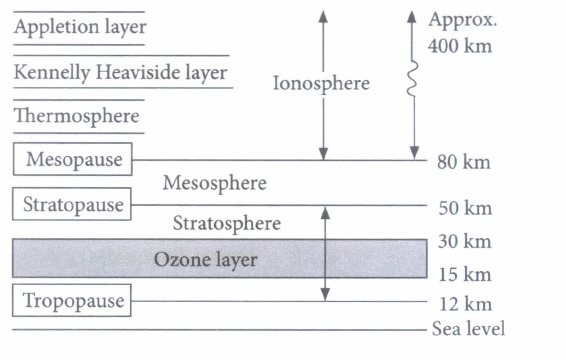
(i) Solar radiation is
| (a) transverse electromagnetic wave |
| (b) longitudinal electromagnetic waves |
| (c) both longitudinal and transverse electromagnetic waves |
| (d) none of these. |
(ii) What is the cause of greenhouse effect?
| (a) Infrared rays | (b) Ultraviolet rays | (c) X-rays | (d) Radiowaves |
(iii) Biological importance of ozone layer is
| (a) it stops ultraviolet rays | (b) It layer reduces greenhouse effect |
| (c) it reflects radiowaves | (d) none of these |
(iv) Ozone is found in
| (a) stratosphere | (b) ionosphere | (c) mesosphere | (d) troposphere |
(v) Earth's atmosphere is richest in
| (a) ultraviolet | (b) infrared | (c) X-rays | (d) microwaves |
33.
All the known radiations from a big family of electromagnetic waves which stretch over a large range of wavelengths. Electromagnetic wave include radio waves, microwaves, visible light waves, infrared rays, UV rays, X-rays and gamma rays. The orderly distribution of the electromagnetic waves in accordance with their wavelength or frequency into distinct groups having widely differing properties is electromagnetic spectrum.
(i) Which wavelength of the Sun is used finally as electric energy?
| (a) radio waves | (b) infrared waves |
| (c) visible light | (d) microwaves |
(ii) Which of the following electromagnetic radiations have the longest wavelength?
| (a) X-rays | (b) \(\Upsilon\)-rays |
| (c) microwaves | (d) radiowaves |
(iii) Which one of the following is not electromagnetic in nature?
| (a) X-rays | (b) gamma rays |
| (c) cathode rays | (d) infrared rays |
(iv) Which of the following has minimum wavelength?
| (a) X-rays | (b) ultraviolet rays |
| (c) \(\Upsilon\)-rays | (d) cosmic rays |
(v) The decreasing order of wavelength of infrared, microwave, ultraviolet and gamma rays is
| (a) microwave, infrared, ultraviolet, gamma rays |
| (b) gamma rays, ultraviolet, infrared, microwave |
| (c) microwave, gamma rays, infrared, ultraviolet |
| (d) infrared, microwave, ultraviolet, gamma rays |
1.
(a) They are transverse in nature, and travel with the speed of light in vacuum.
(b) The selfless attitude of the scientist, service mindedness and modesty.
2.
Energy of photon, \(\mathrm{E}=\mathrm{hv}\)
This implies,\(\mathrm{E}=\mathrm{h} \frac{\mathrm{c}}{\lambda}\)
Where, \(\mathrm{h}=6.62 \times 10^{-34} \mathrm{js}\)
\( \mathrm{c}=3 \times 10^8 \mathrm{~ms}^{-1}\)
If wave length \(\lambda\) is in meter and energy is in joule then, we will divide E by \(1.6 \times 10^{-19}\) to convert into eV (Electron volt).
\(\therefore \mathrm{E}=\frac{\mathrm{hc}}{\lambda \times 1.6 \times 10^{-19}} \mathrm{eV}\)
(1) For y - rays wave length ranges from to less that \(10^{-14} \mathrm{~m}\)
Therefore, \(\text { Energy }=\frac{6.62 \times 10^{-34} \times 3 \times 10^8}{10^{-10} \times 1.6 \times 10^{-19}} \mathrm{eV} \)
\(=12.4 \times 10^3 \mathrm{eV} \approx 10^4 \mathrm{eV}\)
Thus, \( \lambda=10^{-10} \mathrm{~m}, \text { energy }=10^4 \mathrm{eV} \text { and }\) \( \lambda=10^{-14} \mathrm{~m} \text {, energy }=10^8 \mathrm{eV}\)
Energy of y - rays ranges between 104 to \(10^8 \mathrm{eV}\)
(2) For X - rays wave length ranges from \(10^{-8} \mathrm{~m}\) to \(10^{-7} \mathrm{~m}\) For \(\lambda=10^{-8}\)
Therefore, \(\text { Energy }=\frac{6.62 \times 10^{-34} \times 3 \times 10^8}{10^{-8} \times 1.6 \times 10^{-19}} \mathrm{eV} \)
\(=12.4 \approx 10^2 \mathrm{eV}\)
\( \lambda=10^{-13} \mathrm{~m} \text {, energy }=10^7 \mathrm{eV}\)
(3) For violet radiation \(\lambda\) ranges from \(4 \times 10^{-7}\) to \(6 \times 10^{-10}\)
Therefore, for \(\lambda=4 \times 10^{-7}\)
\(\text { Energy }=\frac{6.62 \times 10^{-34} \times 3 \times 10^8}{4 \times 10^{-7} \times 1.6 \times 10^{-19}} \mathrm{eV} =3.1 \mathrm{eV} \approx 10^{10} \mathrm{eV}\)
\(\lambda=6 \times 10^{-10} \mathrm{~m} \text {, Energy }=10^3 \mathrm{eV}\)
Energy of ultraviolet radiation vary between \(10^{10}\) to \(10^3 \mathrm{eV}\).
(4) For visible radiations wave length range from \(4 \times 10^{-7} \mathrm{~m}\) to \(7 \times 10^{-7} \mathrm{~m}\)
Therefore,
For \(\lambda=4 \times 10^{-7} \mathrm{~m}\), and Energy \(=10^{10} \mathrm{eV}\)
\(\text { Energy }=\frac{6.62 \times 10^{-34} \times 3 \times 10^8}{7 \times 10^{-7} \times 1.6 \times 10^{-19}} \mathrm{VV} \)
\(=1.77 \mathrm{eV} \approx 10^{\circ} \mathrm{eV}\)
(5) For infrared radiation $\lambda$ range from \(7 \times 10^{-7} \mathrm{~m}\) to \(7 \times 10^{-14} \mathrm{~m}\)
Therefore, \(\lambda=7 \times 10^{-7} \text {, energy }=10^{\circ} \mathrm{eV}\)
For \(\lambda=7 \times 10^{-4} \text {, energy }=\frac{1}{1000} \text { times }\)
the other order of \(10^{-3}\)eV
(6) For micro waves $\lambda$ ranges from 1 mm to 0.3 m
For \(\lambda=1 \mathrm{~mm}\) or \(10^{-3}\)
energy is equal to \( \text { Energy }=\frac{6.62 \times 10^{-34} \times 3 \times 10^8}{10^{-3} \times 1.6 \times 10^{-19}} \mathrm{eV} \)
\(=1.24 \times 10^{-3} \mathrm{eV} \approx 10^{-3} \mathrm{eV}\)
For \(\lambda=0.3 \mathrm{~m} \text {, Energy }=4.1 \times 10^{-6} \mathrm{eV} \approx 10^{-6} \mathrm{eV} \text {. }\)
(7) For Radio waves $\lambda$ ranges from 1 m to few km For $\lambda=1 \mathrm{~m}$
For λ=1m
Energy is equal to
\(=\frac{6.62 \times 10^{-34} \times 3 \times 10^8}{10^0 \times 1.6 \times 10^{-19}} \mathrm{eV} \)
\(=1.24 \times 10^{-6} \mathrm{eV} \approx 10^{-6} \mathrm{eV}\)
Energy for λ of the order of few km≈10−6eV
The Energy of a photon that a source produces indicates the spacing of relevant energy levels of the source
3.
Given, amplitude of an electromagnetic wave,
E0 = 120 N/C
Frequency of wave, v = 50 MHz = 50 \(\times\) 106 Hz
(i) Speed of light in vacuum, \(c=\frac{E_0}{B_0}\)
\(\begin{aligned} B_0=\frac{E_0}{c}= & \frac{120}{3 \times 10^8}=40 \times 10^{-8} \end{aligned}\)
= 400 \(\times\) 10-9 T = 400 nT
Angular frequency of electromagnetic wave,
\(\omega=2 \pi \nu=2 \times 3.14 \times 50 \times 10^6\)
\(\omega=3.14 \times 10^8 \mathrm{rad} / \mathrm{s}\)
Wave number of electromagnetic wave,
\(k=\frac{\omega}{c}=\frac{3.14 \times 10^8}{3 \times 10^8}=1.05 \mathrm{rad} / \mathrm{m}\)
Wavelength of electromagnetic wave,
\(\lambda=\frac{c}{v}=\frac{3 \times 10^8}{50 \times 10^6}=6.00 \mathrm{~m}\)
(ii) Expression of electric field, E = E0 sin (kx - \(\omega\)t)
E = 120 sin (1.05x - 3.14 \(\times\)108 t)
Expression of magnetic field B,
B = B0 sin (kx - \(\omega\)t)
E = 120 sin (kx - \(\omega\)t)
B = 4 \(\times\)10-7 sin (1.05x - 3.14 \(\times\) 108 t)
4.
Acharge oscillating with some frequency, produces an oscillating electric field in space, which in turn produces an oscillating magnetic field perpendicular to the electric field, this process goes on repeating, producing em waves in space perpendicular to both the fields.
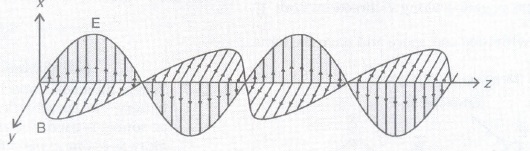
Directions of \(\overrightarrow { E } \) and \(\overrightarrow { B } \) are perpendicular to each other and also perpendicular to direction of propagation of em waves.
Ampere's circuital law is given by as \(\phi \overrightarrow { B } .\overrightarrow { dl } ={ \mu }_{ 0 }{ i }_{ c }\)
But for a circuit containing capacitor, during its charging/discharging the current within the plates of the capacitor varies, (producing displacement current i d)
Therefore, the above equation, as generalized by Maxwell, is given as \(\phi \overrightarrow { B } .\overrightarrow { dl } ={ \mu }_{ 0 }{ i }_{ c }+{ \mu }_{ 0 }{ i }_{ d }\)
During the process of charging capacitor, electric flux (\(\phi _{ c }\)) between the plates of capacitor changes with time, which produces the current within the plates of capacitor. This current, being proportional to \(\frac { d\phi \epsilon }{ dt } \), we have \(i={ \epsilon }_{ 0 }\frac { d\phi \epsilon }{ dt } \)
5.
(i) Microwave
(ii) Infrared waves are used to treat muscular strain.
(iii) X-rays are used as a diagnostic tool in medicine. X-rays are produced by X-ray tubes or inner shell electrons.
6.
Given, amplitude of the magnetic field part of harmonic electromagnetic wave,
B0 = 510 nT = 510 \(\times\)10-9 T
Speed of light in a vacuum, c = 3 × 10⁸ m/s
Amplitude of electric field of the electromagnetic wave is given by the relation,
E = cB0
= 3 × 108 × 510 × 10−9 = 153 N/C
Therefore, the electric field part of the wave is 153 N/C.
7.
f1=7.5×10⁶ Hz
f2=12×106 Hz
λ1=c/f1=40 m
λ2=c/f2=25 m
So the range is 40m to 25m
8.
Using Eq, the magnitude of B is
\(B=\frac { E }{ c } \)
\(=\frac { 6.3V/m }{ 3\times { 10 }^{ 8 }m/s } =2.1\times { 10 }^{ -8 }T\)
To find the direction, we note that E is along y-direction and the wave propagates along x-axis. Therefore, B should be in a direction perpendicular to both x- and y-axes. Using vector algebra, E × B should be along x-direction.
Since, \((+\overrightarrow{\mathbf{j}}) \times(+\hat{\mathbf{k}})=\overrightarrow{\mathbf{i}}, \mathbf{B}\) is along the z-direction.
Thus, \(\mathbf{B}=2.1 \times 10^{-8} \hat{\mathbf{k}} \mathrm{T}\)
9.
It is given that a plane electromagnetic wave travels in vacuum along z-direction and the frequency of the electromagnetic wave is 30MHz.
We can say that electric field and magnetic field will be in x-plane because the electromagnetic wave travels along the z-direction and both fields are mutually perpendicular to each other.
The formula of the wavelength of a wave is,
λ=c/ν
Substitute the values in the above expression,
λ=(3×10⁸)/(30×106)=10m.
Thus, the value of wavelength is 10 m and the direction of electric and magnetic fields will be in x-y plane.
10.
Given \(v=40\times { 10 }^{ 6 }Hz\)
\(\therefore \)\(T=\frac { 1 }{ v } =\frac { 1 }{ 40\times 10^{ -6 } } =0.25\times 10^{ -6 }/s\)
Magnetic field
\({ B }_{ 0 }=\frac { E_{ 0 } }{ c } =\frac { 750 }{ 3\times 10^{ 18 } } =2.5\times 10^{ -6 }T \ along \ (z \ direction)\)
And angular frequency
\(\omega =2\pi v=2\times \pi \times 40\times { 10 }^{ 6 }=8\pi \times { 10 }^{ 7 } \ Hz\)
11.
(a)
accelerated motion of electrons in oscillating circuits.
12.
(a)
Infrared
13.
(b)
X-rays
14.
(d)
\( u_{e}^{2}=\frac{1}{2} u_{m}^{2}\)
15.
(a)
zero
16.
(b)
radio waves
17.
(d)
E x B
18.
(c)
ultraviolet region
19.
(c)
is same for all of them
20.
(c)
\(\frac { 1 }{ \sqrt { { \mu }_{ 0 }{ \epsilon }_{ 0 }{ \mu }_{ r }{ \epsilon }_{ r } } } \)
21.
(a)
Ultraviolet rays
22.
(a)
\({ S }_{ 1 }\),\({ S }_{ 4 }\) and \({ S }_{ 5 }\)
23.
(b)
hv
24.
(d)
\(26.5 \ W/{ m }^{ 2 }\)
25.
(c)
microwaves
26.
(c)
the energy of wave A is equal to that of B
27.
It is given that a charged particle oscillates about its mean equilibrium position and the frequency of charged particle is 109 Hz.
The frequency of an electromagnetic wave produced by the oscillator will be same to the value of frequency of a charged particle that is oscillating about its mean position.
Thus, the value of the frequency of an electromagnetic wave produced by oscillator is 109 Hz.
28.
(a) Comparing the given equation with
\(B_{y}=B_{0} \sin \left[2 \pi\left(\frac{x}{\lambda}+\frac{t}{T}\right)\right]\)
We get, \(\lambda=\frac{2 \pi}{0.5 \times 10^{3}} \mathrm{~m}=1.26 \mathrm{~cm}\)
and \(\frac{1}{T}=v=\left(1.5 \times 10^{11}\right) / 2 \pi=23.9 \mathrm{GHz}\)
(b) E0 = B0c = 2 x 10–7 T x 3 x 108 m/s = 6 x 101 V/m
The electric field component is perpendicular to the direction of propagation and the direction of magnetic field. Therefore, the electric field component along the z-axis is obtained as
Ez = 60 sin (0.5 x 10³x + 1.5 x 10¹¹ t) V/m.
29.
X-rays because \(\lambda=0.825 \stackrel{\circ}{\AA}\)
30.
The speed of light (3 × 10⁸ m/s) in a vacuum is the same for all wavelengths. It is independent of the wavelength in the vacuum.
31.
A charge moving with a circular orbit can produce electromagnetic waves because a circular motion is an accelerated motion and accelerated charges produce e.m.waves
32.
(i) (a)
(ii) (a): Greenhouse effect is due to infrared rays.
(iii) (a): Ozone layer absorbs the harmful ultraviolet radiations coming from the sun.
(iv) (a): Ozone layer lies in stratosphere.
(v) (b): The atmosphere of earth is richest in infrared radiation.
33.
(i) (b): Infrared rays can be converted into electric energy as in solar cell.
(ii) (d): Radiowaves have longest wavelength.
(iii) (c) : Cathode rays are invisible fast moving streams of electrons emitted by the cathode of a discharge tube which is maintained at a pressure of about 0.01 mm of mercury.
(iv) (c): \(\Upsilon\)-rays have minimum wavelength
(v) (a): \(\lambda_{\text {micro }}>\lambda_{\text {infra }}>\lambda_{\text {ultra }}>\lambda_{\text {gamma }}\)

12th Standard CBSE Syllabus & Materials
12th Standard CBSE
CBSE 12th Computer Science Python Revision Tour I - New Previous year Question Papers Study Material - QB365 Set A
NEW12th Standard CBSE
CBSE 12th Business Studies Planning Important Questions And Answers Study Material - QB365 Set A
NEW12th Standard CBSE
CBSE 12th Business Studies Business Environment Important Questions And Answers Study Material - QB365 Set A
NEW12th Standard CBSE
CBSE 12th Business Studies Principles of Management Important Questions And Answers Study Material - QB365 Set A



NCERT Books

Syllabus

Exam Pattern

Sample Question Papers

Previous year Question Papers

Important Notes

MCQ Practice test

NCERT Exemplers

Case study Questions

Image Based Questions

Passage based Questions

HOT Questions

Value Based Questions

Model Questions Papers
NCERT ( Book Back ) Questions

Assertion and Reason
Important Questions And Answers

CBSE 12th Standard CBSE Subjects
CBSE Standards








