
 100% FREE ACCESS
12th Standard CBSE Syllabus & Materials
12th Standard CBSE
CBSE 12th Economics Government Budget and the Economy Previous year Question Papers Study Material - QB365 Set A
NEW12th Standard CBSE
CBSE 12th Computer Science Interface Python with MySQL - New Previous year Question Papers Study Material - QB365 Set A
NEW12th Standard CBSE
CBSE 12th Computer Science Database Concept - New Previous year Question Papers Study Material - QB365 Set A
NEW12th Standard CBSE
CBSE 12th Computer Science Data Communication - New Previous year Question Papers Study Material - QB365 Set A
NEW12th Standard CBSE
CBSE 12th Computer Science Data Structures - New Previous year Question Papers Study Material - QB365 Set A
NEW12th Standard CBSE
CBSE 12th Computer Science Functions - New Previous year Question Papers Study Material - QB365 Set A

Published on: 07/03/2026
Download CBSE Class 12th Standard CBSE Physics question papers, sample papers, important questions, and previous year solved papers in PDF format. Get free study materials, NCERT solutions, and exam preparation resources for Class 12th Standard CBSE Physics
Questions + Answers key
Take MCQ Physics Test
1.
(a) For circuits used for transporting electric power, a low power factor implies large power loss in transmission. Explain.
(b) Power factor can often be improved by the use of a capacitor of appropriate capacitance in the circuit. Explain
2.
A resistance of 40 is connected to an a.c. source of 220 V, 50 Hz. Find
(i) the rms current
(ii) maximum instantaneous current in the resistor
(iii) time taken by the current to change from max. value to rms value.
3.
The terminology of different parts of the electromagnetic spectrum is given in the text. Use the formula E = hv (for energy of a quantum of radiation: photon) and obtain the photon energy in units of eV for different parts of the electromagnetic spectrum. In what way are the different scales of photon energies that you obtain related to the sources of electromagnetic radiation?
4.
Suppose that the electric field amplitude of an electromagnetic wave is E0 = 120 N/C and that its frequency is n = 50.0 MHz.
(a) Determine, B0 ,ω, k, and ⋌.
(b) Find expressions for E and B.
5.
(i) Describe briefly how electromagnetic waves are produced by oscillating charges?
(ii) Give one use of each of the following
(a) Microwaves
(b) X-rays
(c) Infrared rays
(d) Gamma rays
6.
An em wave travelling through a medium has electric field vector. Ey = 4 x 10⁵ cos (3.14 x 10⁸ t - 1.57 x) N/C. Here x is in m and t in s.
Then find:
(i) wavelength,
(ii) frequency,
(iii) direction of propagation,
(iv) speed of wave,
(v) refractive index of medium, and
(vi) amplitude of magnetic field vector.
7.
A 60 μF capacitor is connected to a 110 V, 60 Hz ac supply. Determine the rms value of the current in the circuit.
8.
A light bulb and an open coil inductor are connected to an ac source through a key as shown in Fig.
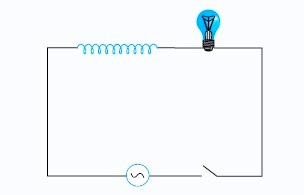
The switch is closed and after sometime, an iron rod is inserted into the interior of the inductor. The glow of the light bulb (a) increases; (b) decreases; (c) is unchanged, as the iron rod is inserted. Give your answer with reasons.
9.
Find the magnitude of e.m.f. induced in a 200 turn coil with cross-sectional area of 0.16 \({ m }^{ 2 }\) if the magnetic field through the coil changes from 0.10 \(Wb{ m }^{ -2 }\) to 0.30 \(Wb{ m }^{ -2 }\) at a uniform rate over a period of 0.05 s.
10.
What is the net power absorbed by each circuit over a complete cycle? Explain your answer.
11.
In a plane e.m. wave, the electric field oscillates sinusoidally at a frequency of \(2.0\times 10^{ 10 }\) Hz and amplitude \(48 \ Vm^{ -1 }\).
(a) What is the wavelength of the wave?
(b) What is the amplitude of the oscillating magnetic field?
(c) Show that the average energy density of the E field equals to the average energy density of the B field. \(\left[ c=3.0\times 10^{ 8 } \ ms^{ -1 } \right] \)
12.
A transformer works on the principle of
converter
inverter.
mutual inductance
self-inductance
13.
Which quantity is increased in a step-down transformer?
Current
Voltage
Power
Frequency
14.
What is not possible in a transformer?
Eddy current
Direct current
Alternating current
Induced current
15.
In a series L-C-R circuit, the capacitance Cis changed to 4C. To keep the resonant frequency same, the inductance must be changed by
2L
L/2
4L
L/4
16.
A lamp emits monochromatic green light uniformly in all directions. The lamp is 3% efficient in converting electrical power to electromagnetic waves and consumes 100 W of power. The amplitude of the electric field associated with the electromagnetic radiation at a distance of 5m from the lamp will be
1.34 V/m
2.68 V/m
4.02 V/m
5.36 V/m
17.
Am electromagnetic wave travels in vacuum along \(z\) direction: \(\overset { \rightarrow }{ E } =({ E }_{ 1 }\overset { \wedge }{ i } +{ E }_{ 2 }\overset { \wedge }{ j } )cos(kz-wt)\). Choose the correct options from the following:
The associated magnetic field is given as
\(\overset { \rightarrow }{ B } =\frac { 1 }{ c } ({ E }_{ 1 }\overset { \wedge }{ i } { E }_{ 2 }\overset { \wedge }{ j) } cos(kz-wt)\)
The associated magnetic field is given as
\(\overset { \rightarrow }{ B } =\frac { 1 }{ c } \ ({ E }_{ 1 }\overset { \wedge }{ i } { -E }_{ 2 }\overset { \wedge }{ j) } \ cos \ (kz-wt)\)
The given electromagnetic field is circularly polarised .
The given electromagnetic wave is plane polarised .
18.
Is the ratio of frequencies of ultraviolet rays and infrared rays in glass more than, less than or equal to 1?
19.
A light bulb and a solenoid are connected in series across an ac source of voltage. Explain, how the glow of the light bulb will be affected when an iron rod is inserted in the solenoid.
20.
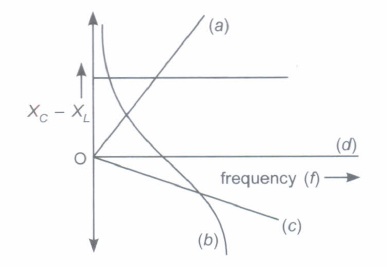
Which of the following curves may represent the reactance of a series LC combination?
21.
A 44 mH inductor is connected to 220 V, 50 Hz AC supply. Determine the rms value of the current in the circuit. What is the net power absorbed over a complete cycle? Explain.
22.
A pure inductor of 25.0 mH is connected to a source of 220 V. Find the inductive reactance and rms current in the circuit if the frequency of the source is 50 Hz.
23.
An electromagnetic wave consists of oscillating electric and magnetic fields. What is the phase relationship between these oscillations?
24.
Name the constituent radiation of electromagnetic spectrum which is used for
(i) aircraft navigation
(ii) studying the crystal structure
Write the frequency range for each.
25.
26.
Radio waves are produced by the accelerated motion of charges in conducting wires. Microwaves are produced by special vacuum tubes. Infrared waves are produced by hot bodies and molecules also known as heat waves. UV rays are produced by special lamps and very hot bodies like Sun.
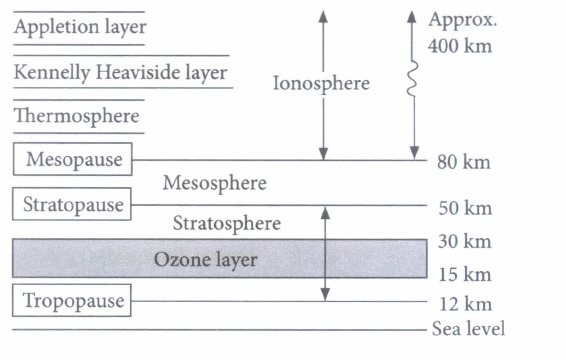
(i) Solar radiation is
| (a) transverse electromagnetic wave |
| (b) longitudinal electromagnetic waves |
| (c) both longitudinal and transverse electromagnetic waves |
| (d) none of these. |
(ii) What is the cause of greenhouse effect?
| (a) Infrared rays | (b) Ultraviolet rays | (c) X-rays | (d) Radiowaves |
(iii) Biological importance of ozone layer is
| (a) it stops ultraviolet rays | (b) It layer reduces greenhouse effect |
| (c) it reflects radiowaves | (d) none of these |
(iv) Ozone is found in
| (a) stratosphere | (b) ionosphere | (c) mesosphere | (d) troposphere |
(v) Earth's atmosphere is richest in
| (a) ultraviolet | (b) infrared | (c) X-rays | (d) microwaves |
1.
(a) We know that P = I V cos\(\phi \) where cos\(\phi \) is the power factor. To supply a given power at a given voltage, if cos\(\phi \) is small, we have to increase current accordingly. But this will lead to large power loss (I2R) in transmission.
(b) Suppose in a circuit, current I lags the voltage by an angle \(\phi \). Then power factor \(\phi \) = R/Z.
We can improve the power factor (tending to 1) by making Z tend to R. Let us understand, with the help of a phasor diagram.
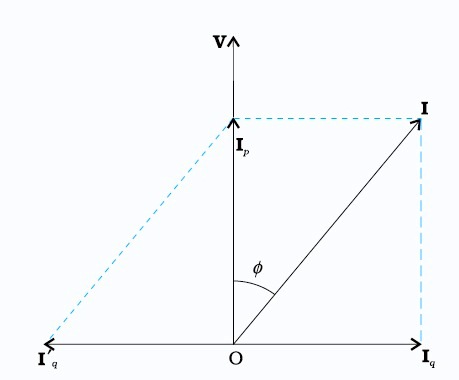
how this can be achieved. Let us resolve I into two components. Ip along the applied voltage V and Iq perpendicular to the applied voltage. Iq as you have learnt in Section 7.7, is called the wattless component since corresponding to this component of current, there is no power loss. IP is known as the power component because it is in phase with the voltage and corresponds to power loss in the circuit.
It’s clear from this analysis that if we want to improve power factor, we must completely neutralize the lagging wattless current Iq by an equal leading wattless current I'q. This can be done by connecting a capacitor of appropriate value in parallel so that Iq and I′q cancel each other and P is effectively Ip V.
2.
\(Here, \ R=40\Omega , \ { E }_{ v }=220V, \ v=50Hz,\)
\((i) \ { I }_{ v }=\frac { { E }_{ v } }{ R } =\frac { 220 }{ 40 } =5.5 \ A\)
\({ I }_{ 0 }=\sqrt { 2 } { I }_{ v }=1.414\times 5.5=7.8 \ A\)
If alternating current is given by
\(I={ I }_{ 0 } \ sin \ \omega t, \ then\)
\({ I }_{ 0 }={ I }_{ 0 } \ sin{ \omega t }; \ sin \ { \omega t }_{ 1 }=1 \ or \ { \omega t }_{ 1 }=\frac { \pi }{ 2 }\)
\(and \ { I }_{ v }=\frac { { { I } }_{ 0 } }{ \sqrt { 2 } } ={ I }_{ 0 }sin{ \ \omega t }_{ 2 }, \ which \ implies\)
\({ \omega t }_{ 2 }=\frac { \pi }{ 2 } +\frac { \pi }{ 4 } \ \ \therefore \omega \left( { t }_{ 2 }-{ t }_{ 1 } \right) =\frac { \pi }{ 2 } +\frac { \pi }{ 4 } -\frac { \pi }{ 2 } =\frac { \pi }{ 4 }\)
\({ t }_{ 2 }-{ t }_{ 1 }=\frac { \pi }{ 4\omega } =\frac { \pi }{ 4\times 2\pi v } =\frac { 1 }{ 8v } =\frac { 1 }{ 8\times 50 } =2.5\times { 10 }^{ -3 }s=2.5 \ ms\)
3.
Energy of photon, \(\mathrm{E}=\mathrm{hv}\)
This implies,\(\mathrm{E}=\mathrm{h} \frac{\mathrm{c}}{\lambda}\)
Where, \(\mathrm{h}=6.62 \times 10^{-34} \mathrm{js}\)
\( \mathrm{c}=3 \times 10^8 \mathrm{~ms}^{-1}\)
If wave length \(\lambda\) is in meter and energy is in joule then, we will divide E by \(1.6 \times 10^{-19}\) to convert into eV (Electron volt).
\(\therefore \mathrm{E}=\frac{\mathrm{hc}}{\lambda \times 1.6 \times 10^{-19}} \mathrm{eV}\)
(1) For y - rays wave length ranges from to less that \(10^{-14} \mathrm{~m}\)
Therefore, \(\text { Energy }=\frac{6.62 \times 10^{-34} \times 3 \times 10^8}{10^{-10} \times 1.6 \times 10^{-19}} \mathrm{eV} \)
\(=12.4 \times 10^3 \mathrm{eV} \approx 10^4 \mathrm{eV}\)
Thus, \( \lambda=10^{-10} \mathrm{~m}, \text { energy }=10^4 \mathrm{eV} \text { and }\) \( \lambda=10^{-14} \mathrm{~m} \text {, energy }=10^8 \mathrm{eV}\)
Energy of y - rays ranges between 104 to \(10^8 \mathrm{eV}\)
(2) For X - rays wave length ranges from \(10^{-8} \mathrm{~m}\) to \(10^{-7} \mathrm{~m}\) For \(\lambda=10^{-8}\)
Therefore, \(\text { Energy }=\frac{6.62 \times 10^{-34} \times 3 \times 10^8}{10^{-8} \times 1.6 \times 10^{-19}} \mathrm{eV} \)
\(=12.4 \approx 10^2 \mathrm{eV}\)
\( \lambda=10^{-13} \mathrm{~m} \text {, energy }=10^7 \mathrm{eV}\)
(3) For violet radiation \(\lambda\) ranges from \(4 \times 10^{-7}\) to \(6 \times 10^{-10}\)
Therefore, for \(\lambda=4 \times 10^{-7}\)
\(\text { Energy }=\frac{6.62 \times 10^{-34} \times 3 \times 10^8}{4 \times 10^{-7} \times 1.6 \times 10^{-19}} \mathrm{eV} =3.1 \mathrm{eV} \approx 10^{10} \mathrm{eV}\)
\(\lambda=6 \times 10^{-10} \mathrm{~m} \text {, Energy }=10^3 \mathrm{eV}\)
Energy of ultraviolet radiation vary between \(10^{10}\) to \(10^3 \mathrm{eV}\).
(4) For visible radiations wave length range from \(4 \times 10^{-7} \mathrm{~m}\) to \(7 \times 10^{-7} \mathrm{~m}\)
Therefore,
For \(\lambda=4 \times 10^{-7} \mathrm{~m}\), and Energy \(=10^{10} \mathrm{eV}\)
\(\text { Energy }=\frac{6.62 \times 10^{-34} \times 3 \times 10^8}{7 \times 10^{-7} \times 1.6 \times 10^{-19}} \mathrm{VV} \)
\(=1.77 \mathrm{eV} \approx 10^{\circ} \mathrm{eV}\)
(5) For infrared radiation $\lambda$ range from \(7 \times 10^{-7} \mathrm{~m}\) to \(7 \times 10^{-14} \mathrm{~m}\)
Therefore, \(\lambda=7 \times 10^{-7} \text {, energy }=10^{\circ} \mathrm{eV}\)
For \(\lambda=7 \times 10^{-4} \text {, energy }=\frac{1}{1000} \text { times }\)
the other order of \(10^{-3}\)eV
(6) For micro waves $\lambda$ ranges from 1 mm to 0.3 m
For \(\lambda=1 \mathrm{~mm}\) or \(10^{-3}\)
energy is equal to \( \text { Energy }=\frac{6.62 \times 10^{-34} \times 3 \times 10^8}{10^{-3} \times 1.6 \times 10^{-19}} \mathrm{eV} \)
\(=1.24 \times 10^{-3} \mathrm{eV} \approx 10^{-3} \mathrm{eV}\)
For \(\lambda=0.3 \mathrm{~m} \text {, Energy }=4.1 \times 10^{-6} \mathrm{eV} \approx 10^{-6} \mathrm{eV} \text {. }\)
(7) For Radio waves $\lambda$ ranges from 1 m to few km For $\lambda=1 \mathrm{~m}$
For λ=1m
Energy is equal to
\(=\frac{6.62 \times 10^{-34} \times 3 \times 10^8}{10^0 \times 1.6 \times 10^{-19}} \mathrm{eV} \)
\(=1.24 \times 10^{-6} \mathrm{eV} \approx 10^{-6} \mathrm{eV}\)
Energy for λ of the order of few km≈10−6eV
The Energy of a photon that a source produces indicates the spacing of relevant energy levels of the source
4.
Given, amplitude of an electromagnetic wave,
E0 = 120 N/C
Frequency of wave, v = 50 MHz = 50 \(\times\) 106 Hz
(i) Speed of light in vacuum, \(c=\frac{E_0}{B_0}\)
\(\begin{aligned} B_0=\frac{E_0}{c}= & \frac{120}{3 \times 10^8}=40 \times 10^{-8} \end{aligned}\)
= 400 \(\times\) 10-9 T = 400 nT
Angular frequency of electromagnetic wave,
\(\omega=2 \pi \nu=2 \times 3.14 \times 50 \times 10^6\)
\(\omega=3.14 \times 10^8 \mathrm{rad} / \mathrm{s}\)
Wave number of electromagnetic wave,
\(k=\frac{\omega}{c}=\frac{3.14 \times 10^8}{3 \times 10^8}=1.05 \mathrm{rad} / \mathrm{m}\)
Wavelength of electromagnetic wave,
\(\lambda=\frac{c}{v}=\frac{3 \times 10^8}{50 \times 10^6}=6.00 \mathrm{~m}\)
(ii) Expression of electric field, E = E0 sin (kx - \(\omega\)t)
E = 120 sin (1.05x - 3.14 \(\times\)108 t)
Expression of magnetic field B,
B = B0 sin (kx - \(\omega\)t)
E = 120 sin (kx - \(\omega\)t)
B = 4 \(\times\)10-7 sin (1.05x - 3.14 \(\times\) 108 t)
5.
(a) See Point Number 6 under the heading ..Chapter At A Glance...
(b) (i) Microwaves are used in radar system, in microwave ovens and for satellite communications etc.
(ii) Ultraviolet rays are used for LASIK eye surgery and to kill germs in water purifiers and hospitals etc.
(iii) Infrared rays are used in remote switches.
(iv) Gamma rays are used for radio therapy in cancer patients and for causing certain nuclear reactions.
6.
\(\text { Given } E_{y}=4 \times 10^{5} \cos \left(3.14 \times 10^{8} t-1.57 x\right) \mathrm{N} / \mathrm{C}\)
∵ General equation of electric field is given by
\(E_{y}=E_{0} \cos (\omega t-k x) \mathrm{N} / \mathrm{C}\)
\(\therefore E_{0}=4 \times 10^{5} \mathrm{~N} / \mathrm{C}, \omega=3.14 \times 10^{8} \mathrm{rad} \mathrm{s}^{-1} \)
\(k=1.57 \mathrm{rad} \cdot \mathrm{m}^{-1} \)
\((i) \lambda=\frac{2 \pi}{k}=\frac{2 \times 3.14}{1.57} \mathrm{~m}=4 \mathrm{~m} \)
\((ii) \mathrm{v}=\frac{\omega}{2 \pi}=\frac{3.14 \times 10^{8}}{2 \times 3.14} \mathrm{~Hz}=5 \times 10^{7} \mathrm{~Hz}\)
(iii) The direction of propagation is +x direction.
\( \text { (iv) } v=\frac{\omega}{k}=\frac{3.14 \times 10^{8}}{1.57} \mathrm{~m} / \mathrm{s}=2 \times 10^{8} \mathrm{~m} / \mathrm{s} \)
\(\text { (v) } \mu=\frac{c}{v}=\frac{3 \times 10^{8}}{2 \times 10^{8}}=1.5 \)
\(\text { (vi) } \because \frac{E_{0}}{B_{0}}=c \)
\(\Rightarrow B_{0}=\frac{E_{0}}{c}=\frac{4 \times 10^{5}}{3 \times 10^{8}} \mathrm{~T}=1.33 \times 10^{-3} \mathrm{~T} \)
7.
The capacitance of the capacitor in the circuit is C = 60 μ F or 60 x 10 -6 F
The source voltage is V = 110 V
The frequency of the source is ν = 60 Hz
The angular frequency can be calculated using the following relation,
ω = 2πν
The capacitive reactance in the circuit is calculated as follows:
\(X_{C}=\frac{1}{\omega C}=\frac{1}{2 \pi \nu C}=\frac{1}{2 \pi \times 60 \times 60 \times 10^{-6}} \Omega\)
Now, the RMS value of the current is determined as follows:
\(I=\frac{V}{X_{C}}=\frac{220}{2 \pi \times 60 \times 60 \times 10^{-6}}=2.49 A\)
Therefore, the RMS current is 2.49 A.
8.
As the iron rod is inserted, the magnetic field inside the coil magnetizes the iron increasing the magnetic field inside it. Hence, the inductance of the coil increases. Consequently, the inductive reactance of the coil increases. As a result, a larger fraction of the applied ac voltage appears across the inductor, leaving less voltage across the bulb. Therefore, the glow of the light bulb decreases.
9.
\(e=?; \ n=200; \ A=0.16{ m }^{ 2 };\)
\({ B }_{ 1 }=0.10 \ Wb{ m }^{ -2 };\ { B }_{ 2 }=0.30\ Wb{ m }^{ -2 }\)
\({ \phi }_{ 2 }-{ \phi }_{ 1 }=NA\left( { B }_{ 2 }-{ B }_{ 1 } \right) =200\times 0.16\left( 0.30-0.10 \right) \)
\({ \phi }_{ 2 }-{ \phi }_{ 1 }=6.4Wb\)
\(dt=0.05s\)
\(e=\frac { d\phi }{ dt } =\frac { { \phi }_{ 2 }-{ \phi }_{ 1 } }{ dt } \ \left[ in\ magnitude \right] \)
\(e=\frac { 6.4 }{ 0.05 } =\frac { 640 }{ 5 } or\ e=128V\)
10.
In the inductive circuit,
Rms value of current, I = 15.92 A
Rms value of voltage, V = 220 V
Hence, the net power absorbed can be obtained by the relation,
P = VI cos Φ
Where,
Φ = Phase difference between V and I
For a pure inductive circuit, the phase difference between alternating voltage and current is 90° i.e., Φ= 90°.
Hence, P = 0 i.e., the net power is zero.
In the capacitive circuit,
Rms value of current, I = 2.49 A
Rms value of voltage, V = 110 V
Hence, the net power absorbed can ve obtained as:
P = VI Cos Φ
For a pure capacitive circuit, the phase difference between alternating voltage and current is 90° i.e., Φ= 90°.
Hence, P = 0 i.e., the net power is zero.
11.
(a) \(\lambda =\frac { c }{ v } =\frac { 3\times 10^{ 8 } }{ 2.0\times 10^{ 10 } } \)
\( =1.5\times 10^{ -2 }m\)
\(E=48Vm^{ -1 }\)
(b) \({ B }_{ 0 }=\frac { E_{ 0 } }{ c } =\frac { 48 }{ 3\times { 10 }^{ 8 } }\)
or \({ B }_{ 0 }=1.6\times 10^{ -7 } \ T\)
(c) Energy density in E field,
\({ U }_{ E }=\frac { 1 }{ 2 } \varepsilon _{ 0 }{ E }^{ 2 }\)
Energy density in B field,
\({ U }_{ B }=\frac { 1 }{ 2\mu _{ 0 } } B^{ 2 }\)
Using \(E=cB\) and \(c=\frac { 1 }{ \sqrt { \mu _{ 0 }\varepsilon _{ 0 } } } ,\)
We find \({ U }_{ E }={ U }_{ B }\).
12.
(c)
mutual inductance
13.
(a)
Current
14.
(b)
Direct current
15.
(d)
L/4
16.
(b)
2.68 V/m
17.
(a)
The associated magnetic field is given as
\(\overset { \rightarrow }{ B } =\frac { 1 }{ c } ({ E }_{ 1 }\overset { \wedge }{ i } { E }_{ 2 }\overset { \wedge }{ j) } cos(kz-wt)\)
18.
More than 1, because the frequency of ultraviolet rays is greater than that of infrared rays.
19.
\(\because \text { Impedance, } Z=\frac{V_{\mathrm{rms}}}{\sqrt{R^{2}+(2 \pi v L)^{2}}}, \text { here } L=\mu_{0} n^{2} A l\)
When the iron rod is inserted in a solenoid, the inductance increases according to L' \(=\mu_{r} \mu_{0} n^{2} A l, \text { as }\) μr for iron is very large. Therefore, the current in the circuit decreases and bulb will glow dimmer.
20.
\(\text { (b) As } X_C-X_L=\frac{1}{2 \pi \vee C}-2 \pi v L\)
21.
Given, inductance, L = 44 mH = 44 x 10-3H, Vrms = 220V
Frequency of inductor, V = 50 Hz
Inductive reactance, XL = 2\(\pi\)VL
= 2 x 3.14 x 50 x 44 x I0-3 = 13.82 \(\Omega\)
The rms value of current in the circuit,
\(I_{\mathrm{rms}}=\frac{V_{\mathrm{rms}}}{X_{L}}=\frac{220}{13.82}=15.9 \mathrm{~A}\)
Power absorbed, F = Vrms Irms cos Φ
For pure inductive circuit, Φ = 90\(\unicode{xb0} \)
\(\therefore\) P = 0
Thus, power spent in one half cycle is retrieved in the other half cycle.
22.
The inductive reactance.
\(X_{L}=2 \pi v L=2 \times 3.14 \times 50 \times 25 \times 10^{-3} \Omega\)
= 7.85Ω
The rms current in the circuit is
\(I=\frac{V}{X_{L}}=\frac{220 \mathrm{~V}}{7.85 \Omega}=28 \mathrm{~A}\)
23.
90 degree
24.
(i) Microwaves are used for aircraft navigation, their frequency range is 109 Hz to 1012 Hz.
(ii) X-rays are used to study crystal structure, their frequency range is 1016 Hz to 1020 Hz.
25.
26.
(i) (a)
(ii) (a): Greenhouse effect is due to infrared rays.
(iii) (a): Ozone layer absorbs the harmful ultraviolet radiations coming from the sun.
(iv) (a): Ozone layer lies in stratosphere.
(v) (b): The atmosphere of earth is richest in infrared radiation.

12th Standard CBSE Syllabus & Materials
12th Standard CBSE
CBSE 12th Computer Science Python Revision Tour I - New Previous year Question Papers Study Material - QB365 Set A
NEW12th Standard CBSE
CBSE 12th Business Studies Planning Important Questions And Answers Study Material - QB365 Set A
NEW12th Standard CBSE
CBSE 12th Business Studies Business Environment Important Questions And Answers Study Material - QB365 Set A
NEW12th Standard CBSE
CBSE 12th Business Studies Principles of Management Important Questions And Answers Study Material - QB365 Set A



NCERT Books

Syllabus

Exam Pattern

Sample Question Papers

Previous year Question Papers

Important Notes

MCQ Practice test

NCERT Exemplers

Case study Questions

Image Based Questions

Passage based Questions

HOT Questions

Value Based Questions

Model Questions Papers
NCERT ( Book Back ) Questions

Assertion and Reason
Important Questions And Answers

CBSE 12th Standard CBSE Subjects
CBSE Standards








