
 100% FREE ACCESS
12th Standard CBSE Syllabus & Materials
12th Standard CBSE
CBSE 12th Economics Government Budget and the Economy Previous year Question Papers Study Material - QB365 Set A
NEW12th Standard CBSE
CBSE 12th Computer Science Interface Python with MySQL - New Previous year Question Papers Study Material - QB365 Set A
NEW12th Standard CBSE
CBSE 12th Computer Science Database Concept - New Previous year Question Papers Study Material - QB365 Set A
NEW12th Standard CBSE
CBSE 12th Computer Science Data Communication - New Previous year Question Papers Study Material - QB365 Set A
NEW12th Standard CBSE
CBSE 12th Computer Science Data Structures - New Previous year Question Papers Study Material - QB365 Set A
NEW12th Standard CBSE
CBSE 12th Computer Science Functions - New Previous year Question Papers Study Material - QB365 Set A

Published on: 02/11/2025
Download CBSE Class 12th Standard CBSE Physics question papers, sample papers, important questions, and previous year solved papers in PDF format. Get free study materials, NCERT solutions, and exam preparation resources for Class 12th Standard CBSE Physics
Questions + Answers key
Take MCQ Physics Test
1.
An infinite line charge produces a field of \(9\times {{10}^{4}}N/C\) at a distance of 2cm. Calculate the linear charge density.
2.
Two point electric charges of values q and 2q are kept at a distance d apart from each other in air.A third charge Q is to be kept along the same line in such a way that the net force acting on q and 2q is zero. Calculate the position of charge Q in terms of d.
3.
Two point charges A and B of value +\(5\mu C\) and \(+6\mu C\)are kept 12 cm apart in air. Calculate the work done when charge B is moved by 2cm towards charge A.
4.
The electric field intensity and potential at a point due to a point charge are 36 N/C and 18 J/C respectively. Calculate
(i) magnitude and
(ii) position of the charge from the point.
5.
Four point charge 10-8 C,\(−2×{{10}^{−8}}C\) and \(-4\times {{10}^{-8}}C\) and \(6\times {{10}^{-8}}C\) are placed at the four corners of a square of side \(2\sqrt { 2 }cm. \) Calculate the electric potential at the centre of square.
6.
The equivalent capacitance of the combination between A and B in the given figure is 15 \(\mu F\). Calculate the capacitance of capacitor C.

7.
(a) conductor A with a cavity as shown in figure.
(i) is given a charge Q. Show that the entire charge must appear on the outer surface of the conductor.
(ii) Another conductor B with charge q is inserted into the cavity keeping B insulated from A. Show that the total charge on the outside surface A is Q + q Figure.
(iii) A sensitive instrument is to be shifted from the strong electrostatic field in its environment. Siggest a possible way.
-Q.png)
-Q.png)
8.
In a certain region of space, electric field is along the z-direction throughout. The magnitude of electric field is, however, not constant but increases uniformly along the positive x-direction, at the rate of 105 NC-1 per metre. What are the force and torque experienced by a system having a total dipole moment equal to 10-7 cm in the negative z-direction?
9.
When a glass rod is rubbed rod is rubbed with a silk cloth, charges appear on both. A similar phenomenon is observed with many other pairs of bodies. Explain how this observation is consistent with the law of conservation of charge.
10.
(a) Explain the meaning of the statement 'electric charge of a body is quantised'.
(b) Why can one ignore quantisation of electric charge when dealing with macroscopeic i.e., large scale charges?
11.
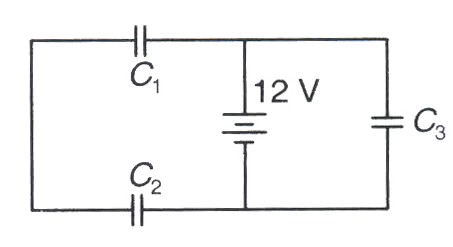
Three identical capacitors C1,C2 and C3 of capacitance \(6\mu F\) each are connected to a 12V battery as shown. Find charge on each capacitor
Find
(i) the charge on each capacitor
(ii) the equivalent capacitances of the network
(iii) the energy stored in the network of capacitors.
12.
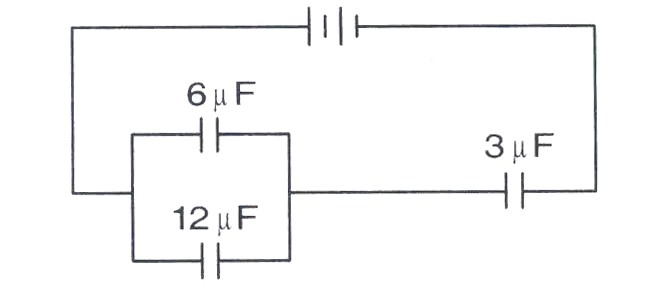
In the arrangement of capacitors shown here,the energy stored \(6\mu F\)capacitor is E. Find the following:
Energy stored in the \(12\mu F\) capacitor
Energy stored in the \(3\mu F\) capacitor
Total energy drawn from the battery.
13.
Work done in carrying an electron from A to B lying on an equipotential surface of one volt potential is
1 eV
10 eV
1 volt
Zero
14.
Electric field intensity (E) due to an electric dipole varies with distance (r) of the point from the centre of dipole as:
\(E\alpha {1\over r}\)
\(E\alpha{1\over r^4}\)
\(E\alpha{1\over r^2}\)
\(E\alpha {1\over r^3}\)
15.
Electric dipole moment is
scalar
neither scalar vector
a vector directed from -q to +q
a vector directed from +q to -q
16.
Electric field due to a single charge is
asymmetric
cylindrically symmetric
spherically symmetric
None of the above
17.
The SI unit of electric field intensity is
N
N/C
C/m2
N/m2
18.
During an endoscopic surgery, a surgeon sees the interior of a patient's body on the viewing screen of a video monitor. The surgeon continues to do the surgery with the help of other medical staff and one of the medical staff on noticing the surgeon's gloved fingers coming within a few centimetres of the screen while pointing to a particular part of the image, say to explain a surgical concern to other medical staff, asks the surgeon that whether his gloves would have got contaminated, the surgeon, answers him later, after the completion of the operation.
What is learnt from the above?
Can you find the bacterial source? If yes, name it.
Name the force which plays a role in bacterial contamination.
19.
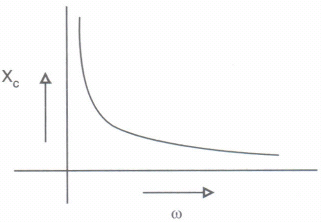
A dipole is made up of two charges + q and - q separated by a distance 2a. Derive an expression for the electric field E\(\overrightarrow{e}\) due to this dipole at a point distance r from the centre of the dipole on the equatorial plane. Draw the shape of the graph, between |Ee| and r when r > >a.
If this dipole were to be put in a uniform external electric field \(\overrightarrow{E}_e\) , obtain an expression for the torque acting on the dipole.
20.
As it is known that all matter is made up of atoms/ molecules. Every atom consists of a central core, called the atomic nucleus, around which negatively charged electrons revolve in circular orbits. Every atom is electrically neutral containing as many electrons as the number of protons in the nucleus. All the materials are electrically neutral, they contain charges, but their charges are exactly balanced.
Read the above passage and answer the following questions.
Everybody whether a conductor or an insulator is electrically neutral. Is it true?
Charging lies in charge imbalance, i.e. excess charge or deficit charge, comment.
How do you visualise this principle being applied in our daily life?
1.
\(0.1\mu C/m\)
2.
\(\frac { d }{ 1+\sqrt { 2 } } ,\frac { \sqrt { 2d } }{ 1+\sqrt { 2 } } \)
3.
\(45\times \)10-2 J
4.
(i) \({{10}^{-9}}C\)
(ii) r = 0.5 m
5.
\(4.5\times {{10}^{3}}V\)
6.
\(60\mu F\)
7.
(a) We know that the net field inside a charged conductor is zero i.e.
\(\overrightarrow { E } \) = 0, inside
Let us choose a gaussian surface lying wholly within the conductor and enclosing the cavity.
According to Gauss' law,
\(\oint \overrightarrow { E } .\overrightarrow { dS } =\frac { q }{ { \varepsilon }_{ 0 } } =0\) \((\because \overrightarrow { E } =0,inside)\)
\(\therefore \) q = 0 i.e. charge inside the cavity is zero. Hence the entire charge Q on the conductor must appear on the outer surface of the conductor.
(b) The conductor B carrying a charge + q inseted in the cavity induces a charge - q on the metal surface of cavity and + q on the outside surface of the conductor A [Fig (b)]. As the outer surface of A originally had a charge Q, the total charge on it would become (Q + q).
(c) To shift a sensitive instrument from the strong electrostatic fields in its environment, enclose the instrument fully by a metallic surface.
8.
Given \(\frac { dE }{ dz } ={ 10 }^{ 5 }{ NC }^{ -1 }\) per metre.
Electric dipole moment,
\(\overrightarrow { dp } =q\times \overrightarrow { dz } ={ 10 }^{ -7 }Cm\) along BA.
Let \(\overrightarrow { dE } \) is the increase in electric field in going from A to B.
Force on charge at A, \(\overrightarrow { { F }_{ A } } =+q\overrightarrow { E } \)
Force on charge at B, \(\overrightarrow { { F }_{ B } } =-q(\overrightarrow { E } +d\overrightarrow { E } )\)
Net force, \(\overrightarrow { F } =+q\overrightarrow { E } -(\overrightarrow { E } +\overrightarrow { dE } )\)
\(=q\overrightarrow { E } -q\overrightarrow { E } -q\overrightarrow { dE } \)
or \(\overrightarrow { F } =-q\overrightarrow { dE } \)
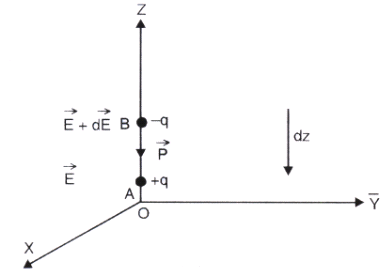
Magnitude of force, \(F=q\frac { dE }{ dz } .dz\)
\(=(qdz)\frac { dE }{ dz } ={ 10 }^{ -7 }\times { 10 }^{ 5 }\)
\(F={ 10 }^{ -2 }N\)
Net torque, \(\overrightarrow { \tau } =\overrightarrow { { r }_{ 1 } } \times \overrightarrow { { F }_{ 1 } } \times \overrightarrow { { r }_{ 2 } } \times \overrightarrow { { F }_{ 2 } } \)
where \(\overrightarrow { { r }_{ 1 } } \) and \(\overrightarrow { { r }_{ 2 } } \) are the position co-ordinates of two charges.
Now \(\overrightarrow { { r }_{ 1 } } ,\overrightarrow { { r }_{ 2 } } \) are in the same direction but \(\overrightarrow { { F }_{ 1 } } \) and \(\overrightarrow { { F }_{ 2 } } \) are in the opposite directions.
\(\left| \overrightarrow { { r }_{ 1 } } \times \overrightarrow { { F }_{ 1 } } \right| ={ r }_{ 1 }{ F }_{ 1 }\) sin \({ 0 }^{ o }={ r }_{ 1 }{ F }_{ 1 }\times 0=0\)
\(\left| \overrightarrow { { r }_{ 2 } } \times \overrightarrow { { F }_{ 2 } } \right| ={ r }_{ 2 }{ F }_{ 2 }\) sin \({ 180 }^{ o }={ r }_{ 2 }{ F }_{ 2 }\times 0=0\)
Hence torque \(\tau \) is zero.
9.
When a glass rod is rubbed with silk, the charges developed on the glass rod and the piece of silk are equal and opposite. Similar is the case in other pair of bodies. So electric charge can neither be produced nor destroyed but simply transferred from one body to another, hence is consistent with the law of conservation of charge.
10.
(a) Quantisation of charge: It is that property of charge by virtue of which charge on a body existst in the form of discrete packet of charge e, only, where e is the charge on an electron. The charge carried by anybody would be equal to \(\pm \) ne, where n = 0, 1, 2, 3, 4, 5, etc. THe charge on a body is thus some multiple of e and cannot exist as a fraction of e.
So charge exists in the form of packets and not in continuous amunts. Thus, charge is said to have a discrete (discontinuous) nature or is said to be quantised.
(b) At macroscopic level, we deal with charges that are enormous as compared to the magnitude of minimum charge i.e. e (1.6 \(\times\) 10-19 C).
In this case, the increase and decrease in units of e is not very different from saying that charges are continuous. So at macroscopic level we can ignore quantisation of electric charge.
11.
(i) The equivalent capacitance of C1 and C2 connected in series
\(\frac { 1 }{ C' } =\frac { 1 }{ { C }_{ 1 } } +\frac { 1 }{ { C }_{ 2 } } \)
\(\Rightarrow C'=\frac { 6 }{ 2n } =3\mu F\)
∴ Charge, q' = C'V = (3μF)12 = 36μF
∴ Charge on each capadtor of C1 and C2 is 36 μC
∴ Charge on C3,
q3 = C3V = (6μF) x 12 = 72μC
q3 = 72μC
(ii) Equivalent capacitance of network,
\({ C }_{ eq }=\frac { { C }_{ 1 }{ C }_{ 2 } }{ { C }_{ 1 }+{ C }_{ 2 } } +{ C }_{ 3 }\)
\(=\frac { 6\times 6 }{ 6+6 } +6\)
= 3 + 6 = 9μF
Ceq = 9μF
(iii) Energy stored in the network of capacitors
U = U1 + U2 + U3 = \(\frac { { q' }^{ 2 } }{ { 2C }_{ 1 } } +\frac { { q }'^{ 2 } }{ { 2C }_{ 2 } } +\frac { { q }^{ 2 } }{ { 2C }_{ 3 } } \)
∵ C1 = C2 = C3 = 6μF
\(\therefore U=\frac { 1 }{ (12\mu F) } [{ q' }^{ 2 }+{ q' }^{ 2 }+{ q }^{ 2 }]\)
\(=\frac { 1 }{ (12\mu F) } [({ 36\mu C) }^{ 2 }+({ 36\mu C) }^{ 2 }+({ 72\mu C) }^{ 2 }]\)
\(U=648\mu J\)
12.
Energy stored in 6 μF capacitor = E
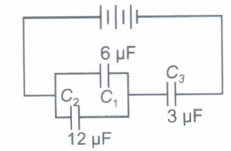
\( \therefore \ \frac{1}{2} C_{1} V_{1}^{2}=E \Rightarrow V_{1}^{2}=\frac{2 E}{C_{1}}=\frac{E}{3} \)
\(\because C_{1} \text { and } C_{2} \text { are in parallel, } \therefore V_{1}^{2}=V_{2}^{2}=\frac{E}{3} \)
Now, \(C_{12}=6+12=18 \mu \mathrm{F}\)
\( \therefore \text { Charge on } C_{12}=q_{12}=C_{12} . V_{12}=18 \times \sqrt{\frac{E}{3}} \)
\(\therefore \text { Charge on } C_{3}=q_{12}=18 \sqrt{\frac{E}{3}} \)
(a) Now, energy stored in 12 μF capacitor
\(=\frac{1}{2} C_{2} V_{1}^{2}=\frac{1}{2} \times 12 \times \frac{E}{3}=2 E\)
(b) Energy stored in 3 μF capacitor
\(=\frac{q_{3}^{2}}{2 C_{3}}=\frac{1}{2} \times\left(\frac{18}{3}\right)^{2} E=18 E\)
\((c) \because C_{e q}=\left(\frac{18 \times 3}{18+3}\right) \mu \mathrm{F}=\frac{18}{7} \mu \mathrm{F}, Q=18 \sqrt{\frac{E}{3}}\)
Energy drawn from the battery,
\(U=\frac{Q^{2}}{2 C_{e q}}=\frac{18 \times 18 \times E \times 7}{3 \times 18}=42 E\)
13.
(d)
Zero
14.
(d)
\(E\alpha {1\over r^3}\)
15.
(c)
a vector directed from -q to +q
16.
(c)
spherically symmetric
17.
(b)
N/C
18.
Concentration & involvement in the work by the doctor, reply by the doctor answering the querry without forgetting, observation of the medical attendant.
Yes, charge.
Electrostatic force.
19.
The magnitudes of the electric fields due to the two charges + q and - q are given by
\(E_{+q} = \frac{q}{4\pi\epsilon_0}\frac{1}{r^2+2a^2}\)
\(E_{-q} = \frac{q}{4\pi\epsilon_0}\frac{1}{r^2+2a^2}\)
and both are equal The directions of E+q and E-q are as shown in fig. Clearly, the components normal to the dipole axis cancel away. The components along the dipole axis add up. The total electric field is opposite to \(\hat{p}\) . We have
E = - (E+q+ E-q) cos \(\theta\) \(\hat{p}\)
\(= \frac{-2qa}{4\pi\epsilon_0(r^2+a^2)^\frac{3}{2}} \hat{p}\)
At large diatances (r > > a), this reduces to
\(= \frac{-2qa}{4\pi\epsilon_0(r^3)} \hat{p}\) (r > > a)
Thus, the graph takes the form as shown below:
.png)
Electric dipole of charges +q and -q separated by distance 2a is shown in figure. It is placed in uniform electric field at an angle \(\theta\) with it.
.png)
Torque on dipole= force x perpendicular distance
= qE x 2a sin\(\theta\)
= 2 qa E sin \(\theta\)
= pEsin \(\theta\)
\(\overrightarrow\tau = \overrightarrow{p}\times\overrightarrow{E}\)
20.
Yes, it is true. Every conductor/insulator is electrically neutral, as it contains equal amounts of positive charge and negative charge.
This statement is true. Charging lies in charge imbalance. When a body loses some electrons, it becomes positively charged because it has excess of protons over electrons. The reverse is also true.
Nature/God has created the universe. In original, all bodies are neutral with no forces of attraction/repulsion. When interests of any two persons clash (i.e. two bodies are rubbed against each other), they become charged. From the charging, the forces of attraction/repulsion arises, i.e. pulls and pressures of life.
Nature/God wants us to live in peace without stress and tensions in life. We get charged over petty things in life and invite all sorts of pulls, pressures and tensions.

12th Standard CBSE Syllabus & Materials
12th Standard CBSE
CBSE 12th Computer Science Python Revision Tour I - New Previous year Question Papers Study Material - QB365 Set A
NEW12th Standard CBSE
CBSE 12th Business Studies Planning Important Questions And Answers Study Material - QB365 Set A
NEW12th Standard CBSE
CBSE 12th Business Studies Business Environment Important Questions And Answers Study Material - QB365 Set A
NEW12th Standard CBSE
CBSE 12th Business Studies Principles of Management Important Questions And Answers Study Material - QB365 Set A



NCERT Books

Syllabus

Exam Pattern

Sample Question Papers

Previous year Question Papers

Important Notes

MCQ Practice test

NCERT Exemplers

Case study Questions

Image Based Questions

Passage based Questions

HOT Questions

Value Based Questions

Model Questions Papers
NCERT ( Book Back ) Questions

Assertion and Reason
Important Questions And Answers

CBSE 12th Standard CBSE Subjects
CBSE Standards








