
 100% FREE ACCESS
12th Standard CBSE Syllabus & Materials
12th Standard CBSE
CBSE 12th Economics Government Budget and the Economy Previous year Question Papers Study Material - QB365 Set A
NEW12th Standard CBSE
CBSE 12th Computer Science Interface Python with MySQL - New Previous year Question Papers Study Material - QB365 Set A
NEW12th Standard CBSE
CBSE 12th Computer Science Database Concept - New Previous year Question Papers Study Material - QB365 Set A
NEW12th Standard CBSE
CBSE 12th Computer Science Data Communication - New Previous year Question Papers Study Material - QB365 Set A
NEW12th Standard CBSE
CBSE 12th Computer Science Data Structures - New Previous year Question Papers Study Material - QB365 Set A
NEW12th Standard CBSE
CBSE 12th Computer Science Functions - New Previous year Question Papers Study Material - QB365 Set A

Published on: 02/11/2025
Download CBSE Class 12th Standard CBSE Physics question papers, sample papers, important questions, and previous year solved papers in PDF format. Get free study materials, NCERT solutions, and exam preparation resources for Class 12th Standard CBSE Physics
Questions + Answers key
Take MCQ Physics Test
1.
A coil of N turns is placed in a magnetic field B such that B is perpendicular to the plane of the coil. B changes with time as B = B0 cos\(\left(\frac{2 \pi}{T} t\right)\) , where T is time period. The magnitude of emf induced in the coil will be maximum at
Here, n = 1, 2, 3, 4, ...
\(t=\frac{n T}{8}\)
\(t=\frac{n T}{4}\)
\(t=\frac{n T}{2}\)
No option is correct.
2.
For a cell, the graph between the potential difference (V) across the terminals of the cell and the current (I) drawn from the cell is shown in the figure.
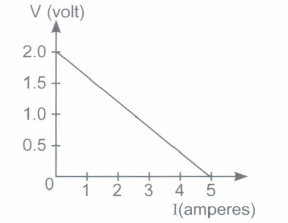
\(2 \mathrm{~V}, 0.5 \Omega\)
\(2 \mathrm{~V}, 0.4 \Omega\)
\(>2 \mathbf{V}, \mathbf{0 . 5} \Omega\)
\(>2 \mathbf{V}, \mathbf{0 . 4} \Omega\)
3.
Which of the following statement is correct? \(\int E \cdot d s=0\) over a surface, then
the electric field inside the surface and on it is zero.
the electric field inside the surface is necessarily uniform.
the number of flux lines entering the surface must be equal to the number of flux lines leaving it.
all charges must not necessarily be outside the surface.
4.
Two parallel wires are placed 1m apart and 1A and 3 A currents are flowing in the wires in opposite direction. The force acting per unit length of both the wires will be
6 x10⁻⁷ N / m attractive
6 x10⁻⁵ N /m attractive
6 x10⁻⁷ N / m repulsive
6 x10⁻⁵ N / m repulsive
5.
Twenty million electrons reaches from point X to point Y in two micro second as shown in the figure. Direction and magnitude of the current is
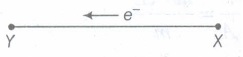
1.5 x 10⁻¹⁰ A from X to Y
1.6 x 10⁻⁶ A from Y to X
1.5 x 10⁻¹³ A from Y to X
1.6 x 10⁻⁴ A from X to Y
6.
For a given surface, the \(\oint \mathbf{E} \cdot d \mathbf{S}=0\) From this, we can conclude that
E is necessarily zero on the surface.
E is perpendicular to the surface at every point
the total flux through the surfaceis zero
the flux is only going out of the surface
7.
2The figure shows electric field fines.The electric field strength at p1 is E1 and that at p2 is E2 If P1 P2 is r, then which of the following statement is true?
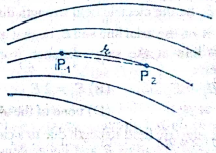
E2 > E1
E2 < E1
E2 = E1/r2
E2 = r2E1
8.
A charge q is placed at the mid point of the line joining two similar and equal charges each equal to + 2μ C. The system will be in equilibrium if q =
-0.5μ C
-1.0μ C
+1.0μ C
+0.5μ C
9.
Four wires each of same length, diameter and material are connected to each other to form a square. If the resistance of each wire is R, then equivalent resistance across the opposite corners is:
R/4
R/2
R
none of the above
10.
Assertion : In series combination of electrical bulbs of lower power emits more light than that of higher power bulb.
Reason : The lower power bulb in series gets more current than the higher power bulb.
Codes:
(A) If both Assertion & Reason are true & the Reason is a correct explanation of the Assertion.
(B) If both Assertion and Reason are true but Reason is not a correct explanation of the Assertion.
(C) If Assertion is true but the Reason is false
(D) If Assertion & Reason both are false.
11.
12.
Assertion : The tyres of aircraft are slightly conducting.
Reason : If a conductor is connected to ground, the extra charge induced on conductor will flow to ground.
Codes:
(a) Both Assertion and Reason are correct and the Reason is a correct explanation of the Assertion.
(b) Both Assertion and Reason are correct but Reason is not a correct explanation of the Assertion.
(c) Assertion is correct, Reason is incorrect
(d) Both Assertion and Reason are correct.
13.
14.
Assertion (A) : When current is represented by a straight line, the magnetic field will be circular.
Reason (R) : According to Fleming's left hand rule, direction of force is parallel to the magnetic field
Codes:
(a) Both A and R are true and R is the correct explanation of A
(b) Both A and R are true but R is NOT the correct explanation of A
(c) A is true but R is false
(d) A is false and R is also false
15.
Assertion (A) : There is a spark in the switch when the switch is closed
Reason (R) : Current flowing in the conductor produces magnetic field.
Codes:
(a) Both A and R are true and R is the correct explanation of A
(b) Both A and R are true but R is NOT the correct explanation of A
(c) A is true but R is false
(d) A is false and R is also false
16.
Assertion: Two bulbs of same wattage, one having a carbon filament and the other having a metallic filament are connected in series. Metallic bulbs will glow more brightly than carbon filament bulb.
Reason: Carbon is a semiconductor.
Codes:
(a) Both A and R are true and R is the correct explanation of A
(b) Both A and R are true but R is NOT the correct explanation of A
(c) A is true but R is false
(d) A is false and R is also false
17.
Assertion (A) : Charge on all the condensers connected in series is the same.
Reason (R) : Capacitance of capacitor is directly proportional to charge on it.
Codes:
(a) Both A and R are true and R is the correct explanation of A
(b) Both A and R are true but R is NOT the correct explanation of A
(c) A is true but R is false
(d) A is false and R is also false
18.
Assertion (A) : A capacitor is connected to a battery. If we move its plate further apart, work will be done against the electrostatic attraction between the plates and the energy of the capacitor gets decreased.
Reason (R) : The energy stored in capacitor is dissipated in the form of heat energy.
Codes:
(a) Both A and R are true and R is the correct explanation of A
(b) Both A and R are true but R is NOT the correct explanation of A
(c) A is true but R is false
(d) A is false and R is also false
19.
Assertion (A) : If a conducting medium is placed between two charges, then electric force between them becomes zero.
Reason (R) : Reduction in a force due to introduced material is inversely proportional to its dielectric constant.
Codes:
(a) Both A and R are true and R is the correct explanation of A
(b) Both A and R are true but R is NOT the correct explanation of A
(c) A is true but R is false
(d) A is false and R is also false
20.
When electric dipole is placed in uniform electric field, its two charges experience equal and opposite forces, which cancel each other and hence net force on electric dipole in uniform electric field is zero. However these forces are not collinear, so they give rise to some torque on the dipole. Since net force on electric dipole in uniform electric field is zero, so no work is done in moving the electric dipole in uniform electric field. However some work is done in rotating the dipole against the torque acting on it.
(i) The dipole moment of a dipole in a uniform external field Ē is B. Then the torque τ acting on the dipole is
(a) τ=p x E
(b) τ = P. Ē
(c) τ = 2(p + Ē)
(d) τ = (P + E)
(ii) An electric dipole consists of two opposite charges, each of magnitude 1.0 μC separated by a distance of 2.0 cm. The dipole is placed in an external field of 105 NC-1. The maximum torque on the dipole is
(a) 0.2 x 10⁻³ Nm
(b) 1x 10⁻³ Nm
(c) 2 x 10⁻³ Nm
(d) 4x 10⁻³ Nm
(iii) Torque on a dipole in uniform electric field is minimum when θ is equal to
(a) 0°
(b) 90°
(c) 180°
(d) Both (a) and (c)
(iv) When an electric dipole is held at an angle in a uniform electric field, the net force F and torque τ on the dipole are
(a) F= 0, τ = 0
(b) F≠0, τ≠0
(c) F=0, τ ≠ 0
(d) F≠0, τ=0
(v) An electric dipole of moment p is placed in an electric field of intensity E. The dipole acquires a position such that the axis of the dipole makes an angle with the direction of the field. Assuming that potential energy of the dipole to be zero when 0 = 90°, the torque and the potential energy of the dipole will respectively be
(a) pEsinθ, -pEcosθ
(b) pEsinθ, -2pEcosθ
(c) pEsinθ, 2pEcosθ
(d) pEcosθ, – pEsinθ
21.
Its working is based on the fact that when a current carrying coil is placed in a magnetic field, it experiences a torque. This torque tends to rotate the coil about its axis of suspension in such a way that the magnetic flux passing through the coil is maximum.
(i) A moving coil galvanometer is an instrument which
(a) is used to measure emf
(b) is used to measure potential difference
(c) is used to measure resistance
(d) is a deflection instrument which gives a deflection when a current flows through its coil
(ii) To make the field radial in a moving coil galvanometer.
(a) number of turns of coil is kept small
(b) magnet is taken in the form of horse-shoe
(c) poles are of very strong magnets
(d) poles are cylindrically cut
(iii) The deflection in a moving coil galvanometer is
(a) directly proportional to torsional constant of spring
(b) directly proportional to the number of turns in the coil
(c) inversely proportional to the area of the coil
(d) inversely proportional to the current in the coil
(iv) In a moving coil galvanometer, having a coil of N-turns of area A and carrying current I is placed in a radial field of strength B.
The torque acting on the coil is
(a) NA2B2I
(b) NABI2
(c) N2ABI
(d) NABI
(v) To increase the current sensitivity of a moving coil galvanometer, we should decrease
(a) strength of magnet
(b) torsional constant of spring
(c) number of turns in coil
(d) area of coil
22.
Metals have a large number of free electrons nearly 1028 per cubic metre. In the absence of electric field, average terminal speed of the electrons in random motion at room temperature is of the order of 105 m s-1 When a potential difference V is applied across the two ends of a given conductor, the free electrons in the conductor experiences a force and are accelerated towards the positive end of the conductor. On their way, they suffer frequent collisions with the ions/atoms of the conductor and lose their gained kinetic energy. After each collision, the free electrons are again accelerated due to electric field, towards the positive end of the conductor and lose their gained kinetic energy in the next collision with the ions/atoms of the conductor. The average speed of the free electrons with which they drift towards the positive end of the conductor under the effect of applied electric field is called drift speed of the electrons.
(i) Magnitude of drift velocity per unit electric field is
| (a) current density | (b) current | (c) resistivity | (d) mobility |
(ii) The drift speed of the electrons depends on
| (a) dimensions of the conductor |
| (b) number density of free electrons in the conductor |
| (c) both (a) and (b) |
| (d) neither (a) nor (b) |
(iii) We are able to obtain fairly large currents in a conductor because
| (a) the electron drift speed is usually very large |
| (b) the number density of free electrons is very high and this can compensate for the low values of the 6 electron drift speed and he very small magnitude of the electron charge |
| (c) the number density of free electrons as well as the electron drift speeds are very large and these compensate for the very small magnitude of the electron charge |
| (d) the very small magnitude of the electron charge has to be divided by the still smaller product of the number density and drift speed to get the electric current |
(iv) Drift speed of electrons in a conductor is very small i.e., i = 10-4 m s-1. The Electric bulb glows immediately. When the switch is closed because
| (a) drift velocity of electron increases when switch is closed |
| (b) electrons are accelerated towards the negative end of the conductor |
| (c) the drifting of electrons takes place at the entire length of the conductor |
| (d) the electrons of conductor move towards the positive end and protons of conductor move towards negative end of the conductor |
(v) The number density offree electrons in a copper conductor is 8.5 x 1028 m-3. How long does an electron take to drift from one end of a wire 3.0 m long to its other end? The area of cross-section of the wire is 2.0 x 10⁻⁶m2 and it is carrying a current of 3.0 A.
| (a) 8.1 x 10⁴ s | (b) 2.7 x 10⁴ s | (c) 9 x 10³ s | (d) 3 x 10³ S |
23.
This energy possessed by a system of charges by virtue of their positions. When two like charges lie infinite distance apart, their potential energy is zero because no work has to be done in moving one charge at infinite distance from the other.
In carrying a charge q from point A to point B, work done \(W=q\left(V_{A}-V_{B}\right)\). This work may appear as change in KE/PE of the charge. The potential energy of two charges q1 and q2 at a distance r in air is \(\frac{q_{1} q_{2}}{4 \pi \varepsilon_{0} r}\). It is measured in joule. It may be positive, negative or zero depending on the signs of ql and q2.
(i) Calculate work done in separating two electrons form a distance of 1m to 2m in air, where e is electric charge and k is electrostatic force constant.
| (a) ke2 | (b) e2/2 | (c) -ke2/2 | (d) zero |
(ii) Four equal charges q each are placed at four corners of a square of side a each. Work done in carrying a charge -q from its centre to infinity is
| (a) zero | \(\text { (b) } \frac{\sqrt{2} q^{2}}{\pi \varepsilon_{0} a}\) | \(\text { (c) } \frac{\sqrt{2} q}{\pi \varepsilon_{0} a}\) | \(\text { (d) } \frac{q^{2}}{\pi \varepsilon_{0} a}\) |
(iii) Two points A and B are located in diametrically opposite directions of a point charge of +2 \(\mu \mathrm{C}\) at distances 2 m and 1 m respectively from it. The potential difference between A and B is
| (a) 3 x 10³ V | (b) 6 x 10⁴ V | (c) -9 X 10³ V | (d) -3 x 10³ V |
(iv) Two point charges A = +3 nC and B = +1 nC are placed 5 ern apart in air. The work done to move charge B towards A by 1 cm is
| (a) 2.0 x 10⁻⁷ J | (b) 1.35 x 10⁻⁷ J | (c) 2.7 X 10⁻⁷ J | (d) 12.1 x 10⁻⁷ J |
(v) A charge Q is placed at the origin. The electric potential due to this charge at a given point in space is V. The work done by an external force in bringing another charge q from infinity up to the point is
| \(\text { (a) } \frac{V}{q}\) | (b) Vq | (c) V + q | (d) V |
1.
(d)
No option is correct.
2.
(b)
\(2 \mathrm{~V}, 0.4 \Omega\)
3.
(c)
the number of flux lines entering the surface must be equal to the number of flux lines leaving it.
4.
(c)
6 x10⁻⁷ N / m repulsive
5.
(b)
1.6 x 10⁻⁶ A from Y to X
6.
(c)
the total flux through the surfaceis zero
7.
(b)
E2 < E1
8.
(a)
-0.5μ C
9.
(d)
none of the above
10.
(C) If Assertion is true but the Reason is false
11.
12.
(b) Both Assertion and Reason are correct but Reason is not a correct explanation of the Assertion.
13.
14.
(c): When current is straight, it means the current is passing through a straight conductor, the magnetic field produced due to current through a straight conductor is in the form of concentric circular magnetic lines of force whose centres lie on the linear conductor and are in a plane perpendicular to the plane of linear conductor. It means the magnetic field is circular.
15.
(b) Both A and R are true but R is NOT the correct explanation of A
16.
(d): When two bulbs are connected in series, the resistance of the circuit increases and so the voltage in each decreases, hence the brightness and the temperature also decreases. Due to decrease in temperature, the resistance of the carbon filament will slightly increase while that of metal filament will decrease. Hence, carbon filament bulb will glow more brightly (P = i2R). Also carbon is not a semiconductor
17.
(c): Let twp capacitors be connected in series. If +q charge is installed on left plate of the first capacitor then -q charge is induced on right plate of this capacitor. This charge comes from electron draw from the left plate of second capacitor. Thus there will be equal charge +q on the left plate of second capacitor and -q charge induced on the right plate of second capacitor. Thus each capacitor has same charge -(q) when connected in series. Capacitance is quantity dependent on construction of capacitor and independent of charge.
18.
(b): When the plates of a capacitor are moved further apart, the capacitance gets decreased. As battery remains connected, hence charge q(= CV) on the plates is decreased and energy \(U=\left[1 / 2 C V^{2}\right]\).also decreases. Some charge from the plates flows to the battery i.e. some energy of capacitor is transferred to the battery. Work done against electrostatic attraction between plates is used in the transference of energy and is dissipated in the form of heat energy in connection wires.
19.
(a): The dielectric constant of any material is \(K=\frac{E_{0}}{E}=\frac{F_{0} / q}{F / q}=\frac{F_{0}}{F} \Rightarrow H=\frac{F_{0}}{K}\) where Fo is force when conductor is not present between the charge. F is a force after introduction of conductor between charges. Since dielectric constant of a conducting medium is infinity therefore F = O.
20.
21.
(i) (d) is a deflection instrument which gives a deflection when a current flows through its coil
(ii) (d) poles are cylindrically cut
(iii)(b) directly proportional to the number of turns in the coil
(iv)(d) NABI
(v) (b) torsional constant of spring
22.
(i) (d): Mobility is defined as the magnitude of drift velocity per unit electric field
Mobility, \(\mu=\frac{\left|v_{d}\right|}{E}\)
(ii) (c): Drift velocity \(v_{d}=\frac{I}{n e A}\)
where the symbols have their usual meanings
(iii) (b): I = neAvd
vd is of order offew m S-I, e = 1.6 x 10⁻¹⁹ C,
A is of the order of mm2, so a large I is due to a large value of n in conductors.
(iv) (c): When we close the circuit, an electric field is established instantly with the speed of electromagnetic wave which causes electrons to drift at every portion of the circuit, due to which the current is set up in the entire circuit instantly. The current which is set up does not wait for electrons to flow from one end of the conductor to another. Thus, the electric bulb glows immediately when switch is closed.
(v) (b): Here,
Number density of free electrons, n = 8.5 x 1028 m-3
Area of cross-section of a wire, A = 2.0 x 10⁻⁶ m2
Length of the wire, 1= 3.0 m
Current, I = 3.0 A
The drift velocity of an electron is \(v_{d}=\frac{I}{n e A}\) ...(i)
The time taken by the electron to drift from one end to other end of the wire is
\(t=\frac{l}{v_{d}}=\frac{\ln e A}{I}\)
\(=\frac{(3.0 \mathrm{~m})\left(8.5 \times 10^{28} \mathrm{~m}^{-3}\right)\left(1.6 \times 10^{-19} \mathrm{C}\right)\left(2.0 \times 10^{-6} \mathrm{~m}^{2}\right)}{(3.0 \mathrm{~A})}\)
= 2.7 x 10⁴ s
23.
(i) (c): \(W=(\text { P.E. })_{\text {final }}-(\text { P.E. })_{\text {initial }}\)
\(=\frac{k e^{2}}{2}-\frac{k e^{2}}{1}=\frac{-k e^{2}}{2}\)
(ii) (b) : Potential at the centre of the square due to four equal charges q at four corners
\(V=\frac{4 q}{4 \pi \varepsilon_{0}(a \sqrt{2}) / 2}=\frac{\sqrt{2} q}{\pi \varepsilon_{0} a}\)
\(W_{0 \rightarrow \infty}=-W_{\infty \rightarrow 0}=-(-q) V=\frac{\sqrt{2} q^{2}}{\pi \varepsilon_{0} a}\)
(iii) (c): Here, \(q=2 \mu \mathrm{C}=2 \times 10^{-6} \mathrm{C}, r_{A}=2 \mathrm{~m}, r_{B}=1 \mathrm{~m}\)
\(\therefore \ V_{A}-V_{B}=\frac{q}{4 \pi \varepsilon_{0}}\left[\frac{1}{r_{A}}-\frac{1}{r_{B}}\right]\)
\(=2 \times 10^{-6} \times 9 \times 10^{9}\left[\frac{1}{2}-\frac{1}{1}\right] \mathrm{V}=-9 \times 10^{3} \mathrm{~V}\)
(iv)(b) : Required work done = Change in potential energy of the system
\(W=U_{f}-U_{i}=k \frac{q_{1} q_{2}}{r_{f}}-k \frac{q_{1} q_{2}}{r_{i}}=k q_{1} q_{2}\left[\frac{1}{r_{f}}-\frac{1}{r_{i}}\right]\)
\(\therefore \ W=\left(9 \times 10^{9}\right)\left(3 \times 10^{-9} \times 1 \times 10^{-9}\right)\) \(\times\left[\frac{1}{4 \times 10^{-2}}-\frac{1}{5 \times 10^{-2}}\right]\)
\(=27 \times 10^{-7} \times(0.05)=1.35 \times 10^{-7} \mathrm{~J}\)
(v) (b)

12th Standard CBSE Syllabus & Materials
12th Standard CBSE
CBSE 12th Computer Science Python Revision Tour I - New Previous year Question Papers Study Material - QB365 Set A
NEW12th Standard CBSE
CBSE 12th Business Studies Planning Important Questions And Answers Study Material - QB365 Set A
NEW12th Standard CBSE
CBSE 12th Business Studies Business Environment Important Questions And Answers Study Material - QB365 Set A
NEW12th Standard CBSE
CBSE 12th Business Studies Principles of Management Important Questions And Answers Study Material - QB365 Set A



NCERT Books

Syllabus

Exam Pattern

Sample Question Papers

Previous year Question Papers

Important Notes

MCQ Practice test

NCERT Exemplers

Case study Questions

Image Based Questions

Passage based Questions

HOT Questions

Value Based Questions

Model Questions Papers
NCERT ( Book Back ) Questions

Assertion and Reason
Important Questions And Answers

CBSE 12th Standard CBSE Subjects
CBSE Standards








