
 100% FREE ACCESS
12th Standard CBSE Syllabus & Materials
12th Standard CBSE
CBSE 12th Economics Government Budget and the Economy Previous year Question Papers Study Material - QB365 Set A
NEW12th Standard CBSE
CBSE 12th Computer Science Interface Python with MySQL - New Previous year Question Papers Study Material - QB365 Set A
NEW12th Standard CBSE
CBSE 12th Computer Science Database Concept - New Previous year Question Papers Study Material - QB365 Set A
NEW12th Standard CBSE
CBSE 12th Computer Science Data Communication - New Previous year Question Papers Study Material - QB365 Set A
NEW12th Standard CBSE
CBSE 12th Computer Science Data Structures - New Previous year Question Papers Study Material - QB365 Set A
NEW12th Standard CBSE
CBSE 12th Computer Science Functions - New Previous year Question Papers Study Material - QB365 Set A

Published on: 07/03/2026
Download CBSE Class 12th Standard CBSE Physics question papers, sample papers, important questions, and previous year solved papers in PDF format. Get free study materials, NCERT solutions, and exam preparation resources for Class 12th Standard CBSE Physics
Questions + Answers key
Take MCQ Physics Test
1.
(a) A comb run through one’s dry hair attracts small bits of paper. Why?
What happens if the hair is wet or if it is a rainy day? (Remember, a paper does not conduct electricity.)
(b) Ordinary rubber is an insulator. But special rubber tyres of aircraft are made slightly conducting. Why is this necessary?
(c) Vehicles carrying inflammable materials usually have metallic ropes touching the ground during motion. Why?
(d) A bird perches on a bare high power line, and nothing happens to the bird. A man standing on the ground touches the same line and gets a fatal shock. Why?
2.
(a) Determine the electrostatic potential energy of a system consisting of two charges 7 μC and –2 μC (and with no external field) placed at (–9 cm, 0, 0) and (9 cm, 0, 0) respectively.
(b) How much work is required to separate the two charges infinitely away from each other?
(c) Suppose that the same system of charges is now placed in an external electric field E = A (1/r 2); A = 9 x 10⁵ NC-1 m2. What would the electrostatic energy of the configuration be?
3.
Figures (a) and (b) show the field lines of a positive and negative point charge respectively
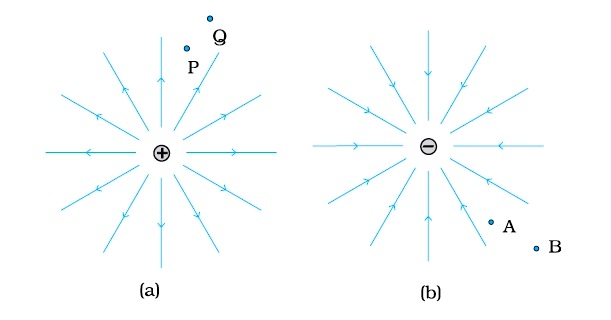
(a) Give the signs of the potential difference VP – VQ; VB – VA.
(b) Give the sign of the potential energy difference of a small negative charge between the points Q and P; A and B.
(c) Give the sign of the work done by the field in moving a small positive charge from Q to P.
(d) Give the sign of the work done by the external agency in moving a small negative charge from B to A.
(e) Does the kinetic energy of a small negative charge increase or decrease in going from B to A?
4.
A regular hexagon of side 10 cm has a charge 5\(\mu\) C at each of its vertices. Calculate the potential at the centre of the hexagon.
5.
Two charges 5 x 10⁻⁸ C and –3 x 10⁻⁸ C are located 16 cm apart. At what point(s) on the line joining the two charges is the electric potential zero? Take the potential at infinity to be zero.
6.
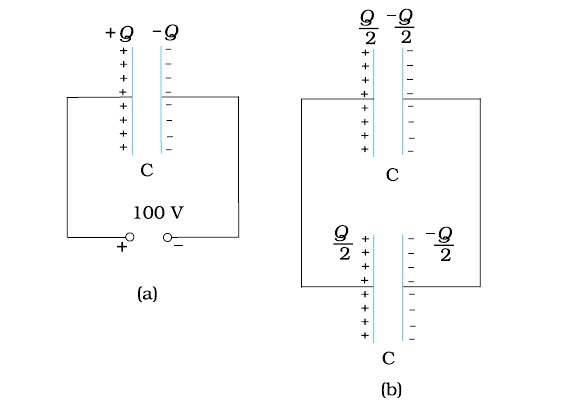
(a) A 900 pF capacitor is charged by 100 V battery [Fig(a)]. How much electrostatic energy is stored by the capacitor?
(b) The capacitor is disconnected from the battery and connected to another 900 pF capacitor [Fig.b)]. What is the electrostatic energy stored by the system?
7.
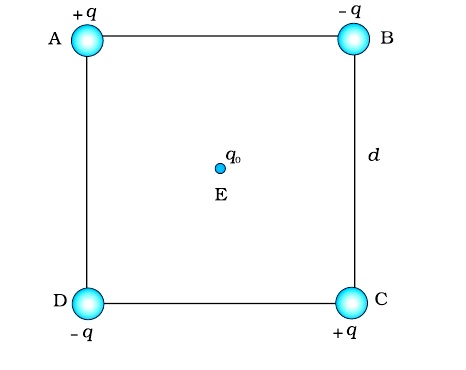
Four charges are arranged at the corners of a square ABCD of side d, as shown in Fig.
(a) Find the work required to put together this arrangement.
(b) A charge q0 is brought to the centre E of the square, the four charges being held fixed at its corners. How much extra work is needed to do this?
8.
Two charges 3 x 10⁻⁸ C and –2 x 10⁻⁸ C are located 15 cm apart. At what point on the line joining the two charges is the electric potential zero? Take the potential at infinity to be zero.
9.
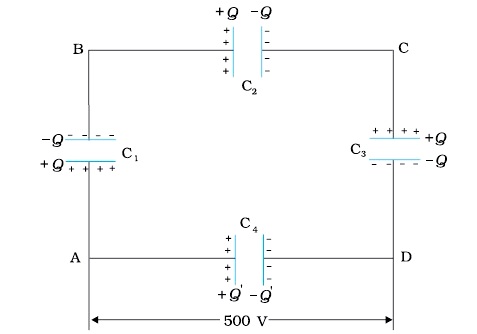
A network of four 10 μF capacitors is connected to a 500 V supply, as shown in Fig. Determine
(a) the equivalent capacitance of the network and
(b) the charge on each capacitor.
(Note, the charge on a capacitor is the charge on the plate with higher potential, equal and opposite to the charge on the plate with lower potential)
10.
(a) calculate the potential at a point P due to a charge of \(4\times 10^{-7}C\) located 9 cm away.
(b) Hence obtain the work done in bringing a charge of \(2\times 10^{-9}C\) from infinity to the point P. Does the answer depend on the path along which the charge is brought?
11.
A 600 pF capacitor is charged by a 200 V supply. It is then disconnected from the supply and is connected to another uncharged 600 pF capacitor. How much electrostatic energy is lost in the process?
12.
Explain what would happen if in the capacitor given in exercise 2.8, a 3mm thick mica sheet were inserted between the plates.
(a) While the voltage supply remained connected.
(b) After the supply was disconnected.
13.
Three capacitors of capacitance 2pF, 3pF and 4pF are connected in parallel.
(a) What is the total capacitance of the combination?
(b) Determine the charge on each capacitor, if the combination is connected to a 100 V supply.
14.
A parallel plate capacitor with air between the plates has a capacitance of 8 pF (1pF = 10-12F). What will be the capacitance if the distance between the plates is reduced by half, and the space between them is filled with a substance of dielectric constant 6?
15.
A spherical conductor of radius 12 cm has a charge of 1.6 \(\times\)10 7C distributed uniformly on its surface. What is the electric field.
(a) inside the sphere
(b) just outside the sphere
(c) at point 18 cm from the centre of the sphere?
16.
Two charges 2 μC and –2 μC are placed at points A and B 6 cm apart.
(a) Identify an equipotential surface of the system.
(b) What is the direction of the electric field at every point on this surface?
17.
A 12pF capacitor is connected to a 50V battery. How much electrostatic energy is stored in the capacitor?
18.
In a parallel plate capacitor with air between the plates, each plate has an area of 6\(\times\)10-3m2 and the distance between the plates is 3 mm. Calculate the capacitance if this capacitor. If this capacitor is connected to a 100 V supply, what is the charge on each plate of the capacitor?
19.
Three capacitors each of capacitance 9 pF are connected in series.
(a) What is the total capacitance of the combination?
(b) What is the potential difference across each capacitor, if the combination is connected to a 120 V supply?
1.
(a) This is because the comb gets charged by friction. The molecules in the paper gets polarised by the charged comb, resulting in a net force of attraction. If the hair is wet, or if it is rainy day, friction between hair and the comb reduces. The comb does not get charged and thus it will not attract small bits of paper.
(b) To enable them to conduct charge (produced by friction) to the ground; as too much of static electricity accumulated may result in spark and result in fire.
(c) Reason similar to (b).
(d) Current passes only when there is difference in potential
2.
(a) \(U=\frac{1}{4 \pi \varepsilon_{0}} \frac{q_{1} q_{2}}{r}=9 \times 10^{9} \times \frac{7 \times(-2) \times 10^{-12}}{0.18}=-0.7 \mathrm{~J}\)
(b) W = U2 – U1 = 0 – U = 0 – (–0.7) = 0.7 J.
(c) The mutual interaction energy of the two charges remains unchanged. In addition, there is the energy of interaction of the two charges with the external electric field. We find
\(q_{1} V\left(\mathbf{r}_{1}\right)+q_{2} V\left(\mathbf{r}_{2}\right)=A \frac{7 \mu \mathrm{C}}{0.09 \mathrm{~m}}+A \frac{-2 \mu \mathrm{C}}{0.09 \mathrm{~m}}\)
and the net electrostatic energy is
\(q_{1} V\left(\mathbf{r}_{1}\right)+q_{2} V\left(\mathbf{r}_{2}\right)+\frac{q_{1} q_{2}}{4 \pi \varepsilon_{0} r_{12}}=A \frac{7 \mu C}{0.09 m}+A \frac{-2 \mu C}{0.09 m}-0.7 \mathrm{~J}\)
= 70 − 20 − 0.7 = 49.3 J
3.
(a) As \(V \propto \frac{1}{r}, V_{P}>V_{Q^{}}\) Thus, (VP – VQ) is positive. Also VB is less negative than VA . Thus, VB > VA or (VB – VA) is positive.
(b) A small negative charge will be attracted towards positive charge. The negative charge moves from higher potential energy to lower potential energy. Therefore the sign of potential energy difference of a small negative charge between Q and P is positive. Similarly, (P.E.)A > (P.E.)B and hence sign of potential energy differences is positive.
(c) In moving a small positive charge from Q to P, work has to be done by an external agency against the electric field. Therefore, work done by the field is negative.
(d) In moving a small negative charge from B to A work has to be done by the external agency. It is positive.
(e) Due to force of repulsion on the negative charge, velocity decreases and hence the kinetic energy decreases in going from B to A.
4.
ABCDEF is a regular hexagon of side 10 cm each. At each corner, the charge q =5 \(\mu\)C is placed. O is the centre of the hexagon.
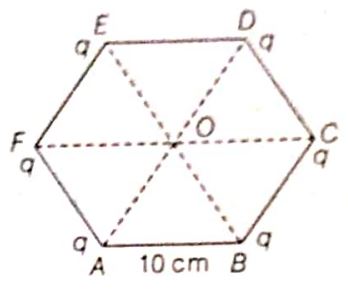
Given, AB = BC = CD = DE
= EF = FA = d = 10 cm
As, the hexagon has six equilateral triangles, so the distance of centre O from every vertex is 10 cm.
i.e. OA = OB = OC = OD
= OE = OF = d = 10 cm
\(\therefore\) Potential at point O = Sum of potentials at centre O due to individual point charge
i.e. VO = VA + VB + VC + VD + VE + VF
\(=\frac{1}{4\pi \varepsilon_{0}}.\left [ \frac{q}{OA}+\frac{q}{OB}+\frac{q}{OC}+\frac{q}{OD}+\frac{q}{OE}+\frac{q}{OF} \right ]\)
\(=\frac{1}{4\pi \varepsilon _{0}}.\frac{6q}{d}\) \(\left [ \because V=\frac{1}{4\pi \varepsilon _{0}.\frac{q}{r}} \right ]\)
Putting the values, we get
\(=9\times 10^{9}\times \frac{6\times 5 \times 10^{-6}}{10\times 10^{-2}}\)
= 2.7 \(\times\)106 V
5.
Given,
q1 = 5 x 10⁻⁸ C
q2 = -3 x 10⁻⁸
The two charges are at a distance, d = 16cm = 0.16m from each other.
Let us consider a point “P” over the line joining charges q1 and q2.
Let the distance of the considered point P from q1 be ‘r
Let us consider point P to have zero electric potential (V)
The electric potential at point P is the summation of potentials due to charges q1 and q2.
Therefore \(V=\frac{1}{4 \pi \epsilon_{o}} \cdot \frac{q_{1}}{r}+\frac{1}{4 \pi \epsilon_{o}} \cdot \frac{q_{2}}{d-r}\) ..........(i)
Here,
ϵo = permittivity of free space.
Putting V = 0, in eqn. (1), we get,
\(0=\frac{1}{4 \pi \epsilon_{o}} \cdot \frac{q_{1}}{r}+\frac{1}{4 \pi \epsilon_{o}} \cdot \frac{q_{2}}{d-r} \quad \frac{1}{4 \pi \epsilon_{o}} \cdot \frac{q_{1}}{r}=-\frac{1}{4 \pi \epsilon_{o}} \cdot \frac{q_{2}}{d-r} \quad \frac{q_{1}}{r}=-\frac{q_{2}}{d-r} \quad \frac{5 \times 10^{-8}}{r}=-\frac{\left(-3 \times 10^{-8}\right)}{0.16-r}\)
5(0.16 – r) = 3r
0.8 = 8r
r = 0.1m = 10 cm.
Therefore, at a distance of 10 cm from the positive charge, the potential is zero between the two charges.
Let us assume a point P at a distance ‘s’ from the negative charge be outside the system, having potential zero.
So, for the above condition, the potential is given by –
\(V=\frac{1}{4 \pi \epsilon_{o}} \cdot \frac{q_{1}}{s}+\frac{1}{4 \pi \epsilon_{o}} \cdot \frac{q_{2}}{s-d}\) ...........(ii)
Here,
ϵo = permittivity of free space.
For V = 0, eqn. (2) can be written as :
\(0=\frac{1}{4 \pi \epsilon_{o}} \cdot \frac{q_{1}}{s}+\frac{1}{4 \pi \epsilon_{o}} \cdot \frac{q_{2}}{s-d} \quad \frac{1}{4 \pi \epsilon_{o}} \cdot \frac{q_{1}}{s}=-\frac{1}{4 \pi \epsilon_{o}} \cdot \frac{q_{2}}{s-d} \quad \frac{q_{1}}{s}=-\frac{q_{2}}{s-d} \quad \frac{5 \times 10^{-8}}{s}=-\frac{\left(-3 \times 10^{-8}\right)}{s-0.16}\)
5(s – 0.16) = 3s
0.8 = 2s
S = 0.4 m = 40 cm.
Therefore, at a distance of 40 cm from the positive charge outside the system of charges, the potential is zero.
6.
(a) The charge on the capacitor is
Q = CV = 900 x 10–12 F x 100 V = 9 x 10⁻⁸ C
The energy stored by the capacitor is
= (1/2) CV2 = (1/2) QV
= (1/2) x 9 x 10–8C x 100 V = 4.5 x 10⁻⁶ J
(b) In the steady situation, the two capacitors have their positive plates at the same potential, and their negative plates at the same potential. Let the common potential difference be V′. The charge on each capacitor is then Q′ = CV′. By charge conservation, Q′ = Q/2. This implies V′ = V/2. The total energy of the system
\(=2 \times \frac{1}{2} Q^{\prime} V^{\prime}=\frac{1}{4} Q V=2.25 \times 10^{-6} \mathrm{~J}\)
Thus in going from (a) to (b), though no charge is lost; the final energy is only half the initial energy.
There is a transient period before the system settles to the situation (b). During this period, a transient current flows from the first capacitor to the second. Energy is lost during this time in the form of heat and electromagnetic radiation
7.
(a) Since the work done depends on the final arrangement of the charges, and not on how they are put together, we calculate work needed for one way of putting the charges at A, B, C and D. Suppose, first the charge +q is brought to A, and then the charges –q, +q, and –q are brought to B, C and D, respectively. The total work needed can be calculated in steps:
(i) Work needed to bring charge +q to A when no charge is present elsewhere: this is zero.
(ii) Work needed to bring –q to B when +q is at A. This is given by (charge at B) x (electrostatic potential at B due to charge +q at A)
\(=-q \times\left(\frac{q}{4 \pi \varepsilon_{0} d}\right)=-\frac{q^{2}}{4 \pi \varepsilon_{0} d}\)
(iii) Work needed to bring charge +q to C when +q is at A and –q is at B. This is given by (charge at C) x (potential at C due to charges at A and B)
\(=+q\left(\frac{+q}{4 \pi \varepsilon_{0} d \sqrt{2}}+\frac{-q}{4 \pi \varepsilon_{0} d}\right)\)
\(=\frac{-q^{2}}{4 \pi \varepsilon_{0} d}\left(1-\frac{1}{\sqrt{2}}\right)\)
(iv) Work needed to bring –q to D when +q at A,–q at B, and +q at C. This is given by (charge at D) x (potential at D due to charges at A, B and C)
\(=-q\left(\frac{+q}{4 \pi \varepsilon_{0} d}+\frac{-q}{4 \pi \varepsilon_{0} d \sqrt{2}}+\frac{q}{4 \pi \varepsilon_{0} d}\right)\)
\(=\frac{-q^{2}}{4 \pi \varepsilon_{0} d}\left(2-\frac{1}{\sqrt{2}}\right)\)
Add the work done in steps (i), (ii), (iii) and (iv). The total work required is
\(=\frac{-q^{2}}{4 \pi \varepsilon_{0} d}\left\{(0)+(1)+\left(1-\frac{1}{\sqrt{2}}\right)+\left(2-\frac{1}{\sqrt{2}}\right)\right\}\)
\(=\frac{-q^{2}}{4 \pi \varepsilon_{0} d}(4-\sqrt{2})\)
The work done depends only on the arrangement of the charges, and not how they are assembled. By definition, this is the total electrostatic energy of the charges.
(Students may try calculating same work/energy by taking charges in any other order they desire and convince themselves that the energy will remain the same.)
(b) The extra work necessary to bring a charge q0 to the point E when the four charges are at A, B, C and D is q0 x (electrostatic potential at E due to the charges at A, B, C and D). The electrostatic potential at E is clearly zero since potential due to A and C is cancelled by thatdue to B and D. Hence no work is required to bring any charge to point E.
8.
Let us take the origin O at the location of the positive charge. The line joining the two charges is taken to be the x-axis; the negative charge is taken to be on the right side of the origin

Let P be the required point on the x-axis where the potential is zero. If x is the x-coordinate of P, obviously x must be positive. (There is no possibility of potentials due to the two charges adding up to zero for x < 0.) If x lies between O and A, we have
\(\frac{1}{4 \pi \varepsilon_{0}}\left[\frac{3 \times 10^{-8}}{x \times 10^{-2}}-\frac{2 \times 10^{-8}}{(15-x) \times 10^{-2}}\right]=0\)
where x is in cm. That is,
\(\frac{3}{x}-\frac{2}{15-x}=0\)
which gives x = 9 cm
If x lies on the extended line OA, the required condition is
\(\frac{3}{x}-\frac{2}{x-15}=0\)
which gives
x = 45 cm
Thus, electric potential is zero at 9 cm and 45 cm away from the positive charge on the side of the negative charge. Note that the formula for potential used in the calculation required choosing potential to be zero at infinity.
9.
(a) In the given network, C1, C2 and C3 are connected in series. The effective capacitance C′ of these three capacitors is given by
\(\frac{1}{C^{\prime}}=\frac{1}{C_{1}}+\frac{1}{C_{2}}+\frac{1}{C_{3}}\)
For C1 = C2 = C3 = 10 μF, C′ = (10/3) μF. The network has C′ and C4 connected in parallel. Thus, the equivalent capacitance C of the network is
\(C=C^{\prime}+C_{4}=\left(\frac{10}{3}+10\right) \mu F=13.3 \mu \mathrm{F}\)
(b) Clearly, from the figure, the charge on each of the capacitors, C1, C2 and C3 is the same, say Q. Let the charge on C4 be Q′. Now, since the potential difference across AB is Q/C1, across BC is Q/C2, across CD is Q/C3 , we have
\(\frac{Q}{C_{1}}+\frac{Q}{C_{2}}+\frac{Q}{C_{3}}=500 \mathrm{~V}\)
Also, Q′/C4 = 500 V.
This gives for the given value of the capacitances
\(Q=500 \mathrm{~V} \times \frac{10}{3} \mu \mathrm{F}=1.7 \times 10^{-3} \mathrm{C}\) and
Q′ = 500 V x 10 μF = 5.0 x10⁻³ C
10.
\(V=\frac{1}{4 \pi \varepsilon_{0}} \frac{Q}{r}=9 \times 10^{9} \mathrm{Nm}^{2} \mathrm{C}^{-2} \times \frac{4 \times 10^{-7} \mathrm{C}}{0.09 \mathrm{~m}}\)
= 4 x 10⁴ V
(b) W = qV = 2 x 10−9C x 4 x 104 V
= 8 x 10⁻⁵ J
No, work done will be path independent. Any arbitrary infinitesimal path can be resolved into two perpendicular displacements: One along r and another perpendicular to r. The work done corresponding to the later will be zero.
11.
Given, C1 = C2 = 600 pF
= 600 \(\times\)10-12F
= 6 \(\times\)10-10 F
V1 = 200 V, V2 = 0
\(\begin{aligned} \therefore \text { Energy lost } & =\frac{C_1 C_2\left(V_1-V_2\right)^2}{2\left(C_1+C_2\right)} \\ \end{aligned}\)
\(\begin{aligned} =\frac{\left(6 \times 10^{-10}\right)^2(200-0)^2}{2 \times 12 \times 10^{-10}} \end{aligned}\)
= 6 \(\times\)10-6 J
12.
(a) Dielectric constant of the mica sheet, k = 6
If voltage supply remained connected, the voltage between two plates will be constant.
Supply voltage, V = 100 V
Initial capacitance, C = 1.771 x 10⁻¹¹ F
New capacitance, C1 = kC = 6 x 1.771 x 10−11 F = 106 pF
New charge, q1 = C1V = 106 x 100 pC = 1.06 x 10⁻⁸ C
Potential across the plates remain 100 V.
(b) Dielectric constant, k = 6
Initial capacitance, C = 1.771 x 10⁻¹¹ F
New capacitance, C1 = kC = 6 x 1.771 x 10−11 F = 106 pF
If the supply voltage is removed, then there will be a constant amount of charge in the plates.
Charge = 1.771 x 10⁻⁹ C
Potential across the plates is given by,
\(\mathrm{V} 1=\mathrm{q} / \mathrm{C} 1=\frac{1.771 \times 10^{-9}}{106 \times 10^{-12}}\)
= 16.7 V
13.
(1) Given, C1 = 2pF, C2 = 3pF and C3 = 4pF.
Equivalent capacitance for the parallel combination is given by Ceq .
Therefore, Ceq = C1 + C2 + C3 = 2 + 3 + 4 = 9pF
Hence, the total capacitance of the combination is 9pF.
(2) Supply voltage, V = 100V
The three capacitors are having the same voltage, V = 100v
q = VC
where,
q = charge
C = capacitance of the capacitor
V = potential difference
for capacitance, c = 2pF
q = 100 x 2 = 200pC = 2 x 10⁻¹⁰C
for capacitance, c = 3pF
q = 100 x 3 = 300pC = 3 x 10⁻¹⁰C
for capacitance, c = 4pF
q = 100 x 4 = 400pC = 4 x 10⁻¹⁰ C
14.
Given,
Capacitance, C = 8pF.
In the first case, the parallel plates are at a distance ‘d’ and is filled with air.
Air has dielectric constant, k = 1
Capacitance, C\(=\frac{k \times \epsilon_{o} \times A}{d}=\frac{\epsilon_{o} \times A}{d}\) .......(i)
Here,
A = area of each plate
ϵo = permittivity of free space.
Now, if the distance between the parallel plates is reduced to half, then d1 = d/2
Given, dielectric constant of the substance, k1 = 6
Hence, the capacitance of the capacitor,
\(\mathrm{C}_{1}=\frac{k_{1} \times \epsilon_{o} \times A}{d_{1}}=\frac{6 \epsilon_{0} \times A}{d / 2}=\frac{12 \epsilon_{o} A}{d}\) .......(ii)
Taking ratios of eqns. (1) and (2), we get,
C1 = 2 x 6 C = 12 C = 12 x 8 pF = 96pF.
Hence, the capacitance between the plates is 96pF.
15.
(1) Given,
Radius of spherical conductor, r = 12cm = 0.12m
Charge is distributed uniformly over the surface, q = 1.6 x 10⁻⁷ C.
The electric field inside a spherical conductor is zero.
(2) Electric field E, just outside the conductor is given by the relation
\(\mathrm{E}=\frac{1}{4 \pi \epsilon_{o}} \cdot \frac{q}{r^{2}}\)
Here, permittivity of free space and \(\frac{1}{4 \pi \epsilon_{o}}=9 \times 10^{9} \mathrm{Nm}^{2} \mathrm{C}^{-2}\)
Therefore,
\(\mathrm{E}=\frac{9 \times 10^{9} \times 1.6 \times 10^{-7}}{(0.12)^{2}}=10^{5} \mathrm{NC}^{-1}\)
Therefore, just outside the sphere the electric field is 4.4 x 10⁴ NC-1.
(3) From the centre of the sphere the electric field at a point 18m = E1.
From the centre of the sphere, the distance of point d = 18 cm = 0.18m
\(\mathrm{E}_{1}=\frac{1}{4 \pi \epsilon_{o}} \cdot \frac{q}{d^{2}}=\frac{9 \times 10^{9} \times 1.6 \times 10^{-7}}{\left(1.8 \times 10^{-2}\right)^{2}}=4.4 \times 10^{4} \mathrm{NC}^{-1}\)
So, from the centre of sphere the electric field at a point 18 cm away is 4.4 x 10⁴ NC-1.
16.
(1) An equipotential surface is defined as the surface over which the total potential is zero. In the given question the plane is normal to line AB. The plane is located at the mid – point of the line AB as the magnitude of the charges are same.
(2) At every point on this surface the direction of the electric field is normal to the plane in the direction of AB.
17.
Given,
Capacitance of the capacitor, C = 12pF = 12 x 10-12 F
Potential difference, V = 50 V
Electrostatic energy stored in the capacitor is given by the relation,
\(\mathrm{E}=\frac{1}{2} \mathrm{CV}^{2}=\frac{1}{2} \times 12 \times 10^{-12} \mathrm{\times}(50)^{2} \mathrm{~J}=1.5 \times 10^{-8} \mathrm{~J}\)
Therefore, the electrostatic energy stored in the capacitor is 1.5 x 10⁻⁸ J. was disconnected.
18.
Given,
The area of plate of the capacitor, A = 6 x 10⁻³ m2
Distances between the plates, d = 3mm = 3 x 10⁻³ m
Voltage supplied, V = 100V
Capacitance of a parallel plate capacitor is given by, \(C=\frac{\epsilon \times A}{d}\)
Here,
ε = permittivity of free space = 8.854 x10⁻¹² N-1 m -2 C-2
\(C=\frac{8.854 \times 10^{-12} \times 6 \times 10^{-3}}{3 \times 10^{-3}}=17.81 \times 10^{-12} \mathrm{~F}=17.71 \mathrm{pF}\)
Therefore, each plate of the capacitor is having a charge of
q = VC = 100 x 17.81 x 10-12 C = 1.771 x 10⁻⁹ C
19.
There are three capacitors cach of capacitance 9 pF.
\(\therefore\) C1 = C2 = C3 = 9 pF
and voltage, V = 120 V
(i) The total capcitance in series combination,
\(\frac{1}{C_{s}}=\frac{1}{C_{1}}+\frac{1}{C_{2}}+\frac{1}{C_{3}}=\frac{1}{9}+\frac{1}{9}+\frac{1}{9}\)
\(\Rightarrow \frac{1}{C_{s}}=\frac{3}{9} \Rightarrow C_{s}=3 pF\)
(ii) Let the charge across the system be q and potentials across C1, C2 and C3 be V1, V2 and V3, respectively.
Charge, q = Cs. V = 3 \(\times\)120 = 360 pC
Potential difference across C1,
\(V_{1}=\frac{q}{C_{1}}=\frac{360}{9}=40 V\)
Potential difference across C2,
\(V_{2}=\frac{q}{C_{2}}=\frac{360}{9}=40 V\)
Potential difference across C3,
\(V_{3}=\frac{q}{C_{3}}=\frac{360}{9}=40 V\)
Thus, the potential difference across each capacitor is 40 V.

12th Standard CBSE Syllabus & Materials
12th Standard CBSE
CBSE 12th Computer Science Python Revision Tour I - New Previous year Question Papers Study Material - QB365 Set A
NEW12th Standard CBSE
CBSE 12th Business Studies Planning Important Questions And Answers Study Material - QB365 Set A
NEW12th Standard CBSE
CBSE 12th Business Studies Business Environment Important Questions And Answers Study Material - QB365 Set A
NEW12th Standard CBSE
CBSE 12th Business Studies Principles of Management Important Questions And Answers Study Material - QB365 Set A



NCERT Books

Syllabus

Exam Pattern

Sample Question Papers

Previous year Question Papers

Important Notes

MCQ Practice test

NCERT Exemplers

Case study Questions

Image Based Questions

Passage based Questions

HOT Questions

Value Based Questions

Model Questions Papers
NCERT ( Book Back ) Questions

Assertion and Reason
Important Questions And Answers

CBSE 12th Standard CBSE Subjects
CBSE Standards








