
 100% FREE ACCESS
12th Standard CBSE Syllabus & Materials
12th Standard CBSE
CBSE 12th Economics Government Budget and the Economy Previous year Question Papers Study Material - QB365 Set A
NEW12th Standard CBSE
CBSE 12th Computer Science Interface Python with MySQL - New Previous year Question Papers Study Material - QB365 Set A
NEW12th Standard CBSE
CBSE 12th Computer Science Database Concept - New Previous year Question Papers Study Material - QB365 Set A
NEW12th Standard CBSE
CBSE 12th Computer Science Data Communication - New Previous year Question Papers Study Material - QB365 Set A
NEW12th Standard CBSE
CBSE 12th Computer Science Data Structures - New Previous year Question Papers Study Material - QB365 Set A
NEW12th Standard CBSE
CBSE 12th Computer Science Functions - New Previous year Question Papers Study Material - QB365 Set A

Published on: 07/03/2026
Download CBSE Class 12th Standard CBSE Physics question papers, sample papers, important questions, and previous year solved papers in PDF format. Get free study materials, NCERT solutions, and exam preparation resources for Class 12th Standard CBSE Physics
Questions + Answers key
Take MCQ Physics Test
1.
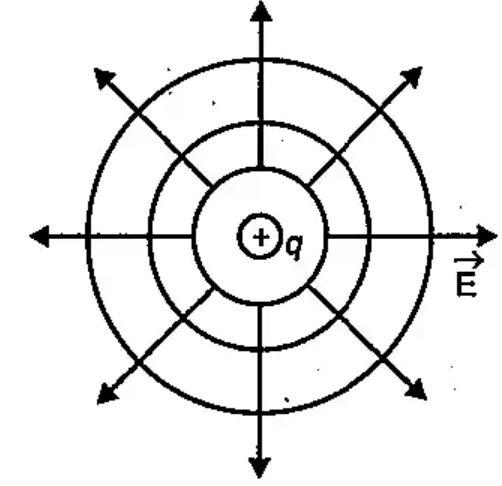
What is the geometrical shape of equipotential surfaces due to a single isolated charge?
2.
Deduce Coulomb's law from Gauss' law.
3.
If an electric dipole is placed in a uniform electric field, then state whether it always experience a torque or not?
4.
why do the electric field lines not form closed loops?
5.
Why should electrostatic field be zero inside a conductor?
6.
A proton is placed in a uniform electric field directed along a positive X-axis. In which direction will it tend to move?
7.
If the radius of the Gaussian surface enclosing a charge q is halved, how does the electric flux through the Gaussian surface change?
8.
What is the electrostatic potential due to electric dipole at an equatorial point?
9.
In which orientation, a dipole placed in a uniform field is in (i) stable (ii) unstable equilibrium?
10.
Name any two basic properties of electric charge.
11.
Three capacitors 2\(\mu\)F, 3\(\mu\)F and 6\(\mu\)F are joined in series with each other. The equivalent capacitance is
1/2 \(\mu\)F
1 \(\mu\)F
2 \(\mu\)F
11 \(\mu\)F
12.
A charge Q is placed at the centre of a cube. The electric flux through one if its face is
\(\frac{Q}{\varepsilon_0}\)
\(\frac{Q}{6 \varepsilon_0}\)
\(\frac{Q}{8 \varepsilon_0}\)
\(\frac{Q}{3 \varepsilon_0}\)
13.
An electric dipole of moment p is placed parallel to the uniform electrie tield. The amount of work done in rotating the dipole by 90° is
2pE
pE
pE/2
zero
14.
The capacitors of capacitance 4 F, 6 F and 12 Fare connected first in series and then in parallel. What is the ratio of equivalent capacitance in the two cases?
2 : 3
11 : 1
1 : 11
1 : 3
15.
An electric dipole is kept in a non-uniform electric field. It experiences
a force and a torque
a force but not a torque
a torque but not a force.
neither a force nor a torque
16.
Electric field at a point varies as ro for
an electric dipole
a point charge
a plane infinite sheet of charge
a line charge of infinite length
17.
The electric field inside a spherical shell of uniform surface charge density is
zero.
constant, less than zero.
directly proportional to the distance from the centre.
none of the these
18.
Which of the following is not a unit of electrostatic potential?
Volt
Joule / coulomb
Newton / Coulomb
Newton - metre / Coulomb
19.
In a system, 'n' electric dipole are placed in a closed surface. The value of emergent electric flux from enclosed surface is
\(\frac{q}{\varepsilon_{0}}\)
\(\frac{2 q}{\varepsilon_{0}}\)
\(-\frac{2 q}{\varepsilon_{0}}\)
zero
20.
The SI unit of electric flux is
\(\frac{\text { volt }}{\text { metre }}\)
\(\frac{\text { newton }}{\text { coulomb }}\)
\(\frac{\text { newton } \times \text { metre }^{2}}{\text { coulomb }}\)
\(\text { volt } \times \text { metre }^{2}\)
21.
Two equal and opposite charges each of 2C are placed at a distance of 0.04 m. Dipole moment of the system will be
6 x 10⁻⁸ C-m
8 x 10⁻² C-m
1.5 x 10² C-m
8 x 10⁻⁶ C-m
22.
Two charges + 1 \(\mu\) Cand +4\(\mu\) C are situated at a distance in air. The ratio of the forces acting on them is
1 : 4
4 : 1
1 : 1
1 : 16
23.
SI unit of electrical permittivity is
N-m 2C-2
Am -2
NC-1
C2N-1m-2
24.
Number of electrons present in a negative charge of 8 C is ____________
5 x10¹⁹
2.5 x 10¹⁹
12.8 x 10¹⁹
1.6 x 10¹⁹
25.
lf q represents charge on a particle and V the potential difference between two points, qV represents the magnitude of
Momentum
Power
Torque
Energy
26.
Gauss's law helps in
determination of electric force between pint. charges
situations where Coulomb's law fails
determination of electric field due to symmetric charge distributions
determining electric potential due to symmetric charge distributions
27.
What is the angle between the electric dipole moment and the electric field strength due to it on the equatorial line?
00
900
1800
None of these
28.
Force between two charges, When placed in free space is 10 N. If they are in medium of relative permittivity 5, the force between them will be
2N
50N
0.5N
None of these
29.
The magnitude of the two charges is doubled and the distance of their separation also doubled. The electrostatic force between them Will
be halved
be doubled
become four times
remain unchanged
30.
When a number of capacitors are connected in parallel between two points, the equivalent capacitance
increases
decreases
remains the same
none of the above
31.
When a conductor is held in an electric field, the field inside the conductor is always
positive
negative
constant
zero
32.
Electric potential V and electric flux \(\phi\) are
both vectors
both scalars
V is scalar, \(\phi\) is vector
V is vector, \(\phi \) is scalar
33.
A closed surface in vacuum encloses charges -q and +3q. Another charge -2q lies outside the surface. Total electric flux over the surface is
Zero
\(2 q\over \epsilon_o\)
\(-{3q\over \epsilon_o}\)
\(4q\over\epsilon_o\)
34.
The correct relation between electric intensity E and electric potential V is
\(E=-{dV\over dr}\)
\(E={dV\over dr}\)
\(V=-{dE\over dr}\)
\(V={dE\over dr}\)
35.
Work done in carrying an electron from A to B lying on an equipotential surface of one volt potential is
1 eV
10 eV
1 volt
Zero
36.
Force \(\overrightarrow { F } \) acting on a test charge qo in a uniform electric field \(\overrightarrow { E } \) is
\(\overrightarrow { F } =q_{ o }\overrightarrow { E } \)
\(\overrightarrow { F } =\frac { \overrightarrow { E } }{ q_{ o } } \)
\(\overrightarrow { F } =\frac { \overrightarrow { q_o } }{\overrightarrow { E } } \)
\(\overrightarrow { F } =q_{ o }^{ 2 }\overrightarrow { E } \)
37.
Electric dipole moment is
scalar
neither scalar vector
a vector directed from -q to +q
a vector directed from +q to -q
38.
Electric field due to a single charge is
asymmetric
cylindrically symmetric
spherically symmetric
None of the above
39.
The SI unit of electric field intensity is
N
N/C
C/m2
N/m2
1.
The equipotential surfaces of an isolated charge are concentric spherical shells.Since the electric field(gradient of potential) decreases with the distance from the charge, the distance between the shells increase with the decrease in electric field and vice versa.
2.
According to Gauss' theorem,
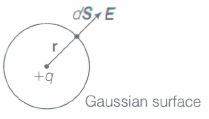
\(\int\)s E. dS \(=\frac { q }{ { \varepsilon }_{ 0 } } \Rightarrow\) E. \(4\pi r^2=\frac { q }{ { \varepsilon }_{ 0 } }\)
\(\therefore\) \(E=\frac { q }{ 4\pi { \varepsilon }_{ 0 } r^2 }\)
If a charge q0 is kept on the surface, then
F = E\(\times\) q0 \(=\frac { q{ q }_{ 0 } }{ 4\pi { \varepsilon }_{ 0 } r^2 } \) , which is Coulomb's law.
3.
No, it does not experience a torque, when it is placed along the direction of electric field
4.
Electric field lines do not form closed loops because they are always directed from positive charge to negative charge.
5.
Electric field lines do not pass through a conductor.Hence, the interior of the conductor is free from the influence of the electric field
6.
Proton will tend to move alone the positive X-axis in the direction of uniform electric field.
7.
As \(\pi={q\over \epsilon_o}\) so flux does not depend upon the radius of Gaussian surface, it will remain unchanged.
8.
Electric potential V = 0
9.
If \theta is angle between \( \overrightarrow { P } \ and\ \overrightarrow { E } , then \theta =0^o\) for stable equilibrium, \( \theta=180^o\) for unstable equilibrium.
10.
(i) Quantization of charge
(ii) Conservation of charge
11.
(b)
1 \(\mu\)F
12.
(b)
\(\frac{Q}{6 \varepsilon_0}\)
13.
(b)
pE
14.
(c)
1 : 11
15.
(a)
a force and a torque
16.
(c)
a plane infinite sheet of charge
17.
(a)
zero.
18.
(c)
Newton / Coulomb
19.
(d)
zero
20.
(c)
\(\frac{\text { newton } \times \text { metre }^{2}}{\text { coulomb }}\)
21.
(b)
8 x 10⁻² C-m
22.
(c)
1 : 1
23.
(d)
C2N-1m-2
24.
(a)
5 x10¹⁹
25.
(d)
Energy
26.
(c)
determination of electric field due to symmetric charge distributions
27.
(c)
1800
28.
(a)
2N
29.
(d)
remain unchanged
30.
(a)
increases
31.
(d)
zero
32.
(b)
both scalars
33.
(b)
\(2 q\over \epsilon_o\)
34.
(a)
\(E=-{dV\over dr}\)
35.
(d)
Zero
36.
(a)
\(\overrightarrow { F } =q_{ o }\overrightarrow { E } \)
37.
(c)
a vector directed from -q to +q
38.
(c)
spherically symmetric
39.
(b)
N/C

12th Standard CBSE Syllabus & Materials
12th Standard CBSE
CBSE 12th Computer Science Python Revision Tour I - New Previous year Question Papers Study Material - QB365 Set A
NEW12th Standard CBSE
CBSE 12th Business Studies Planning Important Questions And Answers Study Material - QB365 Set A
NEW12th Standard CBSE
CBSE 12th Business Studies Business Environment Important Questions And Answers Study Material - QB365 Set A
NEW12th Standard CBSE
CBSE 12th Business Studies Principles of Management Important Questions And Answers Study Material - QB365 Set A



NCERT Books

Syllabus

Exam Pattern

Sample Question Papers

Previous year Question Papers

Important Notes

MCQ Practice test

NCERT Exemplers

Case study Questions

Image Based Questions

Passage based Questions

HOT Questions

Value Based Questions

Model Questions Papers
NCERT ( Book Back ) Questions

Assertion and Reason
Important Questions And Answers

CBSE 12th Standard CBSE Subjects
CBSE Standards








