
 100% FREE ACCESS
12th Standard CBSE Syllabus & Materials
12th Standard CBSE
CBSE 12th Economics Government Budget and the Economy Previous year Question Papers Study Material - QB365 Set A
NEW12th Standard CBSE
CBSE 12th Computer Science Interface Python with MySQL - New Previous year Question Papers Study Material - QB365 Set A
NEW12th Standard CBSE
CBSE 12th Computer Science Database Concept - New Previous year Question Papers Study Material - QB365 Set A
NEW12th Standard CBSE
CBSE 12th Computer Science Data Communication - New Previous year Question Papers Study Material - QB365 Set A
NEW12th Standard CBSE
CBSE 12th Computer Science Data Structures - New Previous year Question Papers Study Material - QB365 Set A
NEW12th Standard CBSE
CBSE 12th Computer Science Functions - New Previous year Question Papers Study Material - QB365 Set A

Published on: 07/03/2026
Download CBSE Class 12th Standard CBSE Physics question papers, sample papers, important questions, and previous year solved papers in PDF format. Get free study materials, NCERT solutions, and exam preparation resources for Class 12th Standard CBSE Physics
Questions + Answers key
Take MCQ Physics Test
1.
A step-down transformer is used at 220 V to provide a current of 0.5 A to a 15 W bulb. If the secondary has 20 turns, find the number of turns in the primary coil and the current that flows in the primary coil.
2.
Sanjay was prparing an electronic project for science exhibition. He required to light the LED using a 6 V supply. LEDs need only a very small current to make them light and they do not heat up in use. So he put a resistor in series to limit the current. Then there would be p.d. of 4 V across the resistor as there is always 2.0 V across the LED itself when it is conducting. The current should be 10 mA through both LED and the resistor. He could use the resistance by equation, R = V/I to calculate the value of R.
\(R=\frac { V }{ I } =\frac { 4V }{ 10mA } =\frac { 4V }{ 0.01A } =400V\)
Thus the protecting resistor should be around \(400\Omega \)
A semiconductor has equal electron and hole concentration of \(6\times 10^{ 8 }/{ m }^{ 3 }\). On doping with certain impurity, electron concentration increase to \(9\times { 10 }^{ 12 }/{ m }^{ 3 }\)
3.
The magnifying power of an astronomical telescope in the normal adjustment position is 100. The distance between the objective and eye piece is 101 cm. Calculate the focal lengths of objective and eye piece.
4.
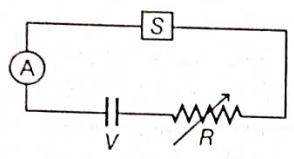
The figure shows a piece of pure semiconductor S in series with a variable resistor R and a Source of constant voltage V. Should the value of R be increased or decreased to keep the reading of the ammeter constant, when semiconductor S is heated? Justify your answer.
Or
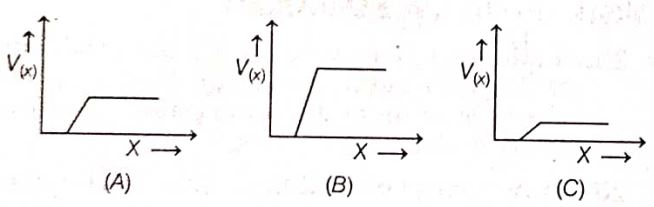
The graph of potential barrier versus width of depletion region for an unbiased diode is shown in graph A. In comparison to A, graphs B and C are obtained after biasing the díode in different ways. Identify the type of biasing in B and C and justify your answer.
5.
A step-down transformer converts a voltage of 2200 V into 220 V in the transmission line. Number of turns in primary coil is 5000. Efficiency of transformer is 90% and its output power is 8 kW. Determine
(i) number of turns in the secondary coil.
(ii) input power.
6.
An electric dipole consists of two opposite charges each of magnitude 1.0 x 10⁻⁶ C separated by 2 cm. The dipole is placed in an external uniform field of 1 x 10⁵ N/ C. Find
(i) the maximum torque exerted by the field on the dipole,
(ii) the work which an external agent will have to do in turning the dipole through 180o starting from the position, \(\theta\) = 0°.
7.
A magnetic needle free to rotate in a vertical plane parallel to the magnetic meridian has its north tip pointing down at 22º with the horizontal. The horizontal component of the earth’s magnetic field at the place is known to be 0.35 G. Determine the magnitude of the earth’s magnetic field at the place.
8.
Explain with the help of ray diagram, the working of an astronomical telescope. The magnifying power of a telescope in its normal adjustment is 20. If the length of the telescope is 105 cm in this adjustment, find the focal length of the two lenses.
9.
A bar magnet when suspended horizontally and perpendicular to the earth's magnetic field experience a torque of 3 x 10⁻⁴ N-m. What is the magnetic moment of the magnetic moment of the magnetic field at that place is 0.4 x 10⁻⁴ T.
10.
Two identical metal spheres A and B have equal and similar charges. They repel each other with a force 103 N, when they are placed 10 cm apart in a medium of dielectric constant 7. Determine the charge on each sphere.
11.
Can non-metals show photoelectric effect?
12.
If an object is moved from infinity to convex mirror, then in which direction will the image shift?
13.
What is the apparent position of an object below a rectangular block of glass 6 cm thick, if a layer of water 4 cm thick is on the top of the glass?
Given, nga = 1.5 and nwa=1.33.
14.
Give one use of each of the following
(i) Infrared rays
(ii) Gamma rays
(iii) microwaves
(iv) ultraviolet rays
15.
What happens to the balance point if the position of the cell and the galvanometer are interchanged in balanced Wheatstone bridge?
16.
Pieces of copper and silicon are initially at room temperature. Both are heated to temperature T.
The conduction of
both increases
both decreases
copper increases and silicon decreases
copper decreases and silicon increases
17.
A coil of self-inductance L is connected in series with a bulb B and an ac source. Brightness of the bulb decreases when
frequency of the ac source is decreased.
number of turns in the coil is reduced
a capacitance of reactance XC = XL in included
an iron rod is inserted in the coil
18.
Let the magnetic field on earth be modelled by that of a point magnetic dipole at the centre of earth. The angle of dip at a point on the geographical equator
is always zero.
can be zero at specific points.
cannot be positive or negative
is not bounded.
19.
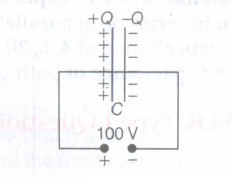
A 900 pF capacitor is charged by 100 V battery in the figure. How much electrostatic energy is stored by the capacitor?
45 x 10-6 J
4.5 x 10⁶ J
4.5 x 10⁻⁶ J
0.45 x 10⁵ J
20.
The direction of induced current is decided by
Lenz's law
Fleming's left hand rule
Biot-Savart's law
Ampere's law
21.
The unit of intensity of electric field is
N/m
C/N
N/C
J/N
22.
When an object is placed 40 cm from a diverging lens, its virtual image is formed 20 cm from the lens.The focal length and power of lens are
F = - 20 cm, P = - 5 D
F = - 40 cm, P = - 5 D
F = - 40 cm,P = -2.5 D
F = -20 cm,P = -2.5 D
23.
The resolving power of teleoscope is
Directly proportional to the diameter (aperture) of the objective lens and inversely proportional to the wavelength of light used
Directly proportional to the diameter of the objective lens and also directly proportional to the wavelength of the light used
Directly proportional to the wavelength of light used and inversely proportional to the diameter of the objective lens
None of these
24.
A charged particle with charge q enters a region of constant, uniform and mutually orthogonal fields \(\vec { E } \quad and\quad \vec { B } \) with a velocity \(\vec { \upsilon } \) perpendicular to both \(\vec { E } \quad and\quad \vec { B } ,\) and comes out without any change in magnitude or direction of \(\vec { \upsilon } .\) Then
\(\vec { \upsilon } =\vec { B } \times \vec { E } /{ E }^{ 2 }\)
\(\vec { \upsilon } =\vec { E } \times \vec { B } /{ B }^{ 2 }\)
\(\vec { \upsilon } =\vec { B } \times \vec { E } /{ B }^{ 2 }\)
\(\vec { \upsilon } =\vec { E } \times \vec { B } /{ E }^{ 2 }\)
25.
In an unbiased p-n junction, holes diffuse from the p- region to n- region because
Free electrons in the n-region attract them
they move across the junction by the potential difference
hole concentration in p-region is more as compared to hole concentration in n-region
all the above
26.
What is the diameter of \(_{ 2 }{ { Be }^{ 4 } }\) in its ground state? Given Bohr radius of hydrogen atom is 53 pm.
53 pm
26.5 pm
1.6 pm
100 pm
27.
An electron is moving with an initial velocity \(\vec { v } ={ v }_{ 0 }\hat { i } \) and is in a magnetic field \(\vec { B } ={ B }_{ 0 }\hat { j } \). Then it's de Broglie wavelength
remains constant
increases with time
decreases with time
increases and decreases periodically
28.
An electric dipole is a system consisting of the two equal and opposite point charges seperated by a small and finite distance. If dipole moment of this system is \(\vec{p}\) and it is placed in a uniform electric field \(\overrightarrow{\boldsymbol{E}}\).
(i) Write the expression of torque experienced by a dipole.
(ii) Identify two pairs of perpendicular vectors in the expression.
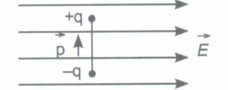
(iii) Show diagrammatically the orientation of the dipole in the field for which the torque is
(a) Maximum.
(b) Half the maximum value.
(c) Zero
29.
The resistance of a conductor at temperature toC is given by Rt = Ro (1 + \(\alpha\)t)
where Rt is the resistance at toC, Ro is the resistance at 0oC and \(\alpha\) is the characteristics constants of the material of the conductor.
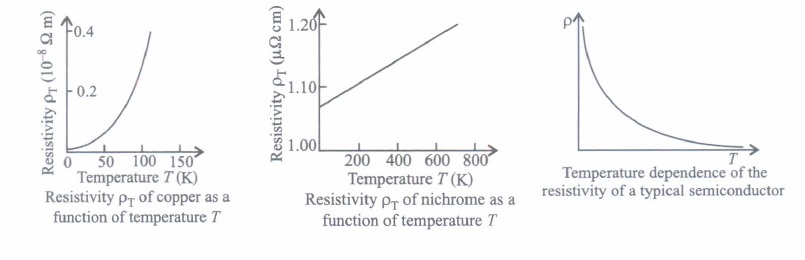
Over a limited range of temperatures, that is not too large. The resistivity of a metallic conductor is approximately given by \(\rho_{t}=\rho_{0}(1+\alpha t)\).
where \(\alpha\) is the temperature coefficient of resistivity. Its unit is \(\mathrm{K}^{-1} \text {or }{ }^{\circ} \mathrm{C}^{-1}\)
For metals, \(\alpha\) is positive i.e., resistance increases with rise in temperature.
For insulators and semiconductors, \(\alpha\) is negative i.e., resistance decreases with rise in temperature.
(i) Fractional increase in resistivity per unit increase in temperature is defined as
| (a) resistivity | (b) temperature coefficient of resistivity |
| (c) conductivity | (d) drift velocity |
(ii) The material whose resistivity is insensitive to temperature is
| (a) silicon | (b) copper | (c) silver | (d) nichrome |
(iii) The temperature coefficient of the resistance of a wire is 0.00125 per oC. At 300 K its resistance is 1 ohm. The resistance of wire will be 2 ohms at
| (a) 1154 K | (b) 1100 K | (c) 1400 K | (d) 1127 K |
(iv) The temperature coefficient of resistance of an alloy used for making resistors is
| (a) small and positive | (b) small and negative | (c) large and positive | (d) large and negative |
(v) For a metallic wire, the ratio V/I (V = applied potential difference and I = current flowing) is
| (a) independent of temperature |
| (b) increases as the temperature rises |
| (c) decreases as the temperature rises |
| (d) increases or decreases as temperature rises depending upon the metal |
30.
Assertion (A) : Velocity of light is constant in all media.
Reason (R) : Light is an electromagnetic wave which has constant velocity in all media.
Codes:
(a) Both A and R are true and R is the correct explanation of A
(b) Both A and R are true but R is NOT the correct explanation of A
(c) A is true but R is false
(d) A is false and R is also false
31.
Assertion (A) : At 0 K, Germanium is a superconductor.
Reason (R) : At 0 K, Germanium offers zero resistance.
Codes:
(a) Both A and R are true and R is the correct explanation of A
(b) Both A and R are true but R is NOT the correct explanation of A
(c) A is true but R is false
(d) A is false and R is also false
32.
Assertion (A) : Balmer series lies in the visible region of electromagnetic spectrum.
Reason (R): \(\frac{1}{\lambda}=R\left(\frac{1}{2^{2}}-\frac{1}{K^{2}}\right),, \text { where } K=3,4,5, \ldots\)
Codes:
(a) Both A and R are true and R is the correct explanation of A
(b) Both A and R are true but R is NOT the correct explanation of A
(c) A is true but R is false
(d) A is false and R is also false
33.
Assertion (A) : The earth's magnetic field is due to iron present in its core.
Reason (R) : At a low temperature magnet losses its magnetic property or magnetism.
Codes:
(a) Both A and R are true and R is the correct explanation of A
(b) Both A and R are true but R is NOT the correct explanation of A
(c) A is true but R is false
(d) A is false and R is also false
1.
Here, Ep = 220V, Is = 0.5A, Ps = 15W,
ns = 20, np = ? IP = ?
\(E_s=\frac{P_s}{I_s}=\frac{15}{0.5}=30 \mathrm{~V}\)
As \(\begin{aligned} \frac{E_P}{E_s}=\frac{n_P}{n_s} \therefore n_P=\frac{E_P}{E_s} \times n_s=\frac{220}{30} \times 20 \end{aligned}\)
= 147
Also, from EpIp = EsIs
\(I_P=\frac{E_s I_s}{E_P}=\frac{P_s}{E_P}=\frac{15}{220}=0.068 \mathrm{~A}\)
2.
(i) New semiconductor must be n-type, because the electron concentration increases.
(ii) Given,
\({ n }_{ i }=6\times 10^{ 8 }/{ m }^{ 3 }\)
\(\\ { n }_{ e }=9\times { 10 }^{ 12 }/{ m }^{ 3 }\)
\(\\ { n }_{ e }{ n }_{ h }={ n }_{ i }^{ 2 }\)
\(\\ \Rightarrow { n }_{ h }=\frac { { n }_{ i }^{ 2 } }{ { n }_{ e } } =\frac { (6\times 10^{ 8 })^{ 2 } }{ 9\times { 10 }^{ 12 } } \)
\(\\ =\frac { 36\times { 10 }^{ 16 } }{ 9\times 10^{ 12 } } \)
\(\\ =4\times 10^{ 4 }/{ m }^{ 3 }\)
3.
m = -100, f0 + fe = 101 cm, f0 = ?, fe = ?
\(m=-{f_0\over f_e}=-100\ \ \therefore f_0=100 f_3\)
Now f0 + fe = 101
100 fe + fe = 101,
fe = 1 cm,
f0 = 100 fe = 100 cm
4.
The value of resistance (R) should be increased to keep the reading of ammeter constant, as with the increase in the temperature of a semiconductor, its resistance decreases and current tends to increase.
Or
For graph B,
As the potential barrier in graph B is higher with respect to potential barrier in graph 4, i.e. potential barrier in graph B is increased. So, it is the case of reverse biased condition.
For graph C,
As the potential barrier in graph C is decreased with respect to potential barrier in graph A. So, the graph C is the case of forward biased condition.
5.
Given, Ep = 2200V , Es = 220 V, Np = 5000
Efficiency, \(\eta \) = 90%
Output power, p0 = 8kW
Since, efficiency,
\(\eta=\frac{\text { Output power }}{\text { Input power }}=\frac{P_{o}}{P_{i}}\)
\(\Rightarrow \quad P_{i}=\frac{P_{o}}{\eta}=\frac{8}{90 / 100}=8.9 \mathrm{~kW}\)
Also, \(\frac{N_s}{N_p}=\frac{E_s}{E_p} \Rightarrow N_s=\frac{E_s}{E_p} N_p=\frac{220}{2200} \times 5000\)
\(\Rightarrow\) Ns = 500
6.
Here, q = 1x 10⁻⁶ C, 2a = 2 cm = 0.02m
\(\therefore\) p = q x 2a = (1 x 10-6) x 0.02 = 2 x 10⁻⁸cm
Intensity of the external electric field, E = 1.0 x 10⁵ N/C
(i) \(\tau\)max = pE = ( 2 x 10⁻⁸)(1.0 x 10⁵) = 2 x 10 -3 N-m
(ii) Net work done in turning the dipole from 0o to 180o
i.e \(W=\int_{0^{\circ}}^{180^{\circ}} \tau d \theta=\int_{0^{\circ}}^{180^{\circ}} p E \sin \theta d \theta=p E[-\cos \theta]_{0^{\circ}}^{180^{\circ}}\)
= - pE (cos 180o-cos0o) = 2pE
= 2 x (2 x 10-8 ) (1 x 10⁵) J = 4 x 10⁻³ J
7.
Horizontal component of earth’s magnetic field, H = 0.35G
Angle made by the needle with the horizontal plane = Angle of dip = δ = 22°
Earth’s magnetic field strength = B
We can relate B and BH as:
\(B_{H}=B \cos \delta \therefore B=\frac{B_{H}}{\cos \delta}\)
\(=\frac{0.35}{\cos 22^{\circ}}=0.38 \mathrm{G}\)
Hence, the strength of the earth’s magnetic field at the given location is 0.38 G.
8.
In normal adjustments, m = \(|\frac { { f }_{ 0 } }{ { f }_{ e } } |=20\\ \)
Also, length of telescope, f0 + fe = 105
20f0 + f e = 105
21f e = 105
f e = 5 cm
f0 = 20 fe = 20 x 5 = 100 cm
9.
Given = 900 = 3 x 10⁻⁴ N-m
and B = 0.4 x 10⁻⁴T
Since, torque is given by
\( \tau = MB\sin { \theta } \)
\(\Rightarrow \ M\ =\frac { 3\times { 10 }^{ -4 } }{ 0.4\times { 10 }^{ -4 }\sin { \theta } } \)
\(\Rightarrow M\ =\ 7.5\ { jT }^{ -1 }\)
10.
Here q1 = q2 = q, F = 103 N
K = 7, r = 10 cm = 0.10 cm
\(F={1\over 4\pi\epsilon_oK}{q^2\over r^2}\)
\(103={{9\times10^9q^2}\over {7(0.10)^2}}\)
or \(q^2={{103\times7\times}(0.10)^2\over 9\times10^9}\)
or \(q=28.3\times 10^{-6}C\)
11.
Yes, when they are exposed to electromagnetic radiations of higher frequency.
12.
The image will shift from focus to the convex mirror.
13.
3 cm
14.
(i) Infrared rays are used in physical therapy i.e., to treat muscular strain
(ii) Gamma rays are used in the treatment of cancer and tumours
(iii) microwaves are used in a radar system for aircraft navigation
(iv) ultraviolet rays are used to destroy the bacteria and the sterling the surgical instruments.
15.
There will be no depletion in the galvanometer as the condition of balanced bridge will still hold good.
16.
(d)
copper decreases and silicon increases
17.
(d)
an iron rod is inserted in the coil
18.
(b)
can be zero at specific points.
19.
(c)
4.5 x 10⁻⁶ J
20.
(a)
Lenz's law
21.
(c)
N/C
22.
(c)
F = - 40 cm,P = -2.5 D
23.
(d)
None of these
24.
(b)
\(\vec { \upsilon } =\vec { E } \times \vec { B } /{ B }^{ 2 }\)
25.
(c)
hole concentration in p-region is more as compared to hole concentration in n-region
26.
(a)
53 pm
27.
(a)
remains constant
28.
(i) \(\vec{\tau}=\vec{p} \times \vec{E}\)
or \(\tau=p E \sin \theta\)
here p = 2aq
(If point charges are q and -q separated by a distance 2a.)
(ii) Torque is perpendicular to dipole moment and electric field. \(\vec{\tau} \perp \vec{p} \text { and } \vec{\tau} \perp \vec{E}\).
(iii) (a) Maximum Torque \(\tau\) = pE when \(\theta\) = 90°
(b) \(\tau=\frac{p E}{2} \text { when, } \sin \theta=\frac{1}{2} \text { i.e., } \theta=30^{\circ} \text { or } 150^{\circ}\)
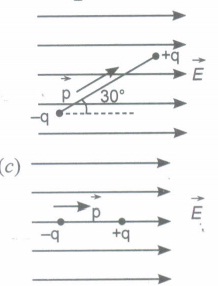
\(\therefore \theta\) = 0° or 180°
\(\therefore \tau \) = pE sin 0° = 0
\(\therefore \tau\) = minimum
29.
(i) (b): Temperature coefficient of resistivity is defined as the fractional increase in resistivity per unit increase in temperature.
(ii) (d): Nichrome (which is an alloy of nickel, iron and chromium) exhibits a very weak dependence of resistivity with temperature.
(iii) (d): Using, \(R_{T}=R_{0}(1+\alpha T)\)
\(\therefore \quad \frac{R_{T_{2}}}{R_{T_{1}}}=\frac{R_{0}\left(1+\alpha T_{2}\right)}{R_{0}\left(1+\alpha T_{1}\right)}=\frac{2}{1}=\frac{\left(1+\alpha T_{2}\right)}{(1+\alpha \times 300)}\)
\(\Rightarrow \quad 2+\alpha \times 600=1+\alpha T_{2}\)
\(\Rightarrow \quad 1=\alpha\left(T_{2}-600\right) \Rightarrow \frac{1}{0.00125}=\left(T_{2}-600\right)\)
\(\Rightarrow \quad 800^{\circ} \mathrm{C}=T_{2}-600\)
T2 = 800 - 273 + 600
T2 = 1127 K
(iv) (a): The temperature coefficient of resistance of an alloy used for making resistors is small and positive.
(v) (b): The resistance of a metallic wire at temperature toC is given by
\(R_{t}=R_{0}(1+\alpha t)\) where \(\alpha\) is the temperature coefficient of resistance and Ro is the resistance of a wire at O°c.
For metals,\(\alpha\) is positive. Hence, resistance of a wire increases with increase in temperature.
Also, from Ohm's law
\(\frac{V}{I}=R\)
Hence on increasing the temperature, the ratio \(\frac{V}{I}\) increases.
30.
(d): Velocity of light has different values in different media. It depends on the refractive index of the medium. Related by formula
\(v_{\text {medium }}=\frac{\text { velocity in vacuum }}{\text { refractive index of medium }}\)
31.
(d) : At 0 K, Germanium offers infinite resistance, and it behaves as an insulator
32.
(b): When we put R = 107 m-1and K = 3,4, 5 in the given formula, values of \(\lambda\) calculated lie between 4000 \(\dot A\) and 8000 \(\dot A\), which is the visible region. The reason is true, but does not explain the assertion properly.
33.
(d): The temperature inside the earth is so high that it is impossible for iron core to behave as a magnet and act as a source of magnetic field. The magnetic field of earth ig.considered to be due to circulating
electric current in the iron (in molten state) and other conducting materials inside the earth.

12th Standard CBSE Syllabus & Materials
12th Standard CBSE
CBSE 12th Computer Science Python Revision Tour I - New Previous year Question Papers Study Material - QB365 Set A
NEW12th Standard CBSE
CBSE 12th Business Studies Planning Important Questions And Answers Study Material - QB365 Set A
NEW12th Standard CBSE
CBSE 12th Business Studies Business Environment Important Questions And Answers Study Material - QB365 Set A
NEW12th Standard CBSE
CBSE 12th Business Studies Principles of Management Important Questions And Answers Study Material - QB365 Set A



NCERT Books

Syllabus

Exam Pattern

Sample Question Papers

Previous year Question Papers

Important Notes

MCQ Practice test

NCERT Exemplers

Case study Questions

Image Based Questions

Passage based Questions

HOT Questions

Value Based Questions

Model Questions Papers
NCERT ( Book Back ) Questions

Assertion and Reason
Important Questions And Answers

CBSE 12th Standard CBSE Subjects
CBSE Standards








