
 100% FREE ACCESS
12th Standard CBSE Syllabus & Materials
12th Standard CBSE
CBSE 12th Economics Government Budget and the Economy Previous year Question Papers Study Material - QB365 Set A
NEW12th Standard CBSE
CBSE 12th Computer Science Interface Python with MySQL - New Previous year Question Papers Study Material - QB365 Set A
NEW12th Standard CBSE
CBSE 12th Computer Science Database Concept - New Previous year Question Papers Study Material - QB365 Set A
NEW12th Standard CBSE
CBSE 12th Computer Science Data Communication - New Previous year Question Papers Study Material - QB365 Set A
NEW12th Standard CBSE
CBSE 12th Computer Science Data Structures - New Previous year Question Papers Study Material - QB365 Set A
NEW12th Standard CBSE
CBSE 12th Computer Science Functions - New Previous year Question Papers Study Material - QB365 Set A

Published on: 07/03/2026
Download CBSE Class 12th Standard CBSE Physics question papers, sample papers, important questions, and previous year solved papers in PDF format. Get free study materials, NCERT solutions, and exam preparation resources for Class 12th Standard CBSE Physics
Questions + Answers key
Take MCQ Physics Test
1.
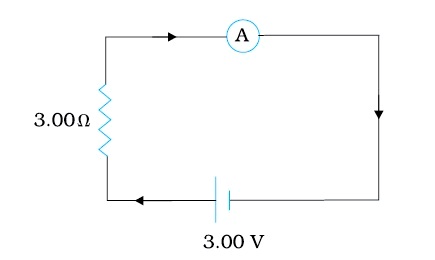
In the circuit the current is to be measured. What is the value of the current if the ammeter shown
(a) is a galvanometer with a resistance RG = 60.00 Ω;
(b) is a galvanometer described in (a) but converted to an ammeter by a shunt resistance rs = 0.02 Ω;
(c) is an ideal ammeter with zero resistance?
2.
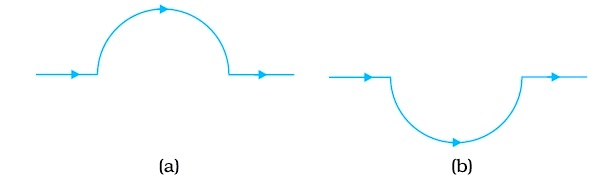
A straight wire carrying a current of 12 A is bent into a semi-circular arc of radius 2.0 cm as shown in Fig (a). Consider the magnetic field B at the centre of the arc.
(a) What is the magnetic field due to the straight segments?
(b) In what way the contribution to B from the semicircle differs from that of a circular loop and in what way does it resemble?
(c) Would your answer be different if the wire were bent into a semi-circular arc of the same radius but in the opposite way as shown in Fig.(b)?
3.
Find the energy equivalent of one atomic mass unit, first in Joules and then in MeV. Using this, express the mass defect of \({ }_{8}^{16} \mathrm{O} \text { in } \mathrm{MeV} / \mathrm{c}^{2}\)
4.
An electric toaster uses nichrome for its heating element. When a negligibly small current passes through it, its resistance at room temperature (27.0 °C) is found to be 75.3 Ω. When the toaster is connected to a 230 V supply, the current settles, after a few seconds, to a steady value of 2.68 A. What is the steady temperature of the nichrome element? The temperature coefficient of resistance of nichrome averaged over the temperature range involved, is 1.70 x 10⁻⁴ °C-1.
5.
(a) Determine the electrostatic potential energy of a system consisting of two charges 7 μC and –2 μC (and with no external field) placed at (–9 cm, 0, 0) and (9 cm, 0, 0) respectively.
(b) How much work is required to separate the two charges infinitely away from each other?
(c) Suppose that the same system of charges is now placed in an external electric field E = A (1/r 2); A = 9 x 10⁵ NC-1 m2. What would the electrostatic energy of the configuration be?
6.
Figures (a) and (b) show the field lines of a positive and negative point charge respectively
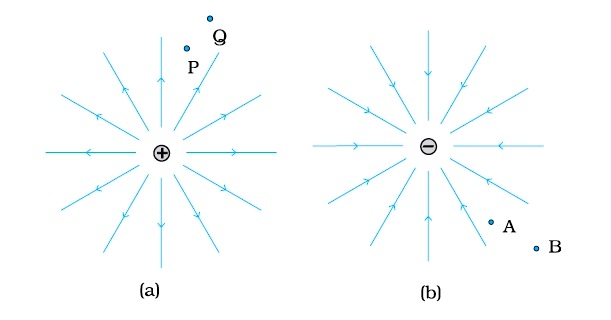
(a) Give the signs of the potential difference VP – VQ; VB – VA.
(b) Give the sign of the potential energy difference of a small negative charge between the points Q and P; A and B.
(c) Give the sign of the work done by the field in moving a small positive charge from Q to P.
(d) Give the sign of the work done by the external agency in moving a small negative charge from B to A.
(e) Does the kinetic energy of a small negative charge increase or decrease in going from B to A?
7.
Current in a circuit falls from 5.0 A to 0.0 A in 0.1 s. If an average emf of 200 V induced, give an estimate of the self-inductance of the circuit.
8.
A closely wound solenoid of 800 turns and area of cross section 2.5 × 10⁻⁴ m2 carries a current of 3.0 A. Explain the sense in which the solenoid acts like a bar magnet. What is its associated magnetic moment?
9.
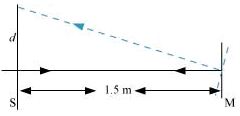
Light incident normally on a plane mirror attached to a galvanometer coil retraces backwards as shown in Fig. A current in the coil produces a deflection of 3.5° of the mirror. What is the displacement of the reflected spot of light on a screen placed 1.5 m away?
10.
Double-convex lenses are to be manufactured from a glass of refractive index 1.55, with both faces of the same radius of curvature. What is the radius of curvature required if the focal length is to be 20cm?
11.
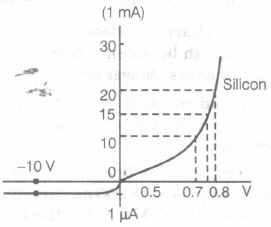
The V-I characteristic of a silicon diode is as shown in the figure. Calculate the resistance of the diode at
(i) I = 15 mA and
(ii) V = -10 V
12.
Use Lenz’s law to determine the direction of induced current in the situations described by Fig.
(a) A wire of irregular shape turning into a circular shape;
(b) A circular loop being deformed into a narrow straight wire

13.
The horizontal component of the earth's magnetic field at a certain place is 3.0 x 10⁻⁵ T and the direction of the field is from geographic south to the geographic north. A very long straight conductor is carrying a steady current of 1 A. What is the force per unit length on it when it is placed on a horizontal table and the direction of current is (a) east to west (b) south to north ?
14.
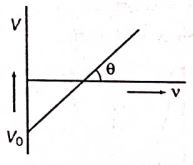
In an experiment on photoelectric effect, the slope of the cut off voltage versus frequency of incident light is found to be \(4.12\times { 10 }^{ -15 }V-s\). Calculate the value of Plank's constant.
15.
Monochromatic light of frequency \(6.0\times { 10 }^{ 14 }Hz\) is produced by a laser.The power emitted is \(2.0\times { 10 }^{ -3 }W\).
(a) What is the energy of a photon in the light beam?
(b) How many photons per second, on the average, are emitted by the source?
Given \(h=6.63\times { 10 }^{ -34 }Js\)
16.
The amplitude of the magnetic field part of a harmonic electromagnetic wave in vacuum is B0 = 510 nT. What is the amplitude of the electric field part of the wave?
17.
The number density of free electrons in a copper conductor estimated is \(8.5\times { 10 }^{ 28 }{ m }^{ -3 }\). How long does an electron take in drifting from one end of a wire 3.0m long to its other end? The area of cross-section of the wire is \(2.0\times { 10 }^{ -6 }{ m }^{ 2 }\) and it is carrying a current of 3.0 A.
18.
A rectangular wire loop of sides 8 cm and 2 cm with a small cut is moving out of a region of uniform magnetic field of magnitude 0.3 T directed normal to the loop. What is the emf developed across the cut if the velocity of the loop is 1 cm s–1 in a direction normal to the
(a) longer side,
(b) shorter side of the loop? For how long does the induced voltage last in each case?
19.
A regular hexagon of side 10 cm has a charge 5\(\mu\) C at each of its vertices. Calculate the potential at the centre of the hexagon.
1.
(a) Total resistance in the circuit is,
RG+3 = 63 Ω. Hence, I = 3 / 63 = 0.048 A.
(b) Resistance of the galvanometer converted to an ammeter is,
\(\frac{R_{G} r_{s}}{R_{G}+r_{s}}=\frac{60 \Omega \times 0.02 \Omega}{(60+0.02) \Omega}=0.02 \Omega\)
Total resistance in the circuit is,
0.02Ω + 3Ω = 3.02Ω . Hence, I = 3 / 3.02 = 0.99 A.
(c) For the ideal ammeter with zero resistance,
I = 3 / 3 = 1.00 A
2.
(a) dl and r for each element of the straight segments are parallel. Therefore, dl x r = 0. Straight segments do not contribute to |B|.
(b) For all segments of the semicircular arc, dl x r are all parallel to each other (into the plane of the paper). All such contributions add up in magnitude. Hence direction of B for a semicircular arc is given by the right-hand rule and magnitude is half that of a circular loop. Thus B is 1.9 x 10⁻⁴ T normal to the plane of the paper going into it.
(c) Same magnitude of B but opposite in direction to that in (b).
3.
1u = 1.6605 x 10⁻²⁷ kg
To convert it into energy units, we multiply it by c2 and find that energy equivalent = \(1.6605 \times 10^{-27} \times\left(2.9979 \times 10^{8}\right)^{2} \mathrm{~kg} \mathrm{~m}^{2} / \mathrm{s}^{2}\)
\(=1.4924 \times 10^{-10} \mathrm{~J}\)
\(=\frac{1.4924 \times 10^{-10}}{1.602 \times 10^{-19}} \mathrm{eV}\)
\(=0.9315 \times 10^{9} \mathrm{eV}\)
\(=931.5 \mathrm{MeV}\)
or, \(1 \mathrm{u}=931.5 \mathrm{MeV} / \mathrm{c}^{2}\)
For, \({ }_{8}^{16} \mathrm{O}, \quad \Delta M=0.13691 \mathrm{u}=0.13691 \times 931.5 \mathrm{MeV} / \mathrm{c}^{2}\)
\(=127.5 \mathrm{MeV} / \mathrm{c}^{2}\)
The energy needed to separate \({ }_{8}^{16} \mathrm{O}\) into its constituents is thus 127.5 MeV/c2.
4.
When the current through the element is very small, heating effects can be ignored and the temperature T1 of the element is the same as room temperature. When the toaster is connected to the supply, its initial current will be slightly higher than its steady value of 2.68 A. But due to heating effect of the current, the temperature will rise. This will cause an increase in resistance and a slight decrease in current. In a few seconds, a steady state will be reached when temperature will rise no further, and both the resistance of the element and the current drawn will achieve steady values. The resistance R2 at the steady temperature T2 is
\(R_{2}=\frac{230 \mathrm{~V}}{2.68 \mathrm{~A}}=85.8 \Omega\)
Using the relation
R2 = R1 [1 + α (T2 - T1)]
with α = 1.70 x 10⁻⁴ °C-1, we get
\(T_{2}-T_{1}=\frac{(85.8-75.3)}{(75.3) \times 1.70 \times 10^{-4}}=820^{\circ} \mathrm{C}\)
that is, T2 = (820 + 27.0) °C = 847 °C
Thus, the steady temperature of the heating element (when heating effect due to the current equals heat loss to the surroundings) is 847 °C.
5.
(a) \(U=\frac{1}{4 \pi \varepsilon_{0}} \frac{q_{1} q_{2}}{r}=9 \times 10^{9} \times \frac{7 \times(-2) \times 10^{-12}}{0.18}=-0.7 \mathrm{~J}\)
(b) W = U2 – U1 = 0 – U = 0 – (–0.7) = 0.7 J.
(c) The mutual interaction energy of the two charges remains unchanged. In addition, there is the energy of interaction of the two charges with the external electric field. We find
\(q_{1} V\left(\mathbf{r}_{1}\right)+q_{2} V\left(\mathbf{r}_{2}\right)=A \frac{7 \mu \mathrm{C}}{0.09 \mathrm{~m}}+A \frac{-2 \mu \mathrm{C}}{0.09 \mathrm{~m}}\)
and the net electrostatic energy is
\(q_{1} V\left(\mathbf{r}_{1}\right)+q_{2} V\left(\mathbf{r}_{2}\right)+\frac{q_{1} q_{2}}{4 \pi \varepsilon_{0} r_{12}}=A \frac{7 \mu C}{0.09 m}+A \frac{-2 \mu C}{0.09 m}-0.7 \mathrm{~J}\)
= 70 − 20 − 0.7 = 49.3 J
6.
(a) As \(V \propto \frac{1}{r}, V_{P}>V_{Q^{}}\) Thus, (VP – VQ) is positive. Also VB is less negative than VA . Thus, VB > VA or (VB – VA) is positive.
(b) A small negative charge will be attracted towards positive charge. The negative charge moves from higher potential energy to lower potential energy. Therefore the sign of potential energy difference of a small negative charge between Q and P is positive. Similarly, (P.E.)A > (P.E.)B and hence sign of potential energy differences is positive.
(c) In moving a small positive charge from Q to P, work has to be done by an external agency against the electric field. Therefore, work done by the field is negative.
(d) In moving a small negative charge from B to A work has to be done by the external agency. It is positive.
(e) Due to force of repulsion on the negative charge, velocity decreases and hence the kinetic energy decreases in going from B to A.
7.
Initial current, I1 = 5.0 A
Final current, I2 = 0.0 A
Change in current dl = I-1- I-2 = 5A
Time taken for the change, t = 0.1 s
Average emf, e = 200 V
For self-inductance (L) of the coil, we have the relation for average emf as:
\(e=L\frac{di}{dt}\)
\(L=\frac{e}{\frac{di}{dt}}\)
\(=\frac{200}{\frac{5}{0.1}}=4H\)
Hence, the self induction of the coil is 4 H.
8.
Number of turns in the solenoid, n = 800
Area of cross-section, A = 2.5 × 10⁻⁴ m2
Current in the solenoid, I = 3.0 A
A current-carrying solenoid behaves like a bar magnet because a magnetic field develops along its axis, i.e., along with its length.
The magnetic moment associated with the given current-carrying solenoid is calculated as:
M = n I A
= 800 x 3 x 2.5 x 10-4
= 0.6 J T-1
9.
Angle of deflection, θ = 3.5°
Distance of the screen from the mirror, D = 1.5 m
The reflected rays get deflected by an amount twice the angle of deflection i.e., 2θ = 7.0°
The displacement (d) of the reflected spot of light on the screen is given as:
\(tan2\theta =\frac { d }{ 1.5 } \)
∴ d = 1.5 x tan 70° = 0.184 m = 18.4 cm
Hence, the displacement of the reflected spot of light is 18.4 cm.
10.
Refractive index of glass, μ
Focal length of the double-convex lens, f = 20 cm
Radius of curvature of one face of the lens = R1
Radius of curvature of the other face of the lens = R2
Radius of curvature of the double-convex lens = R The value of R can be calculated as:
∴ R1 = R and R2 = -R
The value of R can be calculated as:
\(\frac { 1 }{ f } =(\mu -1)\left[ \frac { 1 }{ { R }_{ 1 } } -\frac { 1 }{ { R }_{ 2 } } \right] \)
\(\frac { 1 }{ 20 } =(1.55)\left[ \frac { 1 }{ R } +\frac { 1 }{ R } \right] \)
\(\frac { 1 }{ 20 } =0.55\times \frac { 2 }{ R } \)
∴ R = 0.55 x 2 x 20 = 22 cm
Hence, the radius of curvature of the double-convex lens is 22 cm.
11.
Considering the diode characteristics as a straight line between I = 10 mA to I = 20 mA passing through the origin, we can calculate the resistance using Ohm’s law.
(a) From the curve, at I = 20 mA, V = 0.8 V, I = 10 mA, V = 0.7 V
\(r_{f b}=\Delta V / \Delta I=0.1 \mathrm{~V} / 10 \mathrm{~mA}=10 \ \Omega\)
(b) From the curve at V = –10 V, I = –1 \(\mu\) A,
Therefore,
\(r_{r b}=10 \mathrm{~V} / 1 \mu \mathrm{A}=1.0 \times 10^{7} \ \Omega\)
12.
(i) Here, the direction of magnetic field is perpendicularly inwards to the plane of paper. If a wire of irregular shape turns into a circular shape, then its area increases (\(\because \) the circular loop has greater area than the loop of irregular shape) so that, the magnetic flux linked also increases. Now, the induced current is produced in a direction such that it decreases the magnetic field [i.e. the current will flow in such a direction, so that the wire forming the loop is pulled inward in all directions (to decrease the area)], i.e current is in anti-clockwise direction, ie. along adcba.
(ii) When a circular loop deforms into a narrow straight wire, the magnetic flux linked with it also decreases. The current induced due to change in flux will flow in such a direction that it will oppose the decrease in magnetic flux, so it will flow anti-clockwise, i.e along adcba due to which the magnetic field produced will be out of the plane of paper.
13.
F = Il x B
F = Il B sinθ
The force per unit length is
f = F / l = I B sinθ
(a) When the current is flowing from east to west,
θ = 90°
Hence,
f = I B
= 1 x 3x 10–5 = 3 x 10⁻⁵ N m–1
This is larger than the value 2 x 10⁻⁷ Nm–1 quoted in the definition of the ampere. Hence it is important to eliminate the effect of the earth’s magnetic field and other stray fields while standardising the ampere.
The direction of the force is downwards. This direction may be obtained by the directional property of cross product of vectors.
(b) When the current is flowing from south to north,
θ = 0o
f = 0
Hence there is no force on the conductor.
14.
Given, slope of graph, tan \(\theta\) = 4.12 \(\times\) 10-15 V-s
Charge on electron, e = 1.6 \(\times\)10-19 C
Slope of graph of cut off voltage versus frequency is tan \(\theta=\frac{V}{v}\)
We know that, bv = eV or \(\frac{V}{v}=\frac{b}{e}\)
\(\begin{aligned}
\therefore & \frac{h}{e}=4.12 \times 10^{-15}
\end{aligned}\)
\(\begin{aligned}
\Rightarrow & h=1.6 \times 10^{-19} \times 4.12 \times 10^{-15}
\end{aligned}\)
\(\begin{aligned}
=6.592 \times 10^{-34} \mathrm{~J}-\mathrm{s}
\end{aligned}\)
15.
(a) Each photon has an energy
\(E=hv=6.63\times { 10 }^{ -34 }J s\times 6.0\times { 10 }^{ 14 }Hz\)
(b) If N is the number of photons emitted by the source per second, the power P transmitted in the beam equals N times the energy per photon E, so that P = N E. Then
\(n=\frac { P }{ E } =\frac { 2.0\times { 10 }^{ -3 }W }{ 3.98\times { 10 }^{ -19 }J } \)
\(=5.0\times { 10 }^{ 15 }\) photons per second.
16.
Given, amplitude of the magnetic field part of harmonic electromagnetic wave,
B0 = 510 nT = 510 \(\times\)10-9 T
Speed of light in a vacuum, c = 3 × 10⁸ m/s
Amplitude of electric field of the electromagnetic wave is given by the relation,
E = cB0
= 3 × 108 × 510 × 10−9 = 153 N/C
Therefore, the electric field part of the wave is 153 N/C.
17.
Number density of free electrons in a copper conductor, n = 8.5 x 1028 m-3 Length of the copper wire, l = 3.0 m
Area of cross-section of the wire, A = 2.0 x 10⁻⁶ m2
Current carried by the wire, I = 3.0 A, which is given by the relation,
I = nAeVd
Where,
e = Electric charge = 1.6 x 10⁻¹⁹ C
Vd = Drift velocity = \(\frac{\text { Length of the wire (l) }}{\text { Time taken to cover l(t) }}\)
\(I=n A e \frac{l}{t}\)
\(t=n A e \frac{l}{I}\)
\(=\frac{3 \times 8.5 \times 10^{28} \times 2 \times 10^{-6} \times 1.6 \times 10^{-19}}{3.0}\)
\(=2.7 \times 10^{4} s\)
Therefore, the time taken by an electron to drift from one end of the wire to the other is 2.7 x 10⁴ s.
18.
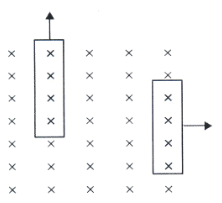
A) Step 1: Find the emf developed in the loop
Formula Used: \(\mathrm{e}=\mathrm{BIV}\)
Strength of magnetic field, \(B=0.3 \mathrm{~T}\)
Velocity of the loop, \(v=1 \mathrm{~cm} / \mathrm{s}=0.01 \mathrm{~m} / \mathrm{s}\)
emf developed in the loop is given as:
\( \mathrm{e}=\mathrm{Blv} \)
\(=0.3 \times 0.08 \times 0.01=2.4 \times 10^{-4} \mathrm{~V}\)
Step 2: Find the time taken to travel.
Formula Used: \(\mathrm{t}=\frac{\text { Distance travelled }}{\text { Velocity }}\)
Time taken to travel along the width, \(\mathrm{t}=\frac{\text { Distance travelled }}{\text { Velocity }}=\frac{\mathrm{bv}}{\mathrm{v}}\)
\(=\frac{0.02}{0.01}=2 \mathrm{~s}\)
Final answer : \(\mathrm{e}=2.4 \times 10^{-4} \mathrm{v}\)
\(\mathrm{t}=2 \mathrm{~s}\)
B) Step 1: Find the emf developed in the loop emf developed, e = BIv
\(e=0.3 \times 0.02 \times 0.01 \)
\(e=0.6 \times 10^{-4} V\)
Step 2: Find the time taken to travel.
Time taken to travel along the length, \(\mathrm{t}=\frac{\text { Distance travelle }}{\text { Velocity }}=\frac{\mathrm{d}}{\mathrm{v}}\)
\(\mathrm{t}=\frac{0.08}{0.01}=8 \mathrm{~s}\)
Hence, the induced voltage is \(0.6 \times 10^{-4} \mathrm{~V}\) which lasts for 8 s .
Final answer: \(\mathrm{e}=0.6 \times 10^{-4} \mathrm{~V}\)
\(\mathrm{t}=8 \mathrm{~s}\)
19.
ABCDEF is a regular hexagon of side 10 cm each. At each corner, the charge q =5 \(\mu\)C is placed. O is the centre of the hexagon.
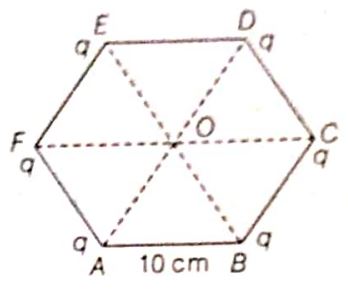
Given, AB = BC = CD = DE
= EF = FA = d = 10 cm
As, the hexagon has six equilateral triangles, so the distance of centre O from every vertex is 10 cm.
i.e. OA = OB = OC = OD
= OE = OF = d = 10 cm
\(\therefore\) Potential at point O = Sum of potentials at centre O due to individual point charge
i.e. VO = VA + VB + VC + VD + VE + VF
\(=\frac{1}{4\pi \varepsilon_{0}}.\left [ \frac{q}{OA}+\frac{q}{OB}+\frac{q}{OC}+\frac{q}{OD}+\frac{q}{OE}+\frac{q}{OF} \right ]\)
\(=\frac{1}{4\pi \varepsilon _{0}}.\frac{6q}{d}\) \(\left [ \because V=\frac{1}{4\pi \varepsilon _{0}.\frac{q}{r}} \right ]\)
Putting the values, we get
\(=9\times 10^{9}\times \frac{6\times 5 \times 10^{-6}}{10\times 10^{-2}}\)
= 2.7 \(\times\)106 V

12th Standard CBSE Syllabus & Materials
12th Standard CBSE
CBSE 12th Computer Science Python Revision Tour I - New Previous year Question Papers Study Material - QB365 Set A
NEW12th Standard CBSE
CBSE 12th Business Studies Planning Important Questions And Answers Study Material - QB365 Set A
NEW12th Standard CBSE
CBSE 12th Business Studies Business Environment Important Questions And Answers Study Material - QB365 Set A
NEW12th Standard CBSE
CBSE 12th Business Studies Principles of Management Important Questions And Answers Study Material - QB365 Set A



NCERT Books

Syllabus

Exam Pattern

Sample Question Papers

Previous year Question Papers

Important Notes

MCQ Practice test

NCERT Exemplers

Case study Questions

Image Based Questions

Passage based Questions

HOT Questions

Value Based Questions

Model Questions Papers
NCERT ( Book Back ) Questions

Assertion and Reason
Important Questions And Answers

CBSE 12th Standard CBSE Subjects
CBSE Standards








