
 100% FREE ACCESS
12th Standard CBSE Syllabus & Materials
12th Standard CBSE
CBSE 12th Economics Government Budget and the Economy Previous year Question Papers Study Material - QB365 Set A
NEW12th Standard CBSE
CBSE 12th Computer Science Interface Python with MySQL - New Previous year Question Papers Study Material - QB365 Set A
NEW12th Standard CBSE
CBSE 12th Computer Science Database Concept - New Previous year Question Papers Study Material - QB365 Set A
NEW12th Standard CBSE
CBSE 12th Computer Science Data Communication - New Previous year Question Papers Study Material - QB365 Set A
NEW12th Standard CBSE
CBSE 12th Computer Science Data Structures - New Previous year Question Papers Study Material - QB365 Set A
NEW12th Standard CBSE
CBSE 12th Computer Science Functions - New Previous year Question Papers Study Material - QB365 Set A

Published on: 02/11/2025
Download CBSE Class 12th Standard CBSE Physics question papers, sample papers, important questions, and previous year solved papers in PDF format. Get free study materials, NCERT solutions, and exam preparation resources for Class 12th Standard CBSE Physics
Questions + Answers key
Take MCQ Physics Test
1.
The magnetic field lines near a substance are as shown in the figure. The substance is
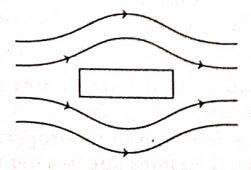
Copper
Iron
Sodium
Aluminium
2.
The magnetic lines of force inside a bar magnet
are from north-pole to south-pole of the magnet
do not exist.
depend upon the area of cross-section of the bar magnet.
are from south-pole to north-pole of the magnet
3.
A magnet of dipole moment M is aligned in equilibrium position in a magnetic field of intensity B. The work done to rotate it through an angle θ with the magnetic field is
MB sin θ
MB cos θ
MB (1 - cos θ)
MB(l - sin θ)
4.
The universal property among all substances is
diamagnetism.
paramagnetism.
ferromagnetism.
all of these
5.
A diamagnetic material in a magnetic field moves
perpendicular to the field
from weaker to stronger parts
from stronger to weaker parts.
in random direction.
6.
The magnetic susceptibility of an ideal diamagnetic substance is
+1
0
-1
∞
7.
If the magnetising field on a ferromagnetic material is increased, its permeability
is decreased
is increased
is unaffected
may be increased or decreased
8.
If M is magnetic moment and B is magnetic field intensity, then the torque is given by
\(\overline{\mathbf{M}} \cdot \overline{\mathbf{B}}\)
\(\frac{|\overline{\mathbf{M}}|}{|\overline{\mathbf{B}}|}\)
\(\overline{\mathbf{M}} \times \overline{\mathbf{B}}\)
MB
9.
Curie temperature is the temperature above which
a ferromagnetic material becomes paramagnetic.
a ferromagnetic material becomes diamagnetic
a paramagnetic material becomes diamagnetic
a paramagnetic material becomes ferromagnetic
10.
Three needles N1, N2 and N3 are made of a ferromagnetic, a paramagnetic and a diamagnetic substance respectively. A magnet, when brought close to them, will
attract N1 strongly, but repel N2 and N3 weakly.
attract all three of them.
attract N1 and N2 strongly but repel N3
attract N1 strongly, N2 weakly and repel N3 weakly
11.
Ferromagnetism show their properties due to
filled inner subshells
vacant inner subshells
partially filled inner subshells
all the subshells equally filled
12.
A short bar magnet placed with its axis at 30° with an external field of 800 G experiences a torque of 0.016 Nm. The magnetic moment of the magnet is
4 Am2
0.5 Am2
2 Am2
0.40 Am2
13.
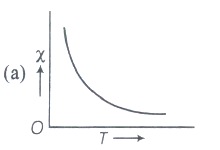
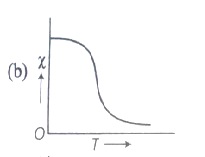
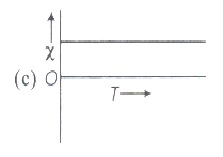
The variation of magnetic susceptibility (x) with temperature for a diamagnetic substance is best represented by figure
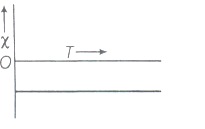
14.
Work done in rotating a bar magnet from 0 to angle \(120\unicode{xb0} \) is
\(\frac{1}{2}\) MB
\(\frac{3}{2}\) MB
MB
\(\frac{2}{3}\) MB
15.
A large magnet is broken into two pieces so that their lengths are in the ratio 2 : 1. The pole strengths of the two pieces will have ratio.
2: 1
1: 2
4: 1
1: 1
1.
(a)
Copper
2.
(d)
are from south-pole to north-pole of the magnet
3.
(c)
MB (1 - cos θ)
4.
(a)
diamagnetism.
5.
(c)
from stronger to weaker parts.
6.
(c)
-1
7.
(a)
is decreased
8.
(c)
\(\overline{\mathbf{M}} \times \overline{\mathbf{B}}\)
9.
(a)
a ferromagnetic material becomes paramagnetic.
10.
(d)
attract N1 strongly, N2 weakly and repel N3 weakly
11.
(c)
partially filled inner subshells
12.
(d)
0.40 Am2
13.
(d)
14.
(b)
\(\frac{3}{2}\) MB
15.
(d)
1: 1

12th Standard CBSE Syllabus & Materials
12th Standard CBSE
CBSE 12th Computer Science Python Revision Tour I - New Previous year Question Papers Study Material - QB365 Set A
NEW12th Standard CBSE
CBSE 12th Business Studies Planning Important Questions And Answers Study Material - QB365 Set A
NEW12th Standard CBSE
CBSE 12th Business Studies Business Environment Important Questions And Answers Study Material - QB365 Set A
NEW12th Standard CBSE
CBSE 12th Business Studies Principles of Management Important Questions And Answers Study Material - QB365 Set A



NCERT Books

Syllabus

Exam Pattern

Sample Question Papers

Previous year Question Papers

Important Notes

MCQ Practice test

NCERT Exemplers

Case study Questions

Image Based Questions

Passage based Questions

HOT Questions

Value Based Questions

Model Questions Papers
NCERT ( Book Back ) Questions

Assertion and Reason
Important Questions And Answers

CBSE 12th Standard CBSE Subjects
CBSE Standards








