
 100% FREE ACCESS
12th Standard CBSE Syllabus & Materials
12th Standard CBSE
CBSE 12th Economics Government Budget and the Economy Previous year Question Papers Study Material - QB365 Set A
NEW12th Standard CBSE
CBSE 12th Computer Science Interface Python with MySQL - New Previous year Question Papers Study Material - QB365 Set A
NEW12th Standard CBSE
CBSE 12th Computer Science Database Concept - New Previous year Question Papers Study Material - QB365 Set A
NEW12th Standard CBSE
CBSE 12th Computer Science Data Communication - New Previous year Question Papers Study Material - QB365 Set A
NEW12th Standard CBSE
CBSE 12th Computer Science Data Structures - New Previous year Question Papers Study Material - QB365 Set A
NEW12th Standard CBSE
CBSE 12th Computer Science Functions - New Previous year Question Papers Study Material - QB365 Set A

Published on: 07/03/2026
Download CBSE Class 12th Standard CBSE Physics question papers, sample papers, important questions, and previous year solved papers in PDF format. Get free study materials, NCERT solutions, and exam preparation resources for Class 12th Standard CBSE Physics
Questions + Answers key
Take MCQ Physics Test
1.
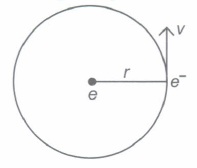
Derive the expression for the magnetic field at the site of a point nucleus in a Hydrogen atom due to the circular motion of the electron. Assume that the atom is in its ground state and give the answer in terms of fundamental constants.
2.
A solenoid having 5000 turns/m carries a current of 2A. An aluminium ring at temperature 300K inside the solenoid provides the core.
(a) If the magnetisation I is 2 x 10⁻² A/m, find the susceptibility of aluminium at 300 K.
(b) If temperature of the aluminium ring is 320 K, what will be the magnetisation?
3.
A closely wound solenoid of 2000 turns and area of cross-section 1.6 x 10⁻⁴ m2, carrying a current of 4.0 A, is suspended through its centre allowing it to turn in a horizontal plane.
(a) What is the magnetic moment associated with the solenoid?
(b) What is the force and torque on the solenoid if a uniform
horizontal magnetic field of 7.5 x 10⁻² T is set up at an angle of 30º with the axis of the solenoid?
4.
A bar magnet of magnetic moment 1.5 J T-1 lies aligned with the direction of a uniform magnetic field of 0.22 T.
(a) What is the amount of work required by an external torque to turn the magnet so as to align its magnetic moment:
(i) normal to the field direction,
(ii) opposite to the field direction?
(b) What is the torque on the magnet in cases (i) and (ii)?
5.
A solenoid has a core of a material with relative permeability 400. The windings of the solenoid are insulated from the core and carry a current of 2A. If the number of turns is 1000 per metre, calculate (a) H, (b) M, (c) B and (d) the magnetising current Im.
6.
A short bar magnet of magnetic moment 0.9 J/T is placed with its axis at 30° to a uniform magnetic field. It experiences a torque of 0.063 J.
(i) Calculate the magnitude of the magnetic field.
(ii) In which orientation will the bar magnet be in stable equilibrium in the magnetic field.
7.
A short bar magnet of magnetic moment 0.1J/T is placed with its axis perpendicular to the horizontal component of the earth's magnetic field of strength 0.4 x 10⁻⁴T. Calculate the position of points on
(i) its axis and
(ii) its normal bisector.
Where does the resultant field make an angle of 45° with the earth's field?
8.
Determine the magnitude of the equatorial fields due to a bar magnet of length 6 cm at a distance of 60 cm from its mid-point. The magnetic moment of the bar magnet is 0.60 A - m2.
9.
Two poles one of which is 5 times as strong as the other, exert on each other a force equal to 0.8 x 10⁻³ kg-wt, when placed 10 cm apart in air. Find the strength of each pole.
10.
A closely wound solenoid of 800 turns and area of cross section 2.5 × 10⁻⁴ m2 carries a current of 3.0 A. Explain the sense in which the solenoid acts like a bar magnet. What is its associated magnetic moment?
11.
The electron in a H - atom circles around the proton with a speed of 2.18 x 10⁶ ms-1 in an orbit of radius 5.3 x 10⁻¹¹ m.
Calculate
(i) the equivalent current
(ii) magnetic field produced at the proton.
Given, charge on electron is 1.6 x 10⁻¹⁹ C and
\(\mu_{0}=4 \pi \times 10^{-7} \mathrm{~T} \mathrm{~mA}^{-1}\)
12.
A short bar magnet has a magnetic moment of 0.48 J / T. Give the direction and magnitude of the magnetic field produced by the magnet at a distance of 10 cm from the centre of the magnet on
(i) the axis,
(ii) the equatorial lines (normal bisector) of the magnet.
13.
State whether the given statement is correct or incorrect and explain it. "The magnetic field lines of a magnet form continuous closed loops unlike electric field lines."
14.
What happens to a bar magnet if it is cut into two pieces
(i) transverse to its length?
(ii) along its length?
15.
Why do magnetic lines of force form continuous closed loops?
16.
Define magnetic dipole moment. Also, write its SI unit.
17.
What is Coulomb's law of magnetic force?
18.
On what factors does the pole strength of a magnet depend?
19.
A bar magnet when suspended horizontally and perpendicular to the earth's magnetic field experiences a torque of 3 x 10⁻⁴ N-m. What is the magnetic moment of the magnet? Horizontal component of earth's magnetic field at that place is 0.4 x 10⁻⁴ T.
20.
A magnetic wire of dipole moment 4\(\pi\) A-m2 is bent in the form of semicircle. Find the new magnetic moment.
21.
Consider a short magnetic dipole of magnetic length 20 cm. Find its geometric length.
22.
There are several magnetic materials like diamagnetic materials, paramagnetic materials and ferromagnetic materials.When a diamagnetic material is placed in a magnetising, field, then it gets feebly magnetised in a direction opposite to the magnetising field. It is weakly repelled by magnetic field. The field (B) inside the diamagnetic material is less than magnetising field (H).
A paramagnetic material is weakly attracted by the magnetic field. The field (B) inside the paramagnetic material is slighly greater than the magnetising field. A ferromagnetic material is aparamagnetic material which acquire very high magnetism in external magnetic field. It is strongly attracted by the magnetic field.
The relative permeability of magnetic material is given by \(\mu\)r, =X +1,where X is susceptibility of the material.
(i) When a diamagnetic material is placed in a magnetic field, then how it is oriented?
(ii) The value of magnetic field B and the magnetic intensity H in magnetic material are found to be 6.28 x 10⁻²T and 100 Am-1, respectively. Determine the value of relative permeability and magnetic susceptibility of the magnetic material.
(iii) Mention the three difference between diamagnetic substances and paramagnetic substances.
(iv) Which types of materials are called soft ferromagnets. Give any two examples of such materials.
23.
When the atomic dipoles are aligned partially or fully, there is a net magnetic moment in the direction of the field in any small volume of the material. The actual magnetic field inside material placed in magnetic field is the sum of the applied magnetic field and the magnetic field due to magnetisation. This field is called magnetic intensity (H).
\(H=\frac{B}{\mu_{0}}-M\)
where M is the magnetisation of the material, llo is the permittivity of vacuum and B is the total magnetic field. The measure that tells us how a magnetic material responds to an external field is given by a dimensionless quantity is appropriately called the magnetic susceptibility: for a certain class of magnetic materials, intensity of magnetisation is directly proportional to the magnetic intensity.
(i) Magnetization of a sample is
| (a) volume of sample per unit magnetic moment | (b) net magnetic moment per unit volume |
| (c) ratio of magnetic moment and pole strength | (d) ratio of pole strength to magnetic moment |
(ii) Identify the wrongly matched quantity and unit pair.
| (a) Pole strength | Am |
| (b) Magnetic susceptibility | dimensionless number |
| (c) Intensity of magnetisation | A m-1 |
| (d) Magnetic permeability | Henry m |
(iii) A bar magnet has length- 3 cm, cross-sectional area 2 cm2 and magnetic moment 3 A m2. The intensity of magnetisation of bar magnet is
| \(\text { (a) } 2 \times 10^{5} \mathrm{~A} / \mathrm{m}\) | \(\text { (b) } 3 \times 10^{5} \mathrm{~A} / \mathrm{m}\) |
| \(\text { (c) } 4 \times 10^{5} \mathrm{~A} / \mathrm{m}\) | \(\text { (d) } 5 \times 10^{5} \mathrm{~A} / \mathrm{m}\) |
(iv) A solenoid has core of a material with relative permeability 500 and its windings carry a current of 1 A. The number of turns of the solenoid is 500 per metre. The magnetization of the material is nearly
| \(\text { (a) } 2.5 \times 10^{3} \mathrm{Am}^{-1}\) | \(\text { (b) } 2.5 \times 10^{5} \mathrm{~A} \mathrm{~m}^{-1}\) |
| \(\text { (c) } 2.0 \times 10^{3} \mathrm{~A} \mathrm{~m}^{-1}\) | \(\text { (d) } 2.0 \times 10^{5} \mathrm{~A} \mathrm{~m}^{-1}\) |
(v) The relative permeability of iron is 6000. Its magnetic susceptibility is
| (a) 5999 | (b) 6001 |
| (c) 6000 x 10-7 | (d) 6000 x 107 |
1.
Let v = speed of electron revolving around a neucleus (proton)
r = orbital radius.
According to the Bohr's second postulate,
\(m v r=n \frac{h}{2 \pi}\)
\(\therefore \ m v r=\frac{h}{2 \pi}\) (∵ in ground state n = 1)
\(\Rightarrow \ v=\frac{h}{2 \pi m r}\) ........(i)
Therefore, the centripetal force for revolution of an electron is provided by the electrostatic force of attraction between nucleus (proton) and an electron.
\(\therefore \frac{m v^{2}}{r}=\frac{e^{2}}{4 \pi \varepsilon_{0} r^{2}} \Rightarrow v^{2}=\frac{e^{2}}{4 \pi \varepsilon_{0} m r}\) ..........(ii)
Using (i) and (ii), we get
\(\frac{h^{2}}{4 \pi^{2} m^{2} r^{2}}=\frac{e^{2}}{4 \pi \varepsilon_{0} m r}\)
\(\Rightarrow \ r=\frac{\varepsilon_{0} h^{2}}{\pi m e^{2}}\) ............(iii)
and \(v=\frac{h}{2 \pi m \frac{\varepsilon_{0} h^{2}}{\pi m e^{2}}}=\frac{e^{2}}{2 \varepsilon_{0} h}\) ...........(iv)
∴ Magnetic field at the site of a point nucleus in a hydrogen atom due to the circular motion of the electron is given by
\(B=\frac{\mu_{0} i}{2 r}=\frac{\mu_{0}}{2 r} \cdot \frac{e}{T}\) .........(v)
∵ T = Time period of revolution of the electron
\(T=\frac{\text { circumference }}{\text { speed }} \Rightarrow T=\frac{2 \pi r}{v}\) ........(vi)
Using (iii) to (vi); we get
\(B=\frac{\mu_{0}}{2 r} \cdot \frac{e v}{2 \pi r}=\frac{\mu_{0} e\left(\frac{e^{2}}{2 \varepsilon_{0} h}\right)}{4 \pi\left(\frac{\varepsilon_{0} h^{2}}{\pi m e^{2}}\right)^{2}}=\frac{\mu_{0} \pi m^{2} e^{7}}{8 \varepsilon_{0}^{3} h^{5}}\)
2.
(a) Here, H = I = 5000 x 2 = 104 A/m
and I = XH
\(\therefore\) \(\chi=\frac{I}{H}\)
\(=\frac{2 \times 10^{-2}}{10^{4}}=2 \times 10^{-6}\)
(b) According to Curie law.
\(x=\frac{c}{T}\)
\(\Rightarrow \quad \frac{\chi_{2}}{\chi_{1}}=\frac{T_{2}}{T_{1}}\)
\(\chi_{2}=\frac{T_{2}}{T_{1}} \chi_{1}=\frac{320}{300} \times 2 \times 10^{-6}\)
= 2.13 x 10⁻⁶
\(\therefore\) Magnetisation at 320 K,
I = X2H = 2.13 x 10-6 x 104
= 2.13 x 10⁻²A/m
3.
Number of turns on the solenoid, n = 2000
Area of cross-section of the solenoid, A = 1.6 x 10⁻⁴ m2
Current in the solenoid, I = 4.0 A
(a) The magnetic moment along the axis of the solenoid is calculated as:
M = nAI
= 2000 x 4 x 1.6 x 10-4
= 1.28 Am2
(b) Magnetic field, B = 7.5 x 10⁻²
The angle between the magnetic field and the axis of the solenoid, θ = 30°
Torque, \(\tau\) = MB sinθ
=1.28 x 7.5 x 10-2 sin30°
= 0.048J
Since the magnetic field is uniform, the force on the solenoid is zero. The torque on the solenoid is 0.048 J
4.
(a) Magnetic moment, M = 1.5 J T-1
Magnetic field strength, B = 0.22 T
(i) Initial angle between the axis and the magnetic field, θ1 = 0°
Final angle between the axis and the magnetic field, θ2 = 90°
The work required to make the magnetic moment normal to the direction of the magnetic field is given as:
W = -MB (cosθ2 - cosθ1)
= -1.5 x 0.22(cos90°- cos0°)
= - 0.33 (0 - 1)
= 0.33 J
(ii) Initial angle between the axis and the magnetic field, θ1 = 0°
Final angle between the axis and the magnetic field, θ2 = 180°
The work required to make the magnetic moment opposite to the direction of the magnetic field is given as:
W = - MB (cosθ2 - cosθ1)
= -1.5 x 0.22 (cos180° - cos0°)
= - 0.33 (- 1 - 1)
= 0.66 J
(b) For case (i):
θ = θ2 = 90°
∴ Torque, \(\tau\) =MB sinθ
= MB sin 90°
= 0.33 J
The torque tends to align the magnitude moment vector along B.
For case (ii):
θ = θ2 = 180° ∴ Torque, \(\tau\) = MB sinθ
= MB sin180°
= 0
5.
(a) The field H is dependent of the material of the core, and is
H = nI = 1000 x 2.0 = 2 x 10³ A/m.
(b) The magnetic field B is given by
B = μr μ0 H
= 400 x 4π x 10-7 (N/A2) x 2 x 103 (A/m)
= 1.0 T
(c) Magnetisation is given by
M = (B - μ0 H)/ μ0
= (μr μ0 H - μ0 H) / μ0 = (μr – 1)H = 399 x H
\(\cong\)8 \(\times\)105 A/m
d) The magnetising current IM is the additional current that needs to be passed through the windings of the solenoid in the absence of the core which would give a B value as in the presence of the core. Thus B = μr n (I + IM). Using I = 2A, B = 1 T, we get IM = 794 A.
6.
(i) We know that \(\tau=M B \sin \theta\)
Magnitude of the magnetic field is calculated as
\(B=\frac{\tau}{M \sin \theta}=\frac{0.063}{0.9 \times \sin 30^{\circ}}=0.14 \mathrm{~T}\)
(ii) When the magnetic moment vector and the magnetic field vectors are in the same direction,
i.e. θ = 0°
It's so because this configuration corresponds to a minimum energy.
U = -MB
7.
BH = Bcos \(\delta \), Bv = Bsin \(\delta \)
\({ Also } \tan \delta=\frac{B_{V}}{B_{H}}\)
8.
Given, magnetic length of bar magnet, 2l = 6 cm
\(\Rightarrow\) l = 3 cm = 3 x 10⁻² m
Distance, d = 60cm = 0.6m
Magnetic moment, M = 0.60 A - m2
\(\therefore \text { Magnetic field, } B=\frac{\mu_{0}}{4 \pi} \times \frac{M}{\left(d^{2}+l^{2}\right)^{3 / 2}}\)
\(=\frac{4 \pi \times 10^{-7} \times 0.60}{4 \pi \times(0.6)^{3}}=2.7 \times 10^{-7} \mathrm{~T}\)
9.
Let m and 5m be the Pole strength of the two poles.
Here, F = 0.8 x 10⁻³kg - wt = 0.8 x 10-3 x 9.8N,
r = 10 cm = 0.1m
\(\therefore \quad F=\frac{\mu_{0}}{4 \pi} \cdot \frac{m_{1} m_{2}}{r^{2}}\)
\(\Rightarrow 0.8 \times 10^{-3} \times 9.8=\frac{10^{-7} \times m \times 5 m}{(0.1)^{2}} \Rightarrow m=12.52 \mathrm{~A}-\mathrm{m}\)
and 5m = 5 x 12.52 A-m = 62.6A-m
10.
Number of turns in the solenoid, n = 800
Area of cross-section, A = 2.5 × 10⁻⁴ m2
Current in the solenoid, I = 3.0 A
A current-carrying solenoid behaves like a bar magnet because a magnetic field develops along its axis, i.e., along with its length.
The magnetic moment associated with the given current-carrying solenoid is calculated as:
M = n I A
= 800 x 3 x 2.5 x 10-4
= 0.6 J T-1
11.
Here, v = 2.18 x 10⁶ mis, r = 5.3 x 10⁻¹¹ m
e = 1.6 x 10⁻¹⁹ C
(i) Time period of revolution of electron is given by
\(T=\frac{2 \pi r}{v}\)
\(=\frac{2 \pi \times 5.3 \times 10^{-11}}{2.18 \times 10^{6}}\)
= 1.528 x 10⁻¹⁶ s
\(\text { Equivalent current, } I=\frac{\text { Charge }}{\text { Time }}=\frac{e}{T}\)
\(I=\frac{1.6 \times 10^{-19}}{1.528 \times 10^{-16}}\)
\(\Rightarrow\) 1 = 1.05 x 10⁻³ A
(ii) Field at proton due to orbiting electron is
\(B=\frac{\mu_{0} I}{2 r} \text { or } B=\frac{\mu_{0}}{4 \pi} \cdot \frac{2 \pi I}{r}\)
\(B=\frac{10^{-7} \times 2 \pi \times 1.05 \times 10^{-3}}{5.3 \times 10^{-11}}=12.4 \mathrm{~T}\)
12.
(i) \(\begin{aligned} & \therefore B=\frac{\mu_0}{4 \pi} \frac{2 M}{d^3} \end{aligned}\)
\(\begin{aligned} \Rightarrow B=\frac{4 \pi \times 10^{-7} \times 2 \times 0.48}{4 \pi \times(0.1)^3}=0.96 \times 10^{-4} \mathrm{~T} \end{aligned}\)
\(\Rightarrow\) B = 0.96 G
The magnetic field is along the S-N direction.
(ii) \(\therefore B=\frac{\mu_0}{4 \pi} \times \frac{M}{d^3}=\frac{4 \pi \times 10^{-7} \times 0.48}{4 \pi \times(0.1)^3}=0.48 \mathrm{G}\)
The magnetic field is along the N-S direction.
13.
The statement is correct. The number of magnetic field lines leaving a surface is balanced by the number of lines entering it. The net magnetic flux is zero.
14.
In both the cases
(i) and
(ii) we get two magnets, each with a North and South pole.
15.
Magnetic lines of force come out from North pole and enter into the South pole outside the magnet and travels from South pole to North pole inside the magnet. So, magnetic lines of force form closed loop, hence magnetic monopoles do not exist.
16.
The magnetic moment of a magnet is a quantity that determines the torque, it will experience in an external magnetic field. Its SI unit is A - m 2.
17.
Coulomb's law of magnetic force is inversely proportional to the squared distance between the magnetic poles and directly proportional to the product of magnetic poles.
18.
The pole strength of a magnet may depend on its cross-section, nature of material.
19.
Given, \(\theta\) = 90°, \(\tau\) = 3 x 10⁻⁴ N-m
and B = 0.4 x 10⁻⁴ T
Since, torque \(\tau\) = MB sin \(\theta\)
\(\therefore \quad M=\frac{\tau}{B \sin \theta}=\frac{3 \times 10^{-4}}{0.4 \times 10^{-4} \sin 90^{\circ}}=7.5 \mathrm{JT}^{-1}\)
20.
If length of wire is 2l , then magnetic moment
M = m x 2l = 4\(\pi\) A-m2 [given]
As wire is bent in the form of semicircle, effective distance between the ends is 2r.
So, new dipole moment
\(M^{\prime}=m \times 2 r=m \times 2 \times \frac{2 l}{\pi}=\frac{2}{\pi}(m \times 2 l) \quad[\because \pi r=2 l]\)
\(=\frac{2}{\pi} M=\frac{2}{\pi} 4 \pi\)
= 8 A - m2
21.
Geometric length of a magnet is \(\frac{6}{5}\) times its magnetic length.
\(\therefore\) Geometric length = \(\frac{6}{5}\) x 20
= 24 cm
22.
(i) Since, diamagnetic subtances gets magnetised in opposíte direction, therefore it will try to reduce the magnctíc field in the direction of magnetising field. Hence, diamagnetic material is oriented towards the region in which magnetising field is weaker.
(ii) Given, B = 6.28 \(\times\)10-2 T
H = 100 Am-1
\(\therefore\) Magnetic permeability.
\(\mu=\frac{B}{H}=\frac{6.28 \times 10^{-2}}{100}\)
= 6.28 \(\times\)10-4 TmA-1
Relative magnetic permeability,
\(\mu_r=\frac{\mu}{\mu_0}=\frac{6.28 \times 10^{-4}}{4 \pi \times 10^{-7}}=5 \times 10^2=500\)
\(\therefore\) Magnetic susceptibility
Xm = \(\mu\)r - 1 = 500 - 1 = 499
(iii)
| Diamagnetic Substances | ParamagneticSubstances |
| These substances are feebly repelled by a magnet. | These substances are feebly attracted by a magnet. |
| In non-uniform magnetic field, the diamagnetic substances are attracted towards the weaker fields, i.e. they move from stronger to weaker magnetic field. | In non-uniform magnetic field, paramagnetic substances move from weaker to stronger part of the magnetic field slowly. |
| Their permeability is less than one (\(\mu\) <1). | Their permeability is slightly greater than one (\(\mu\) >1). |
(iv) There are some ferromagnetic materials in which the magnetisation disappears on the removal of external magnetic field, e.g. soft iron. Such materials are called soft magnetic materials or soft ferromagnets. e.g. Iron, cobalt, nickel, gadolinium, etc.
23.
(i) (b)
(ii) (d): Magnetic permeability - Henry m-1
(iii) (d): Given, L= 3 cm, A = 2 cm2, M = 3 A m2
.Intensity of magnetisation \(=\frac{M}{l A}=\frac{3}{3 \times 10^{-2} \times 2 \times 10^{-4}}\)
\(=\frac{1}{2 \times 10^{-6}}=0.5 \times 10^{6}=5 \times 10^{5} \mathrm{~A} / \mathrm{m}\)
(iv) (b): Here, n = 500 turns/m
\(I=1 \mathrm{~A}, \mu_{-}=500\)
Magnetic intensity \(H=n I=500 \mathrm{~m}^{-1} \times 1 \mathrm{~A}=500 \mathrm{~A} \mathrm{~m}^{-1}\)
As \(\mu_{r}=1+\chi \quad \text { or } \chi=\left(\mu_{r}-1\right)\)
Magnetisation, M = XH
\(=\left(\mu_{r}-1\right) H=(500-1) \times 500 \mathrm{~A} \mathrm{~m}^{-1}\)
\(=2.495 \times 10^{5} \mathrm{~A} \mathrm{~m}^{-1} \approx 2.5 \times 10^{5} \mathrm{~A} \mathrm{~m}^{-1}\)
(v) (a): Relative permeability of iron \(\mu_{r}=6000\)
Magnetic susceptibility \(\chi_{m}=\mu_{r}-1=5999\)

12th Standard CBSE Syllabus & Materials
12th Standard CBSE
CBSE 12th Computer Science Python Revision Tour I - New Previous year Question Papers Study Material - QB365 Set A
NEW12th Standard CBSE
CBSE 12th Business Studies Planning Important Questions And Answers Study Material - QB365 Set A
NEW12th Standard CBSE
CBSE 12th Business Studies Business Environment Important Questions And Answers Study Material - QB365 Set A
NEW12th Standard CBSE
CBSE 12th Business Studies Principles of Management Important Questions And Answers Study Material - QB365 Set A



NCERT Books

Syllabus

Exam Pattern

Sample Question Papers

Previous year Question Papers

Important Notes

MCQ Practice test

NCERT Exemplers

Case study Questions

Image Based Questions

Passage based Questions

HOT Questions

Value Based Questions

Model Questions Papers
NCERT ( Book Back ) Questions

Assertion and Reason
Important Questions And Answers

CBSE 12th Standard CBSE Subjects
CBSE Standards








