
 100% FREE ACCESS
12th Standard CBSE Syllabus & Materials
12th Standard CBSE
CBSE 12th Economics Government Budget and the Economy Previous year Question Papers Study Material - QB365 Set A
NEW12th Standard CBSE
CBSE 12th Computer Science Interface Python with MySQL - New Previous year Question Papers Study Material - QB365 Set A
NEW12th Standard CBSE
CBSE 12th Computer Science Database Concept - New Previous year Question Papers Study Material - QB365 Set A
NEW12th Standard CBSE
CBSE 12th Computer Science Data Communication - New Previous year Question Papers Study Material - QB365 Set A
NEW12th Standard CBSE
CBSE 12th Computer Science Data Structures - New Previous year Question Papers Study Material - QB365 Set A
NEW12th Standard CBSE
CBSE 12th Computer Science Functions - New Previous year Question Papers Study Material - QB365 Set A

Published on: 07/03/2026
Download CBSE Class 12th Standard CBSE Physics question papers, sample papers, important questions, and previous year solved papers in PDF format. Get free study materials, NCERT solutions, and exam preparation resources for Class 12th Standard CBSE Physics
Questions + Answers key
Take MCQ Physics Test
1.
A rectangular loop of wire of size 4 cm x 10 cm carries a steady current of 2 A. A straight long wire carrying 5 A current is kept near the loop as shown. If the loop and the wire are coplanar, find
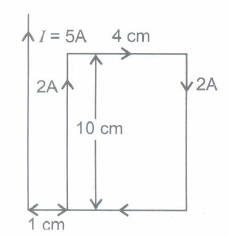
(i) the torque acting on the loop and
(ii) the magnitude and direction of the force on the loop due to the current carrying wire.
2.
Use Biot-Savart's law to derive the expression for the magnetic field on the axis of a current carrying circular loop of radius R. Draw the magnetic field lines due to a circular wire carrying current (I).
3.
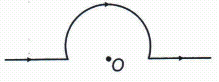
A straight wire carrying a current of 10 A is bent into a semi-circular are of radius 2.0 cm as shown in the figure. What is the magnetic field at O due to
(i) straight segments and
(ii) the semi-circular arc?
4.
A charged 30\(\mu \)F capacitor is connected to a 27mH inductor. What is the angular frequency of free oscillations of the circuit?
5.
The ratio of the number of turns in primary and secondary coil of a step up transformer is 1:200. It is connected to a.c. mains of 220 volt. Calculate the voltage developed in the secondary. Determine the maximum current in secondary coil, when a current of 2 ampere flows through the primary.
6.
Calculate the magnetic field \(\vec { B } \) at a distance 0.1 from a long straight wire carrying a current of 5A.
7.
In a galvanometer there is a deflection of 10 divisions per mA. The internal resistance of the galvanometer is 78 \(\Omega\). If a shunt of 2 \(\Omega\) is connected to the galvanometer and there are 75 divisions in all on the maximum current which the galvanometer can read.
8.
State Biot-Savart law giving the mathematical expression for it. Use this law to derive the expression. Use this law to derive the expression for the magnetic field due to a circular coil carrying current at a point along its axis. How does a circular loop carrying current behave as a magnet?
9.
Two linear parallel conductors carrying currents in the same direction attract each other and two linear parallel conductors carrying in opposite directions repel each other. The force acting per unit length due to currents \({ I }_{ 1 }and{ I }_{ 2 }\)in two linear parallel conductors held distance r apart in vacuum in SI unit is \(F=\frac { { \mu }_{ 0 } }{ 2\pi } \frac { 2{ I }_{ 1 }{ I }_{ 2 } }{ r } \)
Read the above passage and answer the following questions:
(i) What is the basic reason for the force between two linear parallel conductors currents?
(ii) Two straight wires A and B of lengths 2 cm and 20 cm, carrying currents 2.0 A and 5.0 A respectively in opposite directions are lying parallel to each other 4.0 cm apart. The wire A is held near the middle of wire B. What is the force on 20 cm long wire B?
(iii) What does this study imply in day to day life?
10.
A town situated 20km away from a power plant generating power at 440 V requires 600 kW of electric power at 200V. The resistance of town gets power from the line through a 3000-220V step down transformer at a substation in the town. Find line power from the line through a 3000-220V step down transformer at a substation in the town. Find line power losses in the form of heat. How much power must the plant supply assuming that there is negligible power loss due to leakage?
11.
An LC circuit a 20 mH inductor and a \(50\mu F\) capacitor with an initial charge of 10 mC. The resistance of the circuit is negligible. Let the instant the circuit is closed be t = 0.
(a) What is the total energy stored initially? IS it conserved during LC oscillations?
(b) What is the natural frequency of the circuit?
(c) At what time is the energy stored
(i) completely electrical (i.e., stored in the capacitor)?
(ii) completely magnetic (i.e., stored in the inductor).
(d) At what times is the total energy shared equally between the inductor and the capacitor?
(e) If a resistor is inserted in the circuit, how much energy is eventually dissipated as heat?
12.
Define 'quality factor' of resonance in series L-C-R circuit. What is its SI unit?
13.
How much average power over a complete cycle does an a.c.source supply to a capacitor.
14.
A solenoid of length 0.5 m has a radius of 1 cm and is made up of 500 turns. It carries a current of 5 A. What is the magnitude of the magnetic field inside the solenoid ?
15.
Two circular loops of radii r and 2 r have current I and I/2 flowing through them in clockwise and anticlockwise sense respectively. If their equivalent magnetic moments are M1 and M2 ,what is the relation between M1 and M 2 ?
16.
A galvanometer of resistance 50 \(\Omega \) is shunted by a resistance of 5 \(\Omega \) . What fraction of the main current passes through the galvanometer? Through the shunt ?
17.
When a charged particle moves in a magnetic field, does its kinetic energy always remain constant? Explain.
18.
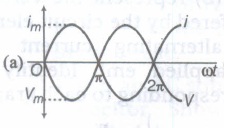
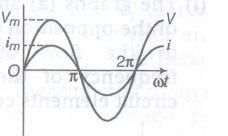
Which of the following graphs shows, in a pure resistor, the voltage and current are in phase?
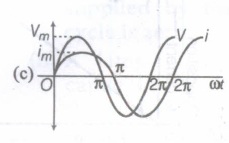
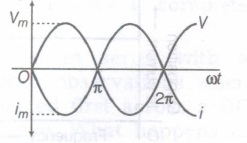
19.
Ferromagnetism show their properties due to
filled inner subshells
vacant inner subshells
partially filled inner subshells
all the subshells equally filled
20.
The intensity of magnetic field at a point X on the axis of a small magnet is equal to the field intensity at another point Y on equatorial axis. The ratio of distance of X and Y from the centre of the magnet will be
(2) - 3
(2) - 1/3
2 3
2 1/3
21.
A conducting wire of length l is turned in the form of a circular coil and a current I is passed through it. For the torque, due to magnetic field produced at its centre, to be maximum, the number of turns in the coil will be
one
two
three
more than three.
22.
The output of a step-down transformer is measured to be 24V when connected to a 12 watt light blub. The value of the peak current is
\(1/\sqrt { 2 } A\)
\(\sqrt { 2 } A\)
2 A
\(2\sqrt { 2 } A\)
23.
Out of the following, choose the wrong statement :
A transformer cannot work on d.c.
A transformer cannot change the frequency of a.c.
A transformer can produce a.c. power
In a transformer, when a.c. voltage is raised n times, the alternating current reduces to 1/n time.
24.
A long solenoid has n turns per metre and current I A is flowing through it. The magnetic field induction at the ends of the solenoid is
zero
\({ \mu }_{ o }nI/2\)
\({ \mu }_{ o }nI\)
\(2{ \mu }_{ o }NI\)
25.
If a copper wire carries a direct current, the magnetic field associated with the current will be
only outside the wire
only inside the wire
both inside and outside the wire
neither inside nor outside the wire
26.
Let an alternating source of emf E= E0sin \(\omega\)t is connected to a circuit having a pure inductance L. If I is the value of instantaneous current in the circuit, then I = I0 \(\sin \left(\omega t-\frac{\pi}{2}\right)\) . The inductive reactance, XL = \(\omega\)L limits the current in a purely inductive circuit.
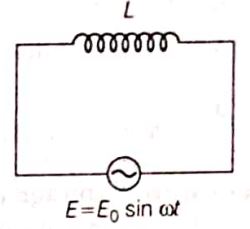
Answer the following questions based on above passage.
(i) What is the phase difference between E and I?
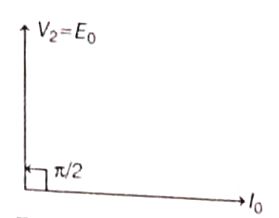
(ii) Draw the phasor diagram of the circuit containing pure inductor and connected to an AC voltage E = E0 sin \(\omega\)t.
(iii) What is the maximum value of current when inductance of 3H is connected to 150 V - 50 Hz supply?
(iv) A 200 Hz AC is flowing in 15 mH coil. What is the value of reactance?
27.
A charged particle moving in a magnetic field experiences a force that is proportional to the strength of the magnetic field, the component of the velocity that is perpendicular to the magnetic field and the charge of the particle.
This force is given by \(\vec{F}=q(\vec{v} \times \vec{B})\) where q is the electric charge of the particle, v is the instantaneous velocity of the particle, and B is the magnetic field (in tesla).
The direction of force is determined by the rules of cross product of two vectors
Force is perpendicular to both velocity and magnetic field. Its direction is same as \(\vec{v} \times \vec{B}\) if q is positive and opposite of \(\vec{v} \times \vec{B}\) if q is negative
The force is always perpendicular to both the velocity of the particle and the magnetic field that created it. Because the magnetic force is always perpendicular to the motion, the magnetic field can do no work on an isolated charge. It can only do work indirectly, via the electric field generated by a changing magnetic field.
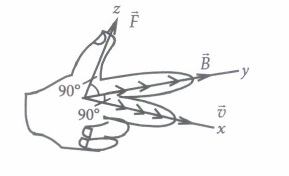
(I) When a magnetic field is applied on a stationary electron, it
| (a) remains stationary |
| (b) spins about its own axis |
| (c) moves in the direction of the field |
| (d) moves perpendicular to the direction of the field. |
(ii) A proton is projected with a uniform velocity v along the axis of a current carrying solenoid, then
| (a) the proton will be accelerated along the axis |
| (b) the proton path will be circular about the axis |
| (c) the proton moves along helical path |
| (d) the proton will continue to move with velocity v along the axis. |
(iii) A charged particle experiences magnetic force in the presence of magnetic field. Which of the following statement is correct?
| (a) The particle is stationary and magnetic field is perpendicular. |
| (b) The particle is moving and magnetic field is perpendicular to the velocity |
| (c) The particle is stationary and magnetic field is parallel |
| (d) The particle is moving and magnetic field is parallel to velocity |
(iv) A charge q moves with a velocity 2 ms-1 along x-axis in a uniform magnetic field \(\vec{B}=(\hat{i}+2 \hat{j}+3 \hat{k}) \mathrm{T}\) then charge will experience a force
| (a) in z-y plane | (b) along -yaxis | (c) along +z axis | (d) along -z axis |
(v) Moving charge will produce
| (a) electric field only | (b) magnetic field only |
| (c) both electric and magnetic field | (d) none ofthese. |
28.
Assertion (A) Diamagnetic substances exhibit magnetism.
Reason (R) Diamagnetic materials do not have permanent magnetic dipole moment.
(a) Both Assertion and Reason are true and Reason is the correct explanation of Assertion.
(b) Both Assertion and Reason are true but Reason is not the correct explanation of Assertion.
(c) Assertion is true but Reason is false.
(d) Assertion is false but Reason is true
29.
Assertion (A) : A transformer cannot work on D.C supply.
Reason (R) : D.C changes neither in magnitude nor in direction.
Codes:
(a) Both A and R are true and R is the correct explanation of A
(b) Both A and R are true but R is NOT the correct explanation of A
(c) A is true but R is false
(d) A is false and R is also false
30.
Assertion (A) : When force is zero, the charged particle follows linear path.
Reason (R) : A charged particle enters in a uniform magnetic field, whose velocity makes an angle \(\theta\) with magnetic field will cover a linear path.
Codes:
(a) Both A and R are true and R is the correct explanation of A
(b) Both A and R are true but R is NOT the correct explanation of A
(c) A is true but R is false
(d) A is false and R is also false
31.
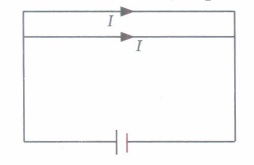
Assertion (A) : When two long parallel wires, hanging freely are connected in parallel to a battery, they come closer to each other.
Reason (R) : Wires carrying current in opposite direction repel each other.
Codes:
(a) Both A and R are true and R is the correct explanation of A
(b) Both A and R are true but R is NOT the correct explanation of A
(c) A is true but R is false
(d) A is false and R is also false
1.
(i) Torque acting on the loop is given by
\(\tau=M B \sin \theta\)
As the angle between the magnetic field vector and the dipole moment vector is zero.
\(\tau=M B \sin (0)=0 \mathrm{Nm}\)
(ii) Magnitude of force is given by
\(F=\frac{2 \mu_{0} I_{1} I_{2} l}{4 \pi}\left[\frac{1}{r_{1}}-\frac{1}{r_{2}}\right]\)
where \( l=10 \times 10^{-2} \mathrm{~m}, I_{1}=2 \mathrm{~A}, I_{2}=5 \mathrm{~A}
r_{1}=1 \times 10^{-2} \mathrm{~m}, r_{2}=5 \times 10^{-2} \mathrm{~m}
\)
\(F=\left[2 \times 10^{-7} \times 2 \times 5 \times 10^{-1}\right]
\quad\left[\frac{1}{10^{-2}}-\frac{1}{5 \times 10^{-2}}\right]
\)
\(
F =20 \times 10^{-8}\left[1-\frac{1}{5}\right] \times \frac{1}{10^{-2}}
\)
\(=\frac{20 \times 10^{-6} \times 4}{5}=16 \times 10^{-6} \mathrm{~N}\)
The net force is attractive because the arm of the loop carrying current in the same direction as the Direction of current in the wire is nearer.
2.
Let us consider a circular loop of radius a with centre C. Let the plane of the coil be
perpendicular to the plane of the paper and current I be flowing in the direction as shown in the figure. Suppose P is any point on the axis at a direction from the centre.
s.png)
Now, consider a current element Idl on top (L) where current comes out of paper normally, whereas at bottom (M) enters into the plane of paper normally.
\(\because LP \bot Idl\)
Also \(MP \bot Idl\)
\(\because LP=MP=\sqrt{r^{2}+a^{2}}\)
The magnetic field at point P due to current element Idl. According to Biot-Savart's law,
dB = \(\frac{\mu_0}{4\pi}.\frac{Idl sin 90^{0}}{(r^{2}+a^{2})}\)
where, a = radius of circular loop,
r = distance of point P from centre along the axis. The direction of dB is perpendicular to LP and along PQ, where \(PQ \bot LP\) Similarly, the same magnitude of magnetic field is obtained due to current element Idl at the bottom and direction is along PQ', where \(PQ^{'} \bot MP\).
Now, resolving dB due to current clement at Land M dB cos \(\phi\) components balance each other and net magnetic field is given by
B = \(\oint dB sin \phi = \oint \frac{\mu_0 }{4\pi} (\frac{Idl}{r{2}+a^{2}}).\frac{a}{\sqrt{r^{2}+a^{2}}}\)
\([\therefore In \Delta PCL, sin \phi = \frac{a}{\sqrt{r^{2}+a^{2}}}]\)
\(=\frac{\mu_0}{4\pi} \frac{Ia}{(r^{2}+a^{2})^{3/2}} \oint dl=\frac{\mu_0}{4\pi}\frac{Ia}{(r^{2}+a^{2})^{3/2}}(2\pi a)\)
or \(B=\frac{\mu_0Ia^{2}}{2(r^{2}+a^{2})^{3/2}}\)
For N turns, B = \(\frac{\mu_0 N Ia^{2}}{2(r^{2}+a^{2})^{3/2}}\) Tesla.
The diagram of magnetic field lines due to a circular wire carrying current I is.
s.png)
3.
(i) Magnetic field due to straight segments is
\(B=\int { \frac { \mu _{ \circ } }{ 4\pi } } .\frac { Id1\times r }{ { r }^{ 3 } } \)
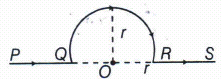
For point O, dI and r for each element of straight segments PQ and RS are parallel.
Therefore, dI x r = 0
Thus, magnetic field due to straight segments is zero.
(ii) Magnetic field at center O due to semi-circular arc
\(=\frac { Magnetic\ field\ at\ center\ of \ circular\ coil }{ 2 } \)
\(=\frac{1}{2}\left(\frac{\mu_0 I}{2 r}\right)=\frac{\mu_0 I}{4 r}=\frac{\left(4 \pi \times 10^{-7}\right) \times 10}{4 \times 2 \times 10^{-2}}\)
[Given, I = 10 A and r = 2.0 cm = \(2\times { 10 }^{ -2 }\)m]
\(=5\pi \times { 10 }^{ -5 }T\)
4.
Capacitance, C = 30μF = 30 × 10−6F
Inductance, L = 27 mH = 27 × 10−3 H
Angular frequency is given as:
\({ \omega }_{ r }=\frac { 1 }{ \sqrt { LC } } =\frac { 1 }{ \sqrt { 27\times { 10 }^{ -3 }\times 30\times { 10 }^{ -6 } } } =\frac { { 10 }^{ 4 } }{ 9 } =1.1\times { 10 }^{ 3 }rad/s\)
Hence, the angular frequency of free oscillations of the circuit is 1.11 × 10³ rad/s.
5.
44 kV, 0.01 amp.
6.
\(Given \ r=0.1m,I=5A.\)
\(\\ \therefore \ d B=\frac { { \mu }_{ 0 }I }{ 2\pi r } =\frac { 4\pi \times { 10 }^{ -7 }\times 5 }{ 2\pi \times 0.1 }\)
\(={ 10 }^{ -5 }J\)
7.
I = 0.3 A
8.
Statement for Biot-Savart Law: The magnitude of magnetic field \(d\overrightarrow { B } \) due to current element is directly proportional to the current I, the elements length \(\left| dl \right| \) and inversely proportional to the square of the distance r of the field point. Its direction is perpendicular to the plane containing \(\overrightarrow { dl } \)and \(\overrightarrow{r}\).
\(d\overrightarrow B\alpha\frac{I\overrightarrow dl \times \overrightarrow r}{r^{ 3}}\)
Or \(d\overrightarrow B=\frac {\mu_0}{4 \pi}\frac{I\overrightarrow dl \times \overrightarrow r}{r^{ 3}}\)
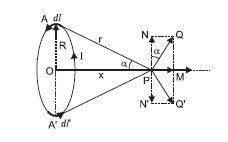
The magnetic field due to \(\overrightarrow {dl}\) is given by Biot Savart law as
\(dB=\frac {\mu_0}{4\pi}.\frac { I\left| \overrightarrow { dl } \times \overrightarrow { r } \right| }{ { r }^{ 3 } } \)
Now dBx= Db Cos \(\theta\) = \(\frac { \mu _{ 0 } }{ 4\pi } .\frac { Idl }{ \left( { x }^{ 2 }+{ R }^{ 2 } \right) } \cos { \theta } \)
\(=\frac { \mu _{ 0 } }{ 4\pi } .\frac { Idl }{ \left( { x }^{ 2 }+{ R }^{ 2 } \right) } \frac { R }{ \left( { x }^{ 2 }+{ R }^{ 2 } \right) ^{ 1/2 } } \)
So, \({ B }_{ x }=\int { dB_{ s }=\frac { { \mu }_{ 0 } }{ 4\pi } } \frac { IR }{ \left( { x }^{ 2 }+{ R }^{ 2 } \right) ^{ 3/2 } } \int { dl } \)
\(=\frac { { \mu }_{ 0 }IR^{ 2 } }{ 2\left( { x }^{ 2 }+{ R }^{ 2 } \right) ^{ 3/2 } } \)
(The y-components, of the field, add up to zero,due to symmetry)
\(\therefore\)Magnetic field at P due to a circular loop
\(=B={ B }_{ x }\overrightarrow { i } =\frac { { \mu }_{ 0 }IR^{ 2 } }{ 2\left( { x }^{ 2 }+{ R }^{ 2 } \right) ^{ 3/2 } } \overrightarrow { i } \)
Explanation: A circular current loop produces magnetic field and its magnetic moment is the product of current and its area \(\overrightarrow M=\overrightarrow {LA}\)
9.
(i) The force is due to the interaction between magnetic fields due to currents in two linear parallel conductors.
(ii) Here, \({ l }_{ 1 }=2cm=2\times { 10 }^{ -2 }m;{ l }_{ 2 }=20\times { 10 }^{ -2 }m;{ I }_{ 1 }=2.0A;{ I }_{ 2 }=5.0A;r=4\times { 10 }^{ -2 }m\)
Since action and reaction are equal and opposite so the magnitude of repulsive force on 20 cm long wire = the magnitude of repulsive force on 2 cm long wire
= \(\frac { { \mu }_{ 0 } }{ 4\pi } \frac { 2{ I }_{ 1 }{ I }_{ 2 } }{ r } { l }_{ 1 }={ 10 }^{ -7 }\times \frac { 2\times 2\times 5\times (2\times { 10 }^{ -2 }) }{ 4\times { 10 }^{ -2 } }\)
\( ={ 10 }^{ -6 }\)
This study shows that when the current through two parallel conductors flow in the same direction, they attract each other and vice versa. It implies that when the thoughts and actions of two business partners are aligned in the same direction, their behavior is cohesive and they succeed. If there thoughts and actions are opposing, the partnership is likely to collapse. The same thing is true for husband and wife. For a successful family life, the coherence of thoughts and action is a must.
10.
Resistance of two line wires, R = 20\(\times\)2\(\times\)0.4 = 16\(\Omega \)
For the transformer, Ep = 3000 V, Es = 220 V and P = 600 kW = 6\(\times\)105 W
\(\therefore \) Current carried by line wires, \({ I }_{ v }=\frac { P }{ { E }_{ p } } =\frac { 6\times { 10 }^{ 5 } }{ 3000 } =200A\)
Power loss in the form of heat = \({ I }_{ v }^{ 2 }\times R=\left( 200 \right) ^{ 2 }\times 16=640000W=640kW\)
\(Power\ supplied \ by\ plant\ =\ power\ demand\ +\ power\ loss\)
\(=\ 600+640=1240kW\)
11.
(a) 1.0 J, yes
(b) \(\omega \) = 103 rad s-1, v = 159 Hz
(c) 1.0 J
12.
The quality factor (Q) of resonance in series L-C-R circuit is defined as the ratio of voltage drop across inductor (or capacitor) to the applied voltage,
\(\text { i.e., } \mathrm{Q}=\frac{V_L}{V_R}=\frac{I_0 X_L}{I_0 R}=\frac{\omega_0 L}{R}=\frac{I}{\omega_0 C R}\)
It is an indicator of sharpness of the resonance. Quality factor has no unit.
13.
\(\text { Average power, } \vec{P}=V_{r m s} \times i_{r m s} \times \cos \phi\)
\(
\text { Where } \phi=90^{\circ} \\
\therefore \vec{P}=V_{r m s} \times i_{r m s} \times \cos 90^{\circ} \\
=0
\)
14.
Given, total number of turns, N = 500
Length of solenoid, l = 0.5 m
Current, I = 5 A
Radius, r = 1 cm = 10-2 m
Here, \(\begin{aligned} \frac{l}{r} & =\frac{0.5}{10^{-2}}=50 \Rightarrow l>>r \\ \end{aligned}\)
\(\begin{aligned} \therefore B & =\mu_0 n I=\frac{\mu_0 N I}{l} \\ \end{aligned}\)
\(\begin{aligned} =4 \pi \times 10^{-7} \times \frac{500}{0.5} \times 5 \end{aligned}\)
= 6.28 \(\times\) 10-3 T
15.
\({ M }_{ 1 }=I\left( { \pi r }^{ 2 } \right) \)
\({ M }_{ 2 }=\frac { I }{ 2 } \left( { \pi 4r }^{ 2 } \right) =I\left( { 2\pi r }^{ 2 } \right) \quad \therefore \frac { { M }_{ 1 } }{ { M }_{ 2 } } =\frac { 1 }{ 2 } \)
The direction of \(\overset { \rightarrow }{ { M }_{ 1 } } \) is opposite to the direction of \(\overset { \rightarrow }{ { M }_{ 2 } } \)
16.
Fraction of current passing through galvanometer
\(=\frac { { i }_{ g } }{ i } =\frac { S }{ G+S } =\frac { 5 }{ 50+5 } =\frac { 1 }{ 11 } \)
Fraction of current passing through shunt
\(=\frac { { i }_{ s } }{ i } =\frac { i-{ i }_{ g } }{ i } =1-\frac { { i }_{ g } }{ i } =1-\frac { 1 }{ 11 } =\frac { 10 }{ 11 } \)
17.
The force on moving charged particle in a magnetic field, \(\overset { \rightarrow }{ F } =q\left( \overset { \rightarrow }{ v } \times \overset { \rightarrow }{ B } \right) \) is always perpendicular to \(\overset { \rightarrow }{ v } \) and \(\overset { \rightarrow }{ B }.\) Thus work done = FS cos 90o = 0.
This means that a uniform magnetic field can do not work on charged particle although it can change its direction of motion. Hence the kinetic energy of charged particle in a magnetic field remains unchanged.
18.
(b)
19.
(c)
partially filled inner subshells
20.
(d)
2 1/3
21.
(a)
one
22.
(a)
\(1/\sqrt { 2 } A\)
23.
(c)
A transformer can produce a.c. power
24.
(b)
\({ \mu }_{ o }nI/2\)
25.
(a)
only outside the wire
26.
(i) The phase difference berween E and I is \(\frac{\pi}{2}\). the voltage E leads the current I by phase angle \(\frac{\pi}{2}\).
(ii) The phasor diagram is given by
(iii) L = 3 H, Erms = 150 V, f = 50 Hz
\(I_0=\frac{E_0}{X_L}=\frac{\sqrt{2} E_{\mathrm{mms}}}{2 \pi f L}=\frac{\sqrt{2} \times 150}{2 \pi \times 50 \times 3}=0.225 \mathrm{~A}\)
(iv) f = 200 Hz, L = 15 mH = 15 \(\times\)10-3 H
\(\therefore\) Inductive reactance, XL = \(\omega\)L = 2\(\pi\)fL
= 2 \(\pi\) \(\times\)200 \(\times\)15 \(\times\)10-3 = 18.84 \(\Omega\)
27.
(i) (a): For stationary electron, \(\vec{v}=0\)
\(\therefore\) Force on the electron is \(\vec{F}_{m}=-e(\vec{v} \times \vec{B})=0\)
(ii) (d): Force on the proton \(\vec{F}_{B}=e(\vec{v} \times \vec{B})\)
Since, \(\vec{v}\) is parallel to \(\vec{B}\)
\(\therefore \quad \vec{F}_{B} \doteq 0\)
Hence proton will continue to move with velocity v along the axis of solenoid.
(iii) (b): Magnetic force on the charged particle q is
\(\vec{F}_{m}=q(\vec{v} \times \vec{B}) \text { or } F_{m}=q v B \sin \theta\)
where \(\theta\) is the angle between \(\vec{v} \text { and } \vec{B}\)
Out of the given cases, only in case (b) it will experience the force while in other cases it will experience no force
(iv) (a) : \(\vec{F}=q(\vec{v} \times \vec{B})\)
\(=q[(2 \hat{i} \times(\hat{i}+2 \hat{j}+3 \hat{k})]=(4 q) \hat{k}-(6 q) \hat{j}\)
(v) (c): When an electric charge is moving both electric and magnetic fields are produced, whereas a static charge produces only electric field.
28.
(a) Both Assertion and Reason are true and Reason is the correct explanation of Assertion.
29.
(a): Transformer works on the principle of mutual induction i.e., if two coils are inductively coupled and when current or magnetic flux is changed through one of the two coils, then induced e.m.f. is produced in the other coil. So whenever there is change in current or magnetic flux, only then e.m.f. is induced. But in case of D.C. current or voltage, e.m.f. is not induced because it remain constant throughout and never changes its direction and magnitude. Therefore transformer cannot work when D.C. is applied.
30.
(c): When charged particle enters the uniform field they makes angle \(\theta\) with the field. Then its path is decided by combined effect of two component of velocity. \(v \cos \theta\) parallel to the field. Due to the parallel
field the charge will follow a linear path and due to the perpendicular component \((v \sin \theta)\) of the field will be circular. This results in a helical path whose axis is parallel to the parallel component of the field
31.
(b): The wires are parallel to each other but the direction of current in it is in same direction so they attract each other. If the current in the wires is in opposite direction then wires repel each other. When the currents are in opposite directions, the magnetic forces are reversed and the wires repels each other

12th Standard CBSE Syllabus & Materials
12th Standard CBSE
CBSE 12th Computer Science Python Revision Tour I - New Previous year Question Papers Study Material - QB365 Set A
NEW12th Standard CBSE
CBSE 12th Business Studies Planning Important Questions And Answers Study Material - QB365 Set A
NEW12th Standard CBSE
CBSE 12th Business Studies Business Environment Important Questions And Answers Study Material - QB365 Set A
NEW12th Standard CBSE
CBSE 12th Business Studies Principles of Management Important Questions And Answers Study Material - QB365 Set A



NCERT Books

Syllabus

Exam Pattern

Sample Question Papers

Previous year Question Papers

Important Notes

MCQ Practice test

NCERT Exemplers

Case study Questions

Image Based Questions

Passage based Questions

HOT Questions

Value Based Questions

Model Questions Papers
NCERT ( Book Back ) Questions

Assertion and Reason
Important Questions And Answers

CBSE 12th Standard CBSE Subjects
CBSE Standards








