
 100% FREE ACCESS
12th Standard CBSE Syllabus & Materials
12th Standard CBSE
CBSE 12th Economics Government Budget and the Economy Previous year Question Papers Study Material - QB365 Set A
NEW12th Standard CBSE
CBSE 12th Computer Science Interface Python with MySQL - New Previous year Question Papers Study Material - QB365 Set A
NEW12th Standard CBSE
CBSE 12th Computer Science Database Concept - New Previous year Question Papers Study Material - QB365 Set A
NEW12th Standard CBSE
CBSE 12th Computer Science Data Communication - New Previous year Question Papers Study Material - QB365 Set A
NEW12th Standard CBSE
CBSE 12th Computer Science Data Structures - New Previous year Question Papers Study Material - QB365 Set A
NEW12th Standard CBSE
CBSE 12th Computer Science Functions - New Previous year Question Papers Study Material - QB365 Set A

Published on: 07/03/2026
Download CBSE Class 12th Standard CBSE Physics question papers, sample papers, important questions, and previous year solved papers in PDF format. Get free study materials, NCERT solutions, and exam preparation resources for Class 12th Standard CBSE Physics
Questions + Answers key
Take MCQ Physics Test
1.
A current carrying wire kept in a uniform magnetic field will experience a maximum force, when it is
perpendicular to the magnetic field
parallel to the magnetic field
at an angle of 45° to the magnetic field
at an angle of 60° to the magnetic field
2.
A potential difference of 200 V is maintained across a conductor of resistance 100Ω. The number of electrons passing through it in 1s is
1.25 x 10¹⁹
2.5 x 10¹⁸
1.25 x 10¹⁸
2.5 x 10¹⁶
3.
A bi-convex lens of focal length is cut into two identical plano-convex lenses. The focal length of each part will be
f
f/2
2f
4f
4.
For ionising an exicited hydrogan atom, the energy required (in eV) will be
a little less than 13.6 eV
13.6 eV
more than 13.6 eV
3.4 or less
5.
The forbidden energy band gap in conductors, semiconductors and insulators are EG1, EG2 and EG3 respectively. The relation among them is
EG1 = EG2 = EG3
EG1 < EG2 < EG3
EG1 > EG2 > EG3
EG1 < EG2 > EG3
6.
Which of the following are not emitted by radioactive substances?
Electrons
Protons
Gamma rays
Helium nuclei
7.
Which of the following spectral series in hydrogen atom gives spectral line of 4860 \(\overset { \circ }{ A } \)?
Lyman
Balmer
Paschen
Brackett
8.
In photoelectric effect, the number of photoelectrons emitted is proportional to
intensity of incident beam.
frequency of incident beam.
velocity of incident beam.
work function of photo cathode.
9.
In Young's double-slit experiment, the intensity is I at a point, where the path difference is \(\frac{\lambda}{6}\) (λ - wavelength of light used). If 10 denotes the maximum intensity then \(\frac{\boldsymbol{I}}{\boldsymbol{I}_{0}}\) is equal to
\( \frac{\sqrt{3}}{2} \)
\( \frac{1}{2} \)
\(\frac{3}{4} \)
\(\frac{1}{\sqrt{2}}\)
10.
When compact disk is illuminated by a source of white light, coloured lines are observed. This is due to
dispersion
diffraction
interference
refraction
11.
A magnifying glass is used, as the object to be viewed can be brought closer to the eye than the normal near point. This results in
a larger angle to be subtended by the object at the eye and hence viewed in greater detail
the formation of a real inverted image.
increase in the field of view.
infinite magnification at the near point.
12.
Which of the following has maximum penetrating power?
Ultraviolet radiation
Microwaves
\(\gamma \text { -rays }\)
Radio waves
13.
An electromagnetic wave travelling along z-axis is given as: \(\boldsymbol{E}=\boldsymbol{E}_{0} \cos (\boldsymbol{k z}-\omega \boldsymbol{t})\) Choose the incorrect option from the following
The associated magnetic field is given as \(B=\frac{1}{c} \hat{k} \times E=\frac{1}{\omega}(\hat{k} \times E)\)
The electromagnetic field can be written in terms of the associated magnetic field as \(\boldsymbol{E}=c(\boldsymbol{B} \times \hat{\boldsymbol{k}})\)
\( \hat{\boldsymbol{k}} \cdot \boldsymbol{E}=\mathbf{0}, \hat{\boldsymbol{k}} \cdot \boldsymbol{B}=\mathbf{0} \)
\(\hat{\boldsymbol{k}} \times \boldsymbol{E}=\mathbf{0}, \hat{\boldsymbol{k}} \times \boldsymbol{B}=\mathbf{0} \)
14.
Which quantity is increased in a step-down transformer?
Current
Voltage
Power
Frequency
15.
Curie law XT = constant, relating magnetic susceptibility (X) and absolute temperature (T) of magnetic substance is obeyed by
all magnetic substances.
paramagnetic substances.
diamagnetic substances.
ferromagnetic substances.
16.
The value of emf in the secondary coil of transformer depends on
the number of turns
material used
voltage
induced flux
17.
A 15.0 \(\mu\)F capacitor is connected to a 220 V,50 Hz source. The capacitive reactance is
220 \(\Omega\)
215 \(\Omega\)
212 \(\Omega\)
204 \(\Omega\)
18.
At a certain place, horizontal component is 1/\(\sqrt{3}\) times the vertical component. The angle of dip at this place is
zero
\(\pi/3\)
\(\pi/6\)
None of these
19.
Figure shows electric field lines in which an electric dipole P is placed as shown. Which of the following statements is correct?
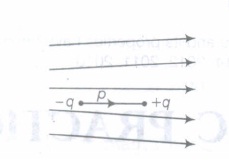
The dipole will not experience any force.
The dipole will experience a force towards right.
The dipole will experience a force towards left.
The dipole will experience a force upwards.
20.
The intensity of magnetic field at a point X on the axis of a small magnet is equal to the field intensity at another point Y on equatorial axis. The ratio of distance of X and Y from the centre of the magnet will be
(2) - 3
(2) - 1/3
2 3
2 1/3
21.
Number of electrons present in a negative charge of 8 C is ____________
5 x10¹⁹
2.5 x 10¹⁹
12.8 x 10¹⁹
1.6 x 10¹⁹
22.
Charge on a body is q1 and it is used to charge another body by induction. Charge on second body is found to be q2 after charging. Then
\(\frac{q_{1}}{q_{2}}=1\)
\(\frac{q_{1}}{q_{2}}<1\)
\(\frac{q_{1}}{q_{2}} \leq 1\)
\(\frac{q_{1}}{q_{2}} \geq 1\)
23.
A lens has focal length 10 cm. An object is placed 15 cm in front of it. Where should a convex mirror be placed, so that image is formed at the object itself, when focal length of convex mirror is 12 cm?
6 cm from lens
8 cm from lens
5 cm from lens
4 cm from lens
24.
The electric field at a distance R due to charge q is E. If the same charge is placed on the copper sphere Of radius R, the electric field strength at the surface of the conductor will be :
E/4
E/2
E
2E
25.
The equivalent resistance in series combination is:
smaller than the largest resistance
larger than the largest resistance
smaller than the smallest resistance
larger than the smallest resistance
26.
The smallest resistance that can be obtained by the combination of n resistors, each of resistance R is:
R/n2
R/n
nR
n2R
27.
A magnet with moment M is given. If it is bent into a semicircular form, its new magnetic moment will be :
\(M/\pi \)
\(M/2\)
\(M\)
\(2M/\pi \)
28.
Consider the two idealized systems: (i) a parallel plate capacitor with large and small separation and (ii) a long solenoid of length L>>R, radius of the cross-section. In (i) \(\overset { \rightarrow }{ E } \) is ideally treated as a constant between plates and zero outside. In (ii) magnetic field is constant inside the solenoid and zero outside. These idealized assumptions, however, contradict fundamental law as below:
case (i) contradicts Gauss's law for electrostatic fields.
case (ii) contradicts Gauss's law for magnetic fields.
case (i) agrees with \(\quad \oint { \overset { \rightarrow }{ E } .d\overset { \rightarrow }{ l } } =0\)
case (ii) contradicts \(\oint { \overset { \rightarrow }{ H } .d\overset { \rightarrow }{ l } } ={ l }_{ en }\)
29.
In Boolean algebra,If A = B = 1, then the value of (A.B+A) is
A
B
A+B
B.A+A
30.
The input resistance of a silicon transistor is 100 ohm. Base current is changed by 40 \(\mu A\)which results in a change in collector current by 2 mA. This transistor is used as a common emitter amplifier with a load resistance of 4 \(k\Omega \) The voltage gain of the amplifier is:
2000
3000
4000
1000
31.
The value of absolute electrical permittivity of free space is
\(9\times 10^9Nm^2C^{-2}\)
\(9\times 10^{-9}Nm^2C^{-2}\)
\(8.85\times 10^{-12}C^2N^{-1}m^{-2}\)
\(8.85\times 10^{-12}C^2Nm^{-2}\)
32.
An X-ray tube operates at 10KV. The ratio of X-ray wavelength to the de-Broglie wavelength is
10 : 1
1 : 10
1 : 100
100 : 1
33.
Electric potential V and electric flux \(\phi\) are
both vectors
both scalars
V is scalar, \(\phi\) is vector
V is vector, \(\phi \) is scalar
34.
Light described at a place by the equation\(E=(100 \ V/m) \ [\sin { (6\times { 10 }^{ 15 }{ s }^{ -1 })t+\sin { (8\times { 10 }^{ 15 } } } { s }^{ -1 })t]\) falls on a metal surface having work function 2.28eV. The maximum energy of the photoelectrons is: (use h = \(6.63\times { 10 }^{ -34 }Js\))
2.28eV
3.0eV
1.24eV
1.50eV
35.
If \(M\left( A,Z \right) ,\ { M }_{ p }\ and\ { M }_{ n }\) denote the masses of the nucleus \(_{ Z }{ { X }^{ A } },\) proton and neutron respectively in units of U \(\left( where\ 1\ U=931.5\quad MeV/{ c }^{ 2 } \right) \) and B.E. represents its B.E. in MeV, then
\(M\left( A,Z \right) =Z{ M }_{ p }+\left( A-Z \right) { M }_{ n }-BE/{ c }^{ 2 }\)
\(M\left( A,Z \right) =Z{ M }_{ p }+\left( A-Z \right) { M }_{ n }+BE\)
\(M\left( A,Z \right) =Z{ M }_{ p }+\left( A-Z \right) { M }_{ n }-BE\)
\(M\left( A,Z \right) =Z{ M }_{ p }+\left( A-Z \right) { M }_{ n }+BE/{ c }^{ 2 }\)
36.
Given the value of Rydberg constant is \({ 10 }^{ 7 }{ m }^{ -1 }.\) The wave number of the last line of Balmer series in hydrogen spectrum will be
\(0.5\times { 10 }^{ 7 }{ m }^{ -1 }\)
\(0.25\times { 10 }^{ 7 }{ m }^{ -1 }\)
\(2.5\times { 10 }^{ 7 }{ m }^{ -1 }\)
\(0.025\times { 10 }^{ 4 }{ m }^{ -1 }\)
37.
Choose the quality whose SI unit is not ohm.
Resistance
Reactance
Capaciatnce
Impedance
38.
When number of turns of a soleniod is doubled, its self inductance becomes k times, where k =
2
1
8
4
39.
Choose the wrong statement:
When ever the amount of magnetic flux linked with a circuit changes, an e.m.f. is induced in the circuit.
The induced e.m.f. lasts so long as the change in magnetic flux continues
Large the amount of magnetic flux linked with a circuit, greater is the e.m.f. induced in it.
The direction of induced e.m.f. is given by Lenz's Llaw.
40.
If \(\overset { \rightarrow }{ E } \) and \(\overset { \rightarrow }{ B } \) represent electric and magnetic field vectors of the electromagnetic wave the direction of propagation of electromagnetic wave is along
\(\overset { \rightarrow }{ E } \)
\(\overset { \rightarrow }{ B } \)
\(\overset { \rightarrow }{ B } \times \overset { \rightarrow }{ E } \)
\(\overset { \rightarrow }{ E } \times \overset { \rightarrow }{ B } \)
41.
42.
The emf induced across the ends of a conductor due to its motion in a magnetic field is called motional emf. It is produced due to the magnetic Lorentz force acting on the free electrons of the conductor. For a circuit shown in figure, if a conductor of length I moves with velocity v in a magnetic field B perpendicular to both its length and the direction of the magnetic field, then all the induced parametres are possible in the circuit

1.Direction of current induced in a wire moving in a magnetic field is found using
a) Fleming left hand rule
b) Fleming right hand rule
c) Amperes law
d) Right hand thumb rule
2.The magnitude of induce emf when the conductor of length l is moved with velocity v does not depends on- on
a) magnetic field
b) velocity
c) resistance
d) length of conductor
3.The current in the primary coil of pair of coils changes from 7 A to 3 A in 0.04s. The mutual inductance between the two coils is 0.5 H. the induced emf in the secondary coil is
a) 50 V
b) 75 V
c) 100 V
c) 220 V
43.
A heavy nucleus breaks into comparatively lighter nuclei which are more stable compared to the original heavy nucleus. When a heavy nucleus like uranium is bombarded by slow moving neutrons, it splits into two parts releasing large amount of energy. The typical fission reaction of \({ }_{92} \mathrm{U}^{235}\).
\({ }_{92} \mathrm{U}^{235}+{ }_{0} n^{1} \rightarrow{ }_{56} \mathrm{Ba}^{141}+{ }_{36} \mathrm{Kr}^{92}+3{ }_{0} n^{1}+200 \mathrm{MeV}\)
The fission of 92U235approximately released 200 MeV of energy.
(i) If 200 MeV energy is released in the fission of a single nucleus of \({ }_{92}^{235} \mathrm{U}\),the fissions which are required to produce a power of 1kW is
| (a) 3.125 x 10¹³ | (b) 1.52 x 10⁶ | (c) 3.125 x 10¹² | (d) 3.125 x 10¹⁴ |
(ii) The release in energy in nuclear fission is consistent with the fact that uranium has
| (a) more mass per nucleon than either ofthe two fragments |
| (b) more mass per nucleon as the two fragment |
| (c) exactly the same mass per nucleon as the two fragments |
| (d) less mass per nucleon than either of two fragments. |
(iii) When 92U235undergoes fission, about 0.1% of the original mass is converted into energy. The energy released when 1 kg of 92U235undergoes fission is
| (a) 9 x 10¹¹J | (b) 9 x 10¹³J | (c) 9 x 10¹⁵J | (d) 9 x 10¹⁸J |
(iv) A nuclear fission is said to be critical when multiplication factor or K
| (a) K= 1 | (b) K> 1 | (c) K< 1 | (d) K=0 |
(v) Einstein's mass-energy conversion relation E = mc2 is illustrated by
| (a) nuclear fission | (b) \(\beta\)-decay | (c) rocket propulsion | (d) steam engine |
44.
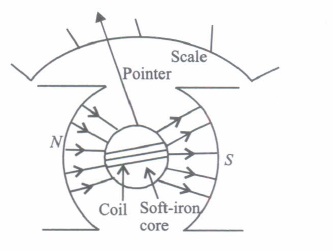
Moving coil galvanometer operates on Permanent Magnet Moving Coil (PMMC) mechanism and was designed by the scientist D'arsonval.
Moving coil galvanometers are of two types
(i) Suspended coil
(ii) Pivoted coil type or tangent galvanometer.
Its working is based on the fact that when a current carrying coil is placed in a magnetic field, it experiences a torque. This torque tends to rotate the coil about its axis of suspension in such a way that the magnetic flux passing through the coil is maximum.
(i) A moving coil galvanometer is an instrument which
| (a) is used to measure emf |
| (b) is used to measure potential difference |
| (c) is used to measure resistance |
| (d) is a deflection instrument which gives a deflection when a current flows through its coil |
(ii) To make the field radial in a moving coil galvanometer
| (a) number of turns of coil is kept small | (b) magnet is taken in the form of horse-shoe |
| (c) poles are of very strong magnets | (d) poles are cylindrically cut |
(iii) The deflection in a moving coil galvanometer is
| (a) directly proportional to torsional constant of spring |
| (b) directly proportional to the number of turns in the coil |
| (c) inversely proportional to the area of the coil |
| (d) inversely proportional to the current in the coil |
(iv) In a moving coil galvanometer, having a coil of N-turns of area A and carrying current I is placed in a radial field of strength B.
The torque acting on the coil is
| \(\text { (a) } N A^{2} B^{2} I\) | \(\text { (b) } N A B I^{2}\) | \(\text { (c) } N^{2} A B I\) | (d) NABI |
(v) To increase the current sensitivity of a moving coil galvanometer, we should decrease
| (a) strength of magnet | (b) torsional constant of spring |
| (c) number ofturns in coil | (d) area of coil |
45.
46.
47.
48.
49.
50.
51.
52.
53.
Assertion (A) : In the field of geometrical optics, light can in assumed to approximately travel in straight line.
Reason (R) : The wavelength of visible light is very small in comparison to the dimensions of typical mirrors and lenses, then light can be assumed to approximately travel in straight line.
(a) Both A and R are true and R is the correct explanation of A.
(b) Both A and R are true but R is not the correct explanation of A.
(c) A is true but R is false.
(d) A is false but R is true.
54.
Assertion (A) : If XC > XL, φ is positive and the circuit is predominantly capacitive. The current in the circuit leads the source voltage.
Reason (R) : If XC < XL, φ is negative and the circuit is predominantly inductive, the current in the circuit lags the source voltage.
(a) Both Assertion and Reason are true and Reason is the correct explanation of Assertion.
(b) Both Assertion and Reason are true but Reason is not the correct explanation of Assertion.
(c) Assertion is true but Reason is false.
(d) Assertion is false but Reason is true.
55.
Assertion (A) : Inductance coil are made of copper.
Reason (R) : Induced current is more in wire having less resistance.
(a) Both Assertion and Reason are true and Reason is the correct explanation of Assertion.
(b) Both Assertion and Reason are true but Reason is not the correct explanation of Assertion.
(c) Assertion is true but Reason is false.
(d) Assertion is false but Reason is true.
56.
Assertion (A) : When a charged particle moves in a circular path. It produces electromagnetic wave.
Reason (R) : Charged particle has acceleration.
Codes:
(a) Both A and R are true and R is the correct explanation of A
(b) Both A and R are true but R is NOT the correct explanation of A
(c) A is true but R is false
(d) A is false and R is also false
57.
Assertion (A) : V - I characteristic of p-n diode is same as that of any other conductor.
Reason (R) : p-n diode behave as conductor at room temperature.
Codes:
(a) Both A and R are true and R is the correct explanation of A
(b) Both A and R are true but R is NOT the correct explanation of A
(c) A is true but R is false
(d) A is false and R is also false
58.
Assertion (A) : Magnetic moment is measured in joule/tesla or amp m2.
Reason (R) : Joule/tesla is equivalent to amp m2.
(a) Both A and R are true and R is the correct explanation of A
(b) Both A and R are true but Ris NOT the correct explanation of A
(c) A is true but R is false
(d) A is false and R is also false
1.
(a)
perpendicular to the magnetic field
2.
(a)
1.25 x 10¹⁹
3.
(c)
2f
4.
(d)
3.4 or less
5.
(b)
EG1 < EG2 < EG3
6.
(b)
Protons
7.
(b)
Balmer
8.
(a)
intensity of incident beam.
9.
(c)
\(\frac{3}{4} \)
10.
(b)
diffraction
11.
(a)
a larger angle to be subtended by the object at the eye and hence viewed in greater detail
12.
(c)
\(\gamma \text { -rays }\)
13.
(d)
\(\hat{\boldsymbol{k}} \times \boldsymbol{E}=\mathbf{0}, \hat{\boldsymbol{k}} \times \boldsymbol{B}=\mathbf{0} \)
14.
(a)
Current
15.
(b)
paramagnetic substances.
16.
(a)
the number of turns
17.
(c)
212 \(\Omega\)
18.
(b)
\(\pi/3\)
19.
(c)
The dipole will experience a force towards left.
20.
(d)
2 1/3
21.
(a)
5 x10¹⁹
22.
(d)
\(\frac{q_{1}}{q_{2}} \geq 1\)
23.
(a)
6 cm from lens
24.
(c)
E
25.
(b)
larger than the largest resistance
26.
(b)
R/n
27.
(d)
\(2M/\pi \)
28.
(d)
case (ii) contradicts \(\oint { \overset { \rightarrow }{ H } .d\overset { \rightarrow }{ l } } ={ l }_{ en }\)
29.
(a)
A
30.
(a)
2000
31.
(c)
\(8.85\times 10^{-12}C^2N^{-1}m^{-2}\)
32.
(a)
10 : 1
33.
(b)
both scalars
34.
(b)
3.0eV
35.
(a)
\(M\left( A,Z \right) =Z{ M }_{ p }+\left( A-Z \right) { M }_{ n }-BE/{ c }^{ 2 }\)
36.
(b)
\(0.25\times { 10 }^{ 7 }{ m }^{ -1 }\)
37.
(c)
Capaciatnce
38.
(d)
4
39.
(c)
Large the amount of magnetic flux linked with a circuit, greater is the e.m.f. induced in it.
40.
(a)
\(\overset { \rightarrow }{ E } \)
41.
42.
1.b) Fleming right hand rule
2.c) resistance
3.a) 50 V
43.
(i) (a) : Let the number of fissions per second be n. Energy released per second
\(=n \times 200 \mathrm{MeV}=n \times 200 \times 1.6 \times 10^{-13} \mathrm{~J}\)
Energy required per second = power x time
\(=1 \mathrm{~kW} \times 1 \mathrm{~s}=1000 \mathrm{~J}\)
\(\therefore \quad n \times 200 \times 1.6 \times 10^{-13}=1000\)
\(\text { or } \quad n=\frac{1000}{3.2 \times 10^{-11}}=\frac{10}{3.2} \times 10^{13}=3.125 \times 10^{13}\)
(ii) (a)
(iii) (b): As only 0.1% of the original mass is converted into energy, hence out of 1 kg mass 1 g is converted into energy.
\(\therefore\) Energy released during fission, \(E=\Delta m c^{2}\)
\(=1 \mathrm{~g} \times\left(3 \times 10^{8} \mathrm{~m} \mathrm{~s}^{-1}\right)^{2}=10^{-3} \times 9 \times 10^{16} \mathrm{~J}=9 \times 10^{13} \mathrm{~J}\)
(iv) (a)
(v) (a)
44.
(I) (d): A moving coil galvanometer is a sensitive instrument which is used to measure a deflection when a current flows through its coil.
(ii) (d): Uniform field is made radial by cutting pole pieces cylindrically.
(iii) (b): The deflection in a moving coil galvanometer \(\phi=\frac{N A B}{k} \cdot I \text { or } \phi \propto N\) where Nis number of turns in a coil, B is magnetic field and A is area of cross-section.
(iv) (d): The deflecting torque acting on the coil
\(\tau_{\text {deflection }}=N I A B\)
(v) (b): Current sensitivity of galvanometer
\(\frac{\phi}{I}=S_{i}=\frac{N B A}{k}\)
Hence, to increase (current sensitivity) Si (torsional constant of spring) k must be decrease.
45.
46.
47.
48.
49.
50.
51.
52.
53.
(a) Both A and R are true and R is the correct explanation of A.
54.
(b) Both Assertion and Reason are true but Reason is not the correct explanation of Assertion.
55.
(a) Both Assertion and Reason are true and Reason is the correct explanation of Assertion.
The inductance coils made of copper will have very small ohmic resistance. Hence, due to change in magnetic flux a large induced current will be produced.
56.
(a): Accelerated charges radiate electromagnetic waves.
57.
(d) : The V-I characteristic of p-n diode depends whether the junction is forward biased or reverse biased. This can be showed by graph between voltage and current.
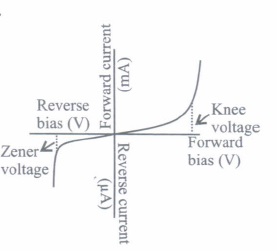
In the given graph knee voltage is a voltage at which forward bias becomes greater than the potential barrier, the forward current increases almost linearly, where as zener voltage is a voltage at which reverse current increases suddenly. From this graph we can verify that p-n diode characteristics are very different from that of conductor which obey's Ohm's law.
58.
(a): Magnetic moment \(=\frac{\text { joule }}{\text { tesla }}=\frac{W}{B}=\frac{W}{F / q v}\)
\(=\frac{W q v}{F}=\frac{\left[M L^{2} T^{-2}\right][A T]\left[L T^{-1}\right]}{\left[M L T^{-2}\right]}\)
\(=\left[\mathrm{AL}^{2}\right]=\mathrm{amp} \mathrm{m}^{2}\)

12th Standard CBSE Syllabus & Materials
12th Standard CBSE
CBSE 12th Computer Science Python Revision Tour I - New Previous year Question Papers Study Material - QB365 Set A
NEW12th Standard CBSE
CBSE 12th Business Studies Planning Important Questions And Answers Study Material - QB365 Set A
NEW12th Standard CBSE
CBSE 12th Business Studies Business Environment Important Questions And Answers Study Material - QB365 Set A
NEW12th Standard CBSE
CBSE 12th Business Studies Principles of Management Important Questions And Answers Study Material - QB365 Set A



NCERT Books

Syllabus

Exam Pattern

Sample Question Papers

Previous year Question Papers

Important Notes

MCQ Practice test

NCERT Exemplers

Case study Questions

Image Based Questions

Passage based Questions

HOT Questions

Value Based Questions

Model Questions Papers
NCERT ( Book Back ) Questions

Assertion and Reason
Important Questions And Answers

CBSE 12th Standard CBSE Subjects
CBSE Standards








