
 100% FREE ACCESS
12th Standard CBSE Syllabus & Materials
12th Standard CBSE
CBSE 12th Economics Government Budget and the Economy Previous year Question Papers Study Material - QB365 Set A
NEW12th Standard CBSE
CBSE 12th Computer Science Interface Python with MySQL - New Previous year Question Papers Study Material - QB365 Set A
NEW12th Standard CBSE
CBSE 12th Computer Science Database Concept - New Previous year Question Papers Study Material - QB365 Set A
NEW12th Standard CBSE
CBSE 12th Computer Science Data Communication - New Previous year Question Papers Study Material - QB365 Set A
NEW12th Standard CBSE
CBSE 12th Computer Science Data Structures - New Previous year Question Papers Study Material - QB365 Set A
NEW12th Standard CBSE
CBSE 12th Computer Science Functions - New Previous year Question Papers Study Material - QB365 Set A

Published on: 02/11/2025
Download CBSE Class 12th Standard CBSE Physics question papers, sample papers, important questions, and previous year solved papers in PDF format. Get free study materials, NCERT solutions, and exam preparation resources for Class 12th Standard CBSE Physics
Questions + Answers key
Take MCQ Physics Test
1.
A bar magnet placed in a uniform magnetic field of strength 0.3 T with its axis at 30o tot he field experiences a torque of 0.06 N-m. What is the magnetic moment of the bar magnet ?
2.
A steel wire of length l has a magnetic moment M. it is bent into a semicircular arc. What is the new magnetic moment ?
3.
An electron is moving northwards with a velocity 3.0 x 10⁷ ms-1 in a uniform magnetic field of 10 T directed eastwards. Find the magnetic and direction of the magnetic force on the electron. (e = 1.6 x 10⁻¹⁹ C)
4.
A voltmeter reads 5.0 V at full scale deflection and is graded according to its resistance per volt at full scale deflection as 2000 \(\Omega\)/V. How will you convert it into a voltmeter that reads 15V at full scale deflection?
5.
Give two points to distinguish between a paramagnetic and a diamagnetic substance.
6.
Name some magnetic and non-magnetic substances.
7.
Explain the action of shunt ?
8.
A rectangular coil of sides l and b carrying a current I is subjected to a uniform magnetic field \(\overset { \rightarrow }{ B } \) acting at an angle \(\theta \) to its plane. Write the expression for the torque acting on it. In which orientation of the coil in the magnetic field, the torque is (i) minimum and (ii) maximum.
9.
A cyclotron is not suitable to accelerate electrons. Why ?
10.
Write the expression for Lorentz magnetic force on a particle of charge q moving with velocity V in a magnetic field B. Show that no work is done by this force on the charged particle.
11.
Can moving coil galvanometer be used to detect an a.c. in a circuit? Give reason.
12.
Which has greater resistance
(a) milliammeter or ammeter ?
(b) milli voltmeter or voltmeter ?
13.
What is the function of soft iron cylinder between the poles of a galvanometer?
14.
On what interaction is the principle of galvanometer based?
15.
Which physical quantity has the unit Wb/m2? Is it a scalar or a vector quantity?
16.
A charged particle moving in a uniform magnetic field penetrates a layer of lead and there by loses one-half of its kinetic energy. How does the radius of curvature of its path change?
17.
What is magnetic dipole moment of a current loop? Give its direction if any.
18.
What is magnetic flux density? Define its units and give its dimensions.
19.
What is the difference between solenoid and toroid?
20.
How does a current loop behave like a bar magnet?
21.
Name the physical quantity whose unit is tesla. Hence define a tesla.
22.
A galvanometer coil has a resistance of 12 Ω and the metre shows full scale deflection for a current of 3 mA. How will you convert the metre into a voltmeter of range 0 to 18 V ?
23.
(a) Using Ampere's circutial law, obtain the expression for the magnetic field due to a long solenoid a point inside the solenoid on its axis.
(b) In what respect is a toroid different from a solenoid? Draw and compare the pattern of the magnetic field lines in the two cases.
24.
When a galvanometer of resistance G is shunted with a low resistance S, then the effective resistance \({ Re }_{ ff }\)of galvanometer becomes
\( { Re }_{ ff }=\frac { GS }{ G+S } \)
If the current is passed through such a galvanometer, then the major amount of current flows through the shunt and the rest through the galvanometer, then the major amount of current flows through the shunt and the rest through galvanometer., the current divides itself in the inverse ratio of resistances.
Read the above passage and answer the following questions:
(i) Why is the resistance of shunted galvanometer lower than that of a shunt?
(ii) A galvanometer of resistance.\(30\Omega \) What the fraction of the main current passes (i) through the galvanometer and (ii) through the galvanometer and (ii) through the shunt?
(iii) What are the basic values you learn from the above study?
25.
Find the expression for maximum energy of a charged particle accelerated by a cyclotron.
26.
A magnetic needle suspended parallel to a magnetic field requires \(\sqrt { 3 } J\) of work to turn it through \({ 60 }^{ ° }.\) The torque needed to maintain the needle in this position will be :
\(2\sqrt { 3 } J\)
\(3J\)
\(\sqrt { 3 } J\)
\(\frac { 3 }{ 2 } J\)
27.
A magnet with moment M is given. If it is bent into a semicircular form, its new magnetic moment will be :
\(M/\pi \)
\(M/2\)
\(M\)
\(2M/\pi \)
28.
A galvanometer having a coil resistance of \(100\Omega \) gives a full scale deflection, when a current of 1 mA is passed through it. The value of the resistance, which can convert this galvanometer into ammeter giving a full scale deflection for a current of 10 A is
\(0.01\Omega \)
\(2\Omega \)
\(0.1\Omega \)
\(3\Omega \)
29.
A straight wire of mass 200 g and length 1.5 m carries a current of 2 A. It is suspended in mid air by uniform horizontal magnetic field B. The magnitude of B (in Tesla) is : (Take \(g=9.8m/{ s }^{ 2 }\))
2
1.5
0.55
0.65
30.
A long straight wire of radius a carries a steady current i. The current is uniformly distributed across its cross-section. The ratio of the magnetic field at a/2 and 2 a is
1/2
1/4
4
1
31.
In a permanent magnet at room temperature
the magnetic moment of each molecule is zero
the individual molecules have a non-zero magnetic moment which is all perfectly aligned
domains are partially aligned
domains are all perfectly aligned.
32.
In a cyclotron a charged particle
undergoes acceleration all the time
speeds up between the dees because of the magnetic field.
speeds up in a dee
slows down within a dee and speeds up between dees.
33.
A coil of wire has an area of 600 sq. cm and has 500 turns. If it carries 1.5 A current, its magnetic dipole moment is
5 Am2
15 Am2
30 Am2
45 Am2
34.
If a copper wire carries a direct current, the magnetic field associated with the current will be
only outside the wire
only inside the wire
both inside and outside the wire
neither inside nor outside the wire
35.
The magnetic field at a perpendicular distance of 2 cm from an infinite straight current carrying conductor is 2x10⁻⁶ T. The current in the wire is
0.1 A
0.2 A
0.4 A
0.8 A
1.
\(Here,B=0.3 \ T,\theta ={ 30 }^{ o },\tau =0.06N-m,M=?\)
\(As \ \tau =MB\quad sin\theta ,\ M=\frac { \tau }{ Bsin\theta } =\frac { 0.06 }{ 0.3sin{ 30 }^{ o } } \)
= 0.4 Am2
2.
Here, pole strength, \(m=\frac { M }{ l } \)
If r is radius of semicircle, then
\(\pi r = l, \ r=\frac { l }{ \pi } \)
New magnetic moment M' = m X 2r
\(=\frac { M }{ l } .\frac { 2l }{ \pi } =\frac { 2M }{ \pi } \)
3.
F = qv B sin\(\theta \) = (1.6 x 10-19) x (3 x 107) x (10) x sin90o = 4.8x10⁻¹¹ N. Here \(\overset { \rightarrow }{ B } \) is directed east wards; current is southwards which is opposite to the motion of electrons. Now apply Fleeming's Left hand rule, the direction of \(\overset { \rightarrow }{ F } \) is vertically upwards.
4.
By using R = 2 \(\times\) 104\(\Omega\) in series
5.
| Diamagnetic | Paramagnetic |
| 1. Weakly repelled by external magnetic field. | 1. Weakly attracted by magnetic field. |
| 2. Align perpendicular to the field. | 2. Align parallel to the field. |
| 3. Move from stronger to weaker region. | 3. Move from weaker to stronger region. |
| 4. Not affected by temperature. | 4. Affected by temperature. |
| 5. Susceptibility <0 | 5. Susceptibility >0 |
| 6. Permeability \(\mu\)r <1 | 6. Permeability \(\mu\)r>1 |
6.
Iron, cobalt, nickel, steel etc. are magnetic substances. Brass, paper, wood etc. are non-magnetic substances.
7.
The shunt is a low resistance connected in parallel to a galvanometer to protect it from the strong currents in the circuit. The galvanometer shows full scale deflection with a very small current. If the whole of the strong current in an electric circuit passes through galvanometer, it may get damaged. The shunt allows only a small part of the current to flow through the galvanometer by pass to the major part of the current.
8.
Torque on the coil,
\(\tau =IAB\quad b \ cos\theta =IlbB \ cos\theta \)
(i)Torque is minimum if minimum, i.e.,
i.e., the plane of coil is set perpendicular to the direction of magnetic field.
(ii) Torque is maximum if \(cos\theta =1 \ or \ \theta ={ 0 }^{ o }\) It means the plane of coil parallel to the direction of magnetic field.
9.
When an electron is accelerated in a cyclotron, very soon it acquires a very high velocity. Due to it, its mass increases with velocity according to relation \(m={ m }_{ o }/\sqrt { \left( 1-{ v }^{ 2 }/{ c }^{ 2 } \right) } \) . Therefore the time taken by electron to describe semicircular path inside the dee of a cyclotron, \(t=\pi m/Bq,\) also increases with the increase of m. Due to it, the electron does not arrive in the gap between the two dees exactly at the instant, the polarity of the two dees is reversed. As a result of it, the electron goes out of steps with the oscillating electric field and hence can not be accelerated by cyclotron.
10.
Lorentz magnetic force on a moving charged particle in the magnetic field is
\(\overset { \rightarrow }{ F } =q\left( \overset { \rightarrow }{ v } \times \overset { \rightarrow }{ B } \right) \)
This force is acting perpendicular to the plane containing \(\overset { \rightarrow }{ v } \) and \(\overset { \rightarrow }{ B } \) , and is directed as given by Right Hand rule. Since work done,
\(\overset { \rightarrow }{ W } =\overset { \rightarrow }{ F } .\overset { \rightarrow }{ s } =Fscos\theta ,\)
where is displacement of charged particle in magnetic field. Here, angle \(\theta ={ 90 }^{ o }\) , so
W = Fs cos 90o
= 0.
11.
A moving coil galvanometer cannot be used to detect a.c. in a circuit, since it measures the average value of current and the average value of a.c. over a complete cycle is zero.
12.
The resistance of milliammeter is greater than that of ammeter. The resistance of voltmeter is greater than that of millivoltmeter.
13.
It concentrates the magnetic field and helps in making the magnetic field radial.
14.
The principle of galvanometer is based on the interaction of current and magnetic field.
15.
Wb/m2 is the SI unit of magnetic field induction B, which is a vector quantity.
16.
\(Kinetic \ energy, \ K=\frac { 1 }{ 2 } { mv }^{ 2 } \ or \ v=\sqrt { \frac { 2K }{ m } }\)
\(Radius \ of \ curvature,\)
\(\\ r=\frac { mv }{ qB } =\frac { m }{ qB } \sqrt { \frac { 2K }{ m } } =\frac { \sqrt { 2mK } }{ qB } \)
\( Therefore,\ r\propto \sqrt { k } ,\)
\( So \ \frac { r' }{ r } =\sqrt { \frac { K/2 }{ K } } =\frac { 1 }{ \sqrt { 2 } } or \ r'=\frac { r }{ \sqrt { 2 } }\)
17.
Magnetic dipole moment of a current loop = niA where n = no. of turns in a current loop; i = current through the loop and A = area of each turn of the loop. Magnetic dipole moment is a vector quantity. Its direction is perpendicular to the plane of loop directed outwards for anticlockwise current in loop and is directed inwards for clockwise current in loop.
18.
Magnetic flux density at a point in a magnetic field means magnetic field induction at that point. It is defined as the force experienced by a unit charge while moving with a unit velocity, perpendicular to the direction of magnetic field at that point. Force experienced by the charged particle having charge q moving with velocity \(\overset { \rightarrow }{ v } \) through a magnetic field \(\overset { \rightarrow }{ B } \) is given by
\( \left| \overset { \rightarrow }{ F } \right| =q\left| \overset { \rightarrow }{ v } \times \overset { \rightarrow }{ B } \right| =qvBsin\theta\)
\(or \ B=\frac { F }{ qvsin\theta } \)
The SI unit of B is tesla, where 1 tesla is the magnetic flux density at a point if 1 coulomb charge while moving with a velocity of 1 ms-1, perpendicular to a magnetic field experiences a force of 1 N at that point.
The dimensional formula of B
\(=\frac { \left[ { MLT }^{ -2 } \right] }{ \left[ AT \right] \left[ { LT }^{ -1 } \right] } =\left[ { ML }^{ o }{ T }^{ -2 }{ A }^{ -1 } \right] \)
19.
A solenoid consists of an insulating long wire closely wound in the form of helix. Its length is very toroid is a hollow circular ring on which a large number of insulated turns of a metallic wire are closely wound. Infact, toroid is an endless solenoid.
20.
A current loop behaves as a bar magnet because
(i) one face of current loop behaves as a south pole and the other face as north pole.
(ii) it possesses a magnetic dipole moment (M = IA) and
(iii) it experiences a torque in an external magnetic field, which tends to align the axis of the loop along the direction of magnetic field as bar magnet does.
21.
Tesla is the SI unit of magnetic field induction or magnetic flux density at a point in the magnetic field. The magnetic field induction at a point in a magnetic field is said to be 1 tesla if one-coulomb charge while moving with a velocity of 1 m/s, perpendicular to the magnetic field experiences a force of 1 N at that point.
22.
Resistance of the galvanometer coil, G = 12 Ω
Current for which there is full scale deflection, Ig = 3 mA = 3 x 10⁻³ A
Range of the voltmeter is 0, which needs to be converted to 18 V.
therefore, V = 18 V
Let a resistor of resistance R be connected in series with the galvanometer to convert it into a voltmeter. This resistance is given as:
\(R=\frac{V}{I_{\mathrm{g}}}-\mathrm{G}\)
\(=\frac{18}{3 \times 10^{-3}}-12=6000-12=5988 \Omega\)
Hence, a resistor of resistance 5998 Ω is to be connected in series with the galvanometer.
23.
\(\oint \overrightarrow B.\overrightarrow{dl}=\mu_0\Sigma i\)
\(\int _{ a }^{ b }{ \overrightarrow { B } .\overrightarrow { dl } + } \int _{ b }^{ c }{ \overrightarrow { B } .\overrightarrow { dl } + } \int _{ c }^{ d }{ \overrightarrow { B } .\overrightarrow { dl } + } \int _{ d }^{ a }{ \overrightarrow { B } .\overrightarrow { dl } =\mu _{ 0 }I(nh) } \)
\(Bh+0+0+0=\mu_0I(nh)\)
\(B=\mu_0nI\)
(b) (Anyon difference ~ In a toroid, magnetic lines do not exist outside this body.
→Toroid is close whereas the solenoid is open on both sides
→ Magnetic field is uniform inside a toroid whereas for solenoid, it is different at the two ends and the centre.
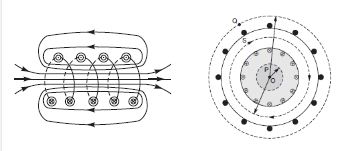
Strengthing of magnetic field: (Anyone) 1
(i) By inserting a ferromagnetic substance inside the solenoid
(ii) By increasing the amount of current through the solenoid
24.
(i) The shunt is a low resistance connected in parallel with the galvanometer. Therefore, the combined resistance is less than that of the shunt.
(ii) Let I be the total current passing through the shunt galvanometer. Let \({ I }_{ g }\),\({ I }_{ s }\) be the currents through galvanometer of resistances G and shunt of resistance S respectively. As current divides itself in the inverse ratio of the resistances, therefore, fraction of current passing through galvanometer
= \(\frac { { I }_{ g } }{ I } =\frac { S }{ G+S } =\frac { 3 }{ 30+3 } =\frac { 1 }{ 11 }\)
\(Fraction \ of \ current \ passing \ through \ shunt=\frac { { I }_{ s } }{ I } =\frac { G }{ G+S } =\frac { 30 }{ 30+3 } =\frac { 10 }{ 11 } \\ \)
(iii) From the above study, we find that the current always divides itself in the inverse ratio of resistances. The major part of current flows through the shunt, which is the path of low resistance. Similarly in life, if different paths are available to reach a destination, then one selects a path of least resistance to reach there. This would save both, time and energy.
25.
Let \({ r }_{ 0 }=\) Maximum radius of circular path followed by charged particle (Equal to the radius of the Dees)
\({ v }_{ 0 }=\) Maximum velocity
Since the necessary centripetal force is provided by the Lorentz magnetic force, therefore,
\( \frac { { m{ v }_{ 0 } }^{ 2 } }{ { r }_{ 0 } } =Bq{ v }_{ 0 }\)
\({ v }_{ 0 }=\frac { Bqr_{ 0 } }{ m }\)
\( \\ \therefore \ { K.E }_{ maxi }=\frac { 1 }{ 2 } \times m\times { \left( \frac { Bqr_{ 0 } }{ m } \right) }^{ 2 }\)
\(=\frac { { b }^{ 2 }{ q }^{ 2 }{ r_{ 0 } }^{ 2 } }{ 2m } \)
This is the required result.
26.
(b)
\(3J\)
27.
(d)
\(2M/\pi \)
28.
(a)
\(0.01\Omega \)
29.
(b)
1.5
30.
(d)
1
31.
(c)
domains are partially aligned
32.
(a)
undergoes acceleration all the time
33.
(d)
45 Am2
34.
(a)
only outside the wire
35.
(b)
0.2 A

12th Standard CBSE Syllabus & Materials
12th Standard CBSE
CBSE 12th Computer Science Python Revision Tour I - New Previous year Question Papers Study Material - QB365 Set A
NEW12th Standard CBSE
CBSE 12th Business Studies Planning Important Questions And Answers Study Material - QB365 Set A
NEW12th Standard CBSE
CBSE 12th Business Studies Business Environment Important Questions And Answers Study Material - QB365 Set A
NEW12th Standard CBSE
CBSE 12th Business Studies Principles of Management Important Questions And Answers Study Material - QB365 Set A



NCERT Books

Syllabus

Exam Pattern

Sample Question Papers

Previous year Question Papers

Important Notes

MCQ Practice test

NCERT Exemplers

Case study Questions

Image Based Questions

Passage based Questions

HOT Questions

Value Based Questions

Model Questions Papers
NCERT ( Book Back ) Questions

Assertion and Reason
Important Questions And Answers

CBSE 12th Standard CBSE Subjects
CBSE Standards








