
 100% FREE ACCESS
12th Standard CBSE Syllabus & Materials
12th Standard CBSE
CBSE 12th Economics Government Budget and the Economy Previous year Question Papers Study Material - QB365 Set A
NEW12th Standard CBSE
CBSE 12th Computer Science Interface Python with MySQL - New Previous year Question Papers Study Material - QB365 Set A
NEW12th Standard CBSE
CBSE 12th Computer Science Database Concept - New Previous year Question Papers Study Material - QB365 Set A
NEW12th Standard CBSE
CBSE 12th Computer Science Data Communication - New Previous year Question Papers Study Material - QB365 Set A
NEW12th Standard CBSE
CBSE 12th Computer Science Data Structures - New Previous year Question Papers Study Material - QB365 Set A
NEW12th Standard CBSE
CBSE 12th Computer Science Functions - New Previous year Question Papers Study Material - QB365 Set A

Published on: 07/03/2026
Download CBSE Class 12th Standard CBSE Physics question papers, sample papers, important questions, and previous year solved papers in PDF format. Get free study materials, NCERT solutions, and exam preparation resources for Class 12th Standard CBSE Physics
Questions + Answers key
Take MCQ Physics Test
1.
A 3.0 cm wire carrying a current of 10 A is placed inside a solenoid perpendicular to its axis. The magnetic field inside the solenoid is given to be 0.27 T. What is the magnetic force on the wire?
2.
What is the magnitude of magnetic force per unit length on a wire carrying a current of 8 A making an angle of 30º with the direction of a uniform magnetic field of 0.15 T?
3.
A horizontal overhead power line carries a current of 90 A in east to west direction. What is the magnitude and direction of the magnetic field due to the current 1.5 m below the line?
4.
A long straight wire in the horizontal plane carries a current of 50 A in north to south direction. Give the magnitude and direction of B at a point 2.5 m east of the wire.
5.
A long straight wire carries a current of 35 A. What is the magnitude of the field B at a point 20 cm from the wire?
6.
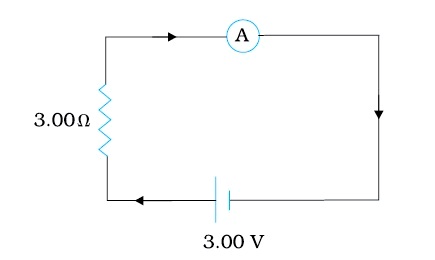
In the circuit the current is to be measured. What is the value of the current if the ammeter shown
(a) is a galvanometer with a resistance RG = 60.00 Ω;
(b) is a galvanometer described in (a) but converted to an ammeter by a shunt resistance rs = 0.02 Ω;
(c) is an ideal ammeter with zero resistance?
7.
A 100 turn closely wound circular coil of radius 10 cm carries a current of 3.2 A.
(a) What is the field at the centre of the coil?
(b) What is the magnetic moment of this coil?
The coil is placed in a vertical plane and is free to rotate about a horizontal axis which coincides with its diameter. A uniform magnetic field of 2T in the horizontal direction exists such that initially the axis of the coil is in the direction of the field. The coil rotates through an angle of 90º under the influence of the magnetic field.
(c) What are the magnitudes of the torques on the coil in the initial and final position?
(d) What is the angular speed acquired by the coil when it has rotated by 90º?. The moment of inertia of the coil is 0.1 kg m2.
8.
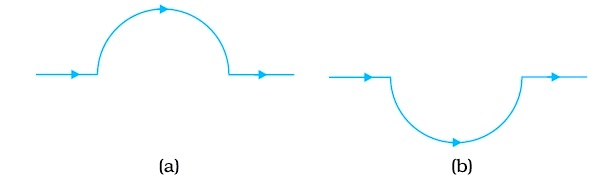
A straight wire carrying a current of 12 A is bent into a semi-circular arc of radius 2.0 cm as shown in Fig (a). Consider the magnetic field B at the centre of the arc.
(a) What is the magnetic field due to the straight segments?
(b) In what way the contribution to B from the semicircle differs from that of a circular loop and in what way does it resemble?
(c) Would your answer be different if the wire were bent into a semi-circular arc of the same radius but in the opposite way as shown in Fig.(b)?
9.
The horizontal component of the earth's magnetic field at a certain place is 3.0 x 10⁻⁵ T and the direction of the field is from geographic south to the geographic north. A very long straight conductor is carrying a steady current of 1 A. What is the force per unit length on it when it is placed on a horizontal table and the direction of current is (a) east to west (b) south to north ?
10.
(i) A circular coil of 30 turns and radius 8.0 cm carrying a current of 6.0 A is suspended vertically in a uniform horizontal magnetic field of magnitude 1.0 T. The field lines make an angle of 60o with the normal of the coil. Calculate the magnitude of the counter torque that must be applied to prevent the coil from turning.
(ii) Would your answer change, if the circular coil were replaced by a planar coil of some irregular shape that encloses the same area? All other particulars are also unaltered.
11.
Obtain the frequency of revolution of the electron in its circular orbit. Does the answer depend on the speed of the electron? Explain.
12.
Two moving coil meters, M1 and M2 have the following particulars:
R1 = 10 Ω, N1 = 30, A1 = 3.6 x 10⁻³ m2, B1 = 0.25 T
R2 = 14 Ω, N2 = 42, A2 = 1.8 x 10⁻³ m2, B2 = 0.50 T
(The spring constants are identical for the two meters). Determine the ratio of (a) current sensitivity and (b) voltage sensitivity of M2 and M1.
13.
A closely wound solenoid 80 cm long has 5 layers of windings of 400 turns each. The diameter of the solenoid is 1.8 cm. If the current carried is 8.0 A, estimate the magnitude of B inside the solenoid near its centre.
14.
In a chamber, a uniform magnetic field of 6.5 G (1 G = 10–4 T) is maintained. An electron is shot into the field with a speed of 4.8 x 10⁶ m s–1 normal to the field. Explain why the path of the electron is a circle. Determine the radius of the circular orbit. (e = 1.5 x 10⁻¹⁹ C, me = 9.1 x 10⁻³¹ kg)
15.
Consider a tightly wound 100 turn coil of radius 10 cm, carrying a current of 1 A. What is the magnitude of the magnetic field at the centre of the coil?
16.
What is the radius of the path of an electron (mass 9 x 10-31 kg and charge 1.6 x 10⁻¹⁹ C) moving at a speed of 3 x 10⁷ m/s in a magnetic field of 6 x 10⁻⁴ T perpendicular to it? What is its frequency? Calculate its energy in keV. ( 1 eV = 1.6 x 10⁻¹⁹ J).
17.
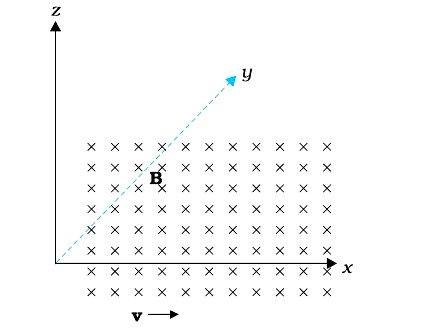
If the magnetic field is parallel to the positive y-axis and the charged particle is moving along the positive x-axis (Figure), which way would the Lorentz force be for
(a) an electron (negative charge),
(b) a proton (positive charge).
18.
A circular coil of wire consisting of 100 turns, each of radius 8.0 cm carries a current of 0.40 A. What is the magnitude of the magnetic field B at the centre of the coil?
19.
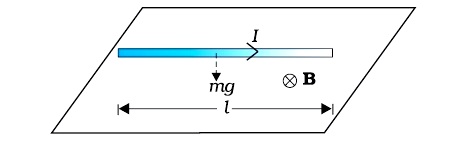
A straight wire of mass 200 g and length 1.5 m carries a current of 2 A. It is suspended in mid air by a uniform horizontal magnetic field B . What is the magnitude of the magnetic field?
20.
A solenoid of length 0.5 m has a radius of 1 cm and is made up of 500 turns. It carries a current of 5 A. What is the magnitude of the magnetic field inside the solenoid ?
21.
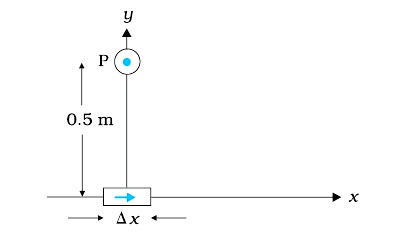
An element Δl = Δx \(\hat i\) is placed at the origin and carries a large current I = 10 A (Figure). What is the magnetic field on the y-axis at a distance of 0.5 m. Δ x = 1 cm.
22.
(a) A Current carrying circular loop lies on a smooth horizontal plane. Can a uniform magnetic field be set up in such a manner that the loop turns around itself(i.e. turns about the vertical axis)?
(b) A current carrying circular loop is located in a uniform external magnetic field. If the loop is free to turn, what is it orientation of stable equilibrium? Show that in this orientation the flux of the total field (external field + field produced by the loop) is maximum.
(c) A loop of irregular shape carrying current is located in an external magnetic field. If the wire is flexible, why does it change to a circular shape?
1.
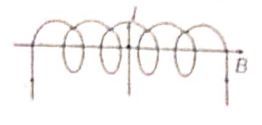
Here, the angle between the magnetic field and the direction of flow of current is 90°. Because the magnetic field due to a solenoid is along the axis of the solenoid and the wire is placed perpendicular to the axis.
Given, l = 3 cm = 3 \(\times\)10-2 m
I = 10 A, B = 0.27 T
The magnitude of magnetic force on the wire,
F = IlB sin 90°
=10 \(\times\)3 \(\times\)10-2 \(\times\)0.27 \(\times\)sin 90°
= 8.1 \(\times\)10-2 N
According to right hand palm rule, the direction of magnetic force is perpendicular to plane of paper inwards.
2.
Here, I = 8 A, \(\theta\) =30°, B = 0.15T, F = ?, l = 1 m
We know that, F = BIl sin \(\theta\)
\(\begin{aligned} & \frac{F}{l}=B I \sin \theta \end{aligned}\)
\(\begin{aligned} \frac{F}{l}=0.15 \times 8 \times \sin 30^{\circ} \end{aligned}\)
= 0.15 \(\times\)8 \(\times\)(1 / 2)
= 0.6 Nm-1
3.
Current in the power line, I = 90 A
Point is located below the power line at distance, r = 1.5 m
Hence, magnetic field at that point is given by the relation,
\(B=\frac{\mu_{0} 2 I}{4 \pi r}\)
Where,
μ0 = Permeability of free space = 4π x 10–7 T m A–1
\(B=\frac{4 \pi \times 10^{-7} \times 2 \times 90}{4 \pi \times 1.5}=1.2 \times 10^{-5} T\)
The current is flowing from East to West. The point is below the power line. Hence, according to Maxwell’s right hand thumb rule, the direction of the magnetic field is towards the South.
4.
Current in the wire, I = 50 A
A point is 2.5 m away from the East of the wire.
∴ Magnitude of the distance of the point from the wire, r = 2.5 m.
Magnitude of the magnetic field at that point is given by the relation, B \(=\frac{\mu_{0} 2 I}{4 \pi r}\)
Where,
μ0 = Permeability of free space = 4π x 10–7 T m A–1
\(B=\frac{4 \pi \times 10^{-7} \times 2 \times 50}{4 \pi \times 2.5}\)
= 4 x 10 -6 T
The point is located normal to the wire length at a distance of 2.5 m. The direction of the current in the wire is vertically downward. Hence, according to the Maxwell’s right hand thumb rule, the direction of the magnetic field at the given point is vertically upward.
5.
Current in the wire, I = 35 A
Distance of a point from the wire, r = 20 cm = 0.2 m
Magnitude of the magnetic field at this point is given as:
\(B=\frac{\mu_{0}}{4 \pi} \frac{2 I}{r}\)
Where,
μ0 = Permeability of free space = 4π x 10–7 T m A–1
\(B=\frac{4 \pi \times 10^{-7} \times 2 \times 35}{4 \pi \times 0.2}\)
= 3.3 x 10⁻⁵ T
Hence, the magnitude of the magnetic field at a point 20 cm from the wire is 3.5 × 10⁻⁵ T.
6.
(a) Total resistance in the circuit is,
RG+3 = 63 Ω. Hence, I = 3 / 63 = 0.048 A.
(b) Resistance of the galvanometer converted to an ammeter is,
\(\frac{R_{G} r_{s}}{R_{G}+r_{s}}=\frac{60 \Omega \times 0.02 \Omega}{(60+0.02) \Omega}=0.02 \Omega\)
Total resistance in the circuit is,
0.02Ω + 3Ω = 3.02Ω . Hence, I = 3 / 3.02 = 0.99 A.
(c) For the ideal ammeter with zero resistance,
I = 3 / 3 = 1.00 A
7.
(a) From Eq.
\(B=\frac{\mu_{0} N I}{2 R}\)
Here, N = 100; I = 3.2 A, and R = 0.1 m. Hence,
\(B=\frac{4 \pi \times 10^{-7} \times 10^{2} \times 3.2}{2 \times 10^{-1}}=\frac{4 \times 10^{-5} \times 10}{2 \times 10^{-1}} \) (using π x 3.2 = 10)
= 2 x 10⁻³ T
The direction is given by the right-hand thumb rule.
(b) The magnetic moment is given by Eq.
m = N I A = N I π r2 = 100 x 3.2 x 3.14 x 10–2 = 10 A m2
The direction is once again given by the right hand thumb rule.
(c) τ = |m × B|
= m B sinθ
Initially, θ = 0. Thus, initial torque τ i = 0. Finally, θ = π/2 (or 90º).
Thus, final torque τf = m B = 10 x 2 = 20 N m.
(d) From Newton’s second law,
\(\mathscr{I} \frac{\mathrm{d} \omega}{\mathrm{d} t}=m B \sin \theta\)
where \(\mathscr{I}\) is the moment of inertia of the coil. From chain rule,
\(\frac{\mathrm{d} \omega}{\mathrm{d} t}=\frac{\mathrm{d} \omega}{\mathrm{d} \theta} \frac{\mathrm{d} \theta}{\mathrm{d} t}=\frac{\mathrm{d} \omega}{\mathrm{d} \theta} \omega\)
Using this,
\(\mathscr{I} \omega \mathrm{d} \omega=m B \sin \theta \mathrm{d} \theta\)
Integrating from θ = 0 to θ = π / 2,
\(\mathscr{I} \int_{0}^{\omega_{f}} \omega \mathrm{d} \omega=m B \int_{0}^{\pi / 2} \sin \theta \mathrm{d} \theta\)
\(\mathscr{I}\frac{\omega_{f}^{2}}{2}=-\left.m B \cos \theta\right|_{0} ^{\pi / 2}=m B\)
\(\omega_{f}=\left(\frac{2 m B}{g}\right)^{1 / 2}=\left(\frac{2 \times 20}{10^{-1}}\right)^{1 / 2}=20 \mathrm{~s}^{-1}\)
8.
(a) dl and r for each element of the straight segments are parallel. Therefore, dl x r = 0. Straight segments do not contribute to |B|.
(b) For all segments of the semicircular arc, dl x r are all parallel to each other (into the plane of the paper). All such contributions add up in magnitude. Hence direction of B for a semicircular arc is given by the right-hand rule and magnitude is half that of a circular loop. Thus B is 1.9 x 10⁻⁴ T normal to the plane of the paper going into it.
(c) Same magnitude of B but opposite in direction to that in (b).
9.
F = Il x B
F = Il B sinθ
The force per unit length is
f = F / l = I B sinθ
(a) When the current is flowing from east to west,
θ = 90°
Hence,
f = I B
= 1 x 3x 10–5 = 3 x 10⁻⁵ N m–1
This is larger than the value 2 x 10⁻⁷ Nm–1 quoted in the definition of the ampere. Hence it is important to eliminate the effect of the earth’s magnetic field and other stray fields while standardising the ampere.
The direction of the force is downwards. This direction may be obtained by the directional property of cross product of vectors.
(b) When the current is flowing from south to north,
θ = 0o
f = 0
Hence there is no force on the conductor.
10.
Here, N = 30, R = 8.0 cm = 8 \(\times\)10-2 m,
I = 6.0 A, \(\theta\)= 60° and B = 1.0 T
(i) The magnitude of the counter torque
= magnitude of the deflecting torque
= NAIB sin \(\theta\) = N .(\(\pi\)R2)IB sin \(\theta\)
= 30 \(\times\) 3.14 \(\times\) (8 \(\times\) 10-2)2 \(\times\) 6.0 \(\times\) 1.0 \(\times\) sin 60°
= 3.14 N.m
(ii) The answer would not change as area enclosed by the coil as well as all other particulars remain unaltered and the formula, \(\tau\) = NAIB sin \(\theta\) is true for planar coil for any shape.
11.
Magnetic field strength, B = 6.5 x 10⁻⁴ T
Charge of the electron, e = 1.6 x 10⁻¹⁹ C
Mass of the electron, me = 9.1 x 10⁻³¹ kg
Velocity of the electron, v = 4.8 x 10⁶ m/s
Radius of the orbit, r = 4.2 cm = 0.042 m
Frequency of revolution of the electron = ν
Angular frequency of the electron = ω = 2πν
Velocity of the electron is related to the angular frequency as:
v = rω
In the circular orbit, the magnetic force on the electron is balanced by the centripetal force. Hence, we can write:
\(e v B=\frac{m v^{2}}{r}\)
\(e B=\frac{m}{r}(r \omega)=\frac{m}{r}(2 \pi r v)\)
\(v=\frac{B e}{2 \pi m}\)
This expression for frequency is independent of the speed of the electron.
On substituting the known values in this expression, we get the frequency as:
\(V=\frac{6.5 \times 10^{-4} \times 1.6 \times 10^{-19}}{2 \times 3.14 \times 9.1 \times 10^{-31}}\)
= 18.2 x 10⁶ Hz
\(\approx\) 18 MHz
Hence, the frequency of the electron is around 18 MHz and is independent of the speed of the electron.
12.
Given, R1 = 10 \(\Omega\), N1 = 30, A1 = 3.6 \(\times\)10-3m2,
B1 = 0.25 T, R2 = 14 \(\Omega\), N2 = 42.
A2 = 1.8 \(\times\)10-3 m2, B2 = 0.50 T
k1 = k2 (spring constants are smae) ...(i)
(i) Using the formula of current sensitivity, \(I=\frac{N A B}{k}\)
\(\therefore \quad \frac{I_{S_2}}{I_{S_1}}=\frac{N_2 B_2 A_2 k_1}{N_1 B_1 A_1 k_2}=\frac{42 \times 0.50 \times 1.8 \times 10^{-3}}{30 \times 0.25 \times 3.6 \times 10^{-3}}\)
= 1.4 [from Eq. (i)]
(ii) Using the formula of voltage sensitivity,
\(\begin{aligned} V & =\frac{N A B}{k R} \end{aligned}\)
\(\begin{aligned} \therefore \quad \frac{V_{S_2}}{V_{S_1}} & =\frac{N_2 B_2 A_2 k_1 R_1}{k_2 R_2 N_1 B_1 A_1} \\ \end{aligned}\)
\(\begin{aligned} =\frac{42 \times 0.50 \times 1.8 \times 10^{-3} \times 10}{14 \times 30 \times 0.25 \times 3.6 \times 10^{-3}} \end{aligned}\)
= 1 [from Eq. (i)]
13.
Length of the solenoid, l = 80 cm = 0.8 m
There are five layers of windings of 400 turns each on the solenoid.
∴ Total number of turns on the solenoid, N = 5 x 400 = 2000
Diameter of the solenoid, D = 1.8 cm = 0.018 m
Current carried by the solenoid, I = 8.0 A
Magnitude of the magnetic field inside the solenoid near its centre is given by the relation,
\(B=\frac{\mu_{0} N I}{l}\)
Where,
μ0 = Permeability of free space = 4π x 10–7 T m A–1
\(B=\frac{4 \pi \times 10^{-7} \times 2000 \times 8}{0.8}\)
\(=8 \pi \times 10^{-3}=2.512 \times 10^{-2} T\)
Hence, the magnitude of the magnetic field inside the solenoid near its centre is 2.512 x 10⁻² T.
14.
Magnetic field strength, B = 6.5 G = 6.5 x 10⁻⁴ T
Speed of the electron, v = 4.8 x 10⁶ m/s
Charge on the electron, e = 1.6 x 10⁻¹⁹ C
Mass of the electron, me = 9.1 x 10⁻³¹ kg
Angle between the shot electron and magnetic field, θ = 90°
Magnetic force exerted on the electron in the magnetic field is given as:
F = evB sinθ
This force provides centripetal force to the moving electron. Hence, the electron starts moving in a circular path of radius r.
Hence, centripetal force exerted on the electron,
\(F_{c}=\frac{m v^{2}}{r}\)
In equilibrium, the centripetal force exerted on the electron is equal to the magnetic force i.e.,
FC = F
\(\frac{m v^{2}}{r}=e v B \sin \theta\)
\(r=\frac{m v}{B e \sin \theta}\)
\(=\frac{9.1 \times 10^{-31} \times 4.8 \times 10^{6}}{6.5 \times 10^{-4} \times 1.6 \times 10^{-19} \times \sin 90^{\circ}}\)
= 4.2 x 10 -2 m = 4.2 cm
Hence, the radius of the circular orbit of the electron is 4.2 cm.
15.
Since the coil is tightly wound, we may take each circular element to have the same radius R = 10 cm = 0.1 m. The number of turns N = 100. The magnitude of the magnetic field is,
\(B=\frac{\mu_{0} N I}{2 R}=\frac{4 \pi \times 10^{-7} \times 10^{2} \times 1}{2 \times 10^{-1}}=2 \pi \times 10^{-4}=6.28 \times 10^{-4} \mathrm{~T}\)
16.
Using Eq. we find
r = m v / (qB) = 9 x 10–31 kg x 3 x 107 m s–1 / ( 1.6 x 10–19 C x 6 x 10–4 T )
= 28 x 10–2 m = 28 cm
ν = v / (2 \(\pi\)r) = 17 x 106 s–1 = 17 x 106 Hz = 17 MHz.
E = (½ ) mv2 = (½ ) 9 x 10–31 kg x 9 x 1014 m2/s2 = 40.5 x 10⁻¹⁷ J
\(\approx \) 4 x 10–16 J = 2.5 keV.
17.
The velocity v of particle is along the x-axis, while B, the magnetic field is along the y-axis, so v x B is along the z-axis (screw rule or right-hand thumb rule). So,
(a) for electron it will be along –z axis.
(b) for a positive charge (proton) the force is along + z axis.
18.
Here, n = 100, r = 8 cm = 8 \(\times\)10-2m and I = 0.40 A
\(\therefore\) Magnetic field B at the centre,
\(\begin{aligned} B=\frac{\mu_0}{4 \pi} \cdot \frac{2 \pi I n}{r} & =\frac{10^{-7} \times 2 \times 3.14 \times 0.40 \times 100}{8 \times 10^{-2}} \\ \end{aligned}\)
\(\begin{aligned} =3.1 \times 10^{-4} \mathrm{~T} \end{aligned}\)
19.
From Equation we find that there is an upward force F, of magnitude IlB,. For mid-air suspension, this must be balanced by the force due to gravity.
m g = I l B
\(B=\frac{m g}{I l}\)
\(=\frac{0.2 \times 9.8}{2 \times 1.5}=0.65 \mathrm{~T}\)
Note that it would have been sufficient to specify m / l, the mass per unit length of the wire. The earth’s magnetic field is approximately 4 x 10⁻⁵ T and we have ignored it.
20.
Given, total number of turns, N = 500
Length of solenoid, l = 0.5 m
Current, I = 5 A
Radius, r = 1 cm = 10-2 m
Here, \(\begin{aligned} \frac{l}{r} & =\frac{0.5}{10^{-2}}=50 \Rightarrow l>>r \\ \end{aligned}\)
\(\begin{aligned} \therefore B & =\mu_0 n I=\frac{\mu_0 N I}{l} \\ \end{aligned}\)
\(\begin{aligned} =4 \pi \times 10^{-7} \times \frac{500}{0.5} \times 5 \end{aligned}\)
= 6.28 \(\times\) 10-3 T
21.
\(|\mathrm{dB}|=\frac{\mu_{0}}{4 \pi} \frac{I \mathrm{~d} l \sin \theta}{r^{2}}\)
dl = Δx = 10−2m , I = 10 A, r = 0.5 m = y, \(\mu_{0} / 4 \pi=10^{-7} \frac{\mathrm{T} \mathrm{m}}{\mathrm{A}}\) θ = 90° ; sin θ = 1
\(|\mathrm{dB}|=\frac{10^{-7} \times 10 \times 10^{-2}}{25 \times 10^{-2}}=4 \times 10^{-8} \mathrm{~T}\)
The direction of the field is in the +z-direction. This is so since
\(\mathrm{d} \mathbf{l} \times \mathbf{r}=\Delta x \hat{\mathbf{i}} \times y \hat{\mathbf{j}}=y \Delta x(\hat{\mathbf{i}} \times \hat{\mathbf{j}})=y \Delta x \hat{\mathbf{k}}\)
We remind you of the following cyclic property of cross-products
\(\hat{\mathbf{i}} \times \hat{\mathbf{j}}=\hat{\mathbf{k}} ; \hat{\mathbf{j}} \times \hat{\mathbf{k}}=\hat{\mathbf{i}} ; \hat{\mathbf{k}} \times \hat{\mathbf{i}}=\hat{\mathbf{j}}\)
Note that the field is small in magnitude.
22.
(a) No, because that would require \(\tau \) to be in the vertical direction. But \(\tau =IA\times B\), and since A of the horizontal loop is in the vertical direction, \(\tau \) would be in the plane of the loop for any B.
(b) Orientation of stable equilibrium is one where the are vector A of the loop is in the direction of external magnetic field. In this orientation, the magnetic field produced by the loop is in the same direction as external field, both normal to the plane of the loop, thus giving rise to maximum flux of the total field.
(c) It assumes circular shape with its plane normal to the field to maximize flux, since, for a given perimeter, a circle encloses greater areas than any other shape.

12th Standard CBSE Syllabus & Materials
12th Standard CBSE
CBSE 12th Computer Science Python Revision Tour I - New Previous year Question Papers Study Material - QB365 Set A
NEW12th Standard CBSE
CBSE 12th Business Studies Planning Important Questions And Answers Study Material - QB365 Set A
NEW12th Standard CBSE
CBSE 12th Business Studies Business Environment Important Questions And Answers Study Material - QB365 Set A
NEW12th Standard CBSE
CBSE 12th Business Studies Principles of Management Important Questions And Answers Study Material - QB365 Set A



NCERT Books

Syllabus

Exam Pattern

Sample Question Papers

Previous year Question Papers

Important Notes

MCQ Practice test

NCERT Exemplers

Case study Questions

Image Based Questions

Passage based Questions

HOT Questions

Value Based Questions

Model Questions Papers
NCERT ( Book Back ) Questions

Assertion and Reason
Important Questions And Answers

CBSE 12th Standard CBSE Subjects
CBSE Standards








