
 100% FREE ACCESS
12th Standard CBSE Syllabus & Materials
12th Standard CBSE
CBSE 12th Economics Government Budget and the Economy Previous year Question Papers Study Material - QB365 Set A
NEW12th Standard CBSE
CBSE 12th Computer Science Interface Python with MySQL - New Previous year Question Papers Study Material - QB365 Set A
NEW12th Standard CBSE
CBSE 12th Computer Science Database Concept - New Previous year Question Papers Study Material - QB365 Set A
NEW12th Standard CBSE
CBSE 12th Computer Science Data Communication - New Previous year Question Papers Study Material - QB365 Set A
NEW12th Standard CBSE
CBSE 12th Computer Science Data Structures - New Previous year Question Papers Study Material - QB365 Set A
NEW12th Standard CBSE
CBSE 12th Computer Science Functions - New Previous year Question Papers Study Material - QB365 Set A

Published on: 07/03/2026
Download CBSE Class 12th Standard CBSE Physics question papers, sample papers, important questions, and previous year solved papers in PDF format. Get free study materials, NCERT solutions, and exam preparation resources for Class 12th Standard CBSE Physics
Questions + Answers key
Take MCQ Physics Test
1.
Two wires carrying currents I1, and I2, lie, one slightly above the other, in a horizontal plane as shown in figure. The region of vertically upward strongest magnetic field is
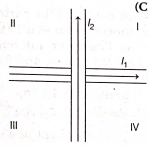
I
II
III
IV
2.
A current of 5 A is flowing from east to west in a long straight wire kept on a horizontal table. The magnetic field developed at a distance of 10 cm de south on the table is
1 x 10⁻⁵ T, acting downwards
1 x 10⁻⁵ T, acting upwards
2 x 10⁻⁵ T, acting downwards
2 x 10⁻⁵ T, acting upwards
3.
A current of 10A is flowing from east to west in a long straight wire kept on a horizontal table. The magnetic field developed at a distance of 10 cm due north on the table is
2 x 10⁻⁵ T, acting downwards
2 x 10⁻⁵ T, acting upwards
4 x 10⁻⁵ T, acting downwards
4 x 10⁻⁵ T, acting upwards
4.
A straight conducting rod of length I and mass m is suspended in a horizontal plane by a pair of flexible strings in a magnetic field of magnitude B. To remove the tension in the supporting strings, the magnitude of the current in the wire is
\(\frac{m g B}{l}\)
\(\frac{m g l}{B}\)
\(\frac{m g}{l B}\)
\(\frac{l B}{m g}\)
5.
A current carrying wire kept in a uniform magnetic field will experience a maximum force, when it is
perpendicular to the magnetic field
parallel to the magnetic field
at an angle of 45° to the magnetic field
at an angle of 60° to the magnetic field
6.
There are uniform electric and magnetic fields in a region pointing along X-axis. An a-particle is projected along Y-axis with a velocity v. The shape of the trajectory will be
circular in XZ-plane
circular in YZ-plane
helical with its axis parallel to X-axis
helical with its axis parallel to Y-axis
7.
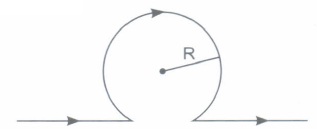
A current I flows through a long straight conductor which is bent into a circular loop of radius R in the middle as shown in the figure.
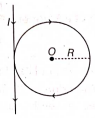
The magnitude of the net magnetic field at point O will be
zero
\(\frac{\mu_0 I}{2 R}(1+\pi)\)
\(\frac{\mu_0 I}{4 \pi R}\)
\(\frac{\mu_0 I}{2 R}\left(1-\frac{1}{\pi}\right)\)
8.
The SI unit of magnetic field intensity is
A-mN-¹
NA-1 m-1
NA-2 m-2
NA-1 m-2
9.
Which of the following statements is correct?
Magnetic field lines do not form closed loops.
Magnetic field lines start from north pole and end at south pole of a magnet.
The tangent at a point on a magnetic field line represents the direction of the magnetic field at that point.
Two magnetic field lines may intersect each other.
10.
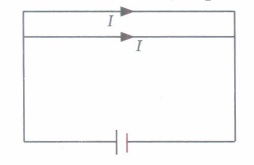
Two long straight parallel conductors A and B, kept at a distance r, carry current I in opposite directions. A third identical conductor C, kept at a distance \(\left(\frac{r}{3}\right)\) from A carry current I1, in the same direction as in A. The net magnetic force on unit length of C is
\(\frac{3 \mu_0 I I_1}{2 \pi r}\), towards A
\(\frac{3 \mu_0 I I_1}{2 \pi r}\), towards B
\(\frac{3 \mu_0 I I_1}{4 \pi r}\), towards A
\(\frac{3 \mu_0 I I_1}{4 \pi r}\), towards B
11.
An electron enters a uniform magnetic field with speed v. It describes a semi-circular path and comes out of the field. The final speed of the electron is
zero
v
\( \frac{v}{2}\)
2v
12.
A circular loop A of radius R carries a current I. Another circular loop B of radius \(r\left(=\frac{R}{20}\right)\) is placed concentrically linked in the plane of A. The magnetic flux linked with loop B is proportinal to
R
\(\sqrt{R}\)
\(R^{\frac{3}{2}}\)
R2
13.
The magnetic susceptibility for a diamagnetic material is
small and negative
small and positive
large and negative
large and positive
14.
A straight wire is kept horizontally along east-west direction. If a steady current flows in wire from east to west, the magnetic field at a point above the wire will point towards
East
West
North
South
15.
In a circular coil of radius r, the magnetic field at the centre is proportional to
r2
r
\(\frac{1}{r}\)
\(\frac{1}{r2}\)
16.
Three long, straight parallel wires, carrying current are arranged as shown in the figure. The force experienced by a 25 cm length of wire C is
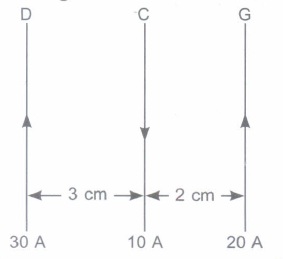
10-3 N
2.5 x 10⁻³ N
zero
1.5 x 10³ N
17.
What is the net force on the rectangular coil?
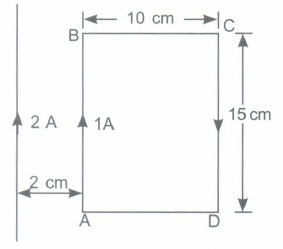
25 x 10-7 N towards wire.
25 x 10-7 N away from wire
35 x 10-7 N towards wire
35 x 10-7 N away from wire.
18.
The maximum current that can be measured by a galvanometer of resistance 40 Ω is 10 mA. It is converted into voltmeter that can read upto 50 V. The resistance to be connected in the series with the galvanometer is
2010 Ω
4050 Ω
5040 Ω
4960 Ω
19.
The strength of magnetic field at the centre of circular coil is
\(\frac{\mu_{0} I}{R}\left(1-\frac{1}{\pi}\right)\)
\(\frac{\mu_{0} \boldsymbol{I}}{\pi \boldsymbol{R}}\)
\(\frac{\mu_{0} I}{2 R}\left(1-\frac{1}{\pi}\right)\)
\(\frac{\mu_{0} I}{2 R}\left(1+\frac{1}{\pi}\right)\)
20.
A circular coil of radius 4 cm and of 20 turns carries a current of 3 amperes. It is placed in a magnetic field of intensity 0.5 weber/m2. The magnetic dipole moment of the coil is
0.15 ampere-m2
0.3 ampere-m2
0.45 ampere-m2
0.6 ampere-m2
21.
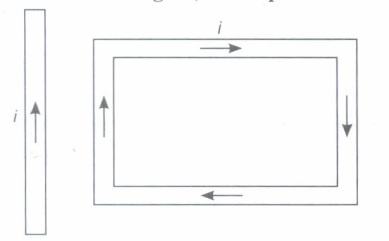
A rectangular loop carrying a current i is situated near a long straight wire such that the wire is parallel to the one of the sides of the loop and is in the plane of the loop. If a steady current I is established in wire as shown in figure, the loop will
rotate about an axis parallel to the wire.
move away from the wire or towards right
move towards the wire
remain stationary.
22.
The coil of a galvanometer consists of 100 turns and effective area of 1 cm2. The restoring couple is 10-8 Nm rad -1. The magnetic, fieldbetween poles is of 5 T. Current sensitivity of this galvanometer is
5x 10⁴ rad /\(\mu\) amp
5 x10⁶ per amp
2 x 10⁻⁷ per amp
5 rad/ \(\mu\) amp
23.
For the voltmeter circuit given,
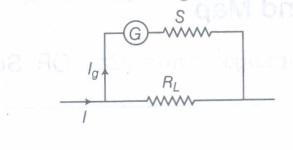
\(\frac{I_{g}}{I}=\frac{G}{S}\)
\(\frac{I}{I_{g}}=\frac{R_{L}+G}{S}\)
(I - Ig )RL = Ig (G+S)
IRL = IgG
24.
The wire which connects the battery of a car to its starter motor carries current of 300 A during starting. Force per unit length between wires (wires are 0.7 m long and 0.015 m distant apart) is
1.2 Nm -1 repulsive
1.2 Nm -1 attractive
2.4 Nm -1 repulsive
2.4 Nm -1attractive
25.
An electron is moving in a cyclotron at a speed of 3.2 x 10⁷ ms" in a magnetic field of 5 x 10⁻⁴ T perpendicular to it. What is the frequency of this electron? (q = 1.6 x 10⁻¹⁹ C,me = 9.1 x 10⁻³¹ kg)
1.4 x 10⁵ Hz
1.4 x 10⁷ Hz
1.4 x 10⁶ Hz
1.4 x 10⁹ Hz
26.
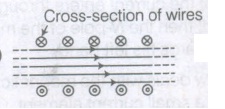
Which of the following represent a correct figure to display of magnetic field lines due to a solenoid?
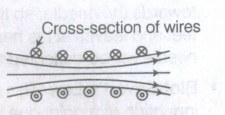
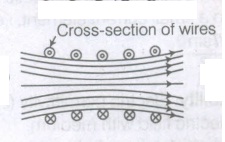
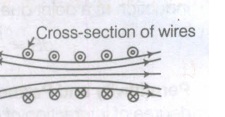
27.
For a cylindrical conductor of radius a, which of the following graphs shows a correct relationship of B versus r?
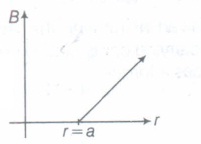
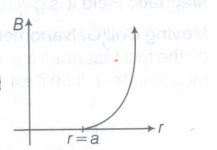
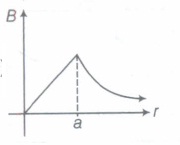
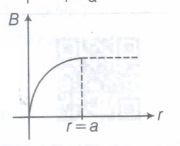
28.
Vector form of Biot-Savart's law is
\(d \mathbf{B}=\frac{\mu_{0}}{4 \pi} \frac{1 \times d l}{r^{2}}\)
\(d \mathbf{B}=\frac{I d \mathbf{l} \times \mathbf{r}}{r^{3}}\)
\(d \mathbf{B}=\frac{\mu_{0}}{4 \pi} \frac{I d \mathbf{l} \times \mathbf{r}}{r^{3}}\)
\(d \mathbf{B}=\frac{\mu_{0}}{4 \pi} \frac{I d \mathbf{l} \times \mathbf{r}}{r^{2}}\)
29.
A galvanometer of resistance 25 \(\Omega\)shows full scale deflection for current of 10 mA. To convert it into 100 V range voltmeter, the required series resistance is
9975 \(\Omega\)
10025 \(\Omega\)
10000 \(\Omega\)
975 \(\Omega\)
30.
The area of a circular ring is 1 cm2 and current of 10 A is passing through it. If a magnetic field of intensity 0.1 T is applied perpendicular to the plane of the ring. The torque due to magnetic field on the ring will be
zero
10-4 N-m
10- 2 N-m
1 N-m
31.
Two parallel wires are placed 1m apart and 1A and 3 A currents are flowing in the wires in opposite direction. The force acting per unit length of both the wires will be
6 x10⁻⁷ N / m attractive
6 x10⁻⁵ N /m attractive
6 x10⁻⁷ N / m repulsive
6 x10⁻⁵ N / m repulsive
32.
If the velocity of charged particle is doubled and value of magnetic field is reduced to half, then the radius of path of charged particle will be
8 times
3 times
4 times
2 times
33.
An electron of charge (e) is moving parallel to uniform magnetic field B with constant velocity v. The force acting on electron is
Bev
Be / v
B / ev
Zero
34.
The value of force F acting on charge q moving with velocity perpendicular to the magnetic field B will be
F = qvB
\(F=\frac{q v}{B}\)
\(F=\frac{q B}{v}\)
\(F=\frac{B v}{q}\)
35.
An element \(\triangle\)I = \(\triangle\)x \(\hat i\) is placed at the origin and carries a current I = 10A.
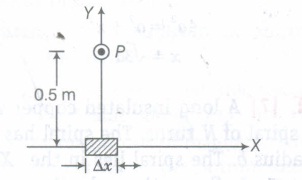
If \(\triangle\)x = 1cm, magnetic field at point P is
\(4 \times 10^{-8} \hat{\mathbf{k}} \mathrm{T}\)
\(4 \times 10^{-8} \hat{\mathbf{i}} \mathrm{T}\)
\(4 \times 10^{-8} \hat{\mathbf{j}} \mathrm{T}\)
\(- 4 \times 10^{-8} \hat{\mathbf{j}} \mathrm{T}\)
36.
A magnetic needle suspended parallel to a magnetic field requires \(\sqrt { 3 } J\) of work to turn it through \({ 60 }^{ ° }.\) The torque needed to maintain the needle in this position will be :
\(2\sqrt { 3 } J\)
\(3J\)
\(\sqrt { 3 } J\)
\(\frac { 3 }{ 2 } J\)
37.
The work done in turning a magnet of magnetic moment M by an angle of \({ 90 }^{ ° }\) from the magnetic meridian is n times the corresponding work done to turn it through an angle of \({ 60 }^{ ° },\) where n is
1/2
2
1/4
1.
38.
A short bar magnet of magnetic moment \(0.4J{ T }^{ -1 }\) is placed in a uniform magnetic field of 0.16 T. The magnet is in stable equilibrium when the potential energy is
-0.064 J
zero
-0.082 J
0.064 J
39.
A magnet with moment M is given. If it is bent into a semicircular form, its new magnetic moment will be :
\(M/\pi \)
\(M/2\)
\(M\)
\(2M/\pi \)
40.
A current of 5 A is flowing through a circular coil of diameter 14 cm having 100 turns. The magnetic dipole moment associated with this coil is :
\(0.077{ Am }^{ 2 }\)
\(0.77{ Am }^{ 2 }\)
\(7.7{ Am }^{ 2 }\)
\(77{ Am }^{ 2 }\)
41.
The current sensitivity of a moving coil galvanometer increases by 35%, when its resistance is increased by a factor 3. The voltage sensitivity of galvanometer changes by a factor
35%
45%
55%
none of the above
42.
In an ammeter 0.5% of main current passes through galvanometer. If resistance of galvanometer is G, the resistance of ammeter will be
G/200
G/199
199 G
200G.
43.
A galvanometer has a sensitivity of 60 division/ampere. When a shunt is used its sensitivity becomes 10 division/ampere. What is the value of shunt used if the resistance of the galvanometer is \(20\Omega \) ?
\(2\Omega \)
\(3\Omega \)
\(4\Omega \)
\(6\Omega \)
44.
A galvanometer of resistance \(25\Omega \) is connected to a battery of 2 volt along with a resistance in series. When the value of this resistance is \(3000\Omega ,\) a full scale deflection of 30 units is obtained in the galvanometer. In order to reduce this deflection 10 20 units, the resistance in series will be
\(4514\Omega \)
\(5413\Omega \)
\(2000\Omega \)
\(6000\Omega .\)
45.
A galvanometer having a coil resistance of \(100\Omega \) gives a full scale deflection, when a current of 1 mA is passed through it. The value of the resistance, which can convert this galvanometer into ammeter giving a full scale deflection for a current of 10 A is
\(0.01\Omega \)
\(2\Omega \)
\(0.1\Omega \)
\(3\Omega \)
46.
Two particles each of mass m and charge q are attached to the two ends of a light rigid rod of length 2 R. The rod is rotated at constant angular speed about a perpendicular axis passing through its centre. The ratio of the magnitudes of the magnetic moment of the system and its angular momentum about the centre of the rod is
q/2 m
q/m
2 q/m
\(q/\pi \ m.\)
47.
A horizontal wire 0.1 m long carries a current of 5 A. Find the magnitude and direction of the magnetic field, which can support the weight of the wire. Given the mass of the wire is \(3\times { 10 }^{ -3 }kg/m\quad and\quad g=10{ ms }^{ -2 }.\)
\(6\times { 10 }^{ -3 }T,\) acting vertically upwards
\(6\times { 10 }^{ -3 }T,\) acting horizontally perpendicular to wire
\(6\times { 10 }^{ -2 }T,\) acting vertically downwards
\(6\times { 10 }^{ -2 }T,\) acting horizontally perpendicular to wire
48.
An electron of mass \({ M }_{ e },\) initially at rest, moves through a certain distance in a uniform electric field in time \({ t }_{ 1 }.\) A proton of mass \({ M }_{ p }\) also initially at rest, takes time \({ t }_{ 2 }\) to move through an equal distance in this uniform electric field. Neglecting the effect of gravity, the ratio \({ t }_{ 2 }/{ t }_{ 1 }\) is nearly equal to
1
\(\sqrt { \frac { { M }_{ p } }{ { M }_{ e } } } \)
\(\sqrt { \frac { { M }_{ e } }{ { M }_{ p } } } \)
1836
49.
A charged particle with charge q enters a region of constant, uniform and mutually orthogonal fields \(\vec { E } \quad and\quad \vec { B } \) with a velocity \(\vec { \upsilon } \) perpendicular to both \(\vec { E } \quad and\quad \vec { B } ,\) and comes out without any change in magnitude or direction of \(\vec { \upsilon } .\) Then
\(\vec { \upsilon } =\vec { B } \times \vec { E } /{ E }^{ 2 }\)
\(\vec { \upsilon } =\vec { E } \times \vec { B } /{ B }^{ 2 }\)
\(\vec { \upsilon } =\vec { B } \times \vec { E } /{ B }^{ 2 }\)
\(\vec { \upsilon } =\vec { E } \times \vec { B } /{ E }^{ 2 }\)
50.
An electric charge + q moves with velocity \(\vec { \upsilon } =3\hat { i } +4\hat { j } +\hat { k } ,\) in an electromagnetic field give \(\vec { E } =3\hat { i } +\hat { j } +2\hat { k } ,\quad \vec { B } =\hat { i } +\hat { j } -3\hat { k } .\)They y-component of the force experienced by + q is
2 q
11 q
5 q
3 q
51.
A proton and an alpha particle both enter a region of uniform magnetic field B, moving at right angles to the field B. If the radius of circular orbits for both the particles is equal and the kinetic energy acquired by proton is 1 MeV, the energy acquired by the alpha particles will be :
1 MeV
4 MeV
0.5 MeV
1.5 MeV
52.
The magnetic force acting on a charged particle of charge \(-2\mu C\) in a magnetic field of 2 T acting in y-direction, when the particle velocity is \(\left( 2\hat { i } +3\hat { j } \right) \times { 10 }^{ 6 }{ ms }^{ -1 }\) is
8 N in z-direction
8 N in -z-direction
4 N in z-direction
8 N in y-direction
53.
A paramagnetic sample shows a net magnetization of when placed \(8{ Am }^{ -1 }\) in an external magnetic field 0.6 T at a temperature of 4K. When the same sample is placed in an external magnetic field of 0.2 T at a temperature of 16 K, the magnetization will be
\(\frac { 32 }{ 3 } { Am }^{ -1 }\)
\(\frac { 2 }{ 3 } { Am }^{ -1 }\)
\(6\quad { Am }^{ -1 }\)
\(2.4\quad { Am }^{ -1 }\)
54.
Consider the two idealized systems: (i) a parallel plate capacitor with large and small separation and (ii) a long solenoid of length L>>R, radius of the cross-section. In (i) \(\overset { \rightarrow }{ E } \) is ideally treated as a constant between plates and zero outside. In (ii) magnetic field is constant inside the solenoid and zero outside. These idealized assumptions, however, contradict fundamental law as below:
case (i) contradicts Gauss's law for electrostatic fields.
case (ii) contradicts Gauss's law for magnetic fields.
case (i) agrees with \(\quad \oint { \overset { \rightarrow }{ E } .d\overset { \rightarrow }{ l } } =0\)
case (ii) contradicts \(\oint { \overset { \rightarrow }{ H } .d\overset { \rightarrow }{ l } } ={ l }_{ en }\)
55.
A toroid of n turns, mean radius R and cross-sectional radius carries a current I. It is placed on a horizontal table taken as x-y plane. Its magnetic moment \(\overset { \rightarrow }{ M } \)
is non-zero and points in the z-direction by symmetry
points along the axis of the toroid \((\overset { \rightarrow }{ M } =M\hat { \phi } )\)
is zero, otherwise, there would be a field falling as \(\frac { 1 }{ { r }^{ 3 } } \)at large distances outside the toroid
is pointing radially outwards.
56.
Two circular coils 1 and 2 are made from the same wire but the radius of the Ist coil twice that of the 2nd coil. What potential difference ratio should be applied across them so that the magnetic field at their centres is the same?
2
3
4
6
57.
Two similar coils of radius R, are lying concentrically with their planes at right angles to each other. The currents flowing in them are I and 2 I respectively. The resultant magnetic field at the centre will be :
\(\frac { \sqrt { 5 } { \mu }_{ 0 }I }{ 2R } \)
\(\frac { 3{ \mu }_{ 0 }I }{ 2R } \)
\(\frac { { \mu }_{ 0 }I }{ 2R } \)
\(\frac { { \mu }_{ 0 }I }{ R } \)
58.
An electron moving in a circular orbit of radius r makes n rotations per second. The magnetic field produced at the centre has magnitude
zero
\(\frac { { \mu }_{ 0 }{ n }^{ 2 }e }{ r } \)
\(\frac { { \mu }_{ 0 }{ n }e }{ 2r } \)
\(\frac { { \mu }_{ 0 }{ n }e }{ 2\pi r } \)
59.
Biot-Savart law indicates that the moving electrons produce a magnetic field \(\overset { \rightarrow }{ B } \) such that
\(\quad \overset { \rightarrow }{ B } \bot \overset { \rightarrow }{ v } \)
\(\overset { \rightarrow }{ B } \parallel \overset { \rightarrow }{ v } \)
it obeys inverse cube law
it is along the line joining the electron and point of observation.
60.
A long solenoid has n turns per metre and current I A is flowing through it. The magnetic field induction at the ends of the solenoid is
zero
\({ \mu }_{ o }nI/2\)
\({ \mu }_{ o }nI\)
\(2{ \mu }_{ o }NI\)
61.
Ampere's circuital law can be derived from
Ohm's law
Biot-Savart's law
Kirchhoff's law
Gauss's law
62.
A coil of wire has an area of 600 sq. cm and has 500 turns. If it carries 1.5 A current, its magnetic dipole moment is
5 Am2
15 Am2
30 Am2
45 Am2
63.
A thin ring of radius R metre has charge q coulomb uniformly spread on it. The ring rotates about its axis with a constant frequency of f revolutions/s. The value of magnetic field induction in Wb/m2 at the centre of the ring is
\(\frac { { \mu }_{ o }qf }{ 2\pi R } \)
\(\frac { { \mu }_{ o }q }{ 2\pi fR } \)
\(\frac { { \mu }_{ o }q }{ 2fR } \)
\(\frac { { \mu }_{ o }qf }{ 2R } \)
64.
A circular coil of n turns and radius r carries a current I. The magnetic field at the centre is
\(\frac { { \mu }_{ o }nI }{ r } \)
\(\frac { { \mu }_{ o }nI }{ 2r } \)
\(\frac { { 2\mu }_{ o }nI }{ r } \)
\(\frac { { \mu }_{ o }nI }{ 4r } \)
65.
The magnetic field at a perpendicular distance of 2 cm from an infinite straight current carrying conductor is 2x10⁻⁶ T. The current in the wire is
0.1 A
0.2 A
0.4 A
0.8 A
66.
67.
Assertion (A) : When radius of a current carrying loop is doubled, its magnetic moment becomes four times.
Reason (R) : The magnetic moment of a current carrying loop is directly proportional to the area of the loop.
(a) Both Assertion and Reason are true and Reason is the correct explanation of Assertion.
(b) Both Assertion and Reason are true but Reason is not the correct explanation of Assertion.
(c) Assertion is true but Reason is false.
(d) Assertion is false but Reason is true.
68.
Assertion (A): A proton and an electron, with same momenta, enter in a magnetic field in a direction at right angles to the lines ofthe force. The radius of the paths followed by them willbe same.
Reason (R) : Electron has less mass than the proton.
(a) Both Assertion and Reason are true and Reason is the correct explanation of Assertion.
(b) Both Assertion and Reason are true but Reason is not the correct explanation of Assertion.
(c) Assertion is true but Reason is false.
(d) Assertion is false but Reason is true.
69.
Assertion (A) : A charged particle moving in a uniform magnetic field penetrates a layer of lead and there by loses half of its kinetic energy. The radius of curvature of its path is now reduced to half of its initial value.
Reason (R) : Kinetic energy is inversely proportional to radius of curvature.
Codes:
(a) Both A and R are true and R is the correct explanation of A
(b) Both A and R are true but R is NOT the correct explanation of A
(c) A is true but R is false
(d) A is false and R is also false
70.
Assertion (A) : Magnetic moment is measured in joule/tesla or amp m2.
Reason (R) : Joule/tesla is equivalent to amp m2
Codes:
(a) Both A and R are true and R is the correct explanation of A
(b) Both A and R are true but R is NOT the correct explanation of A
(c) A is true but R is false
(d) A is false and R is also false
71.
Assertion (A) : Magnetic field is useful in producing parallel beam of charged particle.
Reason (R) : Magnetic field inhibits the motion of charged particle moving across it
Codes:
(a) Both A and R are true and R is the correct explanation of A
(b) Both A and R are true but R is NOT the correct explanation of A
(c) A is true but R is false
(d) A is false and R is also false
72.
Assertion (A) : When current is represented by a straight line, the magnetic field will be circular.
Reason (R) : According to Fleming's left hand rule, direction of force is parallel to the magnetic field
Codes:
(a) Both A and R are true and R is the correct explanation of A
(b) Both A and R are true but R is NOT the correct explanation of A
(c) A is true but R is false
(d) A is false and R is also false
73.
Assertion (A) : In a conductor, free electrons keep on moving but no magnetic force acts on a conductor in a magnetic field.
Reason (R) : Force on free electron due to magnetic field always acts perpendicular to its direction of motion.
Codes:
(a) Both A and R are true and R is the correct explanation of A
(b) Both A and R are true but R is NOT the correct explanation of A
(c) A is true but R is false
(d) A is false and R is also false
74.
Assertion (A) : When two long parallel wires, hanging freely are connected in parallel to a battery, they come closer to each other.
Reason (R) : Wires carrying current in opposite direction repel each other.
Codes:
(a) Both A and R are true and R is the correct explanation of A
(b) Both A and R are true but R is NOT the correct explanation of A
(c) A is true but R is false
(d) A is false and R is also false
75.
Assertion (A) : The magnetic field intensity at the centre of a circular coil carrying current changes, if the current through the coil is doubled.
Reason (R) : The magnetic field intensity is dependent on current in conductor.
Codes:
(a) Both A and R are true and R is the correct explanation of A
(b) Both A and R are true but R is NOT the correct explanation of A
(c) A is true but R is false
(d) A is false and R is also false
76.
Assertion (A) : An ammeter is connected in series in the circuit.
Reason (R) : An ammeter is a high resistance galvanometer
Codes:
(a) Both A and R are true and R is the correct explanation of A
(b) Both A and R are true but R is NOT the correct explanation of A
(c) A is true but R is false
(d) A is false and R is also false
77.
Assertion (A) : Voltmeter is connected in parallel with the circuit.
Reason (R) : Resistance of a voltmeter is very large.
Codes:
(a) Both A and R are true and R is the correct explanation of A
(b) Both A and R are true but R is NOT the correct explanation of A
(c) A is true but R is false
(d) A is false and R is also false
1.
(b)
II
2.
(b)
1 x 10⁻⁵ T, acting upwards
3.
(a)
2 x 10⁻⁵ T, acting downwards
4.
(c)
\(\frac{m g}{l B}\)
5.
(a)
perpendicular to the magnetic field
6.
(b)
circular in YZ-plane
7.
(d)
\(\frac{\mu_0 I}{2 R}\left(1-\frac{1}{\pi}\right)\)
8.
(b)
NA-1 m-1
9.
(c)
The tangent at a point on a magnetic field line represents the direction of the magnetic field at that point.
10.
(a)
\(\frac{3 \mu_0 I I_1}{2 \pi r}\), towards A
11.
(b)
v
12.
(a)
R
13.
(a)
small and negative
14.
(c)
North
15.
(c)
\(\frac{1}{r}\)
16.
(c)
zero
17.
(a)
25 x 10-7 N towards wire.
18.
(d)
4960 Ω
19.
(c)
\(\frac{\mu_{0} I}{2 R}\left(1-\frac{1}{\pi}\right)\)
20.
(b)
0.3 ampere-m2
21.
(c)
move towards the wire
22.
(b)
5 x10⁶ per amp
23.
(c)
(I - Ig )RL = Ig (G+S)
24.
(a)
1.2 Nm -1 repulsive
25.
(b)
1.4 x 10⁷ Hz
26.
(c)
27.
(c)
28.
(c)
\(d \mathbf{B}=\frac{\mu_{0}}{4 \pi} \frac{I d \mathbf{l} \times \mathbf{r}}{r^{3}}\)
29.
(a)
9975 \(\Omega\)
30.
(a)
zero
31.
(c)
6 x10⁻⁷ N / m repulsive
32.
(b)
3 times
33.
(d)
Zero
34.
(a)
F = qvB
35.
(a)
\(4 \times 10^{-8} \hat{\mathbf{k}} \mathrm{T}\)
36.
(b)
\(3J\)
37.
(b)
2
38.
(a)
-0.064 J
39.
(d)
\(2M/\pi \)
40.
(c)
\(7.7{ Am }^{ 2 }\)
41.
(c)
55%
42.
(a)
G/200
43.
(c)
\(4\Omega \)
44.
(a)
\(4514\Omega \)
45.
(a)
\(0.01\Omega \)
46.
(a)
q/2 m
47.
(b)
\(6\times { 10 }^{ -3 }T,\) acting horizontally perpendicular to wire
48.
(b)
\(\sqrt { \frac { { M }_{ p } }{ { M }_{ e } } } \)
49.
(b)
\(\vec { \upsilon } =\vec { E } \times \vec { B } /{ B }^{ 2 }\)
50.
(b)
11 q
51.
(a)
1 MeV
52.
(b)
8 N in -z-direction
53.
(b)
\(\frac { 2 }{ 3 } { Am }^{ -1 }\)
54.
(d)
case (ii) contradicts \(\oint { \overset { \rightarrow }{ H } .d\overset { \rightarrow }{ l } } ={ l }_{ en }\)
55.
(c)
is zero, otherwise, there would be a field falling as \(\frac { 1 }{ { r }^{ 3 } } \)at large distances outside the toroid
56.
(c)
4
57.
(a)
\(\frac { \sqrt { 5 } { \mu }_{ 0 }I }{ 2R } \)
58.
(c)
\(\frac { { \mu }_{ 0 }{ n }e }{ 2r } \)
59.
(a)
\(\quad \overset { \rightarrow }{ B } \bot \overset { \rightarrow }{ v } \)
60.
(b)
\({ \mu }_{ o }nI/2\)
61.
(b)
Biot-Savart's law
62.
(d)
45 Am2
63.
(d)
\(\frac { { \mu }_{ o }qf }{ 2R } \)
64.
(b)
\(\frac { { \mu }_{ o }nI }{ 2r } \)
65.
(b)
0.2 A
66.
67.
(a) Both Assertion and Reason are true and Reason is the correct explanation of Assertion.
68.
(b) Both Assertion and Reason are true but Reason is not the correct explanation of Assertion.
69.
(d): The radius of curvature of a charged particle I.n a magnetic. fiteld IiSgI.ven by, \(r=\frac{m v}{q B}=\frac{\sqrt{2 m K \cdot E}}{q B}\)
\(\text { i.e. } r \propto \sqrt{K . E}\) when kinetic energy is halved, the radius is reduced to \(\left(\frac{1}{\sqrt{2}}\right)\) times its initial value.
70.
(a): Magnetic. moment \(=\frac{\text { joule }}{\text { tesla }}=\frac{W}{B}=\frac{W}{F / q v}\)
\(=\frac{W q v}{F}=\frac{\left[\mathrm{ML}^{2} \mathrm{~T}^{-2}\right][\mathrm{AT}]\left[\mathrm{LT}^{-1}\right]}{\left[\mathrm{MLT}^{-2}\right]}\)
\(=\mathrm{AL}^{2}=\mathrm{amp} \mathrm{m}^{2}\)
71.
(a) Both A and R are true and R is the correct explanation of A.
72.
(c): When current is straight, it means the current is passing through a straight conductor, the magnetic field produced due to current through a straight conductor is in the form of concentric circular magnetic lines of force whose centres lie on the linear conductor and are in a plane perpendicular to the plane of linear conductor. It means the magnetic field is circular.
73.
(c): In a conductor, the average velocity of electrons is zero. Hence no current flows through the conductor. Hence, no force acts on this conductor
74.
(b): The wires are parallel to each other but the direction of current in it is in same direction so they attract each other. If the current in the wires is in opposite direction then wires repel each other. When the currents are in opposite directions, the magnetic forces are reversed and the wires repels each other
75.
(a): The magnetic field at the centre of circular coil is given by
\(B=\frac{\mu_{0}}{4 \pi} \frac{2 \pi n I}{a}\)
So if current through coil is doubled then magnetic field is \(B^{\prime}=2 B\)
The magnetic field also get doubled. The magnetic field is directly proportional to the current in conductor
76.
(c): An ammeter is a low resistance galvanometer. It is used to measure the current in amperes. To measure the current of a circuit, the ammeter is connected in series in the circuit so that the current to be measured must pass through it. Since, the resistance of ammeter is low, so its inclusion in series in the circuit does not change the resistance and hence the main current in the circuit.
77.
(a): A voltmeter is always connected in parallel. This has a large resistance.

12th Standard CBSE Syllabus & Materials
12th Standard CBSE
CBSE 12th Computer Science Python Revision Tour I - New Previous year Question Papers Study Material - QB365 Set A
NEW12th Standard CBSE
CBSE 12th Business Studies Planning Important Questions And Answers Study Material - QB365 Set A
NEW12th Standard CBSE
CBSE 12th Business Studies Business Environment Important Questions And Answers Study Material - QB365 Set A
NEW12th Standard CBSE
CBSE 12th Business Studies Principles of Management Important Questions And Answers Study Material - QB365 Set A



NCERT Books

Syllabus

Exam Pattern

Sample Question Papers

Previous year Question Papers

Important Notes

MCQ Practice test

NCERT Exemplers

Case study Questions

Image Based Questions

Passage based Questions

HOT Questions

Value Based Questions

Model Questions Papers
NCERT ( Book Back ) Questions

Assertion and Reason
Important Questions And Answers

CBSE 12th Standard CBSE Subjects
CBSE Standards








