
 100% FREE ACCESS
12th Standard CBSE Syllabus & Materials
12th Standard CBSE
CBSE 12th Economics Government Budget and the Economy Previous year Question Papers Study Material - QB365 Set A
NEW12th Standard CBSE
CBSE 12th Computer Science Interface Python with MySQL - New Previous year Question Papers Study Material - QB365 Set A
NEW12th Standard CBSE
CBSE 12th Computer Science Database Concept - New Previous year Question Papers Study Material - QB365 Set A
NEW12th Standard CBSE
CBSE 12th Computer Science Data Communication - New Previous year Question Papers Study Material - QB365 Set A
NEW12th Standard CBSE
CBSE 12th Computer Science Data Structures - New Previous year Question Papers Study Material - QB365 Set A
NEW12th Standard CBSE
CBSE 12th Computer Science Functions - New Previous year Question Papers Study Material - QB365 Set A

Published on: 07/03/2026
Download CBSE Class 12th Standard CBSE Physics question papers, sample papers, important questions, and previous year solved papers in PDF format. Get free study materials, NCERT solutions, and exam preparation resources for Class 12th Standard CBSE Physics
Questions + Answers key
Take MCQ Physics Test
1.
The magnetic susceptibility of \(\chi\) of a given material is -0.5. Identify the magnetic material.
2.
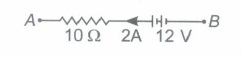
In the figure, what is the potential difference between A and B?
3.
On what factors does the pole strength of a magnet depend?
4.
The Earth’s core contains iron but geologists do not regard this as a source of Magnetic Field, Why?
5.
A rod of length L, along East West direction is dropped from a height H. If B be the magnetic field due to earth at that place and angle of dip is S, then what is the magnitude of induced emf across two ends of the rod when the rod reaches the earth.
6.
If potential difference V applied across a conductor is increased by 2 V, how will the drift velocity of the electrons change?
7.
A short bar magnet of magnetic moment 0.5 J/T is placed with its axis at 30° to a uniform magnetic field of 0.1 T. Calculate
(i) the magnitude of the torque experienced, and
(ii) the direction on which it acts
8.
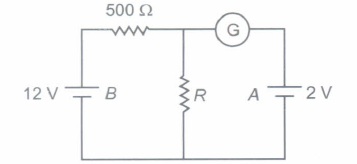
In the circuit shown in the figure, the galvanometer G gives zero deflection. If the batteries A and B have negligible internal resistance, find the value of the resistor R.
9.
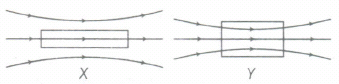
When two materials are placed in an external magnetic field, the behaviour of magnetic field lines is as shown in the figure. Identify the magnetic nature of each of these two materials.
10.
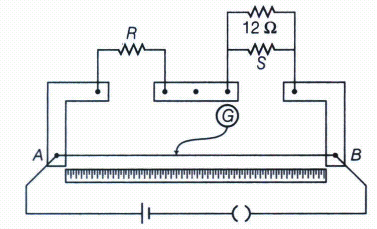
In a meter bridge, the null point is found at a distance of 40 cm from A. If a resistance of 12\(\Omega \) is connected in parallel with S, the null point occurs at 50 cm from A. Determine the values of R and S.
11.
The magnetic field at a point on the magnetic equator is found to be 3.1 x 10⁻⁵ T. Taking the earth's radius to be 6400 km, calculate the magnetic moment of the assumed dipole at the earth's centre.
12.
(i) Derive the expression for the torque acting on a current carrying loop placed in a magnetic field.
(ii) Explain the significance of a radial magnetic field, when a currrent carrying coil is kept in it.
13.
Show that one ampere is equivalent to flow of 6.25 x 10¹⁸ elementary electrons per second? Charge on electron = 1.6 x 10⁻¹⁹ C.
14.
The magnetic susceptibility of an ideal diamagnetic substance is
+1
0
-1
∞
15.
Temperature dependence of resistivity p(T) of semiconductors, insulators and metals is significantly based on the following factors:
number of charge carriers can change with temperature T
time interval between two successive collisions is independent on T.
length of material can be a function of T.
mass of carriers is a function of T
16.
If drift velocity of electron is vd and intensity of electric field is E, then which of the following relation obeys the Ohm's law?
vd = constant
vd ∝ E
vd = \(\sqrt{E}\)
vd ∝ E2
17.
A short bar magnet placed with its axis at 30° with an external field of 800 G experiences a torque of 0.016 Nm. The magnetic moment of the magnet is
4 Am2
0.5 Am2
2 Am2
0.40 Am2
18.
A magnet with moment M is given. If it is bent into a semicircular form, its new magnetic moment will be :
\(M/\pi \)
\(M/2\)
\(M\)
\(2M/\pi \)
19.
A galvanometer having a coil resistance of \(100\Omega \) gives a full scale deflection, when a current of 1 mA is passed through it. The value of the resistance, which can convert this galvanometer into ammeter giving a full scale deflection for a current of 10 A is
\(0.01\Omega \)
\(2\Omega \)
\(0.1\Omega \)
\(3\Omega \)
20.
A charged particle goes undeflected in a region containing electric and magnetic field. It is possible that
\(\vec { E } \parallel \vec { B } \) but \(\vec { \upsilon } \) is not parallel to \(\vec { E } \)
\(\vec { \upsilon } \parallel \vec { B } \) but \(\vec { E } \) is not parallel to \(\vec { B } \)
\(\vec { E } \parallel \vec { B } \), \(\vec { \upsilon } \parallel \vec { E } \)
\(\vec { E } \) is not parallel to \(\vec { B } \) and \(\vec { \upsilon } \)
21.
In a permanent magnet at room temperature
the magnetic moment of each molecule is zero
the individual molecules have a non-zero magnetic moment which is all perfectly aligned
domains are partially aligned
domains are all perfectly aligned.
22.
1.
Substances having (small) negative value (-0.5) of magnetic susceptibility \(\chi_m\) are diamagnetic.
2.
\(V_{A}-V_{B}=12-2 \times 10=-8 \text { volt. }\)
3.
The pole strength of a magnet may depend on its cross-section, nature of material.
4.
Temperature in the core of earth is higher than Curie temperature of Iron.
5.
e = Blv
= B cos \(\theta\) x 1 x (2gH)1/2
6.
Ler R is the resistance of the conductor. In the first case, current in a conductor, I = V/R.
In second case current in conductor,
\(I^{\prime}=\frac{2 V+V}{R}=\frac{3 V}{R}=3 I\)
\(As I=n Aev _d or v_d \propto I(\because n, A , are constant)
\)
\(\therefore \frac{v_d^{\prime}}{v_d}=\frac{I^{\prime}}{I}=\frac{3 I}{I}=3 \text { or } v_d^{\prime}=3 v_d\)
It means drift velocity becomes tripled.
7.
Given: \(M=0.5 \mathrm{~J} / \mathrm{T}, B=3 \times 10^{-2} \mathrm{~T}, \theta=30^{\circ}\)
(i) Torque acting on the needle,
\(\tau\) = MB sin 8 = 0.5 x 0.1 x sin 30° = 2.5 x 10⁻² Nm
(ii) The direction of the torque is perpendicular to the plane containing the vectors \(\vec{M} \text { and } \vec{B}\)
8.
There is no deflection in the galvanometer. It indicates that the potential difference across R is equal to 2 V.
\(
\therefore \ V =I R
\)
\(\frac{2}{R} =\frac{12}{500+R} \Rightarrow 2=\left(\frac{12}{R+500}\right) R
\)
\(1000+2 R=12 R
\)
\(\Rightarrow \ 10 R=1000 \Rightarrow R=100 \Omega
\)
9.
(i) Material X is paramagnetic substance. When a specimen of a paramagnetic substance is placed in a magnetising field, the lines of force prefer to pass through the specimen rather than through air. Thus, magnetic induction
inside the sample is more than the magnetic intensity.
(ii) Material Y is ferromagnetic substance. These are the substances in which a strong magnetism is produced in the same direction as the applied magnetic field, these are strongly attracted by a magnet, exhibits highly concentrated lines of force
10.
Applying the condition of balanced Wheatstone bridge,
\(\frac { R }{ S } =\frac { l }{ 100-l } =\frac { 40 }{ 100-40 }\)
\( =\frac { 40 }{ 60 } =\frac { 2 }{ 3 }\)
\(\frac { R }{ S } =\frac { 2 }{ 3 } .........(i)\)
The equivalent resistance of 12\(\Omega \) and S\(\Omega \) in parallel is \(\frac { 12S }{ 12+S } \Omega \)
Again applying the condition \(\frac { R }{ \left( \frac { 12S }{ 12+S } \right) } =\frac { 50 }{ 50 } =1\)
\(\Rightarrow R=\frac { 12S }{ 12+S } \quad ........(iii)\)
From Eqs. (i) and (ii), we get
\(\frac { 2 }{ 3 } S=\frac { 12S }{ 12+S } \)
\(12+S=18 \ or \ S=6\Omega \)
\(R=\frac { 2 }{ 3 } S=\frac { 2 }{ 3 } \times 6=4\Omega\)
\(R=4\Omega \)
11.
A point on magnetic equator is in broadside-on position of the earth's assumed dipole. Therefore,
\(B=\frac { { \mu }_{ o }M }{ 4\pi { d }^{ 3 } } \)
\(or \ M=\frac { { Bd }^{ 3 } }{ { \mu }_{ o }/4\pi } \)
\(\therefore \ M=\frac { 3.1\times { 10 }^{ -5 }\left( 6.4\times { 10 }^{ 6 } \right) ^{ 3 } }{ { 10 }^{ -7 } } \)
= 8.1 x 10²² Am2
12.
Let us consider a loop ABCD in a uniform magnetic field of strength B. and Let the current through the loop be I.


Consider force on arm AB and force
on arm CD.
The net torque is given by -
Where A is the area of the loop
Now,
The magnetic moment of the loop.
Therefore
This is the expression for the torque acting on a current-carrying loop placed in a magnetic field.
(b) In a radial magnetic field, two sides of the rectangular coil remain perpendicular and other two ides remain parallel to magnetic field lines in all position of the coil.
13.
Here,
I = 1 A,
t = 1 s,
e = 1.6 x 10⁻¹⁹ C
I = \(\frac{ne}{t}\)
or n = \(\frac{It}{e}\)
= \(\frac{1 \times 1}{1.6 \times 10^{-19}}\)
= 6.25 x 10¹⁸
14.
(c)
-1
15.
(a)
number of charge carriers can change with temperature T
16.
(d)
vd ∝ E2
17.
(d)
0.40 Am2
18.
(d)
\(2M/\pi \)
19.
(a)
\(0.01\Omega \)
20.
(c)
\(\vec { E } \parallel \vec { B } \), \(\vec { \upsilon } \parallel \vec { E } \)
21.
(c)
domains are partially aligned
22.

12th Standard CBSE Syllabus & Materials
12th Standard CBSE
CBSE 12th Computer Science Python Revision Tour I - New Previous year Question Papers Study Material - QB365 Set A
NEW12th Standard CBSE
CBSE 12th Business Studies Planning Important Questions And Answers Study Material - QB365 Set A
NEW12th Standard CBSE
CBSE 12th Business Studies Business Environment Important Questions And Answers Study Material - QB365 Set A
NEW12th Standard CBSE
CBSE 12th Business Studies Principles of Management Important Questions And Answers Study Material - QB365 Set A



NCERT Books

Syllabus

Exam Pattern

Sample Question Papers

Previous year Question Papers

Important Notes

MCQ Practice test

NCERT Exemplers

Case study Questions

Image Based Questions

Passage based Questions

HOT Questions

Value Based Questions

Model Questions Papers
NCERT ( Book Back ) Questions

Assertion and Reason
Important Questions And Answers

CBSE 12th Standard CBSE Subjects
CBSE Standards








