
 100% FREE ACCESS
12th Standard CBSE Syllabus & Materials
12th Standard CBSE
CBSE 12th Economics Government Budget and the Economy Previous year Question Papers Study Material - QB365 Set A
NEW12th Standard CBSE
CBSE 12th Computer Science Interface Python with MySQL - New Previous year Question Papers Study Material - QB365 Set A
NEW12th Standard CBSE
CBSE 12th Computer Science Database Concept - New Previous year Question Papers Study Material - QB365 Set A
NEW12th Standard CBSE
CBSE 12th Computer Science Data Communication - New Previous year Question Papers Study Material - QB365 Set A
NEW12th Standard CBSE
CBSE 12th Computer Science Data Structures - New Previous year Question Papers Study Material - QB365 Set A
NEW12th Standard CBSE
CBSE 12th Computer Science Functions - New Previous year Question Papers Study Material - QB365 Set A

Published on: 02/11/2025
Download CBSE Class 12th Standard CBSE Physics question papers, sample papers, important questions, and previous year solved papers in PDF format. Get free study materials, NCERT solutions, and exam preparation resources for Class 12th Standard CBSE Physics
Questions + Answers key
Take MCQ Physics Test
1.
A screen is placed 90cm from an object. The image of the object on the screen is formed by a convex lens at two different locations separated by 20cm. Determine the focal length of the lens.
2.
The earth takes 24 h to rotate once about its axis. How much time does the sun take to shift by 1° when viewed from the earth?
3.
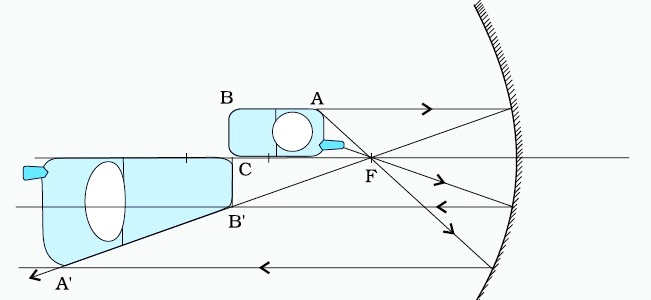
A mobile phone lies along the principal axis of a concave mirror, as shown in Fig. Show by suitable diagram, the formation of its image. Explain why the magnification is not uniform. Will the distortion of image depend on the location of the phone with respect to the mirror?
4.
Suppose that the lower half of the concave mirror’s reflecting surface in Fig. is covered with an opaque (non-reflective) material. What effect will this have on the image of an object placed in front of the mirror?
5.
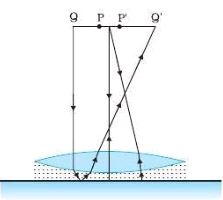
Figure shows an equiconvex lens (of refractive index 1.50) in contact with a liquid layer on top of a plane mirror. A small needle with its tip on the principal axis is moved along the axis until its inverted image is found at the position of the needle. The distance of the needle from the lens is measured to be 45.0cm. The liquid is removed and the experiment is repeated. The new distance is measured to be 30.0cm. What is the refractive index of the liquid?
6.
A Cassegrain telescope uses two mirrors as shown in Fig.Such a telescope is built with the mirrors 20mm apart. If the radius of curvature of the large mirror is 220mm and the small mirror is 140mm, where will the final image of an object at infinity be?
7.
(a) For the telescope described in Exercise (a), what is the separation between the objective lens and the eyepiece?
(b) If this telescope is used to view a 100 m tall tower 3 km away, what is the height of the image of the tower formed by the objective lens?
(c) What is the height of the final image of the tower if it is formed at 25cm?
8.
A small telescope has an objective lens of focal length 140cm and an eyepiece of focal length 5.0cm. What is the magnifying power of the telescope for viewing distant objects when
(a) the telescope is in normal adjustment (i.e., when the final image is at infinity)?
(b) the final image is formed at the least distance of distinct vision (25cm)?
9.
An angular magnification (magnifying power) of 30X is desired using an objective of focal length 1.25cm and an eyepiece of focal length 5cm. How will you set up the compound microscope?
10.
Answer the following questions:
(a) The angle subtended at the eye by an object is equal to the angle subtended at the eye by the virtual image produced by a magnifying glass. In what sense then does a magnifying glass provide angular magnification?
(b) In viewing through a magnifying glass, one usually positions one’s eyes very close to the lens. Does angular magnification change if the eye is moved back?
(c) Magnifying power of a simple microscope is inversely proportional to the focal length of the lens. What then stops us from using a convex lens of smaller and smaller focal length and achieving greater and greater magnifying power?
(d) Why must both the objective and the eyepiece of a compound microscope have short focal lengths?
(e) When viewing through a compound microscope, our eyes should be positioned not on the eyepiece but a short distance away from it for best viewing. Why? How much should be that short distance between the eye and eyepiece?
11.
What should be the distance between the object in Exercise and the magnifying glass if the virtual image of each square in the figure is to have an area of 6.25 mm2 . Would you be able to see the squares distinctly with your eyes very close to the magnifier?
12.
(a) At what distance should the lens be held from the card sheet in Exercise in order to view the squares distinctly with the maximum possible magnifying power?
(b) What is the magnification in this case?
(c) Is the magnification equal to the magnifying power in this case? Explain.
13.
A card sheet divided into squares each of size 1 mm2 is being viewed at a distance of 9 cm through a magnifying glass (a converging lens of focal length 9 cm) held close to the eye.
(a) What is the magnification produced by the lens? How much is the area of each square in the virtual image?
(b) What is the angular magnification (magnifying power) of the lens?
(c) Is the magnification in (a) equal to the magnifying power in (b)? Explain.
14.
At what angle should a ray of light be incident on the face of a prism of refracting angle 60° so that it just suffers total internal reflection at the other face? The refractive index of the material of the prism is 1.524.
15.
(a) Determine the ‘effective focal length’ of the combination of the two lenses in Exercise, if they are placed 8.0cm apart with their principal axes coincident. Does the answer depend on which side of the combination a beam of parallel light is incident? Is the notion of effective focal length of this system useful at all?
(b) An object 1.5 cm in size is placed on the side of the convex lens in the arrangement (a) above. The distance between the object and the convex lens is 40 cm. Determine the magnification produced by the two-lens system, and the size of the image.
16.
Answer the following questions:
(a) You have learnt that plane and convex mirrors produce virtual images of objects. Can they produce real images under some circumstances? Explain.
(b) A virtual image, we always say, cannot be caught on a screen Yet when we ‘see’ a virtual image, we are obviously bringing it on to the ‘screen’ (i.e., the retina) of our eye. Is there a contradiction?
(c) A diver under water, looks obliquely at a fisherman standing on the bank of a lake. Would the fisherman look taller or shorter to the diver than what he actually is?
(d) Does the apparent depth of a tank of water change if viewed obliquely? If so, does the apparent depth increase or decrease?
(e) The refractive index of diamond is much greater than that of ordinary glass. Is this fact of some use to a diamond cutter?
17.
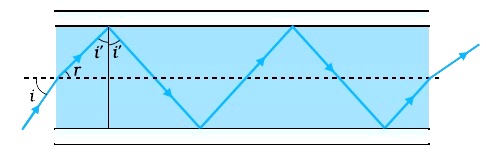
(a) Figure shows a cross-section of a ‘light pipe’ made of a glass fibre of refractive index 1.68. The outer covering of the pipe is made of a material of refractive index 1.44. What is the range of the angles of the incident rays with the axis of the pipe for which total reflections inside the pipe take place, as shown in the figure.
(b) What is the answer if there is no outer covering of the pipe?
18.
Use the mirror equation to deduce that:
(a) an object placed between f and 2f of a concave mirror produces a real image beyond 2f.
(b) a convex mirror always produces a virtual image independent of the location of the object.
(c) the virtual image produced by a convex mirror is always diminished in size and is located between the focus and the pole.
(d) an object placed between the pole and focus of a concave mirror produces a virtual and enlarged image.
[Note: This exercise helps you deduce algebraically properties of images that one obtains from explicit ray diagrams.]
19.
A person with a normal near point (25 cm) using a compound microscope with objective of focal length 8.0 mm and an eyepiece of focal length 2.5cm can bring an object placed at 9.0mm from the objective in sharp focus. What is the separation between the two lenses? Calculate the magnifying power of the microscope,
20.
An object of size 3.0cm is placed 14cm in front of a concave lens of focal length 21cm. Describe the image produced by the lens. What happens if the object is moved further away from the lens?
21.
A beam of light converges at a point P. Now a lens is placed in the path of the convergent beam 12cm from P. At what point does the beam converge if the lens is (a) a convex lens of focal length 20cm, and (b) a concave lens of focal length 16cm?
22.
A prism is made of glass of unknown refractive index. A parallel beam of light is incident on a face of the prism. The angle of minimum deviation is measured to be 40°. What is the refractive index of the material of the prism? The refracting angle of the prism is 60°. If the prism is placed in water (refractive index 1.33), predict the new angle of minimum deviation of a parallel beam of light.
23.
A small bulb is placed at the bottom of a tank containing water to a depth of 80cm. What is the area of the surface of water through which light from the bulb can emerge out? Refractive index of water is 1.33. (Consider the bulb to be a point source.)
24.
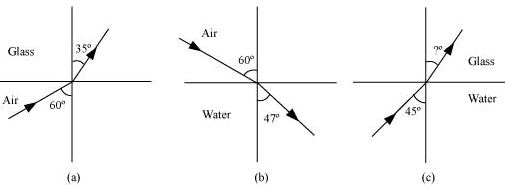
Figures (a) and (b) show refraction of a ray in air incident at 60° with the normal to a glass-air and water-air interface, respectively. Predict the angle of refraction in glass when the angle of incidence in water is 45° with the normal to a water-glass interface [Figure (c)]
25.
A tank is filled with water to a height of 12.5 cm. The apparent depth of a needle lying at the bottom of the tank is measured by a microscope to be 9.4 cm. What is the refractive index of water? If water is replaced by a liquid of refractive index 1.63 up to the same height, by what distance would the microscope have to be moved to focus on the needle again?
26.
A 4.5 cm needle is placed 12 cm away from a convex mirror of focal length 15 cm. Give the location of the image and the magnification. Describe what happens as the needle is moved farther from the mirror.
27.
A small candle, 2.5 cm in size is placed at 27 cm in front of a concave mirror of radius of curvature 36 cm. At what distance from the mirror should a screen be placed in order to obtain a sharp image? Describe the nature and size of the image. If the candle is moved closer to the mirror, how would the screen have to be moved?
28.
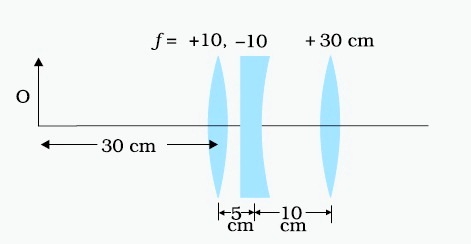
Find the position of the image formed by the lens combination given in the Fig.
29.
(i) If f = 0.5 m for a glass lens, what is the power of the lens?
(ii) The radii of curvature of the faces of a double convex lens are 10 cm and 15 cm. Its focal length is 12 cm. What is the refractive index of glass?
(iii) A convex lens has 20 cm focal length in air. What is focal length in water? (Refractive index of air-water = 1.33, refractive index for air-glass = 1.5.)
30.
Suppose while sitting in a parked car, you notice a jogger approaching towards you in the side view mirror of R = 2 m. If the jogger is running at a speed of 5 m s-1, how fast the image of the jogger appear to move when the jogger is (a) 39 m, (b) 29 m, (c) 19 m, and (d) 9 m away.
31.
An object is placed at (i) 10 cm, (ii) 5 cm in front of a concave mirror of radius of curvature 15 cm. Find the position, nature, and magnification of the image in each case.
32.
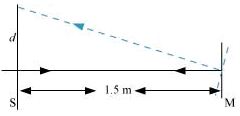
Light incident normally on a plane mirror attached to a galvanometer coil retraces backwards as shown in Fig. A current in the coil produces a deflection of 3.5° of the mirror. What is the displacement of the reflected spot of light on a screen placed 1.5 m away?
33.
The image of a small electric bulb fixed on the wall of a room is to be obtained on the opposite wall 3m away by means of a large convex lens. What is the maximum possible focal length of the lens required for the purpose?
34.
A small pin fixed on a table top is viewed from above from a distance of 50cm. By what distance would the pin appear to be raised if it is viewed from the same point through a 15cm thick glass slab held parallel to the table? Refractive index of glass = 1.5. Does the answer depend on the location of the slab?
35.
A small telescope has an objective lens of focal length 144cm and an eyepiece of focal length 6.0cm. What is the magnifying power of the telescope? What is the separation between the objective and the eyepiece?
36.
What is the focal length of a convex lens of focal length 30cm in contact with a concave lens of focal length 20cm? Is the system a converging or a diverging lens? Ignore thickness of the lenses.
37.
Double-convex lenses are to be manufactured from a glass of refractive index 1.55, with both faces of the same radius of curvature. What is the radius of curvature required if the focal length is to be 20cm?
38.
A ray is incident at an angle of incidence i on one surface of a prism of small angle A and emerges normally from opposite surface. If the refractive index of the material of prism is \(\mu\) , the angle of incidence i is nearly equal to
\(\frac { A }{ \mu } \)
\(\frac { A }{ 2\mu } \)
\(\mu \)A
\(\frac { \mu A }{ 2 }\)
39.
A concave shaving mirror has a radius of curvature of 35.0 cm. It is positioned so that the (upright) image of a man's face is 2.50 times the size of the face. How far is the mirror from the face?
5.25 cm
21.0 cm
10.5 cm
42 cm
40.
A boy of height 1 m stands in front of a convex mirror. His distance from the mirror is equal to its focal length. The height of his image is
0.25 m
0.33 m
0.5 m
0.67 m
41.
What can be the largest distance of an image of a real object from a convex mirror of radius of curvature is 20 cm?
10 cm
20 cm
Infinity
zero
42.
The focal length of the objective of a terrestrial telescope is 80 ern and it is adjusted for parallel rays, then its power is 20. If the focal length of erecting lens is 20 cm, then full length of the telescope will be
164 cm
124 cm
100 cm
84 cm
43.
An object is placed at a distance of 10 cm from a co-axial combination of two lenses A and B in contact. The combination forms a real image three times the size of the object. If lens B is concave with a focal length of 30 cm. The nature and focal length of lens A is
convex, 12 cm
concave, 12 cm
convex, 6 cm
convex, 18 cm
44.
A short linear object of length L lies on the axis of a spherical mirror of focal length f at a distance u form the mirror. Its image has an axial length L' equal to
\(L\left[ \frac { f }{ u-f } \right] ^{ 1/2 }\)
\(L\left[ \frac { u+f }{ f } \right] ^{ 1/2 }\)
\(L\left[ \frac { u-f }{ f } \right] ^{ 2 }\)
\(L\left[ \frac { f }{ u-f } \right] ^{ 2 }\)
45.
A thin convex lens of refractive index 1.5 has 20 cm focal length in air. If the lens is completely immersed in a liquid of refractive index 1.6, then its focal length will be
-160 cm
-100 cm
+10 cm
+100 cm
46.
In a compound microscope, the focal length of the objective is 2.5 cm and of eye lens is 5 cm. If an object is placed at 3.75 cm before the objective and the image is formed at the least distance of distinct vision, then the distance between two lenses will be
11.67 cm
12 cm
12.75 cm
13 cm
47.
If the image formed by a convex mirror of focal length 30 cm is a quarter of the size of the object, then the distance of the object from the mirror will be
30 cm
60 cm
90 cm
120 cm
48.
A thin equiconvex lens of refractive index 3/2 and radius of curvature 30 em is put in water (refractive index = 4/3), its focal length is
0.15 m
0.30 m
0.45 m
1.20 m
49.
A beam of light is incident on a glass slab in a direction as shown in the figure. The reflected light is analysed by a polaroid prism. On rotating the polaroid,
the intensity remains unchanged
the intensity is reduced to zero and remains at zero
the intensity gradually reduced to zero and then again increases
the intensity increase continuously
the intensity increases initially and remains constant afterwards
50.
For having large magnification power of a compound microscope
length of the microscope tube must be small
focal lengths of objective lens and ele-piece should be large
focal lengths of objective lens and eye-piece should be small
focal length of eye-piece must be smaller than the focal length of objective lens
51.
A vessel consists of two plane mirrors at right angles as shown in figure. The vessel is filled with water. The total deviation in incident ray is
0°
60°
90°
180°
52.
If c is the velocity of light in free space, then the time taken by light to travel a distance x in a medium refractive index \(\mu\) is
\(\frac { x }{ c } \)
\(\frac { \mu x }{ c } \)
\(\frac { x }{ \mu c } \)
\(\frac { c }{ \mu x } \)
53.
Two thin lenses of focal lengths f1 and f2 are placed in contact with each other. Then, the equivalent focal length of the combination will be
f1 + f2
\(\frac { 1 }{ { f }_{ 1 }+{ f }_{ 2 } } \)
\(\frac { { f }_{ 1 }{ f }_{ 2 } }{ { f }_{ 1 }+{ f }_{ 2 } } \)
\(\frac { { f }_{ 1 }+{ f }_{ 2 } }{ { f }_{ 1 }{ f }_{ 2 } } \)
54.
The radius of curvature of the convex face of a plano-convex lens is 12 cm and the refractive index of the material of the lens is 1.5. Then, the focal length of the lens is
6 cm
12 cm
18 cm
24 cm
55.
The sun light reaches us as white and not as its components because
air medium is dispersive
air medium is non-dispersive
air medium scatter the sunlight
air medium absorbs the sunlight
speed of light depends on wavelength in vacuum
56.
The magnifying power of the astronomical telescope for normal adjustment is 50. The focal length of the eyepiece is 2 cm. The required length of the telescope for normal adjustment is
102 cm
100 cm
98 cm
25 cm
57.
A small angled prism of refractive index 1.4 is combined with another small angled prism of refractive index 1.6 to produce dispersion without deviation. If the angle of first prism is 6°, then the angle of the second prism is
8°
6°
4°
2°
58.
The. distance of moon form the earth is 3.8x 10⁵ km. Supposing that the eye is most sensitive to the light of wavelength 550 nm, the separation of two points on the moon that can be resolved by a 500 cm telescope is
50 m
55 m
51 m
60 m
59.
When an object is placed 40 cm from a diverging lens, its virtual image is formed 20 cm from the lens.The focal length and power of lens are
F = - 20 cm, P = - 5 D
F = - 40 cm, P = - 5 D
F = - 40 cm,P = -2.5 D
F = -20 cm,P = -2.5 D
60.
A person has a minimum distance of distinct vision as 50 cm. The power of lenses required to read a book at a distance of 25 cm is
3 D
1 D
2 D
4 D
61.
A magnifying glass of focal length 5 cm is used to view an object by a person whose smallest distance of distinct vision is 25cm. If he holds the glass close to eye, then the magnification is
5
6
2.5
3
62.
An object is 8 cm high. It is desired to form a real image 4 cm high at 60 cm from the mirror. The type of mirror needed with the focal length is
convex mirror with focal length f = 40 cm
convex mirror with focal length f = 20 cm
concave mirror with focal length f = - 40 cm
concave mirror with focal length f = - 20 cm
63.
For a normal eye, the cornea of eye provides a converging power of 40 D and the least converging power of the eye lens behind the cornea is 20 D. Using this information, the distance between the retina and the cornea-eye lens can be estimated to be
5 cm
2.5 cm
1.67 cm
1.5 cm
64.
Diameter of the objective of a telescope is 200 cm. What is the resolving power of a telescope? Take, wavelength of light = 5000A.
6.56 x 10⁶
3.28 x 10⁵
1 x 10⁶
3.28 x 10⁶
65.
A microscope is having objective of focal length 1 cm and eye-piece of focal length 6 cm. If tube length is 30 cm and image is formed at the least distance of distinct vision, what is the magnification produced by the microscope.(take, D = 25 cm)
6
150
25
125
66.
The intermediate image formed by the objective of a compound microscope is
real, inverted and magnified
real, erect and magnified
virtual, erect and magnified
virtual, inverted and magnified
67.
Astigmatism is corrected by using
cylindrical lens
plano-convex lens
plano-concave lens
convex lens
concave lens
68.
A focal length of a lens is 10 cm. What is power of a lens in dioptre?
0.1 D
10 D
15 D
1 D
69.
A concave lens of focal length f forms an image which is 1/3 times the size of the object. Then, the distance of object from the lens is
2f
f
\(\frac { 2 }{ 3 } f\)
\(\frac { 3 }{ 2 } f\)
70.
A luminous object is separated from a screen by distance d. A convex lens is placed between the object and the screen such that it forms a distinct image on the screen. The maximum possible focal length of this convex lens is
4d
2d
\(\frac { d }{ 2 } \)
\(\frac { d }{ 4 } \)
71.
Two lenses of power 15D and -3 D are placed in contact. The focal length of the combinations is
10 cm
15 cm
12 cm
18 cm
8.33 cm
72.
The equiconvex lens has focal length f. If it is cut perpendicular to the principal axis passing through optical centre, then focal length of each half is
\(\frac { f }{ 2 } \)
f
\(\frac { 3f }{ 2 } \)
2f
73.
In vacuum, to travel distance d, light takes time t and in medium to travel distance 5d, it takes time T. The critical angle of the medium is
\({ sin }^{ -1 }\left( \frac { 5T }{ t } \right) \)
\({ sin }^{ -1 }\left( \frac { 5t }{3T } \right) \)
\({ sin }^{ -1 }\left( \frac { 5t }{ T } \right) \)
\({ sin }^{ -1 }\left( \frac { 3t }{ 5T } \right) \)
74.
A glass slab consists of thin uniform layers of progressively decreasing refractive indices refractive index such that the refractive index of any layer is \(\mu -m\Delta \mu \) Here, \(\mu \) and \(\Delta \mu \) denote the refractive index of 0th layer and the difference in refractive index between any two consecutive layers, respectively. The integer m = 0, 1, 2, 3, ... denotes the numbers of the successive layers. A ray of light from the 0th layer enters the 1st layer at an angle of incidence of 30°. After undergoing the mth refraction, the ray emerges parallel to the interface. If \(\mu \) = 1.5 and \(\Delta \mu \) = 0.015, then the value of m is
20
30
40
50
75.
An object placed at 20 cm in front of a concave mirror produces three times magnified real image. What is the focal length of the concave mirror?
15 cm
6.6 cm
10 cm
7.5 cm
76.
To get three images of single object, one should have two plane mirrors at an angle of
60°
90°
120°
30°
77.
To measure the roughness of the surface of a material, which of the following microscope is preferred for better result output?
Compound microscope
Electron microscope
Atomic force microscope
None of the above
78.
The limiting angle of incidence for an optical ray that can be transmitted by an equilateral prism of refractive index \(\mu =\sqrt { \frac { 7 }{ 3 } } \) is given by (angles can be assumed to be small, so that sine of the angle is angle itself)
\(\frac { \pi }{ 3 } \)
\(\frac { \pi }{ 6 } \)
\(\frac { 2\pi }{ 3 } \)
\(\frac { \pi }{ 2 } \)
79.
The velocity of image when object and mirror both are moving towards each other with velocities 4 ms-1 and 5 ms-1 respectively, is
-14 ms-1
15ms-1
-9 ms-1
14 ms-1
80.
The magnifying power of a convex lens of focal length 10 cm, when the image is formed at the near point is
6
5.5
4
3.5
81.
A person wants a real image of his own, 3 times enlarged. Where should he stand in front of a concave mirror of radius of curvature of 30 cm?
90 cm
10 cm
20 cm
30 cm
82.
Calculate the focal length of a reading glass of a person, if the distance of distinct vision is 75 crn.
75.2 cm
25.6 cm
100.4 cm
37.5 cm
83.
Dispersion of light is caused due to
intensity of light
density of medium
wavelength
None of these
84.
If \({ \mu }_{ v }=1.5230\) and \({ \mu }_{ R }=1.5145\) then dispersive power of a crown glass is
0.0164
0.00701
0.0132
0.0320
85.
An object is located 4 m from the first of two thin converging lenses of focal lengths 2 m and 1 m, respectively. The lenses are separated by 3 m. The final image formed by the second lens is located from the source at a distance of
8 m
5.5 m
6 m
6.5 m
86.
Aperture of human eye is 0.2 cm. The minimum magnifying power of a visual telescope, whose objective has diameter 100 cm, is
500
0.002
0.02
100
87.
The focal lengths of a converging lens are fv and fr for violet and red lights, respectively. Which of the following is correct?
fv < fr
fv = fr
f v > fr
It depends on the average refractive index
88.
A ray of light passes from a medium A having refractive index 1.6 to the medium B having refractive index 1.5. The value of critical angle of medium
\({ sin }^{ -1 }\sqrt { \frac { 16 }{ 15 } } \)
\({ sin }^{ -1 }\left( \frac { 16 }{ 15 } \right) \)
\({ sin }^{ -1 }\left( \frac { 1 }{ 2 } \right) \)
\({ sin }^{ -1 }\left( \frac { 15 }{ 16 } \right) \)
89.
Angle of minimum deviation for a prism of refractive index 1.5 is equal to the angle of prism of given prism. Then, the angle of prism is
80°
41°24'
60°
82°48'
90.
An object is seen through a simple microscope of focal length 12 cm. What will be the angular magnification produced, if the image is formed at the near point of the eye which is 25 cm away from it?
6.08
3.08
9.03
5.09
91.
The near point and far point of a person are 40 cm and 250 cm, respectively. Determine the power of the lens he/she should use while reading a book kept at distance 25 cm from the eye.
2.5D
5D
1.5D
3.5D
92.
The refracting angle of a prism is A and refractive index of the material of the prism is cot (A/2). The angle of minimum deviation is
180°- 3A
180°- 2A
90°- A
180°+ 2A
93.
The angle of incidence for a ray of light at a refracting surface of a prism is 45°. The angle of prism is 60°. If the ray suffers minimum deviation through the prism, then the angle of minimum deviation and refractive index of the material of the prism respectively, are
\(30°,\sqrt { 2 } \)
\(45°,\sqrt { 2 } \)
\(30°,\frac { 1 }{ \sqrt { 2 } } \)
\(45°,\frac { 1 }{ \sqrt { 2 } } \)
94.
A person can see clearly objects only when they lie bet ween 50 cm and 400 cm from his eyes. In order to increase the maximum distance of distinct vision to infinity, the type and power of the correcting lens, the person has to use, will be
convex, + 2.25 D
concave, - 0.25D
concave, - 0.2 D
convex, + 0.15 D
95.
An infinitely long rod lies along with the axis of a concave mirror of focal length f. The near end of the rod is at a distance u > f from the mirror. Its image will have a length
\(\frac { { f }^{ 2 } }{ u-f } \)
\(\frac { uf }{ u-f } \)
\(\frac { { f }^{ 2 } }{ u+f } \)
\(\frac { uf }{ u+f } \)
96.
An object is placed at 21 cm in front of a concave mirror of radius of a curvature 10 cm, A glass slab of thickness 3 cm and \(\mu\) = 1.5 is then placed close to the mirror in the space between the object and the mirror. The position of final image formed is
-3.94 cm
4.3 cm
-4.93
3.94 cm
97.
The dispersive powers of glasses of lenses used in an achromatic pair are in the ratio 5 : 3. If the focal length of the concave lens' is 15 ern, then the nature and focal length of the other lens would be
convex, 9 cm
concave, 9 cm
convex, 25 cm
concave, 25 cm
98.
A plano-convex lens has a maximum thickness of 6 cm. When placed on a horizontal table with the curved surface in contact with the table surface, then the apparent depth of the bottom most point of the lens is found to be 4 cm. If the lens is inverted such that the plane face of the lens is in contact with the surface of the table, then the apparent depth of the centre of the plane face is found to be \(\frac{17}{3}\) cm. The radius of curvature of the lens is
68 cm
75 cm
128 cm
34 cm
99.
convex lens of focal length f is placed some, where in between an object and a screen. The distance between object and screen is x. If numerical value of magnification produced by lens is m, then focal length of lens is
\(\frac { mx }{ { \left( m+1 \right) }^{ 2 } } \)
\(\frac { mx }{ { \left( m-1 \right) }^{ 2 } } \)
\(\frac { { \left( m+1 \right) }^{ 2 } }{ m } \)
\(\frac { { \left( m-1 \right) }^{ 2 } }{ m } \)
100.
The magnifying power of a microscope with an objective of 5 mm focal length is 400. The length of its tube is 20 cm. Then, the focal length of the eye-piece is
200 cm
160 cm
2.5 cm
0.1 cm
101.
A car is moving with at a constant speed of 60 km h-1 on a straight road. Looking at the rear view mirror, the driver finds that the car following him is at a distance of 100 m and is approaching with a speed of 5 km h-1 In order to keep track of the car in the rear, the driver begins to glance alternatively at the rear and side mirror of his car after every 2 s till the
other car overtakes. If the two cars were maintaining their speeds, which of the following statement (s) is/are correct?
The speed of the car in the rear is 65 km h-1
In the side mirror, the car in the rear would appear to approach with a speed of 5 km h-1 to the driver of the leading car
In the rear view mirror, the speed of the approaching car would appear to decrease as the distance between the cars decreases
In the side mirror, the speed of the approaching car would appear to increase as the distance between the cars decreases
102.
A ray of light, travelling in a medium of refractive index \(\mu\) , is incident at an angle i on a composite transparent plate consisting of three plates of refractive indices \({ \mu }_{ 1 },{ \mu }_{ 2 }\) and \({ \mu }_{ 3 }\) The ray emerges from the composite plate into a medium of refractive index \({ \mu }_{ 4 }\) , at angle x. Then
sin x = sin i
\(sinx=\frac { \mu }{ { \mu }_{ 4 } } \)
\(sinx=\frac { { \mu }_{ 4 } }{ { \mu } } sin \ i\)
\(sinx=\frac { { \mu }_{ 1 } }{ { { \mu }_{ 2 } } } \frac { { \mu }_{ 3 } }{ { { \mu }_{ 2 } } } \frac { { \mu } }{ { { \mu }_{ 4 } } } sin \ i\)
103.
A plano-concave lens is made of glass of refractive index 1.5 and the radius of curvature of its curved face is 100 cm. What is the power of the lens?
+0.5 D
-0.5 D
-2 D
+2 D
104.
A ray of light incident at an angle \(\theta\) on a refracting face of a prism emerges from the other face normally. If the angle of the prism is 5° and the prism is made of a material of refractive index 1.5 then the angle of incidence is
7.5°
5°
15°
2.5°
105.
A plano-convex lens ( f = 20 cm) is silvered at plane surface. Now, focal length will be
20 cm
40 cm
30 cm
10 cm
106.
A plano-convex lens is made of refractive index of 1.6. The focal length of the lens is
400 cm
200 cm
100 cm
50 cm
107.
If light travels a distance x in t1 sec in air and 10 x distance in t2 see in a medium, the critical angle of the medium will be
\({ tan }^{ -1 }\left( \frac { { t }_{ 1 } }{ { t }_{ 2 } } \right) \)
\({ sin }^{ -1 }\left( \frac { { t }_{ 1 } }{ { t }_{ 2 } } \right) \)
\({ sin }^{ -1 }\left( \frac { {10 t }_{ 1 } }{ { t }_{ 2 } } \right) \)
\({ tan }^{ -1 }\left( \frac { { 10t }_{ 1 } }{ { t }_{ 2 } } \right) \)
108.
The radii of curvature of the two surfaces of a lens are 20 cm and 30 cm and the refractive index of the, material of the lens is 1.5. If the lens is concave-convex, then the focal length of the lens is
24 cm
10 cm
15 cm
120 cm
109.
In a plano-convex lens, the radius of curvature of convex surface is 10 cm and the focal length of the lens is 30 cm. The refractive index of the material of the lens will be
1.5
1.66
1.33
3
110.
A ray of light passing through a prism of refraction angle 60° has to deviate by at least 30°. Then, refractive index of prism should be
\(\le \sqrt { 2 } \)
\(\ge \sqrt { 2 } \)
\(\ge \sqrt { 3 } \)
\(\ge \sqrt { 3 } \)
111.
An object of 5 cm height is placed 1 m apart from a concave spherical mirror which has a radius of curvature of 20 cm. The size of the image is
0.11 cm
0.5 cm
0.55 cm
0.60 cm
112.
The focal lengths of the lenses of an astronomical telescope are 50 cm and 5 cm. The length of the telescope when the image is formed at the least distance of distinct vision is
45 cm
55 cm
275/6 cm
325/6 cm
113.
Two mirrors are kept at 60° to each other and a body is placed at the middle. The total number of images formed are
six
four
five
three
114.
The magnification produced by an astronomical telescope for normal adjustment is 10 and the length of the telescope is 1.1 m. The magnification, when the image is formed at least distance of distinct vision is
6
14
16
18
115.
An astronomical telescope in normal adjustment receives light from a distance source S, the tube length is now decreased slightly, then
no image will be formed
a virtual image of S will be formed at a finite distance
a large, real image of S will be formed behind the eye piece, far away from i
a small, real image of S will be formed behind the eye-piece closes to it
116.
Light travels in two media A and B with speeds 1.8 x 10⁸ ms-1 and 2.4 x 10⁸ ms-1 respectively. Then, the critical angle between them is
\({ sin }^{ -1 }\left( \frac { 2 }{ 3 } \right) \)
\({ tan }^{ -1 }\left( \frac { 3 }{ 4 } \right) \)
\({ tan }^{ -1 }\left( \frac { 2 }{ 3 } \right) \)
\({ sin }^{ -1 }\left( \frac { 3 }{ 4 } \right) \)
117.
When sun light is scattered by minute particles of atmosphere, then the intensity of light scattered away is proportional to
(wavelength ot light)4
(frequency of light)4
(wavelength of light)2
(frequency of light)2
118.
Two beams of red and violet colours made to pass separately through a prism (A = 60°). In the minimum deviation position, the angle of refraction inside the prism will be
greater for red colour
equal but not 30° for both the colours
greater for violet colour
30° for both the colours
119.
Mark the correct one.
Our eyes can distinguish between real and virtual image
Virtual image can also be taken on screen
If the incident rays are converging at a point, then the object is real
None of the above
120.
If x1 is the size of the magnified image and x2 is the size of the diminished image in lens displacement method, then the size of the object is
\(\sqrt { { x }_{ 1 }{ x }_{ 2 } } \)
x1x2
x12x2
x1x22
121.
When a lens of refractive index n1 is placed in a liquid of refractive index n2 then the lens looks to be disappeared only, if
n1 = n2/2
n1 = 3n2/2
n1 = n2
n1 = 5n2/2
122.
A beam of light composed of red and green rays is incident obliquely at a point on the face of a rectangular glass slab. When coming out on the opposite parallel face, then the red and green rays emerge from
two points propagating in two different non-parallel directions
two points propagating in two different parallel directions
one point propagating in two different directions
one point propagating in the same direction
123.
Under minimum deviation condition in a prism, if a ray is an incident at an angle 30°, then the angle between the emergent ray and the second refracting surface of the prism is
0°
30°
45°
60°
124.
A mark at the bottom of a liquid appears to rise by 0.1 m. The depth of the liquid is 1 ill. The refractive index of the liquid is
1.33
9/10
10/9
1.5
125.
An object has an image thrice of its original size when kept at 8 em and 16 cm from a convex lens. Focal length of the lens is
less than 8 cm
8 cm
16 cm
between 8 and 16 cm
126.
An object approaches a convergent of lens from the left of the lens with a uniform speed 5m/s and stops at the focus. The image
moves away from the lens with a uniform speed 5 m/s
moves away from the lens with a uniform acceleration
moves away from the lens with a non-uniform acceleration
moves towards the lens with a non-uniform acceleration
127.
A short pulse of white light is incident from air to a glass slab at normal incidence. After travelling through the slab, the first colour to emerge is
blue
green
violet
red
128.
Our eyes are most sensitive for which of the following wavelength?
4500 \(\mathring { A } \)
5500\(\mathring { A } \)
6500\(\mathring { A } \)
Equally sensitive for all wavelengths of visible spectrum
129.
A man has height of 6 m. He observes image of 2 m height erect, then mirror used is
concave
convex
plane
None of these
130.
The minimum magnifying power of telescope is M. If the focal length of its eye lens is halved, the magnifying power will become
m/2
2m
3m
4m
131.
A passenger in an aeroplane
should see a rainbow
may see a primary and a secondary rainbow as concentric circles
may see a primary and a secondary rainbow as concentric arcs
should never see a secondary rainbow
132.
Which of the following statement is correct for hypermetropia?
Near objects are not clearly visible
Distant objects are not clearly visible
Concave lens is used for remedy of hypermetropia
None of the above
133.
The phenomena involved in the reflection of radiowaves by ionosphere is similar to
reflection of light by a plane mirror
total internal reflection of light in air during a mirage
dispersion of light by water molecules during the formation of a rainbow
scattering of light by the particles of air
134.
Phenomena associated with scattering is/are
blue colour of the sky
appearence of reddish sun during sunset and sunrise
both (a) and (b)
None of the above
135.
Rainbow is caused due to
Refraction
reflection
dispersion
All of these
136.
A combination is made of two lenses of focal lengths f1 and f2 and dispersive powers \({ \omega }_{ 1 }\) and \({ \omega }_{ 2 }\)respectively. The combination will be achromatic, if
\({ \omega }_{ 1 }=2{ \omega }_{ 2 }\) and f1 = 2f2
\({ 2\omega }_{ 1 }=2{ \omega }_{ 2 }\) and f1 = 2f2
\({ \omega }_{ 1 }=2{ \omega }_{ 2 }\) and f1 = -2f2
\({ 2\omega }_{ 1 }={ \omega }_{ 2 }\) and 2f1 = f2
137.
Presbyopia can be removed by using
convex lens
concave lens
cylindrical lens
bifocal lens
138.
A person suffering from the defect astigmatism
cannot see any object
cannot see objects in two perpendicular directions simultaneously
cannot see near by Objects
cannot see distant objects
139.
A short-sighted person can see distinctly only those objects which lie between 10 cm and 100 cm from him. The power of the spectacle lens required to see a distance object is
+0.5 D
-1.0 D
-10 D
+4.0 D
140.
For the myopia defect in eye, it can be removed by
convex lens
concave lens
cylindrical lens
toric lens
141.
The resolving power of telescope whose lens has a diameter of 1.22 m for a wavelength of 5000 A is
2 x 10⁵
2 x 10⁶
2 x 10²
2 x 10⁴
142.
Resolving power of a microscope is given by
\(\frac { 2\mu sin\theta }{ { \lambda }^{ 2 } } \)
\(\frac { \mu sin\theta }{ { \lambda } } \)
\(\frac {2 \mu sin\theta }{ { \lambda } } \)
\(\frac { 2\mu cos\theta }{ { \lambda } } \)
143.
Reflecting telescope consists of
convex mirror of large,aperture
concave mirror of large aperture
concave lens of small aperture
None of the above
144.
In Galilean telescope, the final image formed is
real, erect and enlarged
virtual.'erect and enlarged
real, inverted and enlarged
virtual, inverted and enlarged
145.
Magnifying power of a Galilean telescope is given by
\(\frac { { f }_{ 0 } }{ { f }_{ e } } \left( 1-\frac { { f }_{ e } }{ D } \right) \)
\(\frac { { f }_{ 0 } }{ { f }_{ e } } \left( 1+\frac { { f }_{ e } }{ D } \right) \)
\(\frac { { f }_{ 0 } }{ { f }_{ e } } \left( 1+\frac { { 2f }_{ e } }{ D } \right) \)
\(\frac { { f }_{ 0 } }{ { f }_{ e } } \left( 1-\frac { { 2f }_{ e } }{ D } \right) \)
146.
The aperture of a telescope is made large, because to
increase the intensity of image
decrease the intensity of image
have greater magnification
have lesser resolution
147.
If the focal length of objective and eye lens are 1.2 cm and 3 cm respectively and the object is put 1.25 cm away from the objective lens and the final image is formed at infinity. The magnifying power of the microscope is
150
200
250
400
148.
The length of the compound microscope is 14 cm, The magnifying power for relaxed eye is 25. If the focal length of eye lens is 5 cm, then the object distance for objective lens will be
1.8 cm
1.5 cm
2.1 cm
2.4 cm
149.
A compound microscope has two lenses. The magnifying power of one is 5 and the combined magnifying power is 100. The magnifying power of the other lens is
10
20
50
25
150.
In a compound microscope, the intermediate image is
virtual, erect and magnified
real, erect and magnified
real, inverted and magnified
virtual, erect and reduced
151.
Image formed on the retina is
real and inverted
virtual and erect
real and erect
virtual and inverted
152.
For a normal eye, the least distance of distinct vision is
0.25 m
0.50 m
25 m
infinite
153.
A thin prism P1 with angle 6° and made from glass of refractive index 1.54 is combined with another thin prism P2 of refractive index 1.72 to produce dispersion without deviation. The angle of prism P2 will be
5°24'
4°30'
6°
8°
154.
Dispersive power depends upon
the angle of prism
material of prism
deviation produced by prism
height of the prism
155.
When light of wavelength \(\lambda\) is incident on an equilateral prism kept in, its minimum deviation position, it is found that the angle of deviation equals the angle of the prism itself The refractive index of the material of the prism for the wavelength \(\lambda\) is, then
\(\sqrt { 3 } \)
\(\frac { \sqrt { 3 } }{ 2 } \)
2
\(\sqrt { 2 } \)
156.
A ray of light passes through an equilateral glass prism in such a manner that the angle of incidence is equal to the angle of emergence and each of these angles is equal to 3/4 of the angle of the prism. The angle of deviation is
45°
39°
20°
30°
157.
A ray of light is incident at an angle of 60° on one face of a prism of angle 30°. The ray emerging out of the prism makes an angle of 30° with the incident ray. The emergent ray is
normal to the face through which it emerges
inclined at 30° to the face through which it emerges
inclined at 60° to the face through which it emerges
None of the above
158.
A converging lens is used to form an image on a screen. When the upper half of the lens is-covered by an opaque screen, then
half the image will disappear
complete image will disappear
intensity of image will increase
intensity of image will decrease
159.
A biconvex lens has a focal length f. It is cut into two parts along a line perpendicular to principal axis. The focal length of each part will be
f/2
f
(3/2)f
2f
160.
The minimum distance between an object and its real image formed by a convex lens is
1.5 f
2 f
2.5 f
4 f
161.
A plano-convex lens of curvature of 30 cm and refractive index 1.5 produces a real image of an object kept 90 cm from it. What is the magnification?
4
0.5
1.5
2
162.
The real image which is exactly equal to the size of an object is to be obtained on a screen with the help of a convex lens of focal length 15 cm. For this, what must be in the distance between the object and screen?
15 cm
30 cm
45 cm
60 cm
163.
An object is placed at 10 cm from a lens and real image is formed with magnification of 0.5. Then the lens is
concave with focal length of 10/3 cm
convex with focal length of 10/3 cm
concave with focal length of 10 cm
convex with focal length of 10 cm
164.
A plano-convex lens is made of glass of refractive index 1.5. The radius of curvature of its convex surface is R. Its focal length is
R/2
R
2R
1.5R
165.
A glass slab has a critical angle of 30° when placed in air. What will be the critical angle when it is placed in liquid of refractive index 6/5?
45°
37°
53°
60°
166.
The critical angle of a prism is 30°. The velocity of light in the medium is
1.5 x 10⁸ m/s
3 x 10⁸ m/s
4.5 x 10⁸ m/s
None of these
167.
A glass-slab is immersed in water. What will be the critical angle for a light ray at glass-water interface? Where \({ _{ a }{ n }_{ g } }=1.50,{ _{ a }{ n }_{ w } }=1.33\)and sin-1 (0.887) = 62.5
48.8°
72.8°
62.5°
64.5°
168.
A vessel of depth 2 d cm is half filled with a liquid of refractive index \({ \mu }_{ 1 }\)and the upper half with a liquid of refractive index \({ \mu }_{ 2 }\)The apparent depth of the vessel seen perpendicu.
\(d\left[ \frac { { \mu }_{ 1 }{ \mu }_{ 2 } }{ { \mu }_{ 1 }+{ \mu }_{ 2 } } \right] \)
\(d\left[ \frac { 1 }{ { \mu }_{ 1 } } +\frac { 1 }{ { \mu }_{ 2 } } \right] \)
\(2d\left[ \frac { 1 }{ { \mu }_{ 1 } } +\frac { 1 }{ { \mu }_{ 2 } } \right] \)
\(2d\left[ \frac { 1 }{ { \mu }_{ 1 }{ \mu }_{ 2 } } \right] \)
169.
A spot is placed on the bottom of a slab made of a transparent material of refractive index 1.5. The spot is viewed vertically from the top when it seems to be raised by 2 cm. Then, the height of the slab is
10 cm
8 cm
6 cm
4 cm
170.
An object of size 7.5 cm is placed in front of a convex mirror of radius of curvature 25 cm at a distance of 40 cm. The size of the image should be
2.3 cm
1.78cm
1 cm
0.8 cm
171.
A convex mirror of focal length f forms an image which is 1/n times the object. The distance of the object from the mirror is
(n-1)f
\(\left[ \frac { n-1 }{ n } \right] f\)
\(\left[ \frac { n+1 }{ n } \right] f\)
(n+1)f
172.
A point object is placed at a distance of 30 cm from a convex mirror of focal length 30 cm. The image will form at
infinity
pole
focus
15 cm behind the mirror
173.
An object is moving towards a stationary plane mirror with a speed of 2 m/s. Velocity of the image w.r.t. the object is
2 m/s towards right
4 rn/s towards right
2 rn/s towards left
4 rn/s towards left
174.
If the reflected ray is rotated by an angle of 4\(\theta\) in clockwise direction then the mirror was rotated by
2\(\theta\) in anti-clockwise direction
4\(\theta\) in anti-clockwise direction
2\(\theta\) in clockwise direction
4\(\theta\) in clockwise direction
175.
Which of the following is correct for the image formed by a plane mirror?
Always real
Always virtual
Virtual and laterally inverted
Real and laterally inverted
176.
A ray of light travelling in a transparent medium of refractive index \(\mu\) on a surface separating the medium from air at an angle of incidence of 450 For which of the following value of \(\mu\) the ray can undergo total internal reflection?
\(\mu\) = 1.33
\(\mu\) = 1.40
\(\mu\) = 1.50
\(\mu\) = 1.25
177.
Which of the following is not due to total internal reflection?
Difference between apparent and real depth of a pond
Mirage on hot summer days
Brilliance of diamond
Working of optical fibre
178.
A thin prism P1 of angle 4o and refractive index 1.54o is combained with another thin prism P2 of refractive index 1.72 to produce dispersion without deviation. The angle of P2 is
4o
5.33o
2.6o
3o
179.
What is the refractive index of a prism whose angle A = 600 and angle of minimum deviation dm = 300?
\(\sqrt{2}\)
\(\frac{1}{\sqrt{2}}\)
1
\(\frac{1}{\sqrt{3}}\)
180.
The focal length of objective lens is increased then magnifying power of
Microscope will increase but that of telescope decreases
Microscope and telescope both will increase
Microscope and telescope both will decrease
Microscope will decrease but that of telescope will increase
181.
The angle of a prism is A. One of its refracting
2 sin A
2 cos A
1/2 cos A
tan A
182.
Two identical thin plano-convex glass lenses each having radius of curvature of 20cm are placed with their convex surfaces in contact at the centre. The intervening space is filled with oil of refractive index 1.7. The intervening space is filled with oil refractive index 1.7. The focal length of the combination is
-20 cm
-25 cm
-50 cm
50 cm
183.
A convex lens has mean focal length 20 cm. The dispersive power of the material of the lens is 0.02. The longitudinal chromatic aberration for an object at infity, is
0.20
0.40
0.80
103
184.
A hollow prism is filled with water and placed in air, It will deviate the incident rays
towards the base
away from base
parallel to base
towards or away from base depending on the location
185.
The r efracting angle of a prism is A and refractive index of the material of the prism is cot(A/2). The angle of minimum deviation is
180o-3A
180-2A
90o-A
180o+2A
186.
For the figure as shown below, match the following columns.
| A | B | C |
| 2 | 3 | 1 |
| A | B | C |
| 2 | 1 | 3 |
| A | B | C |
| 3 | 2 | 1 |
| A | B | C |
| 3 | 1 | 2 |
187.
The diameter of the moon is \(3.5\times10^3 km\) and its distance from the earth is \(3.8\times10^5 km\) seen by a telescope having focal lengths of the objective and the eye piece as 40mm and 1.0 cm respectively, the angular diameter of the image of the moon will be approximately.
2o
10o
20o
None of these
188.
A simple telescope, consisting of an objective of focal length 60 cm and a single eye lens of focal length 5cm is focusedon a distant object in such a way that parallel rays emerge from the eye lens. If the object subtends an angle of 2o at the objective,the angular width of the image is
100
240
500
(1/6)0
189.
To correct myopia, the focal length of the concave lens should be
equal to the distance of far point
less than the distance of far point
less than the distance of near point
equal to the distance of near point
190.
The refractive index of the material of a prism is \(\sqrt{2}\) and its refracting angle is 300 . One of the refracting surfaces of the prism is made a mirror inwards. A beam of monochromatic light entering the prism from the other face will retrace its path after reflection from the mirrored surface,if its angle of incidence on the prism is
450
600
00
300
191.
A thin glass prism ( \(\mu \) = 1.5) is immersed in water ( \(\mu \) = 1.3). If the angle of deviation in air for a particular ray be D, then in water will be
0.2 D
0.3 D
0.5 D
0.6 D
192.
A thin prism of angle \({ 7 }^{ 0 }\) and refractive index 1.5 is combined with another prism of angle \(\theta \) and refractive index 1.7. The emergent ray goes undeviated. What is the value of \(\theta \) ?
\({ 3 }^{ 0 }\)
\({ 5 }^{ 0 }\)
\({ 9 }^{ 0 }\)
\({ 1 }^{ 0 }\)
193.
A glass prism ABC (refractive index 1.5), immersed in water (refractive index 4/3). A ray of light is incident normally on face AB. If it is totally reflected at face AC, then
\(sin\theta \ge \frac { 8 }{ 9 } \)
\(sin\theta \ge \frac { 2 }{ 3 } \)
\(sin\theta \ge \frac { \sqrt { 3 } }{ 2 } \)
\(\frac { 2 }{ 3 } \)
194.
If the critical angle for total internal reflection from a medium to vaccum is \({ 30 }^{ 0 }\), the velocity of light in the medium is
\(3\times { 10 }^{ 8 }m{ s }^{ -1 }\)
\(1.5\times { 10 }^{ 8 }m{ s }^{ -1 }\)
\(6\times { 10 }^{ 8 }m{ s }^{ -1 }\)
\(\sqrt { 3 } \times { 10 }^{ 8 }m{ s }^{ -1 }\)
195.
Two lamps of powers \({ P }_{ 1 }\)and \({ P }_{ 2 }\) are placed on either side of a paper having an oil spot. The lamps are at 1m and 2 m respectively, On either side of the paper and the oil spot is invisible. What is the value of \({ P }_{ 1 }/{ P }_{ 2 }\)?
0.25
0.40
0.50
0.60
196.
The distance of the image from the focus of a lens is X and that of object is Y. What is the nature of the graph Y versus X ?
Straight line
Ellipse
Parabola
Hyperbola
197.
A thin convergent glass lens( \(\mu \) = 1.5) has a power of + 5.0 D. When this lens is immersed in aliquid of refractive index \(\mu \) it acts as a divergence lens of focal length 100 cm. the value of \(\mu \) should be
3/2
4/3
5/3
2
198.
For an optical arrangement as shown in the figure, Find the position and nature of image.
32 cm
0.6 cm
6 cm
0.5 cm
199.
If in a plano-convex lens, radius of curvature of convex surface is 10 cm and the focal length of the lens is 30 cm. The refractive index of the material of the lens will be
1.5
1.66
1.33
3
200.
A lens has focal length 10 cm. An object is placed 15 cm in front of it. Where should a convex mirror be placed, so that image is formed at the object itself, when focal length of convex mirror is 12 cm?
6 cm from lens
8 cm from lens
5 cm from lens
4 cm from lens
201.
The frequency of a light wave in a material and wavelength is 5000 A The refractive index of material will be
1.40
1.50
3.00
1.33
202.
A small coin is resting on the bottom of a beaker filled with a liquid. A ray of light from the coin travels up to the surface of the liquid and moves along its surface as shown in figure. How fast is the light travelling in the liquid?
\(1.8\times { 10 }^{ 8 }m{ s }^{ -1 }\)
\(2.4\times { 10 }^{ 8 }m{ s }^{ -1 }\)
\(3.0\times { 10 }^{ 8 }m{ s }^{ -1 }\)
\(1.2\times { 10 }^{ 4 }m{ s }^{ -1 }\)
203.
A microscope is focussed on a mark on a piece of paper and then, a slab of glass of thickness 3 cm and refractive index 1.5 is placed over the mark. How should the microscope be moved to get the mark in focus again?
1 cm upward
4.5 cm downward
1 cm downward
2 cm upward
204.
A 4 cm thick layer of water covers a 6 cm thick glass slab. Acoin placed at the bottom of the slab and is being observed from the air side along the normal to the surface. Find the apprent position of the coin from
7.0 cm
8.0 cm
10 cm
5 cm
205.
Aglass slab ( \(\mu \) = 1.5) of thickness 6 cm is placed over a paper. What is the shift in the letters?
4 cm
2 cm
1 cm
None of these
206.
In the given figure, the angle of reflection is
\({ 30 }^{ 0 }\)
\({ 60 }^{ 0 }\)
\({ 45 }^{ 0 }\)
None of these
207.
A Convex lens and a concave lens, each having same focal length of 25 cm, are put in contact to form a combination of lenses. The power in dioptres of the combination is
25
50
infinite
zero
208.
The image formed by a convex mirror of focal length 30 cm is a quarter of the size of the object. The distance of the object from the mirror is
30 cm
90 cm
120 cm
60 cm
209.
A room (cubical) is made of mirrors. An insect is moving along the diagonal on the floor, such that the velocity of image of insect on two adjacent wall mirrors, is \({ 10cms }^{ -1 }\). The velocity of image of insect in ceiling mirror is
\({ 10cms }^{ -1 }\)
\({ 20cms }^{ -1 }\)
\(\frac { 10 }{ \sqrt { 2 } } cm{ s }^{ -1 }\)
\(10\sqrt { 2 } cm{ s }^{ -1 }\)
210.
A Concave mirror form the real image of an object which is magnified 4 times. The object is moved 3 cm away, the magnification of the image is 3 times. What is the focal length of the mirror?
3 cm
12 cm
36 cm
211.
A ray of light is successively deflected from two plane mirrors inclined to each other at a certain angle. If the total deviation in the path of the rays reflected from the two mirrors be \({ 300 }^{ 0 }\) , then what is the number of images formed ?
30
15
11
5
1.
Distance between the image (screen) and the object, D = 90 cm
Distance between two locations of the convex lens, d = 20 cm
Focal length of the lens = f
Focal length is related to d and D as:
f = \(\frac { { D }^{ 2 }-{ d }^{ 2 } }{ 4D } \)
= \(\frac { { (90) }^{ 2 }-({ 20) }^{ 2 } }{ 4\times 90 } =\frac { 770 }{ 36 } =21.3\) cm
Therefore, the focal length of the convex lens is 21.39 cm.
2.
Time taken for 360° shift = 24 h
Time taken for 1° shift = 24/360 h = 4 min.
3.
The ray diagram for the formation of the image of the phone is shown in Fig. The image of the part which is on the plane perpendicular to principal axis will be on the same plane. It will be of the same size, i.e., B'C = BC. You can yourself realise why the image is distorted.
4.
You may think that the image will now show only half of the object, but taking the laws of reflection to be true for all points of the remaining part of the mirror, the image will be that of the whole object. However, as the area of the reflecting surface has been reduced, the intensity of the image will be low (in this case, half).
5.
Focal length of the convex lens, f1 = 30 cm
The liquid acts as a mirror. Focal length of the liquid = f2
Focal length of the system (convex lens + liquid), f = 45 cm
For a pair of optical systems placed in contact, the equivalent focal length is given as:
\(\frac { 1 }{ f } =\frac { 1 }{ { f }_{ 1 } } +\frac { 1 }{ { f }_{ 2 } } \)
\(\frac { 1 }{ { f }_{ 2 } } =\frac { 1 }{ f } -\frac { 1 }{ { f }_{ 1 } } \)
\(=\frac { 1 }{ 45 } -\frac { 1 }{ 30 } =-\frac { 1 }{ 90 } \)
∴ f2 = -90 cm
Let the refractive index of the lens be μ2 and the radius of curvature of one surface be R. Hence, the radius of curvature of the other surface is -R
R can be obtained using the relation:
\(\frac { 1 }{ { f }_{ 1 } } =({ \mu }_{ 1 }-1)\left( \frac { 1 }{ R } +\frac { 1 }{ -R } \right) \)
\(\frac { 1 }{ 30 } =(1.5-1)\left( \frac { 2 }{ R } \right) \)
\(\therefore R=\frac { 30 }{ 0.5\times 2 } =30\) cm
Let μ2 be the refractive index of the liquid.
Radius of curvature of the liquid on the side of the plane mirror = ∞
Radius of curvature of the liquid on the side of the lens, R = -30 cm
The value of μ2 can be calculated using the relation:
\(\frac { 1 }{ { f }_{ 2 } } =({ \mu }_{ 2 }-1)\left[ \frac { 1 }{ -R } -\frac { 1 }{ \infty } \right] \)
\(\frac { -1 }{ 90 } =({ \mu }_{ 2 }-1)\left[ \frac { 1 }{ +30 } -0 \right] \)
\({ \mu }_{ 2 }-1=\frac { 1 }{ 3 } \)
∴ \({ \mu }_{ 2 }=\frac { 4 }{ 3 } =1.33\)
Hence, the refractive index of the liquid is 1.33.
6.
The following figure shows a Cassegrain telescope consisting of a concave mirror and a convex mirror.
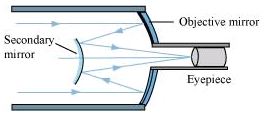
Distance between the objective mirror and the secondary mirror, d = 20 mm
Radius of curvature of the objective mirror, R1 = 220 mm
Hence, focal length of the objective mirror, \({ f }_{ 1 }=\frac { { R }_{ 1 } }{ 2 } =110\)
Radius of curvature of the secondary mirror, R1 = 140 mm
Hence, focal length of the secondary mirror, \({ f }_{ 2 }=\frac { { R }_{ 2 } }{ 2 } =\frac { 140 }{ 2 } \) = 70 mm
The image of an object placed at infinity, formed by the objective mirror, will act as a virtual object for the secondary mirror.
Hence, the virtual object distance for the secondary mirror, u = f1 - d
= 110 - 20
= 90 mm
Applying the mirror formula for the secondary mirror, we can calculate image distance (v) as:
\(\frac { 1 }{ v } +\frac { 1 }{ u } =\frac { 1 }{ { f }_{ 2 } } \)
\(\frac { 1 }{ v } =\frac { 1 }{ { f }_{ 2 } } -\frac { 1 }{ u } \)
\(\frac { 1 }{ 70 } -\frac { 1 }{ 90 } =\frac { 9-7 }{ 630 } =\frac { 2 }{ 630 } \)
∴ v = \(\frac{630}{2}\) = 315 mm
Hence, the final image will be formed 315 mm away from the secondary mirror.
7.
Focal length of the objective lens, fo = 140 cm
Focal length of the eyepiece, fe = 5 cm
(a) In normal adjustment, the separation between the objective lens and the eyepiece = fo + fe = 140 + 5 = 145 cm
(b) Height of the tower, h1 = 100 m
Distance of the tower (object) from the telescope, u = 3 km = 3000 m
The angle subtended by the tower at the telescope is given as:
\(\theta =\frac { { h }_{ 1 } }{ u } \)
\(=\frac { 100 }{ 3000 } =\frac { 1 }{ 30 } \) rad
The angle subtended by the image produced by the objective lens is given as:
\(\theta =\frac { { h }_{ 2 } }{ { f }_{ o } } =\frac { { h }_{ 2 } }{ 140 } \) rad
Where,
h2 = Height of the image of the tower formed by the objective lens
\(\frac { 1 }{ 30 } =\frac { { h }_{ 2 } }{ 140 } \)
∴ h2 = \(\frac{140}{30}\) = 4.7 cm
Therefore, the objective lens forms a 4.7 cm tall image of the tower.
(c) Image is formed at a distance, d = 25 cm
The magnification of the eyepiece is given by the relation:
m = 1 + \(\frac { d }{ { f }_{ e } } \)
= 1 + \(\frac{25}{2}\) = 1 + 5 = 6
Height of the final image = mh2 = 6 x 4.7 = 28.2 cm
Hence, the height of the final image of the tower is 28.2 cm.
8.
Focal length of the objective lens,fo= 140 cm
Focal length of the eyepiece, fe = 5 cm
Least distance of distinct vision, d = 25 cm
(a) When the telescope is in normal adjustment, its magnifying power is given as:
\(m=\frac { { f }_{ o } }{ { f }_{ e } } \)
= \(\frac{140}{5}\) = 28
(b) When the final image is formed at d, the magnifying power of the telescope is given as:
\(\frac { { f }_{ o } }{ { f }_{ e } } \left[ 1+\frac { { f }_{ e } }{ d } \right] \)
= \(\frac { 140 }{ 5 } \left[ 1+\frac { 2 }{ 25 } \right] \)
= 28 [1 + 0.2]
= 28 x 1.2 = 33.6
9.
Focal length of the objective lens, fo = 1.25 cm
Focal length of the eyepiece, fe = 5 cm
Least distance of distinct vision, d = 25 cm
Angular magnification of the compound microscope = 30X
Total magnifying power of the compound microscope, m = 30
The angular magnification of the eyepiece is given by the relation:
\({ m }_{ e }=\left( 1+\frac { d }{ { f }_{ e } } \right) \)
\(=\left( 1+\frac { 25 }{ 5 } \right) =6\)
The angular magnification of the objective lens (mo) is related to me as:
mo me = m
mo = \(\frac { m }{ { m }_{ c } } \)
\(=\frac { 30 }{ 6 } \) = 5
We also have the relation:
mo = \(\frac{Image \ distance \ for \ the \ objective \ lens (v_o)}{ Object \ distace \ for \ the \ objective \ lens (u_o)}\)
\(5=\frac { { v }_{ o } }{ -{ u }_{ o } } \)
∴ vo = -5uo .........(1)
Applying the lens formula for the objective lens:
\(\frac { 1 }{ { f }_{ o } } =\frac { 1 }{ { v }_{ o } } -\frac { 1 }{ { u }_{ o } } \)
\(\frac { 1 }{ 1.25 } =\frac { 1 }{ -5{ u }_{ o } } -\frac { 1 }{ { u }_{ o } } =\frac { -6 }{ 5{ u }_{ 0 } } \)
\(\therefore { u }_{ o }=\frac { -6 }{ 5 } \times 1.25=-1.5\) cm
And vo = -5uo
= -5 x (-1.5) = 7.5 cm
The object should be placed 1.5 cm away from the objective lens to obtain the desired magnification.
Applying the lens formula for the eyepiece:
\(\frac { 1 }{ { v }_{ e } } -\frac { 1 }{ { u }_{ e } } =\frac { 1 }{ { f }_{ e } } \)
Where,
ve = Image distance for the eyepiece = -d = -25 cm
ue = Object distance for the eyepiece
\(\frac { 1 }{ { u }_{ e } } =\frac { 1 }{ { v }_{ e } } -\frac { 1 }{ { f }_{ e } } \)
\(=\frac { -1 }{ 25 } -\frac { 1 }{ 5 } =-\frac { 6 }{ 25 } \)
∴ ue = -4.17 cm
Separation between the objective lens and the eyepiece = |ue| + |vo|
= 4.17 + 7.5
=11.67 cm
Therefore, the separation between the objective lens and the eyepiece should be 11.67 cm.
10.
(a) Though the image size is bigger than the object, the angular size of the image is equal to the angular size of the object. A magnifying glass helps one see the objects placed closer than the least distance of distinct vision (i.e., 25 cm). A closer object causes a larger angular size. A magnifying glass provides angular magnification. Without magnification, the object cannot be placed closer to the eye. With magnification, the object can be placed much closer to the eye.
(b) Yes, the angular magnification changes. When the distance between the eye and a magnifying glass is increased, the angular magnification decreases a little. This is because the angle subtended at the eye is slightly less than the angle subtended at the lens. Image distance does not have any effect on angular magnification.
(c) The focal length of a convex lens cannot be decreased by a greater amount. This is because making lenses having very small focal lengths is not easy. Spherical and chromatic aberrations are produced by a convex lens having a very small focal length.
(d) The angular magnification produced by the eyepiece of a compound microscope is \(\left[ \left( \frac { 25 }{ { f }_{ e } } \right) +1 \right] \)
Where,
fe = Focal length of the eyepiece
It can be inferred that if fe is small, then angular magnification of the eyepiece will be large.
The angular magnification of the objective lens of a compound microscope is given as \(\frac { 1 }{ (|{ u }_{ o }|{ f }_{ o }) } \)
Where,
uo = Object distance for the objective lens
fo = Focal length of the objective
The magnification is large when uo > fo. In the case of a microscope, the object is kept close to the objective lens. Hence, the object distance is very little. Since uo is small, fo will be even smaller. Therefore, fe and fo are both small in the given condition.
(e) When we place our eyes too close to the eyepiece of a compound microscope, we are unable to collect much refracted light. As a result, the field of view decreases substantially. Hence, the clarity of the image gets blurred.
The best position of the eye for viewing through a compound microscope is at the eye-ring attached to the eyepiece. The precise location of the eye depends on the separation between the objective lens and the eyepiece.
11.
Area of the virtual image of each square, A = 6.25 mm2
Area of each square, A0 = 1 mm2
Hence, the linear magnification of the object can be calculated as:
\(m=\sqrt { \frac { A }{ { A }_{ o } } } \)
\(\sqrt { \frac { 6.25 }{ 1 } } =2.5\)
But m = \(\frac{Image \ distance \ (v)}{Object \ distance \ (u)}\)
∴ v = mu
= 2.5 u ....(1)
Focal length of the magnifying glass, f = 10 cm
According to the lens formula, we have the relation:
\(\frac { 1 }{ { f } } =\frac { 1 }{ { v } } -\frac { 1 }{ { u } } \)
\(\frac { 1 }{ 10 } =\frac { 1 }{ 2.5u } -\frac { 1 }{ u } =\frac { 1 }{ u } \left( \frac { 1 }{ 2.5 } -\frac { 1 }{ 1 } \right) =\frac { 1 }{ u } \left( \frac { 1-2.5 }{ 2.5 } \right) \)
\(\therefore u=-\frac { 1.5\times 10 }{ 2.5 } =-6\)
And v = 2.5u
= 2.5 x 6 = -15 cm
The virtual image is formed at a distance of 15 cm, which is less than the near point (i.e., 25 cm) of a normal eye. Hence, it cannot be seen by the eyes distinctly.
12.
Given: The size of each square is 1 mm 2 , the object distance is 9 cmand the focal length of magnifying glass is 10 cm.
(a) The lens formula is given as,
1 f = 1 v − 1 u
Where, object distance is u, focal length of converging lens is fand the image distance is v
The maximum possible magnification is obtained when the image is formed at the near point of eye.
So,
v=−25 cm
By substituting the given values in the above expression, we get
1 u = 1 v − 1 f 1 u = 1 −25 − 1 10 = −2−5 50 u=−7.14 cm
Thus, to view the squares distinctly, the lens should be kept 7.14 cmaway from them.
(b) Magnification is given as,
m=| v u |
By substituting the given values in the above expression, we get
m=| −25 50 7 | = 25×7 50 =3.5
Thus, in this case the magnification is 3.5 times.
(c) Magnifying power of the lens is given as,
m= d | u |
Where, d is the least distance for distinct vision.
By substituting the given values in the above expression,
m= 25 | 50 7 | = 25×7 50 =3.5
Thus, the magnifying power of the lens is 3.5.
Since, in this case the image is formed at the near point of the eye at 25 cm, the magnifying power is equal to the magnitude of magnification.
13.
Note: Here we took focal Length as 10 cm because if we take it as 9 cm then image distance will be zero, which does not make any sense.
(a) Area of each square, A = 1 mm2
Object distance, u = -9 cm
Focal length of a converging lens, f = 9 cm
For image distance v, the lens formula can be written as:
\(\frac { 1 }{ { f } } =\frac { 1 }{ { v } } -\frac { 1 }{ { u } } \)
\(\frac { 1 }{ 10 } =\frac { 1 }{ v } +\frac { 1 }{ 9 } \)
\(\frac { 1 }{ v } =\frac { 1 }{ 90 } \)
∴ v = -90 cm
Magnification, m = \(\frac{v}{u}\)
= \(\frac{-90}{-9}\) = 10
∴ Area of each square in the virtual image = (10)2A
= 102 x 1 = 100 mm2
= 1 cm2
(b) Magnifying power of the lens = \(\frac { d }{ \left| \mu \right| } =\frac { 25 }{ 9 } =2.8\)
(c) The magnification in (a) is not the same as the magnifying power in (b).
The magnification magnitude is \(\left( \left| \frac { v }{ u } \right| \right) \) and the magnifying power is \(\left( \frac { d }{ \left| u \right| } \right) \)
The two quantities will be equal when the image is formed at the near point (25 cm).
14.
The incident, refracted, and emergent rays associated with a glass prism ABC are shown in the given figure.
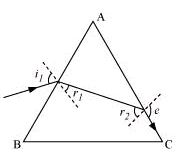
Angle of prism, ∠A = 60°
Refractive index of the prism, µ = 1.524
i1 = Incident angle
r1 = Refracted angle
r2 = Angle of incidence at the face AC
e = Emergent angle = 90°
According to Snell’s law, for face AC, we can have:
\(\frac { sin \ e }{ sin \ { r }_{ 2 } } =\mu \)
\(sin \ { r }_{ 2 }=\frac { 1 }{ \mu } \times sin \ { 90 }^{ o }\)
\(=\frac { 1 }{ 1.524 } =0.6562\)
\(\therefore { r }_{ 2 }={ sin }^{ -1 }0.6562\approx { 41 }^{ o }\)
It is clear from the figure that angle A = r1 + r2
∴ r1 = A - r2 = 60 - 41 = 19o
According to Snell’s law, we have the relation:
\(\mu =\frac { sin{ i }_{ 1 } }{ sin{ r }_{ 1 } } \)
\(sin{ i }_{ 1 }=\mu { sin }r_{ 1 }\)
= 1.524 x sin 19o = 0.496
∴ i1 = 29.75o
Hence, the angle of incidence is 29.75°.
15.
Focal length of the convex lens, f1 = 30 cm
Focal length of the concave lens, f2 = -20 cm
Distance between the two lenses, d = 8.0 cm
(a) When the parallel beam of light is incident on the convex lens first:
According to the lens formula, we have:
\(\frac { 1 }{ { v }_{ 1 } } -\frac { 1 }{ { u }_{ 1 } } =\frac { 1 }{ { f }_{ 1 } } \)
Where,
u1 = Object distance = ∞
v1 = Image distance
\(\frac { 1 }{ { v }_{ 1 } } =\frac { 1 }{ 30 } -\frac { 1 }{ \infty } =\frac { 1 }{ 30 } \)
∴ v1 = 30 cm
The image will act as a virtual object for the concave lens.
Applying lens formula to the concave lens, we have:
\(\frac { 1 }{ { v }_{ 2 } } -\frac { 1 }{ { u }_{ 2 } } =\frac { 1 }{ { f }_{ 2 } } \)
Where,
u2 = Object distance
= (30 - d) = 30 - 8 = 22 cm
v2= Image distance
\(\frac { 1 }{ { v }_{ 2 } } =\frac { 1 }{ 22 } -\frac { 1 }{ 20 } =\frac { 10-11 }{ 220 } =\frac { -1 }{ 220 } \)
∴ v2 = -220 cm
The parallel incident beam appears to diverge from a point that is \(\left( 220-\frac { d }{ 2 } =220-4 \right) 216\) cm from the centre of the combination of the two lenses.
(ii) When the parallel beam of light is incident, from the left, on the concave lens first:
According to the lens formula, we have:
\(\frac { 1 }{ { v }_{ 2 } } -\frac { 1 }{ { u }_{ 2 } } =\frac { 1 }{ { f }_{ 2 } } \)
\(\frac { 1 }{ { v }_{ 2 } } =\frac { 1 }{ { f }_{ 2 } } +\frac { 1 }{ { u }_{ 2 } } \)
Where,
u2 = Object distance = -∞
v2 = Image distance
\(\frac { 1 }{ { v }_{ 2 } } =\frac { 1 }{ -20 } +\frac { 1 }{ -\infty } =-\frac { 1 }{ 20 } \)
∴ v2 = -20 cm
The image will act as a real object for the convex lens.
Applying lens formula to the convex lens, we have:
\(\frac { 1 }{ { v }_{ 1 } } -\frac { 1 }{ { u }_{ 1 } } =\frac { 1 }{ { f }_{ 1 } } \)
Where,
u1 = Object distance
= -(20 + d) = -(20 + 8) = -28 cm
v1 = Image distance
\(\frac { 1 }{ { v }_{ 1 } } =\frac { 1 }{ 30 } +\frac { 1 }{ -28 } =\frac { 14-15 }{ 420 } =\frac { -1 }{ 420 } \)
∴ v2 = - 420 cm
Hence, the parallel incident beam appear to diverge from a point that is (420 - 4) 416 cm from the left of the centre of the combination of the two lenses
The answer does depend on the side of the combination at which the parallel beam of light is incident. The notion of effective focal length does not seem to be useful for this combination.
(b) Height of the image, h1 = 1.5 cm
Object distance from the side of the convex lens, u1 = -40 cm
|u1| = 40 cm
According to the lens formula:
\(\frac { 1 }{ { v }_{ 1 } } -\frac { 1 }{ { u }_{ 1 } } =\frac { 1 }{ { f }_{ 1 } } \)
Where,
v1 = Image distance
\(\frac { 1 }{ { v }_{ 1 } } =\frac { 1 }{ 30 } +\frac { 1 }{ -40 } =\frac { 4-3 }{ 120 } =\frac { 1 }{ 120 } \)
∴ v1 = 120 cm
\(m=\frac { { v }_{ 1 } }{ \left| { u }_{ 1 } \right| } \)
= \(\frac { 120 }{ 40 } =3\)
Hence, the magnification due to the convex lens is 3.
The image formed by the convex lens acts as an object for the concave lens.
According to the lens formula:
\(\frac { 1 }{ { v }_{ 2 } } -\frac { 1 }{ { u }_{ 2 } } =\frac { 1 }{ { f }_{ 2 } } \)
Where,
u2 = Object distance
= +(120 - 8) = 112 cm.
v2 = Image distance
\(\frac { 1 }{ { v }_{ 2 } } =\frac { 1 }{ -20 } +\frac { 1 }{ 112 } =\frac { -112+20 }{ 2240 } =\frac { -92 }{ 2240 } \)
∴ v2 = \(\frac { 2240 }{ 92 } \) cm
Magnification, \({ m }^{ ' }=\left| \frac { { v }_{ 2 } }{ { u }_{ 2 } } \right| \)
\(=\frac { 2240 }{ 92 } \times \frac { 1 }{ 112 } =\frac { 20 }{ 92 } \)
Hence, the magnification due to the concave lens is \(\frac { 20 }{ 92 } \)
The magnification produced by the combination of the two lenses is calculated as:
m x m'
\(=3\times \frac { 20 }{ 92 } =\frac { 60 }{ 92 } =0.652\)
The magnification of the combination is given as:
\(\frac { { h }_{ 2 } }{ { h }_{ 1 } } =0.652\)
h2 = 0.652 x h1
Where,
h1 = Object size = 1.5 cm
h2 = Size of the image
∴ h2 = 0.652 x 1.5 = 0.98 cm
Hence, the height of the image is 0.98 cm
16.
(a) Yes
Plane and convex mirrors can produce real images as well. If the object is virtual, i.e., if the light rays converging at a point behind a plane mirror (or a convex mirror) are reflected to a point on a screen placed in front of the mirror, then a real image will be formed.
(b) No
A virtual image is formed when light rays diverge. The convex lens of the eye causes these divergent rays to converge at the retina. In this case, the virtual image serves as an object for the lens to produce a real image.
(c) The diver is in the water and the fisherman is on land (i.e., in air). Water is a denser medium than air. It is given that the diver is viewing the fisherman. This indicates that the light rays are travelling from a denser medium to a rarer medium. Hence, the refracted rays will move away from the normal. As a result, the fisherman will appear to be taller.
(d) Yes; Decrease
The apparent depth of a tank of water changes when viewed obliquely. This is because light bends on travelling from one medium to another. The apparent depth of the tank when viewed obliquely is less than the near-normal viewing.
(e) Yes
The refractive index of diamond (2.42) is more than that of ordinary glass (1.5). The critical angle for diamond is less than that for glass. A diamond cutter uses a large angle of incidence to ensure that the light entering the diamond is totally reflected from its faces. This is the reason for the sparkling effect of a diamond.
17.
(a) Refractive index of the glass fibre, μ1 = 1.68
Refractive index of the outer covering of the pipe, μ2 = 1.44
Angle of incidence = i
Angle of refraction = r
Angle of incidence at the interface = i’
The refractive index (μ) of the inner core − outer core interface is given a
\(\mu =\frac { { \mu }_{ 1 } }{ { \mu }_{ 2 } } =\frac { 1 }{ sin \ i } \)
sin i' = \(\frac { { \mu }_{ 1 } }{ { \mu }_{ 2 } } \)
= \(\frac{1.44}{1.68}\) = 0.8571
∴ i' = 59o
For the critical angle, total internal reflection (TIR) takes place only wheni > i', i.e., i > 59°
Maximum angle of reflection, rmax = 90o - i' = 90o - 59o = 31o
Let, imax be the maximum angle of incidence.
The refractive index at the air - glass interface, μ1 = 1.68
We have the relation for the maximum angles of incidence and reflection as:
\({ \mu }_1\) = \(\frac { sin{ i }_{ max } }{ sin{ r }_{ max } } \)
sin imsx = μ1 sin rmax
= 1.68 sin 31o
= 1.68 x 0.5150
= 0.8652
∴ imax = sin-1 0.8652 ≈ 60o
Thus, all the rays incident at angles lying in the range 0 < i < 60° will suffer total internal reflection.
(b) If the outer covering of the pipe is not present, then:
Refractive index of the outer pipe, μ1 = Refractive index of air = 1
For the angle of incidence i = 90°, we can write Snell’s law at the air − pipe interface as:
\(\frac { sin \ i }{ sin \ r } ={ \mu }_{ 2 }\) = 1.68
\(sinr=\frac { { sin90 }^{ o } }{ 1.68 } =\frac { 1 }{ 1.68 } \)
r = sin-1 (0.5952)
= 36.5o
∴ i' = 90o - 36.5o = 53.5o
Since i' > r, all incident rays will suffer total internal reflection.
18.
(a) For a concave mirror, the focal length (f) is negative.
∴ f < 0
When the object is placed on the left side of the mirror, the object distance (u) is negative.
∴ u < 0
For image distance v, we can write the lens formula as:
\(\frac { 1 }{ v } -\frac { 1 }{ u } =\frac { 1 }{ f }\)
\(\frac { 1 }{ v } =\frac { 1 }{ f } -\frac { 1 }{ u } \) ....(1)
The object lies between f and 2f.
∴ 2f < u < f (∵ u and f are negative)
\(\frac { 1 }{ 2f } >\frac { 1 }{ u } >\frac { 1 }{ f } \)
\(-\frac { 1 }{ 2f } <-\frac { 1 }{ u } <\frac { 1 }{ f } \)
\(\frac { 1 }{ f } -\frac { 1 }{ 2f } <\frac { 1 }{ f } -\frac { 1 }{ u } <0\) ...(2)
Using equation (1), we get:
\(\frac { 1 }{ 2f } <\frac { 1 }{ v } \)
2f > v
-v > - 2f
Therefore, the image lies beyond 2f.
(b) For a convex mirror, the focal length (f) is positive.
∴ f > 0
When the object is placed on the left side of the mirror, the object distance (u) is negative.
∴ u < 0
For image distance v, we have the mirror formula:
\(\frac { 1 }{ v } +\frac { 1 }{ u } =\frac { 1 }{ f } \)
\(\frac { 1 }{ v } =\frac { 1 }{ f } -\frac { 1 }{ u } \quad \)
Using equation (2), we can conclude that:
\(\frac { 1 }{ v } \) < 0
v > 0
Thus, the image is formed on the back side of the mirror.
Hence, a convex mirror always produces a virtual image, regardless of the object distance.
(c) For a convex mirror, the focal length (f) is positive.
∴ f > 0
When the object is placed on the left side of the mirror, the object distance (u) is negative,
∴ u < 0
For image distance v, we have the mirror formula:
\(\frac { 1 }{ v } +\frac { 1 }{ u } =\frac { 1 }{ f } \)
\(\frac { 1 }{ v } =\frac { 1 }{ f } -\frac { 1 }{ u } \)
But we have u < 0
∴ \(\frac { 1 }{ v } >\frac { 1 }{ f } \)
v < f
Hence, the image formed is diminished and is located between the focus (f) and the pole.
(d) For a concave mirror, the focal length (f) is negative.
∴ f < 0
When the object is placed on the left side of the mirror, the object distance (u) is negative.
∴ u < 0
It is placed between the focus (f) and the pole.
∴ f > u > 0
\(\frac { 1 }{ f } <\frac { 1 }{ u } \)< 0
\(\frac { 1 }{ f } -\frac { 1 }{ u } \)< 0
For image distance v, we have the mirror formula:
\(\frac { 1 }{ v } +\frac { 1 }{ u } =\frac { 1 }{ f } \)
\(\frac { 1 }{ v } =\frac { 1 }{ f } -\frac { 1 }{ u } \)
∴\(\frac { 1 }{ v } \) < 0
v > 0
The image is formed on the right side of the mirror. Hence, it is a virtual image
For u < 0 and v > 0, we can write:
\(\frac { 1 }{ u } >\frac { 1 }{ v } \)
v > u
Magnification, m = \(\frac { u }{ v } \) > 1
Hence, the formed image is enlarged.
19.
Focal length of the objective lens, fo = 8 mm = 0.8 cm
Focal length of the eyepiece, fe = 2.5 cm
Object distance for the objective lens, uo = -9.0 mm = -0.9 cm
Least distance of distant vision, d = 25 cm
Image distance for the eyepiece, ve = -d = -25 cm
Object distance for the eyepiece = uc
Using the lens formula, we can obtain the value of u2 as:
\(\frac { 1 }{ { v }_{ e } } -\frac { 1 }{ { u }_{ e} } =\frac { 1 }{ { f }_{ e } } \)
\(\frac { 1 }{ { u }_{ e } } =\frac { 1 }{ { v }_{ e } } -\frac { 1 }{ { f }_{ e } } \)
\(=\frac { 1 }{ -25 } -\frac { 1 }{ 2.5 } =\frac { -1-10 }{ 25 } =\frac { -11 }{ 25 } \)
∴ uc = \(-\frac { 25 }{ 11 } \) = -2.27 cm
We can also obtain the value of the image distance for the objective lens (vo) using the lens formula.
\(\frac { 1 }{ { v }_{ o } } -\frac { 1 }{ { u }_{ o } } =\frac { 1 }{ { f }_{ o } } \)
\(\frac { 1 }{ { u }_{ o } } =\frac { 1 }{ { v }_{ o } } -\frac { 1 }{ { f }_{ o } } \)
= \(\frac { 1 }{ 0.8 } -\frac { 1 }{ 0.9 } =\frac { 0.9-0.8 }{ 0.72 } =\frac { 0.1 }{ 0.72 } \)
∴ vo = 7.2 cm
The distance between the objective lens and the eyepiece
= |uc| + vo
= 2.27 + 7.2
= 9.47 cm
The magnifying power of the microscope is calculated as:
\(\frac { { v }_{ o } }{ \left| { u }_{ o } \right| } \left( 1+\frac { { d }^{ ' } }{ { f }_{ e } } \right) \)
= \(\frac { 7.2 }{ 0.9 } \left( 1+\frac { 25 }{ 2.5 } \right) =8(1+10)=88\)
Hence, the magnifying power of the microscope is 88.
20.
Size of the object, h1 = 3 cm
Object distance, u = -14 cm
Focal length of the concave lens, f = -21 cm
Image distance = v
According to the lens formula, we have the relation:
\(\frac { 1 }{ v } -\frac { 1 }{ u } =\frac { 1 }{ f } \)
\(\frac { 1 }{ v } =-\frac { 1 }{ 21 } -\frac { 1 }{ 14 } =\frac { -2-3 }{ 42 } =\frac { -5 }{ 42 } \)
\(\therefore v=-\frac { 42 }{ 5 } =-84cm\)
Hence, the image is formed on the other side of the lens, 8.4 cm away from it. The negative sign shows that the image is erect and virtual.
The magnification of the image is given as:
\(m=\frac { Image \ height({ h }_{ 2 }) }{ Object \ height({ h }_{ 1 }) } =\frac { -8.4 }{ -14 } \)
\(\therefore { h }_{ 2 }=\frac { -8.4 }{ -14 } \times 3=0.6\times 3=1.8\) cm
Hence, the height of the image is 1.8 cm
If the object is moved further away from the lens, then the virtual image will move toward the focus of the lens, but not beyond it. The size of the image will decrease with the increase in the object distance.
21.
In the given situation, the object is virtual and the image formed is real.
Object distance, u = +12 cm
(a) Focal length of the convex lens, f = 20 cm
Image distance = v
According to the lens formula, we have the relation:
\(\frac { 1 }{ v } -\frac { 1 }{ u } =\frac { 1 }{ f } \)
\(\frac { 1 }{ v } -\frac { 1 }{ 12 } =\frac { 1 }{ 20 } \)
\(\frac { 1 }{ v } =\frac { 1 }{ 20 } +\frac { 1 }{ 12 } =\frac { 3+5 }{ 60 } =\frac { 8 }{ 60 } \)
\(\therefore v=\frac { 60 }{ 8 } =7.5\)
Hence, the image is formed 7.5 cm away from the lens, toward its right.
(b) Focal length of the concave lens, f = -16 cm
Image distance = v
According to the lens formula, we have the relation:
\(\frac { 1 }{ v } -\frac { 1 }{ u } =\frac { 1 }{ f } \)
\(\frac { 1 }{ v } =-\frac { 1 }{ 16 } +\frac { 1 }{ 12 } =\frac { -3+4 }{ 48 } =\frac { 1 }{ 48 } \)
\(\therefore v=84cm\)
Hence, the image is formed 48 cm away from the lens, toward its right.
22.
Angle of minimum deviation, \({ \delta }^{ ' }_{ m }\) = 40°
Angle of the prism, A = 60°
Refractive index of water, µ = 1.33
Refractive index of the material of the prism = µ'
The angle of deviation is related to refractive index (µ') as:
\({ \mu }^{ ' }=\frac { sin\frac { (A+{ \delta }_{ m }) }{ 2 } }{ sin\frac { A }{ 2 } }\)
\(=\frac { sin\frac { ({ 60 }^{ o }+{ 40 }^{ o }) }{ 2 } }{ sin\frac { { 60 }^{ o } }{ 2 } }\)\(=\frac { sin{ 50 }^{ o } }{ sin{ 30 }^{ o } } =1.532\)
Hence, the refractive index of the material of the prism is 1.532.
Since the prism is placed in water, let be the new angle of minimum deviation for the same prism.
The refractive index of glass with respect to water is given by the relation:
\({ \mu }_{ g }^{ w }=\frac { { \mu }^{ ' } }{ \mu } =\frac { sin\frac { (A+{ \delta }^{ ' }_{ m }) }{ 2 } }{ sin\frac { A }{ 2 } }\)
=\(sin\frac { (A+{ \delta }^{ ' }_{ m }) }{ 2 } =\frac { { \mu }^{ ' } }{ \mu } sin\frac { A }{ 2 }\)
= \(sin\frac { (A+{ \delta }^{ ' }_{ m }) }{ 2 } =\frac { 1.532 }{ 1.33 } \times sin\frac { { 60 }^{ o } }{ 2 } =\)0.5759
= \(\frac { (A+{ \delta }^{ ' }_{ m }) }{ 2 } ={ sin }^{ -1 }{ 0.5759=35.16 }^{ o }\)
= \({ 60 }^{ o }+{ \delta }^{ ' }_{ m }={ 70.32 }^{ o }\)
\(\therefore { \delta }^{ ' }_{ m }={ 70.32 }^{ o }-{ 60 }^{ o }={ 10.32 }^{ o }\)
Hence, the new minimum angle of deviation is 10.32°.
23.
Actual depth of the bulb in water, d1 = 80 cm = 0.8 m
Refractive index of water, μ = 1.33
The given situation is shown in the following figure:
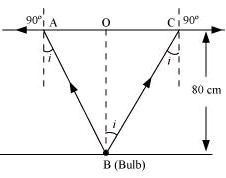
Where,
i = Angle of incidence
r = Angle of refraction = 90°
Since the bulb is a point source, the emergent light can be considered as a circle of radius, \(R=\frac { AC }{ 2 } =OA=OB\)
Using Snell’ law, we can write the relation for the refractive index of water as:
\({ \mu }=\frac { sin \ i }{ sin \ r } \)
\(1.33=\frac { sin{ 90 }^{ o } }{ sini } \)
\(\therefore i={ sin }^{ -i }\left( \frac { 1 }{ 1.33 } \right) =48.{ 75 }^{ o }\)
Using the given figure, we have the relation:
\(tan \ i=\frac { OC }{ OB } =\frac { R }{ { d }_{ 1 } } \)
∴ R = tan 48.75° × 0.8 = 0.91 m
∴ Area of the surface of water = πR2 = π (0.91)2 = 2.61 m2
Hence, the area of the surface of water through which the light from the bulb can emerge is approximately 2.61 m2.
24.
As per the given figure, for the glass-air interface:
Angle of incidence, i = 60°
Angle of refraction, r = 35°
The relative refractive index of glass with respect to air is given by Snell’s law as:
\({ \mu }_{ g }^{ a }=\frac { sin \ i }{ sin\ r } \)
\(=\frac { sin{ 60 }^{ o } }{ { sin35 }^{ o } } =\frac { 0.8660 }{ 0.5736 } =1.51\) ....(1)
As per the given figure, for the air-water interface:
Angle of incidence, i = 60°
Angle of refraction, r = 47°
The relative refractive index of water with respect to air is given by Snell’s law as:
\({ \mu }_{ w }^{ a }=\frac { sin \ i }{ sin \ r } \)
\(=\frac { sin60 }{ sin47 } =\frac { 0.8660 }{ 0.7314 } =1.184\) .....(2)
Using (1) and (2), the relative refractive index of glass with respect to water can be obtained as:
\({ \mu }_{ g }^{ w }=\frac { { \mu }_{ g }^{ a } }{ { \mu }_{ w }^{ a } } \)
\(=\frac { 1.51 }{ 1.84 } =1.275\)
The following figure shows the situation involving the glass-water interface.
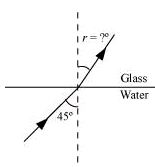
Angle of incidence, i = 45°
Angle of refraction = r
From Snell’s law, r can be calculated as:
\(\frac { sini }{ sinr } ={ \mu }_{ g }^{ w }\)
\(=\frac { sin{ 45 }^{ o } }{ { sinr } } =1.275\)
\(sinr=\frac { \frac { 1 }{ \sqrt { 2 } } }{ 1.275 } =0.5546\)
\(\therefore r={ sin }^{ -1 }(0.5546)={ 38.68 }^{ o }\)
Hence, the angle of refraction at the water-glass interface is 38.68°.
25.
Actual depth of the needle in water, h1 = 12.5 cm
Apparent depth of the needle in water, h2 = 9.4 cm
Refractive index of water = μ
The value of μcan be obtained as follows:
\(\mu =\frac { { h }_{ 2 } }{ { h }_{ 1 } } \)
= \(\frac { 12.5 }{ 9.4 } \approx 1.33\)
Hence, the refractive index of water is about 1.33.
Water is replaced by a liquid of refractive index, μ' = 1.63
The actual depth of the needle remains the same, but its apparent depth changes. Let y be the new apparent depth of the needle. Hence, we can write the relation:
\({ \mu }^{ ' }=\frac { { h }_{ 1 } }{ y } \)
∴ y = \(\frac { { h }_{ 1 } }{ { \mu }^{ ' } } \)
= \(\frac { 12.5 }{ 1.63 } \) = 7.67 cm
Hence, the new apparent depth of the needle is 7.67 cm. It is less than h2. Therefore, to focus the needle again, the microscope should be moved up.
∴ Distance by which the microscope should be moved up = 9.4 - 7.67
= 1.73 cm
26.
Height of the needle, h1 = 4.5 cm
Object distance, u = -12 cm
Focal length of the convex mirror, f = 15 cm
Image distance = v
The value of v can be obtained using the mirror formula:
\(\frac { 1 }{ u } +\frac { 1 }{ v } =\frac { 1 }{ f } \)
\(\frac { 1 }{ v } =\frac { 1 }{ f } -\frac { 1 }{ u } \)
\(\frac { 1 }{ 15 } +\frac { 1 }{ 12 } =\frac { 4+5 }{ 60 } =\frac { 9 }{ 60 } \)
∴ v = \(\frac { 60 }{ 9 } \) = 6.7 cm
Hence, the image of the needle is 6.7 cm away from the mirror. Also, it is on the other side of the mirror.
The image size is given by the magnification formula:
\(m=\frac { { h }_{ 2 } }{ { h }_{ 1 } } =-\frac { u }{ v } \)
\(\therefore { h }_{ 2 }=-\frac { v }{ u } \times { h }_{ 1 }\)
\(=\frac { -6.7 }{ -12 } \times 4.5=+2.5\)cm
Hence, magnification of the image, \(m=\frac { { h }_{ 2 } }{ { h }_{ 1 } } =\frac { 2.5 }{ 4.5 } =0.56\)
The height of the image is 2.5 cm. The positive sign indicates that the image is erect, virtual, and diminished.
If the needle is moved farther from the mirror, the image will also move away from the mirror, and the size of the image will reduce gradually.
27.
Size of the candle, h = 2.5 cm
Image size = h’
Object distance, u = -27 cm
Radius of curvature of the concave mirror, R = -36 cm
\(f=\frac { R }{ 2 } =-18\)cm
Image distance = v
The image distance can be obtained using the mirror formula:
\(\frac { 1 }{ u } +\frac { 1 }{ v } =\frac { 1 }{ f } \)
\(\frac { 1 }{ v } =\frac { 1 }{ f } -\frac { 1 }{ u } \)
\(\frac { 1 }{ -18 } =\frac { 1 }{ -27 } =\frac { -3+2 }{ 54 } =-\frac { 1 }{ 54 } \)
∴ v = -54 cm
Therefore, the screen should be placed 54 cm away from the mirror to obtain a sharp image.
The magnification of the image is given as:
\(m=\frac { { h }^{ ' } }{ h } =-\frac { v }{ u } \)
\(\therefore { h }^{ ' }=-\frac { v }{ u } \times h\)
\(=-\left( \frac { -54 }{ -27 } \right) \times 2.5=-5\)cm
The height of the candle’s image is 5 cm. The negative sign indicates that the image is inverted and real.
If the candle is moved closer to the mirror, then the screen will have to be moved away from the mirror in order to obtain the image.
28.
Image formed by the first lens
\(\frac { 1 }{ { v }_{ 1 } } -\frac { 1 }{ { u }_{ 1 } } =\frac { 1 }{ { f }_{ 1 } } \)
\(\frac { 1 }{ { v }_{ 1 } } -\frac { 1 }{ { -30 } } =\frac { 1 }{ 10 } \)
or v1 = 15 cm
The image formed by the first lens serves as the object for the second.
This is at a distance of (15 - 5) cm = 10 cm to the right of the second lens. Though the image is real, it serves as a virtual object for the second lens, which means that the rays appear to come from it for the second lens.
\(\frac { 1 }{ { v }_{ 2 } } -\frac { 1 }{ 10 } =\frac { 1 }{ -10 } \)
or v2 = ∞
The virtual image is formed at an infinite distance to the left of the second lens. This acts as an object for the third lens.
\(\frac { 1 }{ { v }_{ 3 } } -\frac { 1 }{ { u }_{ 3 } } =\frac { 1 }{ { f }_{ 3 } } \)
or \(\frac { 1 }{ { v }_{ 3 } } =\frac { 1 }{ \infty } +\frac { 1 }{ 30 } \)
or v3 = 30 cm
The final image is formed 30 cm to the right of the third lens.
29.
(i) Power = +2 dioptre.
(ii) Here, we have f = +12 cm, R1 = +10 cm, R2 = -15 cm.
Refractive index of air is taken as unity.
We use the lens formula. The sign convention has to be applied for f, R1 and R2.
Substituting the values, we have
\(\frac { 1 }{ 12 } =(n-1)\left( \frac { 1 }{ 10 } -\frac { 1 }{ 15 } \right) \)
This gives n = 1.5.
(iii) For a glass lens in air, n2 = 1.5, n1 = 1, f = +20 cm. Hence, the lens formula gives
\(\frac { 1 }{ 20 } =0.5\left( \frac { 1 }{ { R }_{ 1 } } -\frac { 1 }{ { R }_{ 2 } } \right) \)
For the same glass lens in water, n2 = 1.5, n1 = 1.33. Therefore \(\frac { 1.33 }{ f } =(1.5-1.33)\left[ \frac { 1 }{ { R }_{ 1 } } -\frac { 1 }{ { R }_{ 2 } } \right] \)
Combining these two equations, we find f = + 78.2 cm.
30.
From the mirror equation, Eq., we get \(v=\frac{f u}{u-f}\)
For convex mirror, since \(R=2 \mathrm{~m}, f=1 \mathrm{~m}\). Then for \(u=-39 \mathrm{~m}, v=\frac{(-39) \times 1}{-39-1}=\frac{39}{40} \mathrm{~m}\)
Since the jogger moves at a constant speed of \(5 \mathrm{~m} \mathrm{~s}^{-1}\), after 1 s the position of the image v (for \(u=-39+5=-34)\) is (34 / 35) m.
The shift in the position of image in 1 s is \(\frac{39}{40}-\frac{34}{35}=\frac{1365-1360}{1400}=\frac{5}{1400}=\frac{1}{280} \mathrm{~m}\)
Therefore, the average speed of the image when the jogger is between 39 m and 34 m from the mirror, is (1/280) m s–1 Similarly, it can be seen that for u = –29 m, –19 m and –9 m, the speed with which the image appears to move is
\(\frac{1}{150} \mathrm{~m} \mathrm{~s}^{-1}, \frac{1}{60} \mathrm{~ms}^{-1} \text { and } \frac{1}{10} \mathrm{~ms}^{-1} \text {, respectively. }\)
Although the jogger has been moving with a constant speed, the speed of his/her image appears to increase substantially as he/she moves closer to the mirror. This phenomenon can be noticed by any person sitting in a stationary car or a bus. In case of moving vehicles, a similar phenomenon could be observed if the vehicle in the rear is moving closer with a constant speed.
31.
The focal length f = -15/2 cm = -7.5 cm
(i) The object distance u = -10 cm. Then Eq gives
\(\frac { 1 }{ v } +\frac { 1 }{ 10 } =\frac { 1 }{ -7.5 } \)
or \(v=\frac { 10\times 7.5 }{ -2.5 } =-30\) cm
The image is 30 cm from the mirror on the same side as the object
Also, magnification m = \(\frac { v }{ u } =-\frac { (-30) }{ (-10) } =-3\)
The image is magnified, real and inverted.
(ii) The object distance u = -5 cm. Then from Eq
\(\frac { 1 }{ v } +\frac { 1 }{ -5 } =\frac { 1 }{ -7.5 } \)
or \(v=\frac { 5\times 7.5 }{ (7.5-5) } =15\) cm
This image is formed at 15 cm behind the mirror. It is a virtual image.
Magnification m = 15 \(-\frac { v }{ u } =-\frac { 15 }{ (-5) } =3\)
The image is magnified, virtual and erect.
32.
Angle of deflection, θ = 3.5°
Distance of the screen from the mirror, D = 1.5 m
The reflected rays get deflected by an amount twice the angle of deflection i.e., 2θ = 7.0°
The displacement (d) of the reflected spot of light on the screen is given as:
\(tan2\theta =\frac { d }{ 1.5 } \)
∴ d = 1.5 x tan 70° = 0.184 m = 18.4 cm
Hence, the displacement of the reflected spot of light is 18.4 cm.
33.
Distance between the object and the image, d = 3 m
Maximum focal length of the convex lens = fmax
For real images, the maximum focal length is given as:
fmax = \(\frac{d}{4}\)
= \(\frac{3}{4}\) = 0.75 m
Hence, for the required purpose, the maximum possible focal length of the convex lens is 0.75 m.
34.
Actual depth of the pin, d = 15 cm
Apparent dept of the pin = d'
Refractive index of glass, μ = 1.5
Ratio of actual depth to the apparent depth is equal to the refractive index of glass, i.e.
μ = \(\frac { d }{ { d }^{ ' } } \)
∴ d' = \(\frac { d }{ \mu } \)
= \(\frac{15}{1.5}\) = 10 cm
The distance at which the pin appears to be raised = d' - d
= 15 - 10 = 5 cm
For a small angle of incidence, this distance does not depend upon the location of the slab.
35.
Focal length of the objective lens, fo = 144 cm
Focal length of the eyepiece, fe = 6.0 cm
The magnifying power of the telescope is given as:
m = \(\frac{f_o}{f_c}\)
= \(\frac{144}{6}\) = 24
The separation between the objective lens and the eyepiece is calculated as:
fo + fe
= 144 + 6 = 150 cm
Hence, the magnifying power of the telescope is 24 and the separation between the objective lens and the eyepiece is 150 cm.
36.
Given, focal length of convex lens, f1 = 30 cm
Focal length of the concave lens, f2 = -20 cm
Using the formula of combination of lenses,
\(\frac{1}{f}=\frac{1}{f_{1}}+\frac{1}{f_{2}}=\frac{1}{30}-\frac{1}{20}=\frac{2-3}{60}=-\frac{1}{60}\)
\(\Rightarrow\) f = -60 cm
Since, the focal length of combination is negative in nature. so, the combination behaves like a diverging lens, i.e. as a concave lens.
37.
Refractive index of glass, μ
Focal length of the double-convex lens, f = 20 cm
Radius of curvature of one face of the lens = R1
Radius of curvature of the other face of the lens = R2
Radius of curvature of the double-convex lens = R The value of R can be calculated as:
∴ R1 = R and R2 = -R
The value of R can be calculated as:
\(\frac { 1 }{ f } =(\mu -1)\left[ \frac { 1 }{ { R }_{ 1 } } -\frac { 1 }{ { R }_{ 2 } } \right] \)
\(\frac { 1 }{ 20 } =(1.55)\left[ \frac { 1 }{ R } +\frac { 1 }{ R } \right] \)
\(\frac { 1 }{ 20 } =0.55\times \frac { 2 }{ R } \)
∴ R = 0.55 x 2 x 20 = 22 cm
Hence, the radius of curvature of the double-convex lens is 22 cm.
38.
(c)
\(\mu \)A
39.
(a)
5.25 cm
40.
(c)
0.5 m
41.
(a)
10 cm
42.
(a)
164 cm
43.
(c)
convex, 6 cm
44.
(d)
\(L\left[ \frac { f }{ u-f } \right] ^{ 2 }\)
45.
(a)
-160 cm
46.
(a)
11.67 cm
47.
(c)
90 cm
48.
(d)
1.20 m
49.
(c)
the intensity gradually reduced to zero and then again increases
50.
(d)
focal length of eye-piece must be smaller than the focal length of objective lens
51.
(d)
180°
52.
(b)
\(\frac { \mu x }{ c } \)
53.
(c)
\(\frac { { f }_{ 1 }{ f }_{ 2 } }{ { f }_{ 1 }+{ f }_{ 2 } } \)
54.
(d)
24 cm
55.
(b)
air medium is non-dispersive
56.
(c)
98 cm
57.
(c)
4°
58.
(b)
55 m
59.
(c)
F = - 40 cm,P = -2.5 D
60.
(c)
2 D
61.
(b)
6
62.
(a)
convex mirror with focal length f = 40 cm
63.
(c)
1.67 cm
64.
(d)
3.28 x 10⁶
65.
(b)
150
66.
(a)
real, inverted and magnified
67.
(a)
cylindrical lens
68.
(b)
10 D
69.
(a)
2f
70.
(d)
\(\frac { d }{ 4 } \)
71.
(e)
8.33 cm
72.
(d)
2f
73.
(c)
\({ sin }^{ -1 }\left( \frac { 5t }{ T } \right) \)
74.
(d)
50
75.
(a)
15 cm
76.
(b)
90°
77.
(c)
Atomic force microscope
78.
(b)
\(\frac { \pi }{ 6 } \)
79.
(a)
-14 ms-1
80.
(d)
3.5
81.
(c)
20 cm
82.
(d)
37.5 cm
83.
(c)
wavelength
84.
(a)
0.0164
85.
(b)
5.5 m
86.
(a)
500
87.
(a)
fv < fr
88.
(d)
\({ sin }^{ -1 }\left( \frac { 15 }{ 16 } \right) \)
89.
(d)
82°48'
90.
(b)
3.08
91.
(c)
1.5D
92.
(b)
180°- 2A
93.
(a)
\(30°,\sqrt { 2 } \)
94.
(b)
concave, - 0.25D
95.
(a)
\(\frac { { f }^{ 2 } }{ u-f } \)
96.
(c)
-4.93
97.
(a)
convex, 9 cm
98.
(d)
34 cm
99.
(a)
\(\frac { mx }{ { \left( m+1 \right) }^{ 2 } } \)
100.
(c)
2.5 cm
101.
(d)
In the side mirror, the speed of the approaching car would appear to increase as the distance between the cars decreases
102.
(b)
\(sinx=\frac { \mu }{ { \mu }_{ 4 } } \)
103.
(b)
-0.5 D
104.
(a)
7.5°
105.
(d)
10 cm
106.
(c)
100 cm
107.
(c)
\({ sin }^{ -1 }\left( \frac { {10 t }_{ 1 } }{ { t }_{ 2 } } \right) \)
108.
(b)
10 cm
109.
(c)
1.33
110.
(b)
\(\ge \sqrt { 2 } \)
111.
(c)
0.55 cm
112.
(d)
325/6 cm
113.
(c)
five
114.
(b)
14
115.
(b)
a virtual image of S will be formed at a finite distance
116.
(d)
\({ sin }^{ -1 }\left( \frac { 3 }{ 4 } \right) \)
117.
(b)
(frequency of light)4
118.
(d)
30° for both the colours
119.
(d)
None of the above
120.
(a)
\(\sqrt { { x }_{ 1 }{ x }_{ 2 } } \)
121.
(c)
n1 = n2
122.
(a)
two points propagating in two different non-parallel directions
123.
(d)
60°
124.
(c)
10/9
125.
(d)
between 8 and 16 cm
126.
(c)
moves away from the lens with a non-uniform acceleration
127.
(d)
red
128.
(b)
5500\(\mathring { A } \)
129.
(b)
convex
130.
(b)
2m
131.
(b)
may see a primary and a secondary rainbow as concentric circles
132.
(a)
Near objects are not clearly visible
133.
(b)
total internal reflection of light in air during a mirage
134.
(c)
both (a) and (b)
135.
(d)
All of these
136.
(c)
\({ \omega }_{ 1 }=2{ \omega }_{ 2 }\) and f1 = -2f2
137.
(d)
bifocal lens
138.
(b)
cannot see objects in two perpendicular directions simultaneously
139.
(b)
-1.0 D
140.
(b)
concave lens
141.
(b)
2 x 10⁶
142.
(c)
\(\frac {2 \mu sin\theta }{ { \lambda } } \)
143.
(b)
concave mirror of large aperture
144.
(b)
virtual.'erect and enlarged
145.
(a)
\(\frac { { f }_{ 0 } }{ { f }_{ e } } \left( 1-\frac { { f }_{ e } }{ D } \right) \)
146.
(a)
increase the intensity of image
147.
(b)
200
148.
(a)
1.8 cm
149.
(b)
20
150.
(c)
real, inverted and magnified
151.
(a)
real and inverted
152.
(a)
0.25 m
153.
(b)
4°30'
154.
(b)
material of prism
155.
(a)
\(\sqrt { 3 } \)
156.
(d)
30°
157.
(a)
normal to the face through which it emerges
158.
(d)
intensity of image will decrease
159.
(d)
2f
160.
(d)
4 f
161.
(d)
2
162.
(b)
30 cm
163.
(b)
convex with focal length of 10/3 cm
164.
(c)
2R
165.
(b)
37°
166.
(a)
1.5 x 10⁸ m/s
167.
(c)
62.5°
168.
(b)
\(d\left[ \frac { 1 }{ { \mu }_{ 1 } } +\frac { 1 }{ { \mu }_{ 2 } } \right] \)
169.
(c)
6 cm
170.
(b)
1.78cm
171.
(a)
(n-1)f
172.
(d)
15 cm behind the mirror
173.
(d)
4 rn/s towards left
174.
(a)
2\(\theta\) in anti-clockwise direction
175.
(c)
Virtual and laterally inverted
176.
(a)
\(\mu\) = 1.33
177.
(a)
Difference between apparent and real depth of a pond
178.
(d)
3o
179.
(a)
\(\sqrt{2}\)
180.
(d)
Microscope will decrease but that of telescope will increase
181.
(b)
2 cos A
182.
(c)
-50 cm
183.
(b)
0.40
184.
(a)
towards the base
185.
(b)
180-2A
186.
(b)
| A | B | C |
| 2 | 1 | 3 |
187.
(a)
2o
188.
(b)
240
189.
(a)
equal to the distance of far point
190.
(a)
450
191.
(b)
0.3 D
192.
(b)
\({ 5 }^{ 0 }\)
193.
(a)
\(sin\theta \ge \frac { 8 }{ 9 } \)
194.
(b)
\(1.5\times { 10 }^{ 8 }m{ s }^{ -1 }\)
195.
(a)
0.25
196.
(d)
Hyperbola
197.
(c)
5/3
198.
(b)
0.6 cm
199.
(c)
1.33
200.
(a)
6 cm from lens
201.
(c)
3.00
202.
(a)
\(1.8\times { 10 }^{ 8 }m{ s }^{ -1 }\)
203.
(a)
1 cm upward
204.
(a)
7.0 cm
205.
(b)
2 cm
206.
(c)
\({ 45 }^{ 0 }\)
207.
(d)
zero
208.
(b)
90 cm
209.
(d)
\(10\sqrt { 2 } cm{ s }^{ -1 }\)
210.
(c)
36 cm
211.
(c)
11

12th Standard CBSE Syllabus & Materials
12th Standard CBSE
CBSE 12th Computer Science Python Revision Tour I - New Previous year Question Papers Study Material - QB365 Set A
NEW12th Standard CBSE
CBSE 12th Business Studies Planning Important Questions And Answers Study Material - QB365 Set A
NEW12th Standard CBSE
CBSE 12th Business Studies Business Environment Important Questions And Answers Study Material - QB365 Set A
NEW12th Standard CBSE
CBSE 12th Business Studies Principles of Management Important Questions And Answers Study Material - QB365 Set A



NCERT Books

Syllabus

Exam Pattern

Sample Question Papers

Previous year Question Papers

Important Notes

MCQ Practice test

NCERT Exemplers

Case study Questions

Image Based Questions

Passage based Questions

HOT Questions

Value Based Questions

Model Questions Papers
NCERT ( Book Back ) Questions

Assertion and Reason
Important Questions And Answers

CBSE 12th Standard CBSE Subjects
CBSE Standards








