
 100% FREE ACCESS
12th Standard CBSE Syllabus & Materials
12th Standard CBSE
CBSE 12th Economics Government Budget and the Economy Previous year Question Papers Study Material - QB365 Set A
NEW12th Standard CBSE
CBSE 12th Computer Science Interface Python with MySQL - New Previous year Question Papers Study Material - QB365 Set A
NEW12th Standard CBSE
CBSE 12th Computer Science Database Concept - New Previous year Question Papers Study Material - QB365 Set A
NEW12th Standard CBSE
CBSE 12th Computer Science Data Communication - New Previous year Question Papers Study Material - QB365 Set A
NEW12th Standard CBSE
CBSE 12th Computer Science Data Structures - New Previous year Question Papers Study Material - QB365 Set A
NEW12th Standard CBSE
CBSE 12th Computer Science Functions - New Previous year Question Papers Study Material - QB365 Set A

Published on: 07/03/2026
Download CBSE Class 12th Standard CBSE Physics question papers, sample papers, important questions, and previous year solved papers in PDF format. Get free study materials, NCERT solutions, and exam preparation resources for Class 12th Standard CBSE Physics
Questions + Answers key
Take MCQ Physics Test
1.
How will the interference pattern i Young's double slit experiment get affected, when
(i) distance between the slits S1 and S2 reduced and
(ii) the entire set up is immersed in water? Justify your answer in each case.
2.
How would the angular separation of interference fringes in Young's double slit experiment change when the distance of separation between slits and screen is doubled?
3.
What type of wavefront will emerge from
(i) a point source and
(ii) distant light source?
4.
If the wavelength of incident light on a concave mirror is increased, how will the focal length of the mirror change?
5.
A compound microscope consists of an objective lens of focal length 2.0 cm and an eye -piece of focal length 6.25 cm separated by a distance should an object be placed in order to obtain the final image at (a) the least distance of distinct vision (25 cm), (b) infinity ? What is the magnifying power of the microscope in each case ?
6.
Define a wavefront. Use Huygens' geometrical construction to show the propagation of plane wavefront from a rarer medium
(1) to a denser medium
(2) undergoing refraction, hence derive Snell's law of refraction.
7.
(a) State Huygen's principle. Using this principle explain how a diffraction pattern is obtained on a screen due to a narrow slit on which a narrow beam coming from a monochromatic source of light is incident normally.
(b) Show that the angular width of the first diffraction fringe is half of that of the central fringe.
8.
Draw a labelled ray diagram on a refracting telescope. Define its magnifying power and write the expression for it.
Write two important limitations of a refracting telescope over a reflecting type telescope.
9.
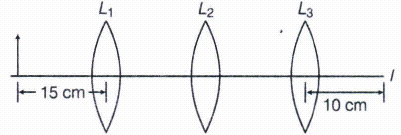
You are given three lenses L1, L2, and L3 each of focal length 10 cm. An object is kept at 15 cm in front of L1, as shown in figure. The final real image is formed at the focus of L3. Find the separation between L1, L2, and L3.
10.
In a Young's double slit experiment, the interference fringes are obtained on a screen 0.75m apart. The third dark band is at a distance of 5.5 mm from the central fringe
(a) Determine the wavelength of light used if the two slits are 0.15 mm apart.
(b) What will be the wavelength of light used if the entire apparatus is immersed in a liquid of refractive index 4/3?
11.
Fringe width central maximum in diffraction pattern is ________.
12.
In diffraction at a single slit, condition for nth secondary minimum is ______________.
13.
The linear magnification of a convex mirror is always...............because image formed in such a mirror is always.............. .
14.
Two independent monochromatic sources of light cannot produce a sustained interference pattern.Give reason.
Light waves each of amplitude a and frequency \(\omega \), emanating from two coherent light sources superpose at a point. If the displacements due to these waves is given by y1 = acos\(\omega t\) and y2 = acos\((\omega t+\phi )\), where \(\phi \) is the phase difference between the two, obtain the expression for the resultant intensity at the point.
In Young's double slit experiment, using monochromatic light of wavelength \(\lambda \) is K units. Find out the intensity of light at a point where path difference is \(\lambda /3\)
15.
(i) Describe briefly how a diffraction pattern is obtained on a screen due to a single narrow slit illuminated by a monochromatic source of light. Hence, obtain the conditions for angular width of secondary minima.
(ii) Two wavelength of solution light of 590nm and 596nm are used in turn to study the diffraction taking place at a single slit of aperture \(2\times { 10 }^{ -6 }m\). The distance between the slit and the screen is 1.5m. Calculate the separation between the position of first maxima of the diffraction pattern obtained in the two cases.
16.
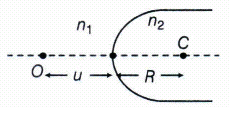
(i) A point object O is kept in amedium of refractive index n1, in front of a convex spherical surface of radius of curvature R which separates the second medium of refractive index n2 from the first one, as shown in the figure.
Draw the ray diagram showing the image formation and deduce the relationship between the object distance and the image distance in term of n1, n2 and R.
(ii) When the image formed above acts as a virtual object for a concave spherical surface separating the medium n2 from n1(n2 > n1), draw this ray diagram and write the similar [similar to (i)] relation. Hence, obtain the expression for lens maker's formula.
17.
An object has an image thrice of its original size when kept at 8 em and 16 cm from a convex lens. Focal length of the lens is
less than 8 cm
8 cm
16 cm
between 8 and 16 cm
18.
The length of the compound microscope is 14 cm, The magnifying power for relaxed eye is 25. If the focal length of eye lens is 5 cm, then the object distance for objective lens will be
1.8 cm
1.5 cm
2.1 cm
2.4 cm
19.
A glass slab has a critical angle of 30° when placed in air. What will be the critical angle when it is placed in liquid of refractive index 6/5?
45°
37°
53°
60°
20.
In a vessel of depth 15cm, liquid is poured till the liquid appears to be at half the depth, the liquid level is 5cm from the top. Calculate the refractive index of the liquid.
1.33
3.30
1.5
1.7
2
21.
22.
Assertion (A) : When a light wave travels from a rarer to a denser medium, it loses speed. The reduction in speed imply a reduction in energy carried by the light wave.
Reason (R) : The energy of a wave is proportional to velocity of wave.
Codes:
(a) Both A and R are true and R is the correct explanation of A
(b) Both A and R are true but R is NOT the correct explanation of A
(c) A is true but R is false
(d) A is false and R is also false
23.
Assertion (A) : In Young's double slit experiment the two slits are at distance d apart. Interference pattern is observed on a screen at distance D from the slits. At a point on the screen when it is directly opposite to one of the slits, a dark fringe is observed. Then the wavelength of wave is proportional to square of distance of two slits.
Reason (R) : For a dark fringe intensity is zero
Codes:
(a) Both A and R are true and R is the correct explanation of A
(b) Both A and R are true but R is NOT the correct explanation of A
(c) A is true but R is false
(d) A is false and R is also false
1.
(i) The fringe width interference pattern increase with the decrase in separation between S1 and S2 as \(\beta \alpha \frac { 1 }{ d } \)
(ii) The fring width decreases as wavelength gets reduced, when interferences set up is taken from air to water as, \(\beta \alpha \lambda \)
2.
Angular separation, \(\theta={\beta\over D}={\lambda\over d}\)
It does not depend upon D, the distance of separation between slits and screen. Therefore, \(\theta\) remains unaffected.
3.
(i) From a point source, the wavefront is diverging spherical wavefront is diverging spherical wavefront.
(ii) From a distant light source, the wavefront is plane wavefront.
4.
The focal length of mirror does not change on changing the wavelength of light incident on it. This is because f = R/2, i.e. f depends only on radius of curvature of the mirror.
5.
20; 13.5 cm
6.
Consider any point Q on the incident wavefront.
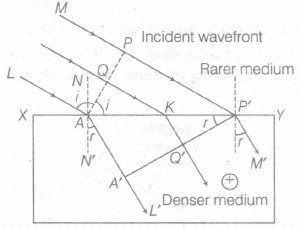
Suppose when disturbance from point P on incident wavefront reaches point P' on the refracted wavefront, the disturbance from point Q reaches point Q' on the refracting surface XY. Since A'Q'P' represents the refracted wavefront. the time taken by light to travel from a point on' incident wavefront to the corresponding point on refracted wavefront should always be the same. Now, time taken by light to go from Q to Q' will be
\(t=\frac { QK }{ c } +\frac { KQ' }{ v } \quad \quad .....(i)\)
(where, c and v are the velocities of light in two mediums)
In right angle \(\triangle AQK,\ \angle QAK=i\)
QK = AK sin i .... (ii)
In right angled \(\triangle P'Q'K, \ \angle Q'P'K=r\)
KQ' = KP' sin r .......(iii)
Substituting Eqs. (ii) and (iii) in Eq. (i), we get
\(t=\frac { AK\sin { i } }{ c } +\frac { KP\sin { r } }{ v } \)
\(t=\frac { AK\sin { i } }{ c } +\frac { (AP'-AK)\sin { r } }{ v } \)
\(or\quad t=\frac { AP' }{ v } \sin { r } +\left( \frac { \sin { i } }{ c } -\frac { \sin { r } }{ v } \right) AK\quad \quad .....(iv)\)
The rays from different points on the incident wavefront will take the same time to reach the corresponding points on the refracted wavefront, i.e., given by Eq. (iv) is independent of AK. It will happen so, if
\(\frac { \sin { i } }{ c } -\frac { \sin { r } }{ v } =0\)
\(\Rightarrow \quad \frac { \sin { i } }{ \sin { r } } =\frac { c }{ v } \)
However, \(\frac { c }{ v } =n\)
This is the Snell's law for refraction of light.
7.
Explanation: As per Huygen's Principle, net effect at any point,
= sum total of contribution of all wavelets with proper phase difference.At the central point (O) contribution from each half in SS1 is in phase with that from the corresponding part in SS2, Hence, 0 is a maxima At the point M where SM-S1M = \(\lambda\) /2 Phase difference between each wavelet from SS1 and corresponding wavelet from SS2 = '\(\lambda\) /2. Hence, M would be a minima . All such points (path difference = n\(\lambda\)/2) are also minima . Similarly, all points, for which path difference = (2n + 1)\(\lambda\)/2, are maxima but with decreasing intensity. From the figure Half angular width of central maxima \(\lambda\) /a
\(\therefore\) Size of central maxima will be reduced to half and intensity of central maxima will be four times if slit is made double the original width.
8.
Magnifying power (in normal adjustments) of a reflecting telescope is the ratio of the focal length of concave reflector and the focal length of the eyepiece.
\(m=\frac { f }{ { f }_{ e } } =\frac { RI2 }{ { f }_{ e } } \)
Limitations of refracting telescope over a reflecting type telescope.
(i) Refracting telescope suffers from chromatic aberration as it uses large sized lenses.
(ii) It is difficult and expensive to make such large sized lenses.
9.
For lens L1, \(\frac { 1 }{ f } =\frac { 1 }{ v } -\frac { 1 }{ u } \)
Given, \(u=-15cm,\ f=+10cm,v=?\)
\(\therefore \quad \frac { 1 }{ 10 } =\frac { 1 }{ v } +\frac { 1 }{ 15 } \Rightarrow \frac { 1 }{ v } =\frac { 1 }{ 10 } -\frac { 1 }{ 15 } \Rightarrow \frac { 1 }{ v } =\frac { 1 }{ 30 } \)
Distance of image from lens L1, v = 30 cm
For lens \({ L }_{ 3 },\quad \frac { 1 }{ { f }^{ '' } } =\frac { 1 }{ { v }^{ '' } } -\frac { 1 }{ { u }^{ '' } } \)
Distance of image from lens L1, v = 10 cm
\(\therefore \ \frac { 1 }{ 10 } =\frac { 1 }{ 10 } -\frac { 1 }{ { u }^{ '' } } \Rightarrow \frac { 1 }{ { u }^{ '' } } =0\Rightarrow { u }^{ '' }=\infty \)
The refracted rays from lens L2 becomes parallel to principal axis. It is possible only when image formed by L1 lies at first focus of L2, i.e. at a distance of 10 cm from L2.
\(\therefore \) Separation between L1 and L2 = 30 + 10 cm
The distance between L2 and L3 may take any value.
10.
\(\left( a \right) 4.4\times { 10 }^{ -7 }m\)
\(\left( b \right) 3.3\times { 10 }^{ -7 }m\)
11.
()
\(\frac{2 D \lambda}{a}\)
12.
()
path difference = \(a \ sin\theta =n\lambda \)
13.
()
positive ; virtual and erect.
14.
Light waves, originating from two independent monochromatic sources, will not have a monochromatic source, will not have a constant phase difference. Therefore, these sources will not be coherent and, therefore, would not produce a sustained interface pattern.
y = y1 + y2
= a cos wt + a cos (wt + \(\phi\))
= 2a cos\(\phi\over2\).cos(wt+\(\phi\over2\))
Amplitude of resultant displacement is 2a cos \(\phi\over2\)
\(\therefore\) Intensity,
I = 4a2 cos2 \(\phi\over2\)
A path difference of \(\lambda \) , corresponds to a phase difference of 2\(\pi\)
\(\therefore\) The intensity, K = 4a2 \(\Rightarrow \) a2 = \(k\over4\)
A path difference of \(\lambda\over3\), corresponds to a phase diference of \(2\pi\over3\)
\(\therefore\)Intensity = 4a2 cos2 \(\phi\)/2
= 4 x a2 x cos2 \({2\pi/3}\over2\)
= 4 x \(k\over4\) x \({ \left( \frac { 1 }{ 2 } \right) }^{ 2 }\)= \(k\over4\)
15.
(ii) For \(\lambda _{ 1 }=590nm\)
Location of 1st maxima,\(\lambda _{ 1 }=\left( 2n+1 \right) \frac { D\lambda _{ 1 } }{ 2a } \)
If \(n=1 \ \Rightarrow \lambda _{ 1 }=\frac { 3D\lambda _{ 1 } }{ 2a } \)
For \(\lambda _{ 2 }=596nm\)
Location of 2nd maxima,\(\lambda _{ 2 }=\left( 2n+1 \right) \frac { D\lambda _{ 1 } }{ 2a } \)
If \(\lambda _{ 2 }=\left( 2n+1 \right) \frac { D\lambda _{ 1 } }{ 2a } \)
Path difference \(\lambda _{ 2 }-\lambda _{ 1 }=\frac { 3D }{ 2a } \left( \lambda _{ 2 }-\lambda _{ 1 } \right) \)
\(=\frac { 3\times 1.5 }{ 2\times 2\times { 10 }^{ -6 } } \left( 596-590 \right) \times { 10 }^{ -9 }\)
\(=6.75\times { 10 }^{ -3 }m\)
16.
(i) \(\frac { { n }_{ 1 } }{ v } -\frac { { n }_{ 2 } }{ u } =\frac { { n }_{ 2 }-{ n }_{ 1 } }{ R } \) ............(i)
(ii) Now, the image I' acts as a virtual object for the second surface that will form a real at I. As, refraction takes place from denser to rarer medium,
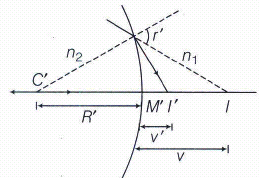
\(\therefore \quad \frac { { -n }_{ 2 } }{ v } +\frac { { n }_{ 1 } }{ { v }^{ ' } } =\frac { { n }_{ 2 }-{ n }_{ 1 } }{ { R }^{ ' } } \) ............(ii)
On adding Eqs. (i) and (ii), we get
\(\frac { 1 }{ f } =\left( { n }_{ 21 }-1 \right) \left( \frac { 1 }{ R } -\frac { 1 }{ { R }^{ ' } } \right) \ \left[ \therefore { n }_{ 21 }=\frac { { n }_{ 2 } }{ { n }_{ 1 } } ,\frac { 1 }{ f } =\frac { 1 }{ v } -\frac { 1 }{ u } \right] \)
17.
(d)
between 8 and 16 cm
18.
(a)
1.8 cm
19.
(b)
37°
20.
(c)
1.5
21.
22.
(d): When a light wave travel from a rarer to a denser medium it loses speed, but energy carried by the wave does not depend on its speed. Instead, it depends on the amplitude of wave. The frequency also remain constant.
23.
(b): For case when dark fringe is observed opposite to one of the slit
\(\text { here } S_{1} P=D \text { and } S_{2} P=\sqrt{D^{2}+d^{2}}=D\left[1+\frac{d^{2}}{2 D^{2}}\right]\)
\(\text { Path difference }=S_{2} P-S_{1} P=\frac{d^{2}}{2 D}=\frac{\lambda}{2} \text { or, } \lambda=\frac{d^{2}}{D}\)

12th Standard CBSE Syllabus & Materials
12th Standard CBSE
CBSE 12th Computer Science Python Revision Tour I - New Previous year Question Papers Study Material - QB365 Set A
NEW12th Standard CBSE
CBSE 12th Business Studies Planning Important Questions And Answers Study Material - QB365 Set A
NEW12th Standard CBSE
CBSE 12th Business Studies Business Environment Important Questions And Answers Study Material - QB365 Set A
NEW12th Standard CBSE
CBSE 12th Business Studies Principles of Management Important Questions And Answers Study Material - QB365 Set A



NCERT Books

Syllabus

Exam Pattern

Sample Question Papers

Previous year Question Papers

Important Notes

MCQ Practice test

NCERT Exemplers

Case study Questions

Image Based Questions

Passage based Questions

HOT Questions

Value Based Questions

Model Questions Papers
NCERT ( Book Back ) Questions

Assertion and Reason
Important Questions And Answers

CBSE 12th Standard CBSE Subjects
CBSE Standards








