
 100% FREE ACCESS
12th Standard CBSE Syllabus & Materials
12th Standard CBSE
CBSE 12th Economics Government Budget and the Economy Previous year Question Papers Study Material - QB365 Set A
NEW12th Standard CBSE
CBSE 12th Computer Science Interface Python with MySQL - New Previous year Question Papers Study Material - QB365 Set A
NEW12th Standard CBSE
CBSE 12th Computer Science Database Concept - New Previous year Question Papers Study Material - QB365 Set A
NEW12th Standard CBSE
CBSE 12th Computer Science Data Communication - New Previous year Question Papers Study Material - QB365 Set A
NEW12th Standard CBSE
CBSE 12th Computer Science Data Structures - New Previous year Question Papers Study Material - QB365 Set A
NEW12th Standard CBSE
CBSE 12th Computer Science Functions - New Previous year Question Papers Study Material - QB365 Set A

Published on: 07/03/2026
Download CBSE Class 12th Standard CBSE Physics question papers, sample papers, important questions, and previous year solved papers in PDF format. Get free study materials, NCERT solutions, and exam preparation resources for Class 12th Standard CBSE Physics
Questions + Answers key
Take MCQ Physics Test
1.
(a) Two thin convex lenses L1 and L2 of focal lengths f1 and f2 respectively, are placed co-axially in contact. An object is placed at a point beyond the focus of lens L1. Draw a ray diagram to show the image formation by the combination and hence derive the expression for the focal length of the combined system.
(b) A ray PQ incident on the face AB of a prism ABC, as shown in the figure, emerges from the face AC such that AQ = AR.
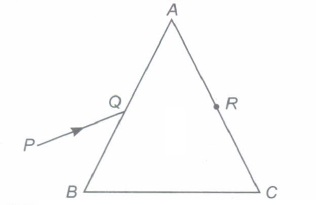
Draw the ray diagram showing the passage of the ray through the prism. If the angle of the prism is 600 and refractive index of the material of the prism is \(\sqrt{3}\), determine the values of angle of incidence and angle of deviation.
2.
(i) A ray PQ of light is incident on the face AB of a glass prism ABC (as shown in the figure) and emerges out of the face AC. Trace the path of the ray. Show that
∠i + ∠e = ∠A + ∠\(\delta\)
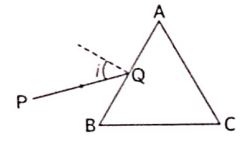
where, \(\delta \) and e denote the angle of deviation and angle of emergence, respectively. Plot a graph showing the variation of the angle of deviation as a function of angle of incidence. State the condition under which ∠\(\delta\) is minimum.
(ii) Find out the relation between the refractive index (μ) of the glass prism and ∠A for the case, when the angle of prism (A) is equal to the angle of minimum deviation (\(\delta\)m). Hence, obtain the value of the refractive index for angle of prism A = 60°.
3.
(a) Determine the ‘effective focal length’ of the combination of the two lenses in Exercise, if they are placed 8.0cm apart with their principal axes coincident. Does the answer depend on which side of the combination a beam of parallel light is incident? Is the notion of effective focal length of this system useful at all?
(b) An object 1.5 cm in size is placed on the side of the convex lens in the arrangement (a) above. The distance between the object and the convex lens is 40 cm. Determine the magnification produced by the two-lens system, and the size of the image.
4.
Relation between focal length (f) and radius of curvature (R) of a spherical mirror is
R = f/2
f = 3R
f = R/2
f = R/4
5.
F1 and F2 are focal lengths of objective and eyepiece respectively, of the telescope. The angular magnification of the given telescope is equal to
\(\frac{F_{1}}{F_{2}}\)
\(\frac{F_{2}}{F_{1}}\)
\(\frac{F_{1} F_{2}}{F_{1}+F_{2}}\)
\(\frac{F_{1}+F_{2}}{F_{1} F_{2}}\)
6.
Two lenses are in contact having powers of 5D and -3D. The focal length of this combination will be
50 cm
75 cm
25 cm
+20 cm
7.
A thin convex lens of refractive index 1.5 has 20 cm focal length in air. If the lens is completely immersed in a liquid of refractive index 1.6, then its focal length will be
-160 cm
-100 cm
+10 cm
+100 cm
8.
When an object is placed 40 cm from a diverging lens, its virtual image is formed 20 cm from the lens.The focal length and power of lens are
F = - 20 cm, P = - 5 D
F = - 40 cm, P = - 5 D
F = - 40 cm,P = -2.5 D
F = -20 cm,P = -2.5 D
9.
A person wants a real image of his own, 3 times enlarged. Where should he stand in front of a concave mirror of radius of curvature of 30 cm?
90 cm
10 cm
20 cm
30 cm
10.
A plano-convex lens ( f = 20 cm) is silvered at plane surface. Now, focal length will be
20 cm
40 cm
30 cm
10 cm
11.
An object has an image thrice of its original size when kept at 8 em and 16 cm from a convex lens. Focal length of the lens is
less than 8 cm
8 cm
16 cm
between 8 and 16 cm
12.
Magnifying power of a Galilean telescope is given by
\(\frac { { f }_{ 0 } }{ { f }_{ e } } \left( 1-\frac { { f }_{ e } }{ D } \right) \)
\(\frac { { f }_{ 0 } }{ { f }_{ e } } \left( 1+\frac { { f }_{ e } }{ D } \right) \)
\(\frac { { f }_{ 0 } }{ { f }_{ e } } \left( 1+\frac { { 2f }_{ e } }{ D } \right) \)
\(\frac { { f }_{ 0 } }{ { f }_{ e } } \left( 1-\frac { { 2f }_{ e } }{ D } \right) \)
13.
Dispersive power depends upon
the angle of prism
material of prism
deviation produced by prism
height of the prism
14.
A ray of light is refracted by a glass prism. Obtain an expression for the refractive index of the glass in terms of the angle of prism A and the angle of minimum deviation \(\delta_m\)
15.
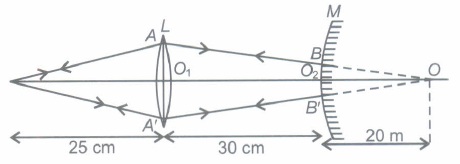
A convex lens, and a convex mirror, (of radius of curvature 20 cm) are placed co-axially with the convex mirror placed at a distance of 30 cm from the lens. For a point object at a distance of 20 cm from the lens, the final image; due to this combination, coincides with the object itself. What is the focal length of the convex lens?
16.
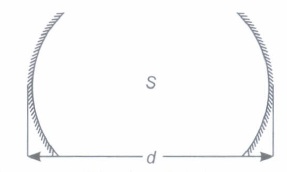
A point source S is placed mid-way between two concave mirrors having equal focal length as shown in figure. Find the value of d for which only one image is formed
17.
The objective of an astronomical telescope has a diameter of 150 mm and a focal length of 4 m. The eyepiece has a focal length of 25 mm. Calculate the magnifying and resolving power of telescope (λ = 6000 \(\overset{o}{A}\) for yellow colour).
18.
Velocity of light in glass is 2 x 10⁸ m/s and that in air is 3 x 10⁸ m/s. By how much would an ink dot appear to be raised, when covered by a glass plate 6 cm thick?
19.
A convex lens of focal length f1 is kept in contact with a concave lens of focal length f2. Find the focal length of the combination.
20.
An object is first seen in red light and then in violet light through a simple microscope. In which case is the magnifying power larger?
21.
A telescope consists of two thin lenses of focal lengths 0.3 m and 3 cm, respectively. It is focused on moon which subtends an angle of 0.5\(\unicode{xb0} \) at the objective. Then, what will be the angle subtended at the eye by the final image?
22.
A biconvex lens made of a transparent material of refractive index 1.25 is immersed in water of refractive index 1.33. Will the lens behave as a converging or a diverging lens? Give reason.
1.
(a)
Power of a lens is the measure of convergence or divergence which a lens can introduce in beam of light falling on it. The SI unit of power is dioptre (D).
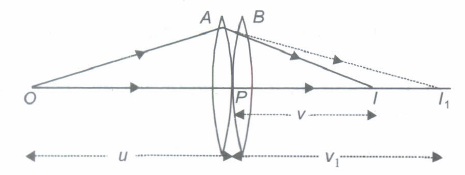
For the 1st lens, we have relation
\(\frac{1}{f_{1}}=\frac{1}{v_{1}}-\frac{1}{u}\) .........(i)
For the 2nd lens, the relation is
\(\frac{1}{f_{2}}=\frac{1}{v}-\frac{1}{v_{1}}\) .........(ii)
Here an image formed by the 1st lens acts as a virtual object for the 2nd lens.
Adding equations (i) and (ii), we get
\(\frac{1}{v}-\frac{1}{u}=\frac{1}{f_{1}}+\frac{1}{f_{2}}\)
If this two lens system is considered as an equivalent single lens of focal length f, we have
\( \frac{1}{v}-\frac{1}{u} =\frac{1}{f} \)
\(\therefore \quad \text { Power } P =\frac{1}{f}=\frac{1}{f_{1}}+\frac{1}{f_{2}} \)
(b) Given: Angle of prism, A = 60°,
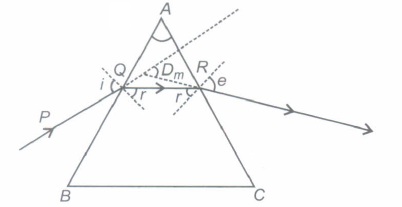
Refractive index, \(n=\sqrt{3}\)
In this case refracted ray is going parallel to base, hence it is the case of minimum deviation. We know
\( r_{1}+r_{2} =A \)
\(i+e =A+D \) ........(i)
For minimum deviation r1 = r2, i = e and D = Dm
\( \therefore \quad 2 r =A \Rightarrow r=\frac{60}{2}=30^{\circ} \)
\(\because \quad \frac{\sin i}{\sin r}=\sqrt{3} \)
\(\Rightarrow \quad \sin i =\frac{\sqrt{3}}{2} \Rightarrow i=60^{\circ} \)
\(\text { From equation (i) } 2 i =A+D_{m} \Rightarrow D_{m}=60^{\circ}\)
2.
(ii) Since, \(\angle\)A = 60° [given]
\(\begin{aligned}
\therefore \quad \mu & =\frac{\sin \left(\frac{60^{\circ}+60^{\circ}}{2}\right)}{\sin \left(60^{\circ} / 2\right)} \\
\end{aligned}\)
\(\begin{aligned}
=\frac{\sin 60^{\circ}}{\sin 30^{\circ}}=\frac{\sqrt{3}}{2} \times \frac{2}{1}=\sqrt{3}=1.732
\end{aligned}\)
3.
Focal length of the convex lens, f1 = 30 cm
Focal length of the concave lens, f2 = -20 cm
Distance between the two lenses, d = 8.0 cm
(a) When the parallel beam of light is incident on the convex lens first:
According to the lens formula, we have:
\(\frac { 1 }{ { v }_{ 1 } } -\frac { 1 }{ { u }_{ 1 } } =\frac { 1 }{ { f }_{ 1 } } \)
Where,
u1 = Object distance = ∞
v1 = Image distance
\(\frac { 1 }{ { v }_{ 1 } } =\frac { 1 }{ 30 } -\frac { 1 }{ \infty } =\frac { 1 }{ 30 } \)
∴ v1 = 30 cm
The image will act as a virtual object for the concave lens.
Applying lens formula to the concave lens, we have:
\(\frac { 1 }{ { v }_{ 2 } } -\frac { 1 }{ { u }_{ 2 } } =\frac { 1 }{ { f }_{ 2 } } \)
Where,
u2 = Object distance
= (30 - d) = 30 - 8 = 22 cm
v2= Image distance
\(\frac { 1 }{ { v }_{ 2 } } =\frac { 1 }{ 22 } -\frac { 1 }{ 20 } =\frac { 10-11 }{ 220 } =\frac { -1 }{ 220 } \)
∴ v2 = -220 cm
The parallel incident beam appears to diverge from a point that is \(\left( 220-\frac { d }{ 2 } =220-4 \right) 216\) cm from the centre of the combination of the two lenses.
(ii) When the parallel beam of light is incident, from the left, on the concave lens first:
According to the lens formula, we have:
\(\frac { 1 }{ { v }_{ 2 } } -\frac { 1 }{ { u }_{ 2 } } =\frac { 1 }{ { f }_{ 2 } } \)
\(\frac { 1 }{ { v }_{ 2 } } =\frac { 1 }{ { f }_{ 2 } } +\frac { 1 }{ { u }_{ 2 } } \)
Where,
u2 = Object distance = -∞
v2 = Image distance
\(\frac { 1 }{ { v }_{ 2 } } =\frac { 1 }{ -20 } +\frac { 1 }{ -\infty } =-\frac { 1 }{ 20 } \)
∴ v2 = -20 cm
The image will act as a real object for the convex lens.
Applying lens formula to the convex lens, we have:
\(\frac { 1 }{ { v }_{ 1 } } -\frac { 1 }{ { u }_{ 1 } } =\frac { 1 }{ { f }_{ 1 } } \)
Where,
u1 = Object distance
= -(20 + d) = -(20 + 8) = -28 cm
v1 = Image distance
\(\frac { 1 }{ { v }_{ 1 } } =\frac { 1 }{ 30 } +\frac { 1 }{ -28 } =\frac { 14-15 }{ 420 } =\frac { -1 }{ 420 } \)
∴ v2 = - 420 cm
Hence, the parallel incident beam appear to diverge from a point that is (420 - 4) 416 cm from the left of the centre of the combination of the two lenses
The answer does depend on the side of the combination at which the parallel beam of light is incident. The notion of effective focal length does not seem to be useful for this combination.
(b) Height of the image, h1 = 1.5 cm
Object distance from the side of the convex lens, u1 = -40 cm
|u1| = 40 cm
According to the lens formula:
\(\frac { 1 }{ { v }_{ 1 } } -\frac { 1 }{ { u }_{ 1 } } =\frac { 1 }{ { f }_{ 1 } } \)
Where,
v1 = Image distance
\(\frac { 1 }{ { v }_{ 1 } } =\frac { 1 }{ 30 } +\frac { 1 }{ -40 } =\frac { 4-3 }{ 120 } =\frac { 1 }{ 120 } \)
∴ v1 = 120 cm
\(m=\frac { { v }_{ 1 } }{ \left| { u }_{ 1 } \right| } \)
= \(\frac { 120 }{ 40 } =3\)
Hence, the magnification due to the convex lens is 3.
The image formed by the convex lens acts as an object for the concave lens.
According to the lens formula:
\(\frac { 1 }{ { v }_{ 2 } } -\frac { 1 }{ { u }_{ 2 } } =\frac { 1 }{ { f }_{ 2 } } \)
Where,
u2 = Object distance
= +(120 - 8) = 112 cm.
v2 = Image distance
\(\frac { 1 }{ { v }_{ 2 } } =\frac { 1 }{ -20 } +\frac { 1 }{ 112 } =\frac { -112+20 }{ 2240 } =\frac { -92 }{ 2240 } \)
∴ v2 = \(\frac { 2240 }{ 92 } \) cm
Magnification, \({ m }^{ ' }=\left| \frac { { v }_{ 2 } }{ { u }_{ 2 } } \right| \)
\(=\frac { 2240 }{ 92 } \times \frac { 1 }{ 112 } =\frac { 20 }{ 92 } \)
Hence, the magnification due to the concave lens is \(\frac { 20 }{ 92 } \)
The magnification produced by the combination of the two lenses is calculated as:
m x m'
\(=3\times \frac { 20 }{ 92 } =\frac { 60 }{ 92 } =0.652\)
The magnification of the combination is given as:
\(\frac { { h }_{ 2 } }{ { h }_{ 1 } } =0.652\)
h2 = 0.652 x h1
Where,
h1 = Object size = 1.5 cm
h2 = Size of the image
∴ h2 = 0.652 x 1.5 = 0.98 cm
Hence, the height of the image is 0.98 cm
4.
(c)
f = R/2
5.
(a)
\(\frac{F_{1}}{F_{2}}\)
6.
(c)
25 cm
7.
(a)
-160 cm
8.
(c)
F = - 40 cm,P = -2.5 D
9.
(c)
20 cm
10.
(d)
10 cm
11.
(d)
between 8 and 16 cm
12.
(a)
\(\frac { { f }_{ 0 } }{ { f }_{ e } } \left( 1-\frac { { f }_{ e } }{ D } \right) \)
13.
(b)
material of prism
14.
In the given diagram,
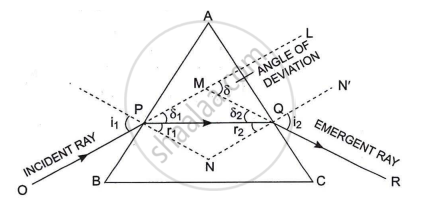
OP is the incident ray, which makes the angle i1 normal, and \(\angle N ' Q R\) is the angle of emergence, which is represented by \(\mathrm{i}_2\).
A is the prism angle, and \(\mu\) is the refractive index of the prism.
A = Prism angle, \(\delta=\) Angle of deviation, i1 = Angle of incidence,i2= Angle of emergence .
In the case of minimum deviation,
\( \angle r_1=\angle r_2=\angle r\)
\(\mathrm{~A}=\angle r_1+\angle r_2\)
So,\(A=\angle r+\angle r=\angle 2 r\)
\(\angle \mathrm{r}=\frac{A}{2}\)
Now, again
\(A+\delta=i_1+i_2 \ldots\left(\because\right.\) In the case of minimum deviation \(i_1=i_2=i\) and \(\left.\delta=\delta_m\right)\)
So, \(A+\delta_m=i+i=2 i\)
Now, \(i=\frac{\left(A+\delta_m\right)}{2}\)
Now, from Snell's rule,
\(\mu=\frac{\sin i}{\sin r}\)
\(\mu=\frac{\sin \left(\frac{A+\delta_m}{2}\right)}{\sin \frac{A}{2}}\)
15.
The final image, formed by the combination, is coinciding with the object itself. This implies that the rays, from the object, are retracing their path, after refraction from the lens and reflection from the mirror.
The (refracted) rays are, therefore, falling normally on the mirror. It follows that the rays AB, and A'B' when produced, are meeting at the centre of curvature, C of the mirror. Hence, O2O = 20 cm, i.e. the radius of curvature of the
mirror.
From the figure, we then see that for the convex lens, u = - 25 cm and v = + (30 + 20) cm = + 50 cm. from the focal length of the lens, we have
\(
\frac{1}{50}-\frac{1}{(-25)} =\frac{1}{f} \Rightarrow \frac{1}{f}=\frac{1+2}{50}
f =\frac{50}{3} \mathrm{~cm}=16.67 \mathrm{~cm}
\)
16.
If a point source S is placed at the common focus of both the mirrors, then the rays after reflection from mirror 1 will become parallel to the principal axis. When these parallel rays fall on mirror 2, the rays will get focussed at S.
\(\therefore \quad d=2 f\)
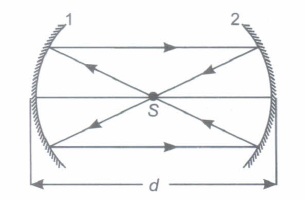
If a source S is placed at the centre of curvature of the two mirrors, the image of the source will be formed at C only.
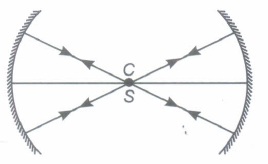
∴ d = 4 f, where f = focal length of each mirror.
17.
The diameter of objective of the telescope
= 150 x 10-3 m, fo = 4 m
fe = 25 x 10-3 m and D = 0.25 m
Magnifying power, m = \(-\frac{f_{0}}{f_{e}}\left(1+\frac{D}{f_{e}}\right)\)
\(=-\frac{4}{25 \times 10^{-3}}\left(1+\frac{0.25}{25 \times 10^{-3}}\right)=-1760\)
Now, \(d \theta=\frac{1.22 \lambda}{D}=\frac{1.22 \times 6 \times 10^{-7}}{0.25}\)
= 2.9 x 10⁻⁶ rad
∴ Resolving power \(=\frac{1}{d \theta}=\frac{1}{2.9 \times 10^{-6}}\)
= 0.34 x 10⁶
18.
Given, velocity of light in glass, v = 2 x 10⁸ m/s
Velocity of light in air, c = 3 x 10⁸ m/s
∴ Refractive index of glass with respect to air,
\({ }^{a} \mu_{g}=\frac{c}{v}=\frac{3 \times 10^{8}}{2 \times 10^{8}}=1.5\)
∴ Normal shift in the position of ink dot,
\(
d =t\left(1-\frac{1}{{ }^{a} \mu_{g}}\right) \quad[\because t=6 \mathrm{~cm}]
\)
\(=6\left(1-\frac{1}{1.5}\right)=\frac{6 \times 0.5}{1.5}=2 \mathrm{~cm}
\)
19.
For a convex lens of focal length f1,
\(\frac{1}{f_{1}}=\frac{1}{v^{\prime}}-\frac{1}{u}\) ...........(i)
For a concave lens of focal length f2,
\(\frac{1}{-f_{2}}=\frac{1}{v}-\frac{1}{v^{\prime}}\) .............(ii)
The image of the 1st lens acts as a virtual object for the 2nd lens. From equations (i) and (ii), we get
\(\frac{1}{f_{1}}-\frac{1}{f_{2}}=\frac{1}{v^{\prime}}-\frac{1}{u}+\frac{1}{v}-\frac{1}{v^{\prime}}\)
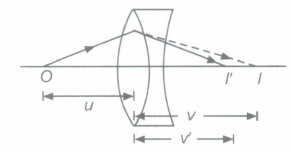
\( \Rightarrow \ \frac{1}{f}=\frac{1}{v}-\frac{1}{u} \)
\(\text {Thus, } \frac{1}{F}=\frac{1}{f_{1}}+\frac{1}{-f_{2}} \Rightarrow F=\frac{f f_{2}}{f_{2}-f_{1}} \)
20.
\(\mathrm{m}=1+\frac{D}{f}\)
\(\because f_V<f_R\)
So, the magnifying power is larger when the object is seen in violet light.
21.
Since, \(m=\frac{\tan \beta}{\tan \alpha} \approx \frac{\beta}{\alpha}=\frac{f_{e}}{f_{e}}\)
\(\therefore \quad \frac{\beta}{0.5^{\circ}}=\frac{0.3}{0.03}=5^{\circ}\)
22.
When a lens is placed in a liquid, where refractive index is more than that of the material of lens, then the nature of the lens changes. So, when a biconvex lens of refractive index 1.25 is immersed in water (refractive index 1.33), i.e. in the liquid of higher refractive index, its nature will change. So, biconvex lens will act as converging or diverging lens.

12th Standard CBSE Syllabus & Materials
12th Standard CBSE
CBSE 12th Computer Science Python Revision Tour I - New Previous year Question Papers Study Material - QB365 Set A
NEW12th Standard CBSE
CBSE 12th Business Studies Planning Important Questions And Answers Study Material - QB365 Set A
NEW12th Standard CBSE
CBSE 12th Business Studies Business Environment Important Questions And Answers Study Material - QB365 Set A
NEW12th Standard CBSE
CBSE 12th Business Studies Principles of Management Important Questions And Answers Study Material - QB365 Set A



NCERT Books

Syllabus

Exam Pattern

Sample Question Papers

Previous year Question Papers

Important Notes

MCQ Practice test

NCERT Exemplers

Case study Questions

Image Based Questions

Passage based Questions

HOT Questions

Value Based Questions

Model Questions Papers
NCERT ( Book Back ) Questions

Assertion and Reason
Important Questions And Answers

CBSE 12th Standard CBSE Subjects
CBSE Standards








