
12th Standard CBSE Syllabus & Materials
12th Standard CBSE
CBSE 12th Economics Government Budget and the Economy Previous year Question Papers Study Material - QB365 Set A
NEW12th Standard CBSE
CBSE 12th Computer Science Interface Python with MySQL - New Previous year Question Papers Study Material - QB365 Set A
NEW12th Standard CBSE
CBSE 12th Computer Science Database Concept - New Previous year Question Papers Study Material - QB365 Set A
NEW12th Standard CBSE
CBSE 12th Computer Science Data Communication - New Previous year Question Papers Study Material - QB365 Set A
NEW12th Standard CBSE
CBSE 12th Computer Science Data Structures - New Previous year Question Papers Study Material - QB365 Set A
NEW12th Standard CBSE
CBSE 12th Computer Science Functions - New Previous year Question Papers Study Material - QB365 Set A

Published on: 20/08/2026
Download CBSE Class 12th Standard CBSE Physics question papers, sample papers, important questions, and previous year solved papers in PDF format. Get free study materials, NCERT solutions, and exam preparation resources for Class 12th Standard CBSE Physics
Questions + Answers key
Take MCQ Physics Test
1.
How does the refractive index of a transparent medium depend on the wavelength of incident light used? Velocity of light in glass is 2 x 10⁸ m/s and in air is 3 x 10⁸ m/s, If the ray of light passes from glass to air, calculate the value of critical angle.
2.
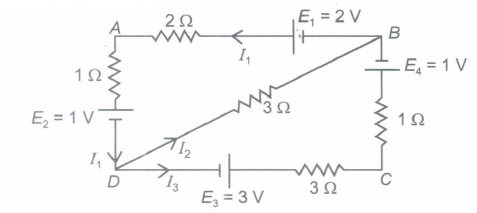
In the given network, find the values of the currents, I1, I2 and I3.
3.
Electromagnetic waves travel in a medium with a speed of 2 x 10⁸ ms-1. The relative magnetic permeability of the medium is 1. Find the relative electrical permittivity.
4.
An aluminium wire of diameter 0.24cm is connected in series to a copper wire of diameter 0.16cm. The wires carry an electric current of 10A. Determine the current density in aluminium wire.
5.
A parallel plate capacitor has a capacitance of \(2\mu F\). A slab of dielectric constant 5 is inserted between the plates and the capacitor is charged to 100 V and then isolated.
(a) what is the new potential different, if the dielectric slab is removed?
(b) How much work is required to remove the dielectric slab?
6.
A metal wire of diameter 2 mm and length 50 cm has a resistance \(0.31 \ \Omega\) at 25oC and \(0.51 \ \Omega\) at 125oC. Find
(i) the temperature coefficient of resistance
(ii), resistance at 0oC and
(iii) resistivity at 0oC and 25oC.
7.
Four resistances of \(16 \ \Omega\), \(12 \ \Omega\), \(4 \ \Omega\) and \(9 \ \Omega\) respectively are connected in cyclic order to form a Wheatstone bridge. Calculate the resistance to be connected in parallel with \(9 \ \Omega\) resistance to balance the bridge.
8.
A galvanometer having 30 divisions has a current sensitivity of \(20\mu \)A per division. It has a resistance of \(25\Omega \). How will you convert it into an ammeter measuring upto I A? How will you convert in this ammeter into a voltmeter reading upto 1 V?
9.
A galvanometer coil has a resistance of 15 Ω and the metre shows full scale deflection for a current of 4 mA. How will you convert the metre into an ammeter of range 0 to 6 A?
10.
(a) Differentiate between a wavefront and a ray.
(b) State Huygens' principle and verify laws of reflection using suitable diagram.
(c) In Young's double slit experiment, the slits S1 and S2 are 3 mm apart and the screen is placed 1.0 m away from the slits. It is observed that the fourth bright fringe is at a distance of 5 mm from the second dark fringe. Find the wavelength of light used.
11.
i) State Gauss' law. Using this law, obtain the expression for the electric field due to an infinitely long straight conductor of linear charge density \(\lambda .\)
ii) A wire AB of length L has linear charge density \(\lambda=k x\) where x is measured from the end A of the wire. This wire is enclosed by a Gaussian hollow surface.
Find an expression for the electric flux through this surface.
12.
Draw a labelled ray diagram of an astronomical telescope for the near point adjustment.
You are given three lenses of powers 0.5 0, 4 0, 10 D. State, with reason, which two lenses will you select for constructing a good astronomical telescope. Calculate the resolving power of this telescqpe, assuming the diameter of the objective lens to be 6 em and the wavelength of light used to be 540 nm.
13.
When a galvanometer of resistance G is shunted with a low resistance S, then the effective resistance \({ Re }_{ ff }\)of galvanometer becomes
\( { Re }_{ ff }=\frac { GS }{ G+S } \)
If the current is passed through such a galvanometer, then the major amount of current flows through the shunt and the rest through the galvanometer, then the major amount of current flows through the shunt and the rest through galvanometer., the current divides itself in the inverse ratio of resistances.
Read the above passage and answer the following questions:
(i) Why is the resistance of shunted galvanometer lower than that of a shunt?
(ii) A galvanometer of resistance.\(30\Omega \) What the fraction of the main current passes (i) through the galvanometer and (ii) through the galvanometer and (ii) through the shunt?
(iii) What are the basic values you learn from the above study?
14.
Two linear parallel conductors carrying currents in the same direction attract each other and two linear parallel conductors carrying in opposite directions repel each other. The force acting per unit length due to currents \({ I }_{ 1 }and{ I }_{ 2 }\)in two linear parallel conductors held distance r apart in vacuum in SI unit is \(F=\frac { { \mu }_{ 0 } }{ 2\pi } \frac { 2{ I }_{ 1 }{ I }_{ 2 } }{ r } \)
Read the above passage and answer the following questions:
(i) What is the basic reason for the force between two linear parallel conductors currents?
(ii) Two straight wires A and B of lengths 2 cm and 20 cm, carrying currents 2.0 A and 5.0 A respectively in opposite directions are lying parallel to each other 4.0 cm apart. The wire A is held near the middle of wire B. What is the force on 20 cm long wire B?
(iii) What does this study imply in day to day life?
15.
Show that the resistance of a conductor is given by \(R=\frac { ml }{ n{ e }^{ 2 }A\tau } \)
16.
A straight conducting rod of length I and mass m is suspended in a horizontal plane by a pair of flexible strings in a magnetic field of magnitude B. To remove the tension in the supporting strings, the magnitude of the current in the wire is
\(\frac{m g B}{l}\)
\(\frac{m g l}{B}\)
\(\frac{m g}{l B}\)
\(\frac{l B}{m g}\)
17.
Which of the following statements is correct?
Magnetic field lines do not form closed loops.
Magnetic field lines start from north pole and end at south pole of a magnet.
The tangent at a point on a magnetic field line represents the direction of the magnetic field at that point.
Two magnetic field lines may intersect each other.
18.
In Young's double-slit experiment, the intensity is I at a point, where the path difference is \(\frac{\lambda}{6}\) (λ - wavelength of light used). If 10 denotes the maximum intensity then \(\frac{\boldsymbol{I}}{\boldsymbol{I}_{0}}\) is equal to
\( \frac{\sqrt{3}}{2} \)
\( \frac{1}{2} \)
\(\frac{3}{4} \)
\(\frac{1}{\sqrt{2}}\)
19.
When there is an electric current through a conducting wire along its length, then an electric field must exist
outside the wire but normal to it.
outside the wire but parallel to it
inside the wire but parallel to it.
inside the wire but normal to it
20.
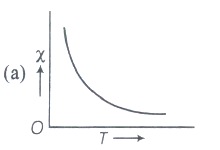
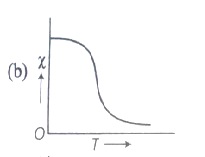
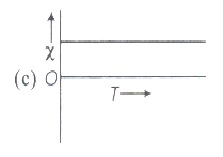
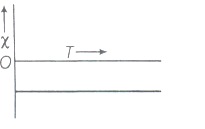
The variation of magnetic susceptibility (x) with temperature for a diamagnetic substance is best represented by figure
21.
SI unit of electrical permittivity is
N-m 2C-2
Am -2
NC-1
C2N-1m-2
22.
The minimum distance between an object and its real image formed by a convex lens is
1.5 f
2 f
2.5 f
4 f
23.
A positively charged glass rod is brought near the disc of uncharged gold leaf electroscope. The leaves diverge. Which of the following statement is correct?
No charge is present on the leaves
Positive charge is induced on the leaves
Negative charge is induced On the leaves
Positive charge is induced on one leave and negative charge induced on the other leaves
24.
The minimum amount of charge observed so faris
1C
4.8 x 10⁻¹³C
1.6 x 10⁻¹⁹C
None of these above
25.
A wire of resistance R is bent in the form of a circle. The resistance between two points on the circumference of the wire and at the end of a diameter of the circle is:
R/4
R/8
R/16
R/32
26.
which of the following electromagnetic waves has smaller wavelengths?
X-rays
Microwaves
\(\gamma \) -rays
Radiowaves
27.
Which of the following is not true for electromagnetic waves ?
They transport energy
They have momentum
They travel at different speeds in air depending on their frequency
They travel at different speeds in medium depending on their frequency
28.
State the law used to determine the direction of magnetic field at the centre of current carrying circular coil.
29.
A biconvex lens has a focal length 2/3 times the radius of curvature of either surface. Calculate the refractive index of lens material.
30.
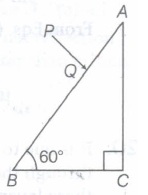
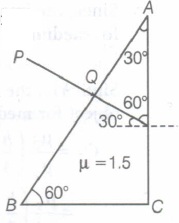
A ray PQ incident normally on the refracting face BA is refracted in the prism BAC made of material of refractive index 1.5. Complete the path of ray through the prism. From which face will the ray emerge? Justify your answer.
31.
A ring of radius R carries a uniformly distributed charge + Q. A point charge - q is placed on the axis of the ring at a distance 2R from the centre of the ring and released from rest. Will the particle execute simple harmonic motion along the axis of the ring?
32.
Represent graphically the variation of electric field with distance, for a uniformly charged plane sheet.
33.
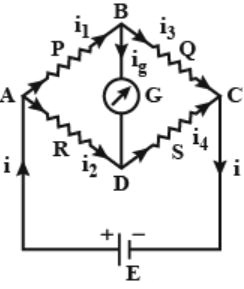
Use Kirchhoff's rules to obtain the balance conditions in a Wheatstone bridge.
34.
A magnetic field can be produced by moving charges or electric current. The basic equation of magnetic field due to a current distribution is governed by Biot-Savart law. According to this law, the magnetic field at a point due to a current element of length d l carrying current I, at a distance r from the element d l is,
\(d \mathbf{B}=\frac{\mu_0}{4 \pi} \cdot \frac{I d \mathbf{l} \times \mathbf{r}}{r^3}\)This law has certain similarities as well as differences with coulomb's law of electrostatic. e.g. There is an angle dependence in Biot-Savart law which is absent in electrostatic case.
(i) Write the alternative way to express Biot-Savart law.
(ii) What is the difference between Biot-Savart law and Coulomb's law in electrostatic.
(iii) How magnetic field due to an infinitely long current carrying wire at a distance r on its perpendicular bisector is related with current?
(vi) What is the magnetic field at a point on a long current carrying wire?
35.
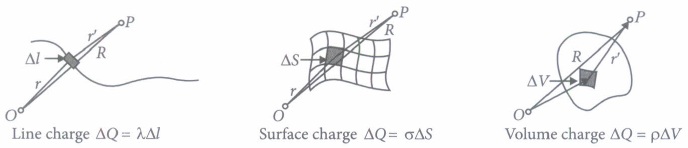
In practice, we deal with charges much greater in magnitude than the charge on an electron, so we can ignore the quantum nature of charges and imagine that the charge is spread in a region in a continuous manner. Such a charge distribution is known as continuous charge distribution. There are three types of continuous charge distribution : (i) Line charge distribution (ii) Surface charge distribution (iii) Volume charge distribution as shown in figure.
(I) Statement 1 : Gauss's law can't be used to calculate electric field near an electric dipole.
Statement 2 : Electric dipole don't have symmetrical charge distribution.
| (a) Statement 1 and statement 2 are true | (b) Statement 1 is false but statement 2 is true |
| (c) Statement 1 is true but statement 2 is false | (d) Both statements are false |
(ii) An electric charge of 8.85 X 10⁻¹³ C is placed at the centre of a sphere of radius 1 m. The electric flux through the sphere is
| (a) 0.2 N C-1 m2 | (b) 0.1 N C-1 m2 | (c) 0.3 N C-1 m2 | (d) 0.01 N C-1 m2 |
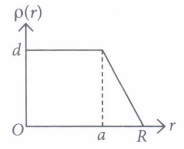
(iii) The electric field within the nucleus is generally observed to be linearly dependent on r. So,
| (a) a=O | \(\text { (b) } a=\frac{R}{2}\) | (c) a=-R | \(\text { (d) } a=\frac{2 R}{3}\) |
(iv) What charge would be required to electrify a sphere of radius 25 cm so as to get a surface charge density of \(\frac{3}{\pi} \mathrm{C} \mathrm{m}^{-2} ?\)
| (a) 0.75 C | (b) 7.5 C | (c) 75 C | (d) zero |
(v) The SI unit of linear charge density is
| (a) Cm | (b) Cm-1 | (c) C m-2 | (d) C m-3 |
36.
37.
Assertion (A) : A convex lens of glass (\(\mu\) = 1.5) behave as a diverging lens when immersed in carbon disulphide of higher refractive index (\(\mu\) = 1.65).
Reason (R) : A diverging lens is thinner in the middle and thicker at the edges.
Codes:
(a) Both A and R are true and R is the correct explanation of A
(b) Both A and R are true but R is NOT the correct explanation of A
(c) A is true but R is false
(d) A is false and R is also false
38.
Assertion (A) : Two point coherent sources oflight S1 and S2 are placed on a line as shown. P and Q are two points on that line. If at point P maximum intensity is observed then maximum intensity should also be observed at Q.
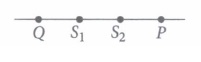
Reason (R) : In the figure of assertion the distance IS1P - S2PI is equal to distance IS2Q - S1QI.
Codes:
(a) Both A and R are true and R is the correct explanation of A
(b) Both A and R are true but R is NOT the correct explanation of A
(c) A is true but R is false
(d) A is false and R is also false
39.
Assertion (A) : Magnetic moment is measured in joule/tesla or amp m2.
Reason (R) : Joule/tesla is equivalent to amp m2.
(a) Both A and R are true and R is the correct explanation of A
(b) Both A and R are true but Ris NOT the correct explanation of A
(c) A is true but R is false
(d) A is false and R is also false
1.
The refractive index of a transparent medium decreases with increase in wavelength of the incident light.
We have \(\mu_{g a}=\frac{v_{a}}{v_{g}}=\frac{3 \times 10^{8}}{2 \times 10^{8}}=\frac{3}{2}=1.5\)
\(
\therefore \quad \mu_{g a}=\frac{1}{\sin i_{c}}
\)
\(\Rightarrow i_{c}=\sin ^{-1}\left(\frac{1}{\mu_{g a}}\right)
\)
\(\Rightarrow \quad i_{c}=\sin ^{-1}\left(\frac{2}{3}\right)=41.8\)
2.
Here, \(I_{1}=I_{2}+I_{3}\) ......(i)
From the loop ADBA,
\(3 I_{1}+3 I_{2}=2-1 ; 3 I_{1}+3 I_{2}=1\) .....(ii)
From the loop DCBD,
\(4 I_{3}-3 I_{2}=3-1 ; 4 I_{3}-3 I_{2}=2\) .....(iii)
\(4\left(I_{1}-I_{2}\right)-3 I_{2}=2 \quad\left(\because I_{3}=I_{1}-I_{2}\right)\)
\(4 I_{1}-7 I_{2}=2\) .....(iv)
From equations (ii) and (iv), we get
\(
3 I_{1}+3 I_{2} =1
\)
\(4 I_{1}-7 I_{2} =2
\)
\(I_{1} =\frac{13}{33}, \quad I_{2}=-\frac{2}{33}, \ I_{3}=\frac{15}{33}\)
3.
Given, v = 2 x 10⁸ m / s and \(\mu _{ r }\)
The speed of electromagnetic waves in medium is given by
v = \(\frac { 1 }{ \sqrt { \mu \varepsilon } } \)
Where, \(\mu \) and \(\varepsilon \) are absolute permeability and absolute permittivity of the medium.
Now, \(\mu \) = \(\mu _{ 0 }\mu _{ r }\)
and \(\varepsilon =\varepsilon _{ 0 }\varepsilon _{ r }\)
Eq. (i) becomes, v = \(\frac { 1 }{ \sqrt { \mu _{ 0 }\mu _{ r }\varepsilon _{ 0 }\varepsilon _{ r } } } \)
= \(\frac { 1 }{ \sqrt { \mu _{ 0 }\varepsilon _{ 0 } } } \) x \(\frac { 1 }{ \sqrt { \mu _{ r }\varepsilon _{ r } } } \)
v = \(\frac { c }{ \sqrt { \mu _{ r }\varepsilon _{ r } } } \) \(\left[ c=\frac { 1 }{ \sqrt { \mu _{ 0 }\varepsilon _{ 0 } } } \right] \)
On squaring both sides, we get
\(\varepsilon _{ r }=\frac { c^{ 2 } }{ v^{ 2 }\mu _{ r } } \)
= \(\frac { (3\times10^{ 8 })^{ 2 } }{ (2\times10^{ 8 })^{ 2 }\times1 } \) = 2.25
4.
Given, diameter = 0.24 cm,
radius, \(r=\frac { 0.24\times { 10 }^{ -2 } }{ 2 } \) = 0.12 x 10⁻² m
and Current, I = 10A
\(\therefore\) Current density, \(J=\frac { I }{ A } =\frac { I }{ \pi { { r }^{ 2 } } } \)
\(=\frac{10}{3.14 \times\left(0.12 \times 10^{-2}\right)^2}=2.2 \times 10^6 \mathrm{Am}^{-2}\)
5.
Here, \(C_o=2\mu F=2\times 10^{-6}F, K=5, V=100 volt\)
When dielectric slab is removed, capacity becomes \(1\over K\) times and potential becomes K times.
New potential \(V_o=5\times 100=500V\)
Work required to remove dielectric
\(=U_2-U_1={1\over 2}C_oV_o^2-{1\over 2}CV^2\)
\(={1\over 2}[2\times 10^{-6}(500)^2-10\times 10^{-6}(100)^2]\)
\(={1\over2}(0.5-0.1)=0.2J\)
6.
Here, r = 1 mm = 10-3 m;
l = 50 cm = 0.50 m;
R1 = \(0.31 \ \Omega\),
t1 = 25oC,
R2 = \(0.51 \ \Omega\),
t2 = 125oC
(i) Temperature coefficient of resistance
\(\alpha=\frac{R_2-R_1}{R_1(t_2-t_1)}=\frac{0.51-0.31}{0.31(125-25)}\)
= \(\frac{0.20}{0.31\times100}\) = 6.45 x 10⁻³ oC-1
(ii) Resistance at 0oC is
\(R_0=\frac{R_1}{1+\alpha t_1}=\frac{0.31}{1+(6.4\times10^{-3})\times 25}=0.267 \ \Omega\)
(ii) Resistivity at 0oC
\(\rho_0 =\frac{R_0A}{l}=\frac{R_0 \times \pi r^2}{l}=\frac{0.267 \times 3.242 \times (10^{-3})^2}{0.50}\)
= \(1.68 \times 10^{-6} \ \Omega m\)
Resistivity at 25oC,
\(\rho_{25}=\rho_0[1+\alpha \times 25]\)
= \(1.68 \times 10^{-6}[1+6.4 \times10^{-3}\times25]\)
=\(1.948 \times 10^{-6} \ \Omega m\)
7.
Here, P = \(16 \ \Omega\), Q = \(12 \ \Omega\), R = \(9 \ \Omega\), S = \(4 \ \Omega\)
Let \(9 \ \Omega\) be shunted with resistance x to balance the bridge. Then effective resistance of \(9 \ \Omega\) and x ohm in parallel,
\(R'=\frac{9x}{9 + x}\)
For balanced bridge,
\(\frac{P}{Q}=\frac{R'}{S}\)
\(\therefore \frac{16}{12}=\frac{9x/(9+x)}{4}\)
or \(\frac{4}{3}=\frac{9x}{4(9+x)}\)
or 144 + 16 x = 27 x
or x = \(13.1 \ \Omega\)
8.
Given current sensitivity
\({ I }_{ S }=20\mu A{ div }^{ -1 }=20\times { 10 }^{ -6 }A{ div }^{ -1 }\)
The galvanometer ha 30 divisions, so current for full-scale deflection
,\({ I }_{ g }=30\times 20\times { 10 }^{ -6 }A=6\times { 10 }^{ -4 }A\)
When the galvanometer is to be converted into an ammeter, thus the value of shunt required
\(S=\frac { { I }_{ g } }{ I-{ I }_{ g } } G=\frac { 6\times { 10 }^{ -7 } }{ 1-6\times { 10 }^{ -4 } } \times 25\) (in parallel)
\(\\ =0.015\Omega \)
When the galvanometer is to be converted into a voltmeter, then the value of resistance R is given by
\(R=\frac { V }{ I } -{ R }_{ A }\)
\(=\frac { 1 }{ 1 } -\frac { GS }{ G+S } =1-\frac { 25\times 0.015 }{ 25+0.015 } \)
\(=1-0.015=0.985\Omega \) (in series)
9.
Resistance of the galvanometer coil, G = 15 Ω
Current for which the galvanometer shows full scale deflection,
= 4 mA = 4 x 10⁻³ A
Range of the ammeter is 0, which needs to be converted to 6 A.
Current, I = 6 A
A shunt resistor of resistance S is to be connected in parallel with the galvanometer to convert it into an ammeter. The value of S is given as:
\(S=\frac{I_{g} G}{I-I_{g}}\)
\(=\frac{4 \times 10^{-3} \times 15}{6-4 \times 10^{-3}}\)
\(S=\frac{6 \times 10^{-2}}{6-0.004}=\frac{0.06}{5.996}\)
\(\approx 0.01 \Omega=10 \mathrm{~m} \Omega\)
Hence, a 10 mΩ shunt resistor is to be connected in parallel with the galvanometer.
10.
(a) A wavefront is defined as the locus of all the particles of a medium vibrating in the same phase at a given instant. The shape of a wavefront depends upon the shape of the source of disturbance and it is normal to the direction of propagation of wave.
A line drawn perpendicular to the plane wavefront gives the direction of propagation of a wave and is called ray of light.
(b) Huygens' Principle and Reflection at a Plane Surface
(c) Position of nth maxima, \(y_n=\frac{n D \lambda}{d}\) (Bright fringe) and position of mth minima,
\(y_m^{\prime}=\left(m-\frac{1}{2}\right) \frac{D \lambda}{d}\) (Dark fringe)
Given, d = 3 mm = 3 \(\times\) 10-3 m
D = 1 m
and y4 - y2' = 5 mm = 5 \(\times\) 10-3m
Now, \(\frac{4 D \lambda}{d}-\left(2-\frac{1}{2}\right) \frac{D \lambda}{d}=5 \times 10^{-3} \mathrm{~m}\)
\(\Rightarrow\) \(\frac{4 D \lambda}{d}-\frac{3}{2} \frac{D \lambda}{d}=5 \times 10^{-3}\)
\(\begin{aligned} \Rightarrow \left(4-\frac{3}{2}\right) \frac{D \lambda}{d}=5 \times 10^{-3} \end{aligned}\)
\(\begin{aligned} \Rightarrow \frac{5}{2}\left(\frac{(1) \lambda}{3 \times 10^{-3}}\right)=5 \times 10^{-3} \end{aligned}\)
\(\Rightarrow\) \(\lambda=\frac{3}{2} \times 10^{-6} \mathrm{~m}\)
\(\Rightarrow\) \(\lambda=1.5 \times 10^{-6} \mathrm{~m}\)
\(\Rightarrow\) \(\lambda=1.5 \mu \mathrm{m}\)
11.
ii) use , dQ = \(\lambda \), dl and Gauss' theorem \(\phi=\frac{Q}{\varepsilon_0}\)
12.
If the final image is formed at the distance of distinct visioa, the magnifying power of the telescope is given as
\(m=\frac{f_{o}}{-f_{e}}\left(1+\frac{f_{e}}{D}\right)\)
Astronomical telescope in near point adjustment.
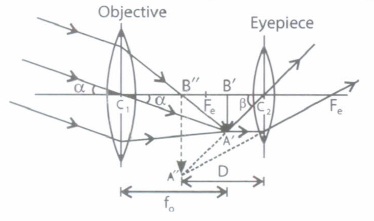
For an astronomical telescope, we will select lens of power 10D for eye piece and lens of power 0.5 D for objective because magnifying power of telescope is \(m=\frac{f_{o}}{f_{e}}\)
Resolving power of the telescope:
Given: \(
D_{0}=6 \mathrm{~cm}, \lambda =540 \times 10^{-9} \mathrm{~m}
\)
\(
\text { R.P. } =\frac{D_{o}}{1.22 \lambda}=\frac{6 \times 10^{-2}}{1.22 \times 540 \times 10^{-9}}
\)
\(= 0.9 \times 10^{5}
\)
13.
(i) The shunt is a low resistance connected in parallel with the galvanometer. Therefore, the combined resistance is less than that of the shunt.
(ii) Let I be the total current passing through the shunt galvanometer. Let \({ I }_{ g }\),\({ I }_{ s }\) be the currents through galvanometer of resistances G and shunt of resistance S respectively. As current divides itself in the inverse ratio of the resistances, therefore, fraction of current passing through galvanometer
= \(\frac { { I }_{ g } }{ I } =\frac { S }{ G+S } =\frac { 3 }{ 30+3 } =\frac { 1 }{ 11 }\)
\(Fraction \ of \ current \ passing \ through \ shunt=\frac { { I }_{ s } }{ I } =\frac { G }{ G+S } =\frac { 30 }{ 30+3 } =\frac { 10 }{ 11 } \\ \)
(iii) From the above study, we find that the current always divides itself in the inverse ratio of resistances. The major part of current flows through the shunt, which is the path of low resistance. Similarly in life, if different paths are available to reach a destination, then one selects a path of least resistance to reach there. This would save both, time and energy.
14.
(i) The force is due to the interaction between magnetic fields due to currents in two linear parallel conductors.
(ii) Here, \({ l }_{ 1 }=2cm=2\times { 10 }^{ -2 }m;{ l }_{ 2 }=20\times { 10 }^{ -2 }m;{ I }_{ 1 }=2.0A;{ I }_{ 2 }=5.0A;r=4\times { 10 }^{ -2 }m\)
Since action and reaction are equal and opposite so the magnitude of repulsive force on 20 cm long wire = the magnitude of repulsive force on 2 cm long wire
= \(\frac { { \mu }_{ 0 } }{ 4\pi } \frac { 2{ I }_{ 1 }{ I }_{ 2 } }{ r } { l }_{ 1 }={ 10 }^{ -7 }\times \frac { 2\times 2\times 5\times (2\times { 10 }^{ -2 }) }{ 4\times { 10 }^{ -2 } }\)
\( ={ 10 }^{ -6 }\)
This study shows that when the current through two parallel conductors flow in the same direction, they attract each other and vice versa. It implies that when the thoughts and actions of two business partners are aligned in the same direction, their behavior is cohesive and they succeed. If there thoughts and actions are opposing, the partnership is likely to collapse. The same thing is true for husband and wife. For a successful family life, the coherence of thoughts and action is a must.
15.
Since drift velocity \({ v }_{ d }\) and current, I flowing in a conductor are related by the relation:
\({ v }_{ d }=\frac { I }{ neA }.........(1)\)
\(Also \ drift \ velocity \ in \ terms \ of \ average \ relaxation \ time \ \tau \ is \ given \ by\)
\({ v }_{ d }=\frac { eE\tau }{ m } .........(2)\)
\( From \ (1) \ and \ (2), \ we \ have\)
\( \frac { eE\tau }{ m } =\frac { I }{ neA }\)
\(or\quad \frac { E }{ I } =\frac { m }{ n{ e }^{ 2 }A\tau }\)
\( or \ \frac { V }{ lI } =\frac { m }{ n{ e }^{ 2 }A\tau } \)
\( or \ \frac { V }{ I } =\frac { ml }{ n{ e }^{ 2 }A\tau } ...........(3)\)
\( The \ R.H.S. \ of \ Eq(3) \ is \ constant\)
\( \frac { V }{ I } = \ Constant\)
\( This \ is \ Ohm's \ law\)
16.
(c)
\(\frac{m g}{l B}\)
17.
(c)
The tangent at a point on a magnetic field line represents the direction of the magnetic field at that point.
18.
(c)
\(\frac{3}{4} \)
19.
(c)
inside the wire but parallel to it.
20.
(d)
21.
(d)
C2N-1m-2
22.
(d)
4 f
23.
(b)
Positive charge is induced on the leaves
24.
(c)
1.6 x 10⁻¹⁹C
25.
(a)
R/4
26.
(c)
\(\gamma \) -rays
27.
(c)
They travel at different speeds in air depending on their frequency
28.
The right-hand thumb rule gives the direction of magnetic field which is stated as under:
Curl the palm of your right hand around a circular wire with the fingers, pointing in the direction of the current and the right hand thumb gives the direction of magnetic field.
29.
Given, \(f=\frac{2}{3} R, R_{1}=+R, R_{2}=-R\)
∴ Using lens Maker's formula,
\(\frac{1}{f}=(\mu-1)\left(\frac{1}{R_{1}}-\frac{1}{R_{2}}\right)\)
\( \Rightarrow \frac{3}{2 R}=(\mu-1)\left(\frac{2}{R}\right) \)
\(\Rightarrow \quad \mu-1=\frac{3}{4} \)
\(\Rightarrow \quad \mu=1+\frac{3}{4}=\frac{7}{4} \)
30.
Given, refractive index of the material of the prism, μ = 1.5
∴ Critical angle for the material,
\(\sin C=\frac{1}{\mu}=\frac{1}{1.5}=2 / 3\)
\(\Rightarrow C=\sin ^{-1}\left(\frac{2}{3}\right) \simeq 42^{\circ}\)
From the ray diagram, it is clear that angle of incidence i = 30°< C.
Therefore, ftie ray incident at the face AC will not suffer total internal reflection and merges out through this face.
31.
Yes, but motion is simple harmonic only when charge - q is not very far from the centre of ring on its axis. Otherwise motion is periodic, but not simple harmonic in nature.
32.
It is independent of the distance. It' s a straight line parallel to x-axis.
33.
We apply Kirchoff's current law in the shown circuit.
At junction B,
i1=ig+i3
At junction D,
i2+ig=i4
If current through the galvanometer is zero,
ig = 0
thus i1 = i3
and i2 = i4
Applying Kirchoff's voltage law for loop ABDA,
i1P + igG = i2R
Applying Kirchoff's voltage law for loop BCDB,
i3Q + i4S + igG
When ig = 0,
i1P = i2R
and i3Q = i4S
But i1 = i3 and i2 = i4,
Therefore \(\frac{P}{Q}=\frac{R}{S}\)
34.
(i) Biot-Savart law can be expressed alternatively as Ampere's circuital law.
(ii) Biot-Savart law is angle dependence law, whereas Coulomb's law in electrostatic is angle independent law.
(iii) The magnetic field due to an infinitely long current carrying wire,
\(\begin{aligned}
B=\frac{\mu_0 I}{2 \pi r}
\end{aligned}\)
\(\begin{aligned}
\therefore \quad B & \propto I
\end{aligned}\)
(iv) The magnetic field at a point on the long current carrying wire,
\(\begin{aligned}
d B=\frac{\mu_0}{4 \pi} \cdot \frac{I d l \sin \theta}{r^2}
\end{aligned}\)
\(\begin{aligned}
=\frac{\mu_0}{4 \pi} \cdot \frac{I d l \sin 0^{\circ}}{r^2}
\quad \quad \quad{\left[\because \theta=0^{\circ}\right]}
\end{aligned}\)
= 0
35.
(i) (a): Gauss's law is applicable for any closed surface. Gauss's law is most useful in situation where the charge distribution has spherical or cylindrical symmetry or is distributed uniformly over the plane.
Whereas electric dipole is a system of two equal and opposite point charges separated by a very small and finite distance.
So both statements are correct.
(ii) (b): According to Gauss's law, the electric flux through the sphere is
\(\phi=\frac{q_{\mathrm{in}}}{\varepsilon_{0}}=\frac{8.85 \times 10^{-13} \mathrm{C}}{8.85 \times 10^{-12} \mathrm{C}^{2} \mathrm{~N}^{-1} \mathrm{~m}^{-2}}=0.1 \mathrm{~N} \mathrm{C}^{-1} \mathrm{~m}^{2}\)
(iii) (c) : For uniformly volume charge density,
\(E=\frac{\rho r}{3 \varepsilon_{0}}\)
\(E \propto r\)
(iv) (a): r = 25 ern = 0.25 m \(\sigma=\frac{3}{\pi} \mathrm{C} / \mathrm{m}^{2}\)
As, \(\sigma=\frac{q}{4 \pi r^{2}} \Rightarrow q=4 \pi \times(0.25)^{2} \times \frac{3}{\pi}=0.75 \mathrm{C}\)
(v) (b): The line charge density at a point on a line is the charge per unit length of the line at that point
\(\lambda=\frac{d q}{d L}\)
Thus, the SI unit for \(\lambda \text { is } \mathrm{Cm}^{-1} \text {. }\)
36.
37.
(b) : \(\mu=\frac{\mu_{g}}{\mu_{c}}=\frac{1.5}{1.65}<1\)
\(\text { From } \frac{1}{f}=(\mu-1)\left(\frac{1}{R_{1}}-\frac{1}{R_{2}}\right)\)
f becomes negative.
Therefore, the lens behaves as a diverging lens.
38.
(b): If maximum intensity is observed at P then for maximum intensity to be also observed at Q, S1 and S2 must have phase difference of 2 m\(\pi\) (where m is an integer).
39.
(a): Magnetic moment \(=\frac{\text { joule }}{\text { tesla }}=\frac{W}{B}=\frac{W}{F / q v}\)
\(=\frac{W q v}{F}=\frac{\left[M L^{2} T^{-2}\right][A T]\left[L T^{-1}\right]}{\left[M L T^{-2}\right]}\)
\(=\left[\mathrm{AL}^{2}\right]=\mathrm{amp} \mathrm{m}^{2}\)

12th Standard CBSE Syllabus & Materials
12th Standard CBSE
CBSE 12th Computer Science Python Revision Tour I - New Previous year Question Papers Study Material - QB365 Set A
NEW12th Standard CBSE
CBSE 12th Business Studies Planning Important Questions And Answers Study Material - QB365 Set A
NEW12th Standard CBSE
CBSE 12th Business Studies Business Environment Important Questions And Answers Study Material - QB365 Set A
NEW12th Standard CBSE
CBSE 12th Business Studies Principles of Management Important Questions And Answers Study Material - QB365 Set A



NCERT Books

Syllabus

Exam Pattern

Sample Question Papers

Previous year Question Papers

Important Notes

MCQ Practice test

NCERT Exemplers

Case study Questions

Image Based Questions

Passage based Questions

HOT Questions

Value Based Questions

Model Questions Papers
NCERT ( Book Back ) Questions

Assertion and Reason
Important Questions And Answers

CBSE 12th Standard CBSE Subjects
CBSE Standards








