
 100% FREE ACCESS
12th Standard CBSE Syllabus & Materials
12th Standard CBSE
CBSE 12th Economics Government Budget and the Economy Previous year Question Papers Study Material - QB365 Set A
NEW12th Standard CBSE
CBSE 12th Computer Science Interface Python with MySQL - New Previous year Question Papers Study Material - QB365 Set A
NEW12th Standard CBSE
CBSE 12th Computer Science Database Concept - New Previous year Question Papers Study Material - QB365 Set A
NEW12th Standard CBSE
CBSE 12th Computer Science Data Communication - New Previous year Question Papers Study Material - QB365 Set A
NEW12th Standard CBSE
CBSE 12th Computer Science Data Structures - New Previous year Question Papers Study Material - QB365 Set A
NEW12th Standard CBSE
CBSE 12th Computer Science Functions - New Previous year Question Papers Study Material - QB365 Set A

Published on: 02/11/2025
Download CBSE Class 12th Standard CBSE Physics question papers, sample papers, important questions, and previous year solved papers in PDF format. Get free study materials, NCERT solutions, and exam preparation resources for Class 12th Standard CBSE Physics
Questions + Answers key
Take MCQ Physics Test
1.
The energy gap between conduction band and valence band is of the order of 0.07 eV. It is a/an
insulator
conductor
semiconductor
alloy
2.
After 2 hours, \(\frac { 1 }{ 16 } th\) of initial amount of a certain radioactive isotope remains undecayed. The half-life of the isotope is
15 min
30 min
45 min
60 min
3.
Two spherical nuclei have mass number 216 and 64 with their radii \({ R }_{ 1 }\ and\ { R }_{ 2 }\) respectively. The ratio, \(\frac { { R }_{ 1 } }{ { R }_{ 2 } } \) is equal to
3 : 2
1 : 3
1 : 2
2 : 3
4.
Hole is
an anti-particle of electron
a vacancy created when an electron leaves a covalent bond
absence of free electron
an artificially created particle
5.
Given the value of Rydberg constant is \({ 10 }^{ 7 }{ m }^{ -1 }.\) The wave number of the last line of Balmer series in hydrogen spectrum will be
\(0.5\times { 10 }^{ 7 }{ m }^{ -1 }\)
\(0.25\times { 10 }^{ 7 }{ m }^{ -1 }\)
\(2.5\times { 10 }^{ 7 }{ m }^{ -1 }\)
\(0.025\times { 10 }^{ 4 }{ m }^{ -1 }\)
6.
In intrinsic semiconductor at room temperature, the number of electrons and holes are
equal
zero
unequal
infinite
7.
What is de-Broglie wavelength associated with electron moving under a potential difference of 104 V.
12.27nm
1 nm
0.01227nm
0.1227nm
8.
The slope of frequency of incident light and stopping potential for a given surface will be
h
h/e
eh
e
9.
A proton,a neutron, an electron and an \(\alpha \)-particle have the same energy.Then their de-Broglie wavelengths compare as
\(\lambda _{ p }=\lambda _{ n }>\lambda _{ c }>\lambda _{ \alpha }\)
\(\lambda _{ \alpha }<\lambda _= \lambda _{ n }>\lambda _{ c }\)
\(\lambda _{ e }<\lambda _=\lambda _{ n }>\lambda _{ \alpha }\)
\(\lambda _{ c }=\lambda =\lambda _{ n }=\lambda _{ \alpha }\)
10.
A nucleus \(_{ 92 }^{ 238 }{ U }\) undergoes α-decay and transforms to thorium. What is
(i) the mass number and
(ii) atomic number of the nucleus produced?
11.
Draw a plot of BE/A versus mass number A for Use this graph to explain the release of enegry in the process of nuclear fusion of two light nuclei.
12.
Write Einstein's photoelectric equation.Explain the terms of threshold frequency
13.
Calculate the half-life period of a radioactive substances,if its activity drops to \(\frac { 1 }{ 16 } \) th of its initial value in 30 years
14.
What is the
(i) momentum
(ii) speed
(iii) de-Broglie wavelength of an electron with kinetic energy of 120 eV?
15.
A Zener of power rating 1 W is to be used as a voltage regulator. If Zener has a breakdown of 5 V and it has to regulate voltage which fluctuated between 3 V and 7 V, what should be the value of RS for safe operations as shown below figure?

16.
The graph shows the variation of stopping potential with the frequency of incident radiation for two photosensitive metals A and B.
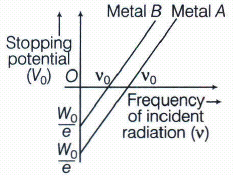
Which one of the two has higher value of work function? Justify your answer.
17.
State two characteristic properties of nuclear forces.
18.
Name the series of hydrogen spectrum which lies in the visible region of electromagnetic spectrum?
19.
The work function of cesium is 2eV. Explain this statement.
20.
Define photoelectric work function. How is it related to threshold frequency?
21.
In \(n-type\) semiconductor the ................are majority carriers and..............are minority carriers
22.
The main aim of Davisson-Germer experiment is to verify.........
23.
Obtain the relation N = N0e\(-\lambda t\) for a sample of radioactive material having decay constant \(\lambda\), where N is the number of nuclei present at instant t. Hence obtain the relation between decay constant \(\lambda\) and half life T1/2 of the sample.
24.
(a)How is a photo diode Fabricated?
(b) Briefly explain its working. Draw its V-I characteristics for two different intensities of illumination.
25.
Distinguish between a conductor, a semiconductor and an insulator on the basis of energy band diagrams.
26.
Give reasons for the following :
(i) The Zener diode is fabricated by heavily doping both the p and n sides of the junction
(ii) A photodiode, when used as a detector of optical singles is operated under reverse bias.
(iii) The band gap of the semiconductor used for fabrication of visible LED's must at least be 1.8 eV.
27.
(i) Describe briefly three experimentally observed features in the phenomenon of photoelectric effect.
(ii) Discuss briefly how wave theory of light cannot explain these features.
28.
The work functio of caesium is 2.14 eV. calculate
(i) the threshold frequency for caesium and
(ii) the wavelength of the incident light, if the photocurrent is brought to zero by a stopping potential of 0.60 V.
Given, h = 6.63 x 10⁻³⁴ J-s.
29.
(i) Draw a schematic arrangement of Geiger-Marsden experiment showing the scattering of a-particles by a thin foil of gold. Why is it that most of the a-particles go right through the foil and only a small fraction gets scattered at large angles?
Draw the trajectory of the a-particle in the coulomb field of a nucleus. What is the Significance of impact parameter and what information can be obtained regarding the size of the nucleus?
(ii) Estimate the distance of closest approach to the nucleus (Z = 80) if a 7.7 MeV a-particle before it comes momentarily to rest and reverses its direction.
30.
(a) Write two important limitations of Rutherford model which could not explain the observed features of atomic spectra. How were these explained in Bohr's model of hydrogen atom? Use the Rydberg formula to calculate the wavelength of the H∝ line.
(b) Using Bohr's postulates, obtain the expression for the radius of the nth orbit in hydrogen atom.
31.
(a) Define the terms
(i) half life (\({ T }_{ 1/2 }\)) and
(ii) average life (\(\tau \)). Find their relationships with the decay constant ( \(\lambda \))
(b) A radioactive nucleus has a decay constant, \(\lambda\) = 0.3465 (day)-1. How long would it take the nucleus to decay to 75% of its initial amount?
1.
(b)
conductor
2.
(b)
30 min
3.
(a)
3 : 2
4.
(b)
a vacancy created when an electron leaves a covalent bond
5.
(b)
\(0.25\times { 10 }^{ 7 }{ m }^{ -1 }\)
6.
equal
7.
(c)
0.01227nm
8.
(b)
h/e
9.
(b)
\(\lambda _{ \alpha }<\lambda _= \lambda _{ n }>\lambda _{ c }\)
10.
In α-decay, the mass number of parent nucleus decreases by 4 units and atomic number decreases by 2 units.
\(\therefore 238_{U_{02}} \stackrel{\alpha-\text { decay }}{\longrightarrow} 234 T h_{90}\)
11.
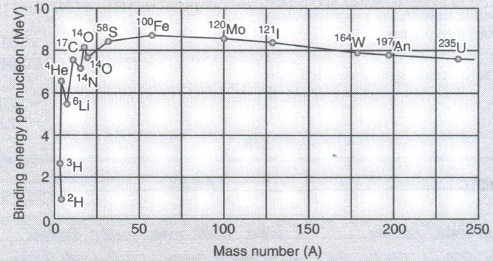
The above curve shows that
(i) when a heavy nucleus breaks into two medium sized nuclei(in nuclear fission)the BE/nucleon increases resulting in the release of energy
(ii) When two small nuclei combine to form relatively bigger nuclear fusion BE/nucleon increases ,resulting in the release of energy.
12.
Einstein's photoelectric equation,
K.E. of photoelectron = Incident energy of photons - Work function
or K.E = hv - W0
or K.E = hv - hv0
where v0 is called threshold frequency
Threshold Frequency : For a given metal, there exists a certain minimum frequency of the incident radiation below which no emission of photoelectrons takes place. This frequency is called threshold frequency.
13.
\(N=\frac { { N }_{ 0 } }{ { 16 }^{ ' } } \)
Where 30 years
\(N={ N }_{ 0 }\left( \frac { 1 }{ 2 } \right) ^{ n }\)
\(\frac { N }{ { N }_{ 0 } } =\left( \frac { 1 }{ 2 } \right) ^{ 4 }\)
No.of half lives = 4
\(4=\frac { Time \ of \ disintegration }{ half \ life \ period } \)
\(\Rightarrow \frac { 30 \ years }{ 4 } =half \ life \ period\)
Half-life period = 7.5 years
14.
Given, Kinetic energy = KE = 120 eV
p=\(\sqrt { 2eVm } =\sqrt {2KE.m }\) \([\because K E=e V]\)
\(P=\sqrt { 2\times 120\times 1.6\times 10^{ -19 }\times 9.1\times 10^{ -31 } } \)
\(=5.91\times 10^{ -24 }\ kg-m/s\)
(ii) We know that momentum, p = mv
or, \(v=\frac{p}{m}=\frac{5.91 \times 10^{-24}}{9.1 \times 10^{-31}}\)
\(=6.5 \times 10^{6} \mathrm{~m} / \mathrm{s}\)
(iii) de-Broglie wavelength associated with electron,
\(\lambda =\frac { 12.27 }{ \sqrt { V_{ } } } \mathring { A } =\frac { 12.27 }{ \sqrt { 120 } } \mathring { A=0.112\times 10^{ -9 } } \ m=0.112 \ nm\)
15.
Give, power = 1 W, Zener breakdown, VZ = 5 V
Minimum voltage, Vmin = 3 V
Maximum voltage, Vmax = 7 V
Current, \({ I }_{ Zmax }=\frac { P }{ { V }_{ Z } } =\frac { 1 }{ 5 } =0.2A\)
The values of RS for safe operation,
\({ R }_{ S }=\frac { { V }_{ max }-{ V }_{ Z } }{ { I }_{ Zmax } } =\frac { 7-5 }{ 0.2 } =\frac { 2 }{ 0.2 } =10\Omega\)
16.
Metal A has higher value of work function because the slopes of both materials are constant and the intercept of the line depends on the work function.
17.
Nuclear forces are the strongest forces in nature.They are effective only inside the nucleus.
18.
Balmer series lies in the visible region.
19.
For the emission of photoelectrons from the cesium metal, the minimum energy of the incident light on the metal surface should have the photon of energy 2eV.
20.
The work function of a metal is the minimum energy required by an electron to just escape from the metal surface so as to overcome the restraining forces at the surface.
The relation between work function \(\left(\phi_0\right)\) and threshold frequency \(\left(v_0\right) \text { is } \phi_0=h v_0\) where h is Plank's constant.
21.
()
electrons,holes
22.
()
the wave nature of slow moving electrons
23.
Let a sample of radioactive material have N0 nuclei, at t = 0
At time t, Number of nuclei = N
As per the decay law
\(-\frac{dN}{dt}=\lambda N\)
\(\Rightarrow \ \int _{ { N }_{ 0 } }^{ N }{ \frac { dN }{ N } } =\int _{ 0 }^{ t }{ -\lambda } dt\)
\(\Rightarrow \ { \left( \log _{ e }{ N } \right) }_{ { N }_{ 0 } }^{ N }=-\left( { t }_{ 0 } \right) { t }^{ 1/2 }\)
\(\frac{N}{N_0}=e^-\lambda^ t\)
\(\Rightarrow \ \ N={ N }_{ 0 }{ e }^{ -\lambda t }\)
After one half life, Number of nuclei becomes \(\frac{N_0}{2}\)
\(\Rightarrow \ \frac { N_{ 0 } }{ 2 } =N_{ 0 }e^{ - }\lambda ^{ T }1/2\)
\(\Rightarrow\) 2 = \(e^\lambda \)T1/2
\(\Rightarrow\) loge 2 = \({ \lambda T }_{ \frac { 1 }{ 2 } }\)
\(\Rightarrow\) \({ \lambda T }_{ \frac { 1 }{ 2 } }\) = 0.6931
\(\Rightarrow\) \({ T }_{ \frac { 1 }{ 2 } }\) = \(\frac{0.6931}{\lambda}\)
24.
(a) Photo diode is fabricated with a transparent window to allow light to fall on the diode.
(b) (i) Working: When reverse biased photo diode is illuminated with light of energy greater than the forbidden energy gap (Eg), electron hole pair are generated in, or near, the depletion region. Due to junction field, electrons are collected on the n-side and holes on p-side, giving rise to a potential difference.
25.
.png)
(a) metals, (b) insulators and (c) semiconductors
Two distinguishing features:
(i) In conductors, the valence band and conduction band tend to overlap (or nearly overlap) while in insulators they are separated by a large energy gap and in semiconductors they are separated by a smaJ1'ep.ergygap.
(ii) The conduction band, of a conductor, has a large number of electrons available for electrical conduction. However the conduction band of insulators is almost empty while that of the semiconductor has only a (very) small number of such electrons available for electrical conduction.
.png)
26.
(i) Heavy doping makes the depletion region very thin. This makes the electric field of the junction.
(ii) When operated under reverse bias, the photodiode can detect changes in current with changes in light intensity more easily.
(iii) The photon energy, of visible light photons varies from about 1.8 eV. Hence for visible LED's, the semiconductor must have a band gap of 1.8 eV.
27.
(i) Three experimentally observed features in the phenomenon of photoelectric effect are as follows:
(a) Intensity When intensity of incident light increase as one [hoton ejects one electron, the increase in intensity will increase the number of ejected electrons. Frequency has no number of photoelectrons.
(b) Frequency When the frequency of incident photon increase, the knietic energy of the emitted electrons increase. Intensity has no effect on kinetic energy of photoelectron.
(c) No time lag When energy of incident photon is greater than the work function, the photoelectron is immediately ejected. Thus, there is no tile lag between the incident oflight and emission of photoelectron.
(ii) These features cannot be explained by the wave theory of light because wave nature of radition cannot explain the following:
(a) The instataneous ejection of photoelectrons.
(b) The existance of threshold frequency for a metal surface.
(c) The fact that kinetic energy of the emitted electrons is independent of the intensity of light and depends upon its frequency.
28.
Here V0 = 0.60V
\(\phi _{ 0 }=2.14\quad eV=2.14\times 1.6\times { 10 }^{ -19 }J\)
(i) Threshold frequency, \(V_{ 0 }=\frac { \phi _{ 0 } }{ h } \ [\because \ \phi _{ 0 }=hV_{ 0 }]\)]
\(=\frac { 2.14\times 1.6\times { 10 }^{ -19 } }{ 6.63\times { 10 }^{ -34 } } \)
\(=5.16\times 10^{ 14 } \ Hz\)
(ii) \(eV_{ 0 }=\frac { hc }{ \lambda } -\phi _{ 0 } \ or \ \lambda =\frac { hc }{ (eV_{ 0 }+\phi _{ 0 }) } \)
\(=\frac { 6.63\times 10^{ -34 }\times 3\times 10^{ 8 } }{ (1.6\times { 10 }^{ -19 }\times 0.60+2.14\times 1.6\times 10^{ -19 }) }\)
\( \approx 454\times { 10 }^{ -9 } \ m\)
\( =454 \ nm\)
29.
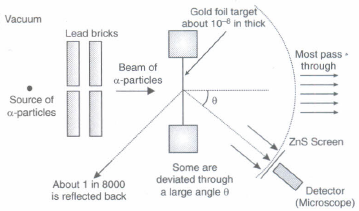
It gives an estimate of the size of nucleus.
(ii) K.E of the ∝-particle = potential energy Possessed by beam at distance of closest approach.
\(\frac { 1 }{ 2 } { mv }^{ 2 }=\frac { 1 }{ 4\pi { \varepsilon }_{ 0 } } .\frac { (2e)(Ze) }{ { r }_{ 0 } } \)
7.7 x 1.6 x 10-3 = \(\frac { 9\times { 10 }^{ 9 }\times 2\times 2.56\times { 10 }^{ -38 } }{ { r }_{ 0 } } \)
r0 = \(\frac { 9\times { 10 }^{ 9 }\times 2\times 2.56\times { 10 }^{ -38 } }{ 7.7\times 1.6\times { 10 }^{ -13 } } m\)
= 299 x 10-16 m
30.
(a) (i) Electron moving in a circular orbit around the nucleus would get accelerated, therefore it would spiral into the nucleus, as it looses its energy.
(ii) It must emit a continuous spectrum. According to Bohr's model of hydrogen atom
(i) Electron in an atom can revolve in certain stable orbits without the emission of radiant energy
31.
(a) Definition
(i) Half life: Time taken by a radioactive nuclei to reduce to half of the initial number of radio nuclei.
(ii)Average life: Ratio of total life time of all radioactive nuclei to the total number of nuclei in the sample.
Relation between half life and decay constant:
\({ T }_{ 1/2 }=\frac { 0.693 }{ \lambda } \)
Relation between average life and decay constant
\(\tau =\frac { 1 }{ \lambda } \)
(b) \(N={ N }_{ 0 }{ e }^{ -\lambda t }\)
\(\frac { 3 }{ 4 } { N }_{ 0 }={ N }_{ 0 }{ e }^{ -(0.3465)^{ t }\quad }\) = (\(\because N\)75% of N0)
\(N=\frac { 3 }{ 4 } { N }_{ 0 }\)
\({ e }^{ (0.3465)t }=\frac { 4 }{ 3 } \)
\(0.3465\times t={ log }_{ e }(4/3)\)
\(=2.303[log4-log3]\)
\(=2.303[0.6020-0.4771]\)
\( =2.303\times 0.1249\)
\( t=\frac { 2.303\times 0.1249 }{ 0.3465 } \)
\( \therefore \ t=0.83days\ or\ 19.92\ hours\)

12th Standard CBSE Syllabus & Materials
12th Standard CBSE
CBSE 12th Computer Science Python Revision Tour I - New Previous year Question Papers Study Material - QB365 Set A
NEW12th Standard CBSE
CBSE 12th Business Studies Planning Important Questions And Answers Study Material - QB365 Set A
NEW12th Standard CBSE
CBSE 12th Business Studies Business Environment Important Questions And Answers Study Material - QB365 Set A
NEW12th Standard CBSE
CBSE 12th Business Studies Principles of Management Important Questions And Answers Study Material - QB365 Set A



NCERT Books

Syllabus

Exam Pattern

Sample Question Papers

Previous year Question Papers

Important Notes

MCQ Practice test

NCERT Exemplers

Case study Questions

Image Based Questions

Passage based Questions

HOT Questions

Value Based Questions

Model Questions Papers
NCERT ( Book Back ) Questions

Assertion and Reason
Important Questions And Answers

CBSE 12th Standard CBSE Subjects
CBSE Standards








