
 100% FREE ACCESS
12th Standard CBSE Syllabus & Materials
12th Standard CBSE
CBSE 12th Economics Government Budget and the Economy Previous year Question Papers Study Material - QB365 Set A
NEW12th Standard CBSE
CBSE 12th Computer Science Interface Python with MySQL - New Previous year Question Papers Study Material - QB365 Set A
NEW12th Standard CBSE
CBSE 12th Computer Science Database Concept - New Previous year Question Papers Study Material - QB365 Set A
NEW12th Standard CBSE
CBSE 12th Computer Science Data Communication - New Previous year Question Papers Study Material - QB365 Set A
NEW12th Standard CBSE
CBSE 12th Computer Science Data Structures - New Previous year Question Papers Study Material - QB365 Set A
NEW12th Standard CBSE
CBSE 12th Computer Science Functions - New Previous year Question Papers Study Material - QB365 Set A

Published on: 02/11/2025
Download CBSE Class 12th Standard CBSE Physics question papers, sample papers, important questions, and previous year solved papers in PDF format. Get free study materials, NCERT solutions, and exam preparation resources for Class 12th Standard CBSE Physics
Questions + Answers key
Take MCQ Physics Test
1.
Calculate the speed and wavelength of light (i) in glass (ii) in air, when light waves of frequency \(6\times { 10 }^{ 14 }Hz\) travel from air to glass of \(\mu =1.5\)
2.
The distance of distinct vision of a person is 50cm.He wants to read a book placed at 25cm.What should be the focal length of the spectacles?
3.
In a Young's double slit experiment, interference fringes were produced on a screen placed at 1.5m from the two slits 0.3mm apart and illuminated by light of \(6400\mathring { A } \) Find the fringe width.
4.
Define the term:
(a) (i)Work function
(ii) threshold frequency and
(iii) stopping potential with reference to photoelectric effect
(b) Calculate the maximum kinetic energy of electrons emitted from a photosensitive surface of work function 3.2 eV for the incident radiation of wavelength 300 nm.
5.
How does the refractive index of a transparent medium depend on the wavelength of incident light used? Velocity of light in glass is 2 x 10⁸ m/s and in air is 3 x 10⁸m/s. If the ray of light passes from glass to air, calculate the value of critical angle.
6.
Figure shows a ray of light passing through a prism. If the refracted ray QR is parallel to the base BC, show that (i) r1 = r2 = A/2, (ii) angle of minimum deviation, D or Dm = 2i -A.
.jpg)
7.
When monochromatic light travels from a rarer to a denser medium, explain the following, giving reasons.
(i) Is the frequency of reflected and refracted light same as the frequency of incident light?
(ii) Does the decrease in speed imply a reduction in the energy carried light wave?
8.
An equiconvex lens of focal length 15 cm is cut into two equal halves in thickness.What is the focal length of each half?
9.
Why is a photo-electric cell also called an electric eye?
10.
If an electron behaves like a wave, what should determine the wavelength and frequency of this wave?
11.
(a) The refractive index of glass is 1.5. What is the speed of light in glass?
(b) Is the speed of light in glass independent of the color of light? If not, which of the two colors, red and violet travels slower in a glass prism?
12.
The wavelength \(\lambda \) of a photon and the de-Broglie wavelength o an electron have the same value. Show that the energy of the photon is \(\frac { 2\lambda mc }{ h } \) times the kinetic energy of the electron, where m, c and h have their usual meanings.
13.
The rest mass of a photon of wavelength λ is
zero
\(\frac{h}{c \lambda}\)
\(\frac{h}{ \lambda}\)
\(\frac{hc}{ \lambda}\)
14.
According to Huygens' principle, light is a form of
particle
rays
wave
radiation
15.
Variation of photoelectric current with intensity of light is
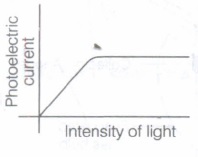
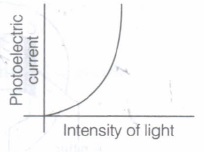
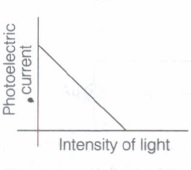
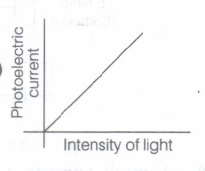
16.
A telescope uses an objective lens of focal length \(f_{ 0 }\) and an eye lens of focal length \(f_{ e }\). In normal adjustment, distance between the two lenses is
\(f_{ o }/f_{ e }\)
\(f_{ e }/f_{ o }\)
\((f_{ o }-f_{ e })\)
\((f_{ o }+f_{ e })\)
17.
Distance between two successive bright or dark fringes is called fringe width.
\(\beta=Y_{n+1}-Y_{n}=\frac{(n+1) \lambda D}{d}-\frac{n \lambda D}{d}=\frac{\lambda D}{d}\)
Fringe width is independent of the order of the maxima. If whole apparatus is immersed in liquid of refractive index \(\mu\) then \(\beta=\frac{\lambda D}{\mu d}\) (fringe width decreases). Angular fringe width (\(\theta\)) is the angular separation between two consecutive maxima or minima \(\theta=\frac{\beta}{D}=\frac{\lambda}{d}\)
In the arrangement shown in figure, slit S3 and S4 are having a variable separation Z. Point 0 on the screen is at the common perpendicular bisector of S1S2 and S3S4.
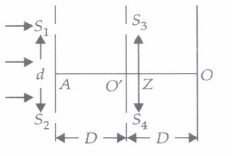
(i) The maximum number of possible interference maxima for slit separation equal to twice the wavelength in Young's double-slit experiment, is
| (a) infinite | (b) five | (c) three | (d) zero |
(ii) In Young's double - slit experiment if yellow light is replaced by blue light, the interference fringes become
| (a) wider | (b) brighter | (c) narrower | (d) darker |
(iii) In Young's double slit experiment, if the separation between the slits is halved and the distance between the slits and the screen is doubled, then the fringe width compared to the unchanged one will be
| (a) Unchanged | (b) Halved | (c) Doubled | (d) Quadrupled |
(iv) When the complete Young's double slit experiment is immersed in water, the fringes
| (a) remain unaltered | (b) become wider | (c) become narrower | (d) disappear |
(v) In a two slit experiment with white light, a white fringe is observed on a screen kept behind the slits. When the screen is moved away by 0.05 m, this white fringe
| (a) does not move at all | (b) gets displaced from its earlier position |
| (c) becomes coloured | (d) disappears |
18.
When light of sufficiently high frequency is incident on a metallic surface, electrons are emitted from the metallic surface. This phenomenon is called photoelectric emission. Kinetic energy of the emitted photoelectrons depends on the wavelength of incident light and is independent of the intensity of light. Number of emitted photoelectrons depends on intensity. (hv - \(\phi\) is the maximum kinetic energy of emitted photoelectrons (where \(\phi\) is the work function of metallic surface). Reverse effect of photo emission produces X-ray. X-ray is not deflected by electric and magnetic fields. Wavelength of a continuous X-ray depends on potential difference across the tube. Wavelength of characteristic X-ray depends on the atomic number.
(i) Einstein's photoelectric equation is
| \(\text { (a) } E_{\max }=h v-\phi\) | \(\text { (b) } E=m c^{2}\) | \(\text { (c) } E^{2}=p^{2} c^{2}+m_{0}^{2} c^{4}\) | \(\text { (d) } E=\frac{1}{2} m v^{2}\) |
(ii) Light of wavelength \(\lambda\) which is less than threshold wavelength is incident on a photosensitive material. If incident wavelength is decreased so that emitted photoelectrons are moving with some velocity then stopping potential will
| (a) increase | (b) decrease | (c) be zero | (d) become exactly half |
(iii) When ultraviolet rays incident on metal plate then photoelectric effect does not occur, it occur by incident of
| (a) Infrared rays | (b) X-rays | (c) Radio wave | (d) Micro wave |
(iv) If frequency (v > v0) of incident light becomes n times the initial frequency (v), then K.E. of the emitted photoelectrons becomes (v0 threshold frequency).
| (a) n times of the initial kinetic energy |
| (b) More than n times of the initial kinetic energy |
| (c) Less than n times of the initial kinetic energy |
| (d) Kinetic energy of the emitted photoelectrons remains unchanged |
(v) A monochromatic light is used in a photoelectric experiment. The stopping potential
| (a) Is related to the mean wavelength | (b) Is related to the shortest wavelength |
| (c) Is not related to the minimum kinetic energy of emitted photoelectrons | (d) Intensity of incident light |
19.
20.
Assertion (A) : Light added to light can produce darkness.
Reason (R) : The destructive interference of two coherent light sources may give dark fringe
Codes:
(a) Both A and R are true and R is the correct explanation of A
(b) Both A and R are true but R is NOT the correct explanation of A
(c) A is true but R is false
(d) A is false and R is also false
1.
Here, \(v=6\times { 10 }^{ 14 }Hz.\mu =1.5\)
(i) In glass,
speed of light,
\({ v }_{ g }=\frac { { v }_{ a } }{ \mu } =\frac { 3\times { 10 }^{ 8 } }{ 1.5 } =2\times { 10 }^{ 8 }m/s\)
wavelength of light,
\({ \lambda }_{ g }=\frac { { v }_{ g } }{ v } =\frac { 2\times { 10 }^{ 8 } }{ 6\times { 10 }^{ 14 } } =3.3\times { 10 }^{ -7 }m\)
(ii) In air
speed of light,
\({ v }_{ a }=c=3\times { 10 }^{ 8 }m/s\)
Wavelength of light,
\({ \lambda }_{ a }=\frac { { v }_{ a } }{ v } =\frac { 3\times { 10 }^{ 8 } }{ 6\times { 10 }^{ 14 } } =5\times { 10 }^{ -7 }m\)
2.
Here, u = -25cm, v = -50cm,
As \({1\over f}={1\over v}-{1\over u}={1\over-50}+{1\over25}={1\over 50}\)
f = +50cm
3.
Conditions for constructive interference is that the path difference between two rays must be \(=n\lambda \) Where n is a whole number
\(HereD=1.5;d=0.3mm=0.3\times{ 10 }^{ -3 }m\)
\( =3\times{ 10 }^{ -4 }m\)
\( \lambda =6,400\mathring { A } =6.4\times{ 10 }^{ -7 }m;\beta =?\)
\( \beta =\frac { \lambda D }{ d } =\frac { 6.4\times{ 10 }^{ -7 }\times1.5 }{ 3\times{ 10 }^{ -4 } } \)
\( \beta =3.2\times{ 10 }^{ -3 }m \ or \ 3.2 \ mm.\)
4.
0.9 eV
5.
According to the mirror equation, we have
\(\frac { 1 }{ V } +\frac { 1 }{ u } =\frac { 1 }{ f } \)
where, u = distance of the object from the mirror
v = distance of the image from the mirror
f = focal length of the mirror
From the mirror equation, we have
\(V=\frac { uf }{ u-1 } \) ...(1)
Applying new Cartesian sign convention, we get
f = -ve and u = -ve
Given, f < u « 2f
\(\Rightarrow v=-ve\) [from Eq(1)]
Magnification is given by
\(m=-\left( \frac { -v }{ -u } \right) =-ve\)
Hence, the image formed is real
.From the mirror formula, when u = - 2f.
\(\Rightarrow \frac { 1 }{ -2f } +\frac { 1 }{ v } =\frac { 1 }{ -f } \)
Therefore, when the object is at f, then image is formed at infinity.
6.
(i) From given figure, A = r1 + r2
As ray QR is parallel to the base BC, then
Therefore, 2r1(or 2r2) = A(ii) D = x + y, r1 = r2 = A/2
D = (i - r1) + (e - r2)
D = (i + e) - (r1 + r2)
D = 2i - A
7.
(i) The frequency of reflected and refracted light remains same as that of incident light because frequency only depends on the source of light.
(ii) Since the frequency remains same, hence there is no reduction in energy.
8.
\(From\frac { 1 }{ f } =(u-1)\left( \frac { 1 }{ { R }_{ 1 } } -\frac { 1 }{ { R }_{ 2 } } \right) ,\)
\(\\ taking \ { R }_{ 1 }=R \ and \ { R }_{ 2 }=-R\)
\( \frac { 1 }{ 15 } =(\mu -1)\left( \frac { 1 }{ R } +\frac { 1 }{ R } \right) =\frac { 2 }{ R } (u-1)\)
For each half(plano-convex) lens
\({ R }_{ 1 }=R,{ R }_{ 2 }=\infty\)
\( \therefore \frac { 1 }{ { f }^{ ' } } =(u-1)\left( \frac { 1 }{ R } -\frac { 1 }{ \infty } \right) =\frac { \mu -1 }{ R } =\frac { 1 }{ 30 }\)
\(\therefore \ { f }^{ ' }=30 \ cm\)
9.
A photoelectric cell is called an electric eye as the photoelectric current set up in the photoelectric cell corresponding to incident light provides the information about the objects as has been seen by our eye in the presence of light.
10.
Momentum and Energy.
11.
(a) Refractive index of glass, μ = 1.5
Speed of light, c = 3 x 10⁸ m/s
Speed of light in glass is given by the relation
\(v=\frac{c}{\mu}\)
\(=\frac{3 \times 10^{8}}{1.5}=2 \times 10^{8} \mathrm{~m} / \mathrm{s}\)
Hence, the speed of light in glass is 2 x 10⁸ m/s.
(b) The speed of light in glass is not independent of the colour of light
The refractive index of a violet component of white light is greater than the refractive index of a red component. Hence, the speed of violet light is less than the speed of red light in glass. Hence, violet light travels slower than red light in a glass prism.
12.
K.E. of electron,
\(K=\frac { 1 }{ 2 } { mv }^{ 2 }=\frac { 1 }{ 2 } \frac { { m }^{ 2 }{ v }^{ 2 } }{ m } =\frac { 1 }{ 2 } \frac { { h }^{ 2 } }{ m{ \lambda }^{ 2 } } \left[ \therefore \lambda =\frac { h }{ mv } \right] \)
Energy of a photon, \(E=\frac { hc }{ \lambda } \)
\(\therefore \frac { E }{ K } =\frac { hc/\lambda }{ \frac { 1 }{ 2 } \frac { { h }^{ 2 } }{ { m\lambda }^{ 2 } } } =\frac { 2\lambda mc }{ h }\)
\( \\ or \ E=\frac { 2\lambda mc }{ h } K=\frac { 2\lambda mc }{ h } \times K.E.of \ electron\)
13.
(a)
zero
14.
(c)
wave
15.
(d)
16.
(d)
\((f_{ o }+f_{ e })\)
17.
(i) (b): The condition for possible interference maxima on the screen is, dsin\(\theta\) = nA
where d is slit separation and Ais the wavelength.
As d = 2\(\lambda\) (given) \(\therefore\) 2\(\lambda\)sin\(\theta\)= n\(\lambda\) or 2sin\(\theta\) = n
For number of interference maxima to be maximum,
sin\(\theta\) = 1 \(\therefore\) n = 2
The intprference maxima will be forgied when
n = 0, ± 1, ± 2
Hence the maximum number of possible maxima is 5.
(ii) (c): Fringe width, \(\beta=\frac{\lambda D}{d}\)
\(\therefore\) If we replace yellow light with blue light, i.e., longer wavelength with shorter one, therefore the fringe width decreases.
(iii) (d): \(d^{\prime}=\frac{d}{2} \text { and } D^{\prime}=2 D\)
Fringe width, \(\beta=\frac{\lambda D}{d}\)
New fringe width \(\beta^{\prime}=\lambda\left(\frac{2 D}{d / 2}\right)=4 \beta\)
(iv) (c): When Young's double slit experiment is repeated in water, instead of air \(\lambda^{\prime}=\frac{\lambda}{\mu}\) i.e., wavelength decreases.\(\beta=\frac{\lambda^{\prime} D}{d}\) i.e..,fringe width decreases.
\(\therefore\) The fringe become narrower.
(v) (a): Using white light, we get white fringe at the centre i.e., white fringe is the central maximum. When the screen is moved, its position is not changed.
18.
(i) (a)
(ii) (a): According to Einstein's photoelectric equation,
\(e V_{0}=\frac{h c}{\lambda}-\frac{h c}{\lambda_{0}}\)
As \(\lambda\)0 is constant, so when \(\lambda\). is decreased, stopping potential (V0) increases.
(iii) (b): It indicates that threshold frequency is greater than that of ultraviolet light. As X-rays have greater frequency than ultraviolet rays, so they can cause photoelectric effect.
(iv) (b): \(\mathrm{K.E}_{\cdot 1}=h \mathrm{v}-\phi\)
\({K.E}_{\cdot 2}=n h v-\phi=n(h v-\phi)+(n-1) \phi\)
\({K.E.} 2=n \mathrm{KE}_{1}+(n-1) \phi \)
\(\text { K.E. }_{2}>n \mathrm{KE}_{1}\)
(v) (b): Stopping potential is the measurement of maximum kinetic energy of emitted photoelectrons and kinetic energy of emitted photoelectrons is linearly related with the frequency of incident light corresponding (i.e., corresponding to shortest wavelength, KE. is maximum). Stopping potential is independent of intensity.
19.
20.
(a): When light waves from two coherent sources superimpose at any particular point, crest of one wave falls on trough of the other and trough falls on the crest, the amplitude of the resultant wave is zero. Hence resultant intensity is zero. This is the phenomenon of destructive interference. Thus destructive interference produces darkness.

12th Standard CBSE Syllabus & Materials
12th Standard CBSE
CBSE 12th Computer Science Python Revision Tour I - New Previous year Question Papers Study Material - QB365 Set A
NEW12th Standard CBSE
CBSE 12th Business Studies Planning Important Questions And Answers Study Material - QB365 Set A
NEW12th Standard CBSE
CBSE 12th Business Studies Business Environment Important Questions And Answers Study Material - QB365 Set A
NEW12th Standard CBSE
CBSE 12th Business Studies Principles of Management Important Questions And Answers Study Material - QB365 Set A



NCERT Books

Syllabus

Exam Pattern

Sample Question Papers

Previous year Question Papers

Important Notes

MCQ Practice test

NCERT Exemplers

Case study Questions

Image Based Questions

Passage based Questions

HOT Questions

Value Based Questions

Model Questions Papers
NCERT ( Book Back ) Questions

Assertion and Reason
Important Questions And Answers

CBSE 12th Standard CBSE Subjects
CBSE Standards








