
 100% FREE ACCESS
12th Standard CBSE Syllabus & Materials
12th Standard CBSE
CBSE 12th Economics Government Budget and the Economy Previous year Question Papers Study Material - QB365 Set A
NEW12th Standard CBSE
CBSE 12th Computer Science Interface Python with MySQL - New Previous year Question Papers Study Material - QB365 Set A
NEW12th Standard CBSE
CBSE 12th Computer Science Database Concept - New Previous year Question Papers Study Material - QB365 Set A
NEW12th Standard CBSE
CBSE 12th Computer Science Data Communication - New Previous year Question Papers Study Material - QB365 Set A
NEW12th Standard CBSE
CBSE 12th Computer Science Data Structures - New Previous year Question Papers Study Material - QB365 Set A
NEW12th Standard CBSE
CBSE 12th Computer Science Functions - New Previous year Question Papers Study Material - QB365 Set A

Published on: 02/11/2025
Download CBSE Class 12th Standard CBSE Physics question papers, sample papers, important questions, and previous year solved papers in PDF format. Get free study materials, NCERT solutions, and exam preparation resources for Class 12th Standard CBSE Physics
Questions + Answers key
Take MCQ Physics Test
1.
Define the resolving power of a telescope. Write any two advantages of a reflecting telescope over a refracting telescope.
2.
Draw a ray diagram of a reflecting type telescope. State two advantages of this telescope over a refracting telescope.
3.
Two thin lenses of power +5D and -2.5D are in contact What is the focal length of the combination?
4.
Name the phenomenon which proves transerve wave nature of light.Gives two uses of the devices whose functioning is based on this phenomenon.
5.
Name the phenomenon which is responsible for bending of light around sharp corner of an obstacle. Under what conditions does this phenomenon take place? Give one application of this phenomenon in everyday life.
6.
How would the angular separation of interference fringes in Young's double slit experiment change when the distance of separation between slits and screen is doubled?
7.
What type of wavefront will emerge from
(i) a point source and
(ii) distant light source?
8.
what is a wavefront?
9.
Two concave lenses each of focal length 30 cm are placed in contact. What is focal length of the compound lens?
10.
Define a wavefront. Use Huygens' geometrical construction to show the propagation of plane wavefront from a rarer medium
(1) to a denser medium
(2) undergoing refraction, hence derive Snell's law of refraction.
11.
What is an unpolarized light? Explain with the help of suitable ray diagram how an unpolarized light can be polarized by reflection from a transparent medium. Write the expression for Brewster angle in terms of the refractive index of denser medium.
12.
Find the position of the image formed of the object O by the lens combination given in the figure.

13.
Light of wavelength 600 nm is incident normally on a slit of width 3 mm. Calculate linear width of central maximum on a screen kept 3 m away from the slit.
14.
The radius of curvature of the faces of double convex lens are 10 cm and 15 cm. If focal length of lens is 12 cm, find the refractive index of the material of the lens.
15.
Reflecting telescope consists of
convex mirror of large,aperture
concave mirror of large aperture
concave lens of small aperture
None of the above
16.
Dispersive power depends upon
the angle of prism
material of prism
deviation produced by prism
height of the prism
17.
A biconvex lens has a focal length f. It is cut into two parts along a line perpendicular to principal axis. The focal length of each part will be
f/2
f
(3/2)f
2f
18.
The critical angle of a prism is 30°. The velocity of light in the medium is
1.5 x 10⁸ m/s
3 x 10⁸ m/s
4.5 x 10⁸ m/s
None of these
19.
Which of the following is not due to total internal reflection?
Difference between apparent and real depth of a pond
Mirage on hot summer days
Brilliance of diamond
Working of optical fibre
20.
The final image in an astronomical telescope (w.r.t. object) is
virtual and erect
real and erect
real and inverted
virtual and inverted
21.
The correct formula for magnifying power of a simple microscope is
\(m=\left( 1+\frac { f }{ d } \right) \)
\(m=\left( 1-\frac { d }{ f } \right) \)
\(m=\left( 1+\frac { d }{ f } \right) \)
\(m=\left( 1-\frac { f }{ d } \right) \)
22.
The relation governing refraction of light from rarer to denser medium at a spherical refracting surface is
\(-\frac { \mu _{ 1 } }{ u } +\frac { \mu _{ 2 } }{ \upsilon } =\frac { \mu _{ 2 }-\mu _{ 1 } }{ R } \)
\(\frac { \mu _{ 1 } }{ u } +\frac { \mu _{ 2 } }{ \upsilon } =\frac { \mu _{ 2 }-\mu _{ 1 } }{ R } \)
\(\frac { \mu _{ 1 } }{ u } -\frac { \mu _{ 2 } }{ \upsilon } =\frac { \mu _{ 2 }-\mu _{ 1 } }{ R } \)
none of these
23.
For total internal reflection, light must travel
from rarer to denser medium
from denser to rarer medium
in air only
in water only
24.
Polarizing angle for a medium is \(60°\) . Its refractive index is
1.732
1
1.414
2
25.
(a) Draw a ray diagram showing the image formation by a compound microscope. Obtain expression for total magnification when the image is formed at infinity.
(b) How does the resolving power of a compound microscope get affected, when
(i) focal length of the objective is decreased.
(ii) the wavelength of light is increased? Give reasons to justify your answer.
26.
(a) In Young's double slit experiment, describe briefly how bright and dark fringes are obtained
on the screen kept in front of a double slit. Hence obtain the expression for the fringe width.
(b) The ratio of the intensities at minima to the maxima in the Young's double slit experiment is 9 : 25. Find the ratio of the width of the slits
27.
(a) Obtain Lens Maker's formula using the expression
\(\frac { { n }_{ 2 } }{ v } -\frac { { n }_{ 1 } }{ u } =\frac { \left( { n }_{ 2 }-{ n }_{ 1 } \right) }{ R } \)
Here the ray of light propagating from a rarer medium of refractive index (n1) to a denser medium of refractive index (n2) is incident on the convex side of spherical refracting surface of radius of curvature R.
(b) Draw a ray diagram t show the image formation by a concave mirror when the object is kept between its focus and the pole. Using this diagram, derive the magnification formula for the image formed.
1.
Resolving power of a microscope is defined as the reciprocal of its limit of resolution (d) i.e.
RP of microscope = 1/d
where, limit of resolution is equal to the smallest distance between two closest objects whose vivid or clean image can be seen through the
microscope and given by d = \(\frac { \lambda }{ 2\mu sin\theta } \)
Resolving power of microscope = \(\frac { 2\mu sin\theta }{ \lambda } \)
where, \(\lambda \) = wavelength of light used,
\(\theta =\) semivertical angle of the cone formed by object
at objective and \(\mu \) = refractive index of molecule between object and lens.
(a) Resolving power increases with the increase of \(\mu \)
(b) Resolving power decreases as resolving power \(\propto 1/\lambda \)
2.
Ray diagram of a reflecting type telescope
Advantages :
(i) Reflecting telescopes have high resolving power due to a large aperture of mirrors.
(ii) Due to availability of paraboloidal mirror, the image is free from chromatic and spherical aberration.
3.
f = 40 cm
4.
Polarization.
Two Uses:
Polaroids can be used in sunglasses, window panes, photographic cameras, 3D movie cameras
5.
Direction; Condition: Size of the obstacle sharpness should be comparable to the wavelength of the light falling.
Application: the finite resolution of our eye.
6.
Angular separation, \(\theta={\beta\over D}={\lambda\over d}\)
It does not depend upon D, the distance of separation between slits and screen. Therefore, \(\theta\) remains unaffected.
7.
(i) From a point source, the wavefront is diverging spherical wavefront is diverging spherical wavefront.
(ii) From a distant light source, the wavefront is plane wavefront.
8.
A wavefront is the locus of all such particles of the medium, which are vibrating in the same phase.
9.
-15 cm, from 1/f = 1/f1 + 1/f2
10.
Consider any point Q on the incident wavefront.
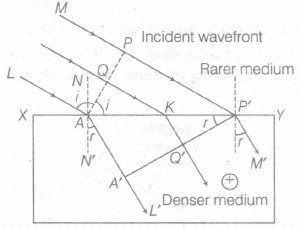
Suppose when disturbance from point P on incident wavefront reaches point P' on the refracted wavefront, the disturbance from point Q reaches point Q' on the refracting surface XY. Since A'Q'P' represents the refracted wavefront. the time taken by light to travel from a point on' incident wavefront to the corresponding point on refracted wavefront should always be the same. Now, time taken by light to go from Q to Q' will be
\(t=\frac { QK }{ c } +\frac { KQ' }{ v } \quad \quad .....(i)\)
(where, c and v are the velocities of light in two mediums)
In right angle \(\triangle AQK,\ \angle QAK=i\)
QK = AK sin i .... (ii)
In right angled \(\triangle P'Q'K, \ \angle Q'P'K=r\)
KQ' = KP' sin r .......(iii)
Substituting Eqs. (ii) and (iii) in Eq. (i), we get
\(t=\frac { AK\sin { i } }{ c } +\frac { KP\sin { r } }{ v } \)
\(t=\frac { AK\sin { i } }{ c } +\frac { (AP'-AK)\sin { r } }{ v } \)
\(or\quad t=\frac { AP' }{ v } \sin { r } +\left( \frac { \sin { i } }{ c } -\frac { \sin { r } }{ v } \right) AK\quad \quad .....(iv)\)
The rays from different points on the incident wavefront will take the same time to reach the corresponding points on the refracted wavefront, i.e., given by Eq. (iv) is independent of AK. It will happen so, if
\(\frac { \sin { i } }{ c } -\frac { \sin { r } }{ v } =0\)
\(\Rightarrow \quad \frac { \sin { i } }{ \sin { r } } =\frac { c }{ v } \)
However, \(\frac { c }{ v } =n\)
This is the Snell's law for refraction of light.
11.
In an unpolarised light, the vibrations of electric field vector are in every plane perpendicular to the direction of propagation of light.
When unpolarised light is incident on the boundary between two transparent media, the reflected light is polarised with its electric vector perpendicular to the plane of incidence when the refracted and reflected rays make a right angle with each other. 1 Brewster angle:
\(\mu =tan{ i }_{ B }\) .
12.
For convex lens of focal length 10 cm,
f =+ 10cm, u = -3 cm
Using lens formula,
\( \frac { 1 }{ f } =\frac { 1 }{ v } -\frac { 1 }{ u }\)
\(\Rightarrow \ \frac { 1 }{ 10 } =\frac { 1 }{ v } -\frac { 1 }{ \left( -30 \right) } \Rightarrow v=15cm\)
The image formed by first lens acts as a virtual object for plano-concave lens.
For plano-concave lens,
\(u=+10cm,\quad f=-10cm,v=?\)
Using lens formula,
\(\frac { 1 }{ f } =\frac { 1 }{ v } -\frac { 1 }{ u } \)
\(\Rightarrow \quad \frac { 1 }{ v } =0\)
\( \Rightarrow \quad v=\infty \)
The refracted ray becomes parallel to principal axis for convex lens of focal length 30 cm.
\(u=-\infty ,v=?,f=30cm\)
\(\frac { 1 }{ f } =\frac { 1 }{ v } -\frac { 1 }{ u } \)
\(\Rightarrow \ \frac { 1 }{ 30 } =\frac { 1 }{ v } -\frac { 1 }{ \left( -\infty \right) } \ \Rightarrow \ v=30cm\)
So, final image is formed at a distance of 30 cm from second convex lens on the other side of u.
13.
\(Here,\ \lambda =600nm=6\times { 10 }^{ -7 }m,\)
\(a=3mm=3\times { 10 }^{ -3 }m\)
\( D=3m;\left( 2x \right) =?\)
\(2x=\frac { 2\lambda D }{ a } =\frac { 2\times 6\times { 10 }^{ -7 }\times 3 }{ 3\times { 10 }^{ -3 } }\)
\(=12\times { 10 }^{ -4 }m=1.2mm\)
14.
Here,\(Here,{ R }_{ 1 }=10cm,{ R }_{ 2 }=-15cm,f=12cm\)
\(\mu =?\)
From lens makers formula
\(\frac { 1 }{ f } =(\mu -1)\left( \frac { 1 }{ { R }_{ 1 } } -\frac { 1 }{ { R }_{ 2 } } \right) \)
\(\frac { 1 }{ 12 } =(\mu -1)\left( \frac { 1 }{ 10 } +\frac { 1 }{ 15 } \right) =(\mu -1)\frac { 1 }{ 6 }\)
\( \\ \mu -1=\frac { 6 }{ 12 } =\frac { 1 }{ 2 } ,\mu =\frac { 1 }{ 2 } +1=\frac { 3 }{ 2 } =1.5\)
15.
(b)
concave mirror of large aperture
16.
(b)
material of prism
17.
(d)
2f
18.
(a)
1.5 x 10⁸ m/s
19.
(a)
Difference between apparent and real depth of a pond
20.
(c)
real and inverted
21.
(c)
\(m=\left( 1+\frac { d }{ f } \right) \)
22.
(a)
\(-\frac { \mu _{ 1 } }{ u } +\frac { \mu _{ 2 } }{ \upsilon } =\frac { \mu _{ 2 }-\mu _{ 1 } }{ R } \)
23.
(b)
from denser to rarer medium
24.
(a)
1.732
25.
(a) The ray diagram, showing image formation by a compound microscope, is given below:
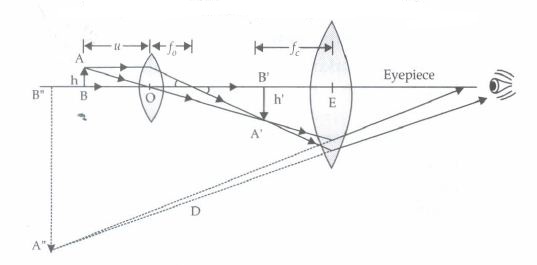
Linear magnification due to the objective = \(=\frac { h^{ ' } }{ h } =\frac { L }{ f_{ 0 } } \)
\(\left( \therefore tan\beta =\frac { h }{ f_{ 0 } } =\frac { h^{ ' } }{ L } \right) \)
Here, L = tube length = distance between the second focal point of the objective and the first focal point of the eyepiece.
When the final image is formed at infinity, the angular magnification due to the eyepiece equals
\(\frac { D }{ f_{ e } } \) (D = least distance of distinct vision)
\(\therefore \) Total magnification when the final image is formed
at infinity = \(\left( \frac { L }{ f_{ 0 } } ,\frac { D }{ f_{ e } } \right) \)
(b) Resolving power increases when the focal length of the objective is decreased.
(i) This is because the minimum separation \(d_{ min }\left( =\frac { 1.22f\lambda }{ D } \right) \) decreases when f is decreased
(ii) Resolving power decreases when the wavelength of light is increased.
This is because the minimum separation, \(d_{ min }\left( =\frac { 1.22f\lambda }{ d } \right) \) increases when \(\lambda \) is increased.
26.
(a) The light rays from the two (coherent) slits, reaching a point 'P' on the screen, have a path
difference (S2P - S1P). The point 'P' would, therefore be a
(i) Point of maxima (bright fringe), If
S2P - S1P = n\(\lambda\) .
(ii) Point of minima (dark fringle), If
S2P- S1P = (2n + 1) \(\lambda\)/2
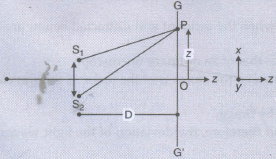
We have (S2P)2- (S1P)2
\(=\left\{D^2-\left(x+{d\over2}\right)^2\right\}-\left\{D^2+\left(x-{d\over2}\right)^2\right\}\)
= 2 xd
\(S_2P-S_1P={2xd\over S_3P+S_1P}={2xd\over 2D}={xd\over D}\)
We have maxima at point, where
\({xd\over D}=n\lambda\)
and minima at points where
\({xd\over D}=\left(2n+1\over 2\right)\lambda\)
Now, fringe width \(\beta\) = separation between two successive maxima (or two successaive minima)
= xn - xn-1
\(\beta={\lambda D\over d}\)
(b) We have \({I_{max}\over {I_{min}}}={(a_1+a_2)^2\over (a_1-a_2)^2}={25\over 9}\)
\(\therefore\ \ {a_1+a_2\over a_1-a_2}={5\over 3}\Rightarrow{a_1\over a_2}={4\over 1}\)
\(\therefore\ {W_1\over W_2}={I_1\over I_2}={(a_1)^2\over (a_2)^2}={16\over 1}\)
27.
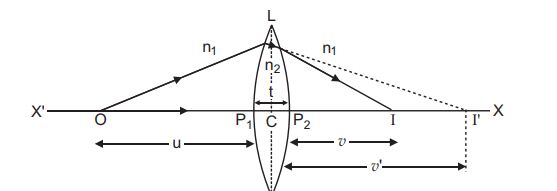
For refraction at the first surface
\(\frac { { n }_{ 2 } }{ { v }_{ 1 } } -\frac { { n }_{ 1 } }{ u } =\frac { { n }_{ 2 }-{ n }_{ 1 } }{ { R }_{ 1 } } \)
For the second surface, I1 acts as a virtual object (located in the denser medium) whose final real image is formed in the rarer medium at I.
so for refraction at this surface, we have
\(\frac { { n }_{ 2 } }{ v } -\frac { { n }_{ 1 } }{ { v }_{ 1 } } =\frac { { n }_{ 2 }-{ n }_{ 1 } }{ { R }_{ 2 } } \)
From the above two equation, \(\frac { 1 }{ v } -\frac { 1 }{ u } =\left( \frac { { n }_{ 2 } }{ { n }_{ 1 } } -1 \right) \left( \frac { 1 }{ { R }_{ 1 } } -\frac { 1 }{ { R }_{ 2 } } \right) \)
The point, where image of an object, located at infinity is formed, is called the focus F, of the lens and the distance f gives its focal length.
So for \(u=\infty ,v=+f\)
\(\Rightarrow\) \(\frac { 1 }{ f } =\left( \frac { { n }_{ 2 } }{ { n }_{ 1 } } -1 \right) \left( \frac { 1 }{ { R }_{ 1 } } -\frac { 1 }{ { R }_{ 2 } } \right) \)
(b)
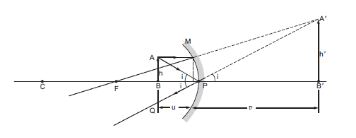
\(\triangle\) ABP is similar to \(\triangle\)A'B'P
So \(\frac { A'B' }{ AB } =\frac { B'P }{ BP } \)
Nor A'B' = I, AB = O, B'P = + v and BP = - u
So magnification \(m=\frac { I }{ O } =-\frac { v }{ u } \)

12th Standard CBSE Syllabus & Materials
12th Standard CBSE
CBSE 12th Computer Science Python Revision Tour I - New Previous year Question Papers Study Material - QB365 Set A
NEW12th Standard CBSE
CBSE 12th Business Studies Planning Important Questions And Answers Study Material - QB365 Set A
NEW12th Standard CBSE
CBSE 12th Business Studies Business Environment Important Questions And Answers Study Material - QB365 Set A
NEW12th Standard CBSE
CBSE 12th Business Studies Principles of Management Important Questions And Answers Study Material - QB365 Set A



NCERT Books

Syllabus

Exam Pattern

Sample Question Papers

Previous year Question Papers

Important Notes

MCQ Practice test

NCERT Exemplers

Case study Questions

Image Based Questions

Passage based Questions

HOT Questions

Value Based Questions

Model Questions Papers
NCERT ( Book Back ) Questions

Assertion and Reason
Important Questions And Answers

CBSE 12th Standard CBSE Subjects
CBSE Standards








