
 100% FREE ACCESS
12th Standard CBSE Syllabus & Materials
12th Standard CBSE
CBSE 12th Economics Government Budget and the Economy Previous year Question Papers Study Material - QB365 Set A
NEW12th Standard CBSE
CBSE 12th Computer Science Interface Python with MySQL - New Previous year Question Papers Study Material - QB365 Set A
NEW12th Standard CBSE
CBSE 12th Computer Science Database Concept - New Previous year Question Papers Study Material - QB365 Set A
NEW12th Standard CBSE
CBSE 12th Computer Science Data Communication - New Previous year Question Papers Study Material - QB365 Set A
NEW12th Standard CBSE
CBSE 12th Computer Science Data Structures - New Previous year Question Papers Study Material - QB365 Set A
NEW12th Standard CBSE
CBSE 12th Computer Science Functions - New Previous year Question Papers Study Material - QB365 Set A

Published on: 02/11/2025
Download CBSE Class 12th Standard CBSE Physics question papers, sample papers, important questions, and previous year solved papers in PDF format. Get free study materials, NCERT solutions, and exam preparation resources for Class 12th Standard CBSE Physics
Questions + Answers key
Take MCQ Physics Test
1.
Two point charges \(+4\mu C\) and \(-6\mu C\) are separated by a distance of 20cm in air. At what point on the line joining the two charges is the electric potential zero?
2.
In Akash's classroom the fan above the teacher was running very slowly. Due to which his teacher was sweating and was restless and tired. All his classmates wanted to rectify this. They called for an electrician who came and changed the capacitor only after which the fan started running fast.
(a) What values did Akash and his classmates have?
(b) What energy is stored in the capacitor and where?
3.
A fully charged parallel plate capacitor is connected across an uncharged identical capacitor. Show that the energy stored in the combination is less than stored initially in the single capacitor.
4.
A rectangular coil of n turns each of area A, carrying current I, when suspended in a uniform magnetic field B, experiences a torque
\(\tau =nI \ BA \ sin\theta \)
Where is \(\theta \) the angle which a normal drawn on the plane of coil makes with the direction of magnetic field. This torque tends to rotate the coil and bring it in an equilibrium position. In the stable equilibrium state, the resultant force on the coil is zero. The torque on the coil is also zero and the coil has minimum potential energy.
Read the above passage and answer the following questions:
(i) In which position, a current carrying coil suspended in uniform magnetic field experiences
(a) minimum torque and
(b) maximum torque?
(ii) a circular coil of 200 turns, radius 5 cm carries a current of 2.0 A. It is suspended vertically in a uniform horizontal magnetic field of 0.20 T, with the plane of the coil making an angle with \(60°\) the field lines. Calculate the magnitude of the torque that must be applied on it to prevent it from turning.
(iii) what is the basic value displayed by the above study?
5.
A series LCR circuit with L = 80mH, C = 50\(\mu\)F and R = 60 ohm is connected to a variable frequency 220V source. Determine
(i) the source frequency which drive the circuit in resonance
(ii) the quality factor Q of the circuit.
6.
It is estimated that the atomic bomb exploded at Hiroshima released a total energy of \(7.6\times { 10 }^{ 13 }\)J. If on the average, 200MeV energy was released per fission, calculate
(i) the number of Uranium atoms fissioned.
(ii) the mass of Uranium used in the bomb.
7.
A TV transmitting antenna is tall. How much service area this transmitting antenna cover, if the receiving antenna is at the ground level? Radius of earth = 6400 km.
8.
A thin prism of refracting angle \(2°\) deviates an incident ray through an angle of \(1°\). Find the value of refractive index of material of prism.
1.
Given: \(q_{1}=4 \mu \mathrm{C}=4 \times 10^{-6} \mathrm{C}\)
\(q_{2}=-6 \mu \mathrm{C}=-6 \times 10^{-6} \mathrm{C}, r=20 \mathrm{~cm}\)
Let the electric potential be zero at a point P, a distance x (in cm) from q1 Then
\(\frac{1}{4 \pi \varepsilon_{0}} \cdot \frac{q_{1}}{x}+\frac{1}{4 \pi \varepsilon_{0}} \frac{q_{2}}{(r-x)}=0\)
\( \therefore \frac{4}{x} =-\frac{(-6)}{(20-x)} \)
\(\Rightarrow 4(20-x=6 x \)
\(x =8 \mathrm{~cm}\)
i.e. 8 cm from 4 μC charge.
2.
(a) Team work, concern, respect to teacher and responsibility.
(b) Electrical energy in the dielectric of the capacitor
3.
Initially, if we consider a charged capacitor, then its charge would be
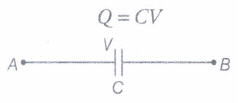
and energy stored is
U1 = \(\frac { 1 }{ 2 } { CV }^{ 2 }\) ...........(i)
Then, this charged capacitor is connected to unchanged capacitor.
Let the common potential be V1. The charge flows from first capacitor to the other capacitor unless both the capacitors attain common potential
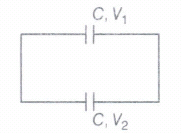
Q1 = CV1 and Q = CV2
Applying conservation of charge,
Q = Q1 + Q2
\(\Rightarrow\) CV = CV1 + CV2
\(\Rightarrow\) V = V1+ V2
\(\Rightarrow \ V_{1}=\frac{V}{2}\)
Total energy stored, \(U_{2}=\frac{1}{2} C V_{1}^{2}+\frac{1}{2} C V_{2}^{2}\)
\(=\frac{1}{2} C\left(\frac{V}{2}\right)^{2}+\frac{1}{2} C\left(\frac{V}{2}\right)^{2} \Rightarrow U_{2}=\frac{1}{4} C V^{2}\) ...........(ii)
From Eqs. (i) and (ii), we get
U2 < U1
Hence, energy stored in the combination is less than that stored initially in single capacitor.
4.
As \(\tau =nIBA \ sin \ \theta ,\ therefore,\ (i) \ \tau =0, \ when \ sin\theta =0 \ or \ \theta =0°, \ i.e.\)when the plane of coil is perpendicular to the direction of magnetic field. (ii) \(\tau =\) maximum, when \(sin \ \theta \)=maximum=1 or \(\theta =90°\)
\({ \tau }_{ max }=nIBA\times 1=nIBA\)
It will be so when the plane of coil is parallel to the direction of magnetic field.
(ii) Here, n = 200; r = 0.05m; I = 2.0 A; B = 0.20 T; \(\theta =90°-60°\)=\(30°\)
\( \tau =nIBA \ sin \ \theta ,\ therefore,\ (i) \ \tau =0, \ when \ sin\theta =0 \ or \ \theta =30°-60°, \ i.e.,\)
\( \\ { \tau }_{ max }=nIBA\times 1=nIBA\)
\( \tau =nIBA \ sin \ \theta =nIB({ \pi r }^{ 2 })sin\theta =200\times 2.0\times 0.20\left[ (22/7)\times { \left( 0.05 \right) }^{ 2 } \right] \times sin30°\)
\(=0.314\quad N-m=0.31\ Nm\)
(iii) From the above study, we find that when potential energy of the coil is minimum, both force and torque acting on the coil are zero. The same is true in real life. a person who is humble and boasts of nothing, would be a happy person, with no pulls and pressure of life.
5.
\(Here, \ L=80mH=80\times { 10 }^{ -3 }H, \ C=50\times { 10 }^{ -6 }F, \ R=60\Omega \ { E }_{ v }=220V, \ v=?\)
At resource, \( \ { X }_{ L }={ X }_{ C }\)
\( i.e., \ \ \omega L=\frac { 1 }{ \omega C } , \ \omega =\frac { 1 }{ \sqrt { LC } }\)
\(\omega =\frac { 1 }{ \sqrt { LC } } =\frac { 1 }{ \sqrt { 80\times { 10 }^{ -3 }\times 50\times { 10 }^{ -6 } } } = \ 500 \ rad/s\)
\(v=\frac { \omega }{ 2\pi } =\frac { 500 }{ 2\times 3.14 } =79.6Hz\)
\(\\ Q=\frac { { \omega }_{ r }L }{ R } =\frac { 500\times 80\times { 10 }^{ -3 } }{ 60 } =0.67\)
6.
Number of Uranium atoms fissioned
\(n=\frac { total \ energy \ released }{ energy \ released/fission } \)
\( =\frac { 7.6\times { 10 }^{ 13 } }{ 200\times 1.6\times { 10 }^{ -13 } } =2.375\times { 10 }^{ 24 }\)
\( =\frac { 7.6\times { 10 }^{ 13 } }{ 200\times 1.6\times { 10 }^{ -13 } } =2.375\times { 10 }^{ 24 }\)
\( Mass \ of \ Uranium=\frac { Mass \ number }{ Avogadro's \ number } \times n\)
\(=\frac { 235\times 2.375\times { 10 }^{ 24 } }{ 6.023\times { 10 }^{ 23 } } =926.66g\)
7.
Here, h = 125 m ;
R = 6400 km = 6.4 x 10⁶ m.
Area covered = \(\pi { d }^{ 2 }=\pi \times 2hR\ \left[ \because \ \sqrt { 2hR } \right] \)
= 3.14 x 2 x 125 x 6.4 x 106
= 5024 x 106 m2 = 5024 km2
8.
Here, \(A=2°,\delta =1°,\mu =?\)
As prism is thin, therefore, \(\delta =(\mu -1)A\)
\(1=(\mu -1)2,\quad \mu =1+\frac { 1 }{ 2 } =\frac { 3 }{ 2 } =1.5\)

12th Standard CBSE Syllabus & Materials
12th Standard CBSE
CBSE 12th Computer Science Python Revision Tour I - New Previous year Question Papers Study Material - QB365 Set A
NEW12th Standard CBSE
CBSE 12th Business Studies Planning Important Questions And Answers Study Material - QB365 Set A
NEW12th Standard CBSE
CBSE 12th Business Studies Business Environment Important Questions And Answers Study Material - QB365 Set A
NEW12th Standard CBSE
CBSE 12th Business Studies Principles of Management Important Questions And Answers Study Material - QB365 Set A



NCERT Books

Syllabus

Exam Pattern

Sample Question Papers

Previous year Question Papers

Important Notes

MCQ Practice test

NCERT Exemplers

Case study Questions

Image Based Questions

Passage based Questions

HOT Questions

Value Based Questions

Model Questions Papers
NCERT ( Book Back ) Questions

Assertion and Reason
Important Questions And Answers

CBSE 12th Standard CBSE Subjects
CBSE Standards








