
 100% FREE ACCESS
12th Standard CBSE Syllabus & Materials
12th Standard CBSE
CBSE 12th Economics Government Budget and the Economy Previous year Question Papers Study Material - QB365 Set A
NEW12th Standard CBSE
CBSE 12th Computer Science Interface Python with MySQL - New Previous year Question Papers Study Material - QB365 Set A
NEW12th Standard CBSE
CBSE 12th Computer Science Database Concept - New Previous year Question Papers Study Material - QB365 Set A
NEW12th Standard CBSE
CBSE 12th Computer Science Data Communication - New Previous year Question Papers Study Material - QB365 Set A
NEW12th Standard CBSE
CBSE 12th Computer Science Data Structures - New Previous year Question Papers Study Material - QB365 Set A
NEW12th Standard CBSE
CBSE 12th Computer Science Functions - New Previous year Question Papers Study Material - QB365 Set A

Published on: 02/11/2025
Download CBSE Class 12th Standard CBSE Physics question papers, sample papers, important questions, and previous year solved papers in PDF format. Get free study materials, NCERT solutions, and exam preparation resources for Class 12th Standard CBSE Physics
Questions + Answers key
Take MCQ Physics Test
1.
The refractive index of water is 4/3. Obtain the value of the semivertical angle of the cone within which the entire outside view would be confined for a fish under water. Draw an appropriate ray diagram
2.
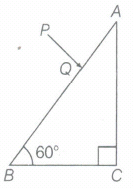
A ray PQ incident normally on the refracting face BA is refracted in the prism BAC made of material of refractive index 1.5. Complete the path of ray through the prism. From which face will the ray emerge? Justify your answer.
3.
Figure shows a ray of light passing through a prism. If the refracted ray QR is parallel to the base BC, show that (i) r1 = r2 = A/2, (ii) angle of minimum deviation, D or Dm = 2i -A.
.jpg)
4.
An object AB is kept in front of a concave mirror as shown in the figure complete the ray diagram showing the image formation of the object. How will the position and intensity of the image be, affected if the lower half of the mirror's reflecting surface is painted black?
.jpg)
5.
A convex lens of local length 25 cm is placed coaxially in contact with a concave lens of focal length 20 cm. Determine the power of the combination. Will the system be converging or diverging in nature ?
6.
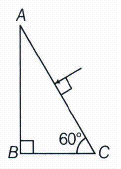
Trace the path of a ray of light passing through a glass prism (ABC) as shown in the figure. If the refractive index value of the angle of emergence from the prism.
7.
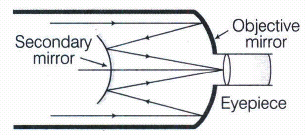
A Cassegrain telescope uses two mirrors as shown in the figure. Such a telescope is built with the mirrors 20mm apart. If the radius of curvature of large mirror is 220mm and the small mirror is 140 mm, where will the final image of an object at infinity be?
8.
Two plane mirrors are inclined at an angle \(\theta \). It is found that a ray incident on one mirror at any angle rendered parallel to itself after reflection from both the mirrors. What will be the value of \(\theta \)?
9.
Three immiscible liquids of densities \({ d }_{ 1 }>{ d }_{ 2 }>{ d }_{ 3 } \) and refractive indices \({ \mu }_{ 1 }>{ \mu }_{ 2 }>{ \mu }_{ 3 }\) are put in a beaker. The height of each liquid column is \(\frac { h }{ 3 } \).A dot is made at the bottom of the beaker. for near normal vision, find the apparent depth of the dot
10.
How does the resolving power of a microscope change on
(i) decreasing wavelength of light
(ii) decreasing diameter of objective lens?
11.
Which colour deviates (i) most (ii) least on passing through a prism?
12.
For which colour,\(\mu \) of material of a prism, is (i) minimum (ii) maximum?
13.
Two thin lenses of power +3D and -1D are held in contact with each other.Focal length of the combination is:
14.
How does focal length of a convex lens change if violet light is used instead of red light.
15.
What is focal length of a lens of power -2.5D?
16.
A glass lens of refractive index 1.45, when immersed in a transparent liquid, becomes invisible. Under what condition does it happen?
17.
What is the relation between refractive index and critical angle for a given pair of optical media?
18.
Can total internal reflection occur when light goes from a rarer to a denser medium.
19.
What are focal length and power of a plane mirror?
20.
Why is the aperture of objective lens of a telescope taken large?
21.
A compound microscope consists of an objective lens of focal length 2.0 cm and an eye -piece of focal length 6.25 cm separated by a distance should an object be placed in order to obtain the final image at (a) the least distance of distinct vision (25 cm), (b) infinity ? What is the magnifying power of the microscope in each case ?
22.
Draw a ray diagram to show the formation of the Image of an object placed on the axis of a convex refracting surface of radius of curvature 'R', separating the two media of refractive indices 'n1' and 'n2' (n2'>n1) Use this diagram to deduce the relation \(\frac { n_{ 2 } }{ U } =\frac { R_{ 1 } }{ u } =\frac { n_{ 2 }-n_{ 1 } }{ R } \) where u and u represent respectively the distance of the object and the image formed
23.
For a normal eye, the far point is at infinity and the near point of distinct vision is about 25 cm in front of an eye. The corner of the eye provides a converging power of about 40 dioptres and the least converging power of eye lens behind the cornea is about 20 dioptres. From this rough data estimate the range of accommodation (i.e. the range of converging power of the eye lens) of a normal eye
24.
Fig (a) and (b) show refraction of a ray in air incident at with the normal to a \({ 60 }^{ \circ }\) glass in air and water-air interface respectively. Predict the angle of refraction in glass when the angle of incidence in water at \({ 45 }^{ \circ }\) with the normal to a water-glass interface
-Q.png)
-Q.png)
-Q.png)
25.
An astronomical telescope has a magnifying power of 10. In normal adjustment, distance between the objective and eye piece is 22 cm. The focal length of objective lens is
10 cm
22 cm
20 cm
2 cm
26.
What focal length should be reading spectacles have for a person whose near point is 50 cm?
25 cm
50 cm
-50 cm
-25 cm
27.
A telescope uses an objective lens of focal length \(f_{ 0 }\) and an eye lens of focal length \(f_{ e }\). In normal adjustment, distance between the two lenses is
\(f_{ o }/f_{ e }\)
\(f_{ e }/f_{ o }\)
\((f_{ o }-f_{ e })\)
\((f_{ o }+f_{ e })\)
28.
The focal length of a double convex lens is equal to radius of curvature of either surface. The refractive index of its material is
3/2
1
4/3
none of these
29.
For total internal reflection, light must travel
from rarer to denser medium
from denser to rarer medium
in air only
in water only
30.
Which is not true for the image formed in a plane mirror? The image is
virtual
erect
laterally inverted
closer to the mirror than the object
31.
The ratio of the speed of an object to the speed of its real image of magnification m in the case of a convex mirror is
\(-\frac { 1 }{ { m }^{ 2 } } \)
\({ m }^{ 2 }\)
-xm
\(\frac { 1 }{ { m } } \)
32.
For a normal eye, the least distance of distinct vision is................and far point is..................... .
33.
(a) Obtain Lens Maker's formula using the expression
\(\frac { { n }_{ 2 } }{ v } -\frac { { n }_{ 1 } }{ u } =\frac { \left( { n }_{ 2 }-{ n }_{ 1 } \right) }{ R } \)
Here the ray of light propagating from a rarer medium of refractive index (n1) to a denser medium of refractive index (n2) is incident on the convex side of spherical refracting surface of radius of curvature R.
(b) Draw a ray diagram t show the image formation by a concave mirror when the object is kept between its focus and the pole. Using this diagram, derive the magnification formula for the image formed.
34.
Define magnifying power of a telescope. Write its expression. A small telscope has an objective lens of focal length 150cm and an eyepiece of focal length 5cm. If this telescope is used to view a 100m high tower 3Km away, find the height of the final image, when it is formed 25cm away from the eyepiece.
1.
Clearly , the fish can see the outside view of the cone with semi vertical angle
But \(\mu \) = 1.sin ic
or 1/3 = 1/ sin ic
or sin ic = 3/4 = 0.75
\(\theta\)/2 =ic = sin-1 (0.75 ) = 48.60
2.
Given refractive index of the material of the prism \(\mu =1.5\)
Critical angle for the material
sin C= \(\frac { 1 }{ \mu } =\frac { 1 }{ 1.5 } =2/3\)
\(\Rightarrow C=sin^{ -1 }\left( \frac { 2 }{ 3 } \right) =42^{ 0 }\)
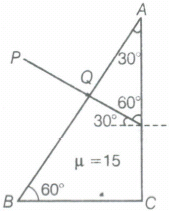
From the ray diagram, it is clear that angle of incidence i = 30°< C. Therefore the ray incident at the face AC will not suffer total internal reflection and merges out through this face.
3.
(i) From given figure, A = r1 + r2
As ray QR is parallel to the base BC, then
Therefore, 2r1(or 2r2) = A(ii) D = x + y, r1 = r2 = A/2
D = (i - r1) + (e - r2)
D = (i + e) - (r1 + r2)
D = 2i - A
4.
(i)
.jpg)
(ii) The position of image will remain same /unchanged, but the intensity of the image will decrease.
5.
Power of convex lens = 1/0.25 = 4D
Power of concave lens = 1/0.20 = -5D
Power of the combination, P = P1+P2 = -1D
Nature : Diverging
6.
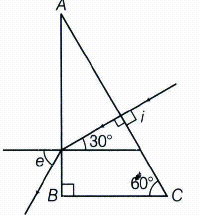
While tracing the path of the ray, we should remember that prism bends the incident ray towards its base.
Refractive index of glass,
\({ \mu }_{ g }=\sqrt { 3 } \)
Since, i = 0
At the interface AC, we have (according to Snell's law)
\( \frac { sin \ i }{ sin \ r } =\frac { { \mu }_{ g } }{ { \mu }_{ a } }\)
\( But \ sin \ i=sin{ 0 }^{ 0 }=0\)
\(Thus,\ sinr=\frac { { \mu }_{ a }sin \ i }{ { \mu }_{ g } } =0\)
\(Hence,\ r=0\)
This ray pass unrefracted at AC interface and reaches AB interface. Here, we can see angle of incidence becomes 300.
Thus, applying Snell's law,
\(\frac { sin{ 30 }^{ 0 } }{ sin \ e } =\frac { { \mu }_{ a } }{ { \mu }_{ g } } \frac { 1 }{ \sqrt { 3 } } \)
\(sin \ e=\sqrt { 3 } \times sin{ 30 }^{ 0 }=\frac { \sqrt { 3 } }{ 2 } \)
Thus, e = 600
Hence, angle of emergence is 600.
7.
Radius of curvature of objectrive mirror,
R1 = 220 mm
\({ f }_{ 1 }=\frac { { R }_{ 1 } }{ 2 } =\frac { 220 }{ 2 } =110 \ mm\)
Radius of curvature of secondary mirrors, R2 = 140 mm
\({ f }_{ 2 }=\frac { { R }_{ 2 } }{ 2 } =\frac { 140 }{ 2 } =70 \ mm\)
Distance between two mirrors, d = 20 mm from objective mirror.
Now, for secondary mirror, u = f1 - d = 110 - 20
= 90 mm
From mirror formula,
\(\frac { 1 }{ v } +\frac { 1 }{ u } =\frac { 1 }{ { f }_{ 2 } } \Longrightarrow \frac { 1 }{ v } =\frac { 1 }{ { f }_{ 2 } } -\frac { 1 }{ u } \)
\( =\frac { 1 }{ 70 } -\frac { 1 }{ 90 } \Longrightarrow v=\frac { 630 }{ 2 } =315\ mm\)
i.i., final image will be at 31.5 cm to the right of secondary mirror.
8.
Let \(\theta \) be the angle between the mirrors \({ M }_{ 1 }\) and \({ M }_{ 2 }\)
Since, rays LM and NS are parallel to each other

\(\angle LMN=\angle SNQ=2i\)
\( \Rightarrow \quad 2i_{ 1 }+2i=180^{ \circ }\)
\(\Rightarrow i_{ 1 }+i=90^{ \circ }...............(i)\)
\(Also \ in \ \triangle MBN,\)
\( \theta +\left( 90-i \right) +\left( 90-i \right) =180^{ \circ }\)
\(\Rightarrow \theta =i_{ 1 }+i..............(ii)\)
On comparing Eqs. (i) and (ii), we get
\(\theta =90^{ \circ }\)
9.
Here, real depth of the dot under liquid of density \({ d }_{ 1 }\) is h/3. if \({ x }_{ 1 }\) is its apparent depth, when seen from air, then from \({ \mu }_{ 1 }=\frac { h/3 }{ { x }_{ 1 } } \ or \ { x }_{ 1 }=\frac { h }{ 3{ \mu }_{ 1 } } \)
similarly, apparent depths of the dot when seen from air through two other liquids are
\({ x }_{ 2 }=\frac { h }{ 3{ \mu }_{ 2 } } \ and \ { x }_{ 3 }=\frac { h }{ 3{ \mu }_{ 3 } } \)
apparent depths of the dot when seen from air through two other liquids are
\(x={ x }_{ 1 }+{ x }_{ 2 }+{ x }_{ 3 }=\frac { h }{ 3{ \mu }_{ 1 } } +\frac { h }{ 3{ \mu }_{ 2 } } +\frac { h }{ 3{ \mu }_{ 3 } } =\frac { h }{ 3 } \left[ \frac { 1 }{ { \mu }_{ 1 } } +\frac { 1 }{ { \mu }_{ 2 } } +\frac { 1 }{ { \mu }_{ 3 } } \right] \)
10.
On decreasing \(\lambda \), resolving power of microscope increases and on decreasing diameter of objective lens, resolving power of microscope decreases.
11.
Violet colour suffers maximum deviation and red colour suffers the least deviation.
12.
\(\mu \) is minimum for red colour and \(\mu \) is maximum for violet colour.
13.
P = P1 + P2 = +3 - 1 = 2D
F = 100/P = 100/2 = 50 cm
14.
\(\frac { 1 }{ { f }_{ v } } =({ \mu }_{ v }-1)\left( \frac { 1 }{ { R }_{ 1 } } -\frac { 1 }{ { R }_{ 2 } } \right) \)
\( \frac { 1 }{ { f }_{ r } } =({ \mu }_{ r }-1)\left( \frac { 1 }{ { R }_{ 1 } } -\frac { 1 }{ { R }_{ 2 } } \right) \)
\(As \ { \mu }_{ v }>{ \mu }_{ r } \ \therefore { f }_{ v }<{ f }_{ r }\)
i.e., focal length decreases.
15.
f = 100/P = 100/-2.5 = -40cm
16.
When refractive index of the liquid is equal to refractive index of the material of the lens = 1.45
17.
\(\mu =\frac { 1 }{ \sin { C } } \)
18.
No, Total internal reflection cannot occur.
19.
Focal length of a plane mirror is infinity.
Power \(P=\frac { 1 }{ f } =\frac { 1 }{ \infty } =Zero\)
20.
This is done to increase the light gathering capacity and hence brightness of image.
21.
20; 13.5 cm
22.
Refraction at convex spherical surface. When object is in rarer medium and image formed is real.
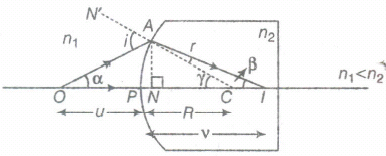
In \(\triangle AC,i=\alpha +\gamma \) and
In \(\triangle AIC,\gamma =r+\beta \quad r=\gamma -\beta \)
\(\therefore \) By snell's law n2 =\(\frac { sini }{ sinr } =\frac { i }{ r } =\frac { \alpha +\gamma }{ \gamma -\beta } \)
or \(\frac { n_{ 2 } }{ n_{ 1 } } =\frac { \alpha +\beta }{ \gamma -\beta } n_{ 2 }\gamma -n_{ 2 }\beta =n_{ 1 }\gamma \)
As \(\alpha ,\beta ,\gamma \) are small and p and N lie close to each other
So, \(\alpha =tan\alpha =\frac { AN }{ NO } =\frac { AN }{ PO } \)
\(\beta =tan\beta =\frac { AN }{ NI } =\frac { AN }{ PI } \)
\(\gamma =tan\gamma =\frac { AN }{ NC } =\frac { AN }{ PC } \)
On using them inEq(1) we get
\(\left( n_{ 2 }-n_{ 1 } \right) \frac { AN }{ PC } =n_{ 1 }\frac { AN }{ PO } +n_{ 2 }\frac { AN }{ PI } \)
\(\frac { n_{ 2 }-n_{ 1 } }{ PC } =\frac { n_{ 1 } }{ PO } +\frac { n_{ 2 } }{ PI } \)
where, PC = +R. radius of curvature
PO = -u, object distance
PI = +v, image distance
So \(\frac { n_{ 2 }-n_{ 1 } }{ R } =\frac { n_{ 1 } }{ -u } +\frac { n_{ 2 } }{ v } \)
\(\frac { n_{ 2 }-n_{ 1 } }{ R } =\frac { n_{ 1 } }{ v } +\frac { n_{ 1 } }{ u } \)
This gives formula for refraction at spherical surface, when object is in rarer medium.
23.
To see objects at infinity, the eye uses its least converging power = (40 + 20) dioptres = 60 dioptres. This gives a rough idea of the distance between the retina and cornea eye lens
So focal length
\( f=\frac { 1 }{ p } \)
\(or \ f=\frac { 1 }{ 60 } m \ = \ \frac { 5 }{ 3 } cm\)
To focus an object at the near point (u = -25 cm) and the retina (v = 5/3 cm) the focal length should be
\(-\frac { 1 }{ u } +\frac { 1 }{ v } =\frac { 1 }{ f }\)
\( \frac { 1 }{ 25 } +\frac { 3 }{ 5 } =\frac { 1 }{ f }\)
\(\frac { 1+15 }{ 25 } =\frac { 1 }{ f }\)
\(orf=\frac { 25 }{ 16 } cm\)
24.
\(First\ case,\)
\(angle \ of \ incidence \ i={ 60 }^{ \circ }\)
\(angle \ of \ refraction \ r={ 35 }^{ \circ }\)
\({ \alpha }_{ { \mu }_{ g } }= \ \frac { 1 }{ { g }_{ { \mu }_{ \alpha } } } =\frac { sin\ i }{ sin \ r } \)
\(Second \ case,\)
\( { \alpha }_{ { \mu }_{ \omega } }=\frac { sin\ { 60 }^{ \circ } }{ sin\ { 47 }^{ \circ } } =1.18\)
\( { \omega }_{ { \mu }_{ g } }= { \alpha }_{ { \mu }_{ g } }\times { \omega }_{ { \mu }_{ \alpha } }\)
\(=\frac { { \alpha }_{ { \mu }_{ g } } }{ { \alpha }_{ { \mu }_{ \omega } } } =\frac { 1.51 }{ 1.18 } =1.28\)
\(Third \ case,\)
\( angle \ of \ incidence \ i={ 45 }^{ \circ }\)
\( angle \ of \ refraction \ r=?\)
\( { \omega }_{ { \mu }_{ g } }=\frac { sin\ i }{ sin\ r } \)
\(\frac { sin \ i }{ sin\ r } =1.28\)
\(sin \ r=\frac { sin \ { 45 }^{ \circ } }{ 1.28 } =0.5525\)
\( sin \ r= \ sin{ 33 }^{ \circ }54'\)
\(r= \ { 33 }^{ \circ }54'\)
25.
(c)
20 cm
26.
(b)
50 cm
27.
(d)
\((f_{ o }+f_{ e })\)
28.
(a)
3/2
29.
(b)
from denser to rarer medium
30.
(d)
closer to the mirror than the object
31.
(a)
\(-\frac { 1 }{ { m }^{ 2 } } \)
32.
()
25 cm ; at infinity
33.
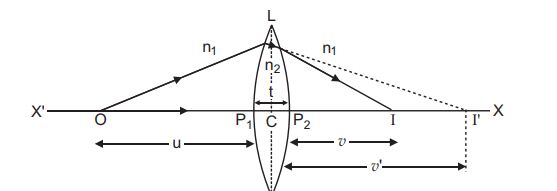
For refraction at the first surface
\(\frac { { n }_{ 2 } }{ { v }_{ 1 } } -\frac { { n }_{ 1 } }{ u } =\frac { { n }_{ 2 }-{ n }_{ 1 } }{ { R }_{ 1 } } \)
For the second surface, I1 acts as a virtual object (located in the denser medium) whose final real image is formed in the rarer medium at I.
so for refraction at this surface, we have
\(\frac { { n }_{ 2 } }{ v } -\frac { { n }_{ 1 } }{ { v }_{ 1 } } =\frac { { n }_{ 2 }-{ n }_{ 1 } }{ { R }_{ 2 } } \)
From the above two equation, \(\frac { 1 }{ v } -\frac { 1 }{ u } =\left( \frac { { n }_{ 2 } }{ { n }_{ 1 } } -1 \right) \left( \frac { 1 }{ { R }_{ 1 } } -\frac { 1 }{ { R }_{ 2 } } \right) \)
The point, where image of an object, located at infinity is formed, is called the focus F, of the lens and the distance f gives its focal length.
So for \(u=\infty ,v=+f\)
\(\Rightarrow\) \(\frac { 1 }{ f } =\left( \frac { { n }_{ 2 } }{ { n }_{ 1 } } -1 \right) \left( \frac { 1 }{ { R }_{ 1 } } -\frac { 1 }{ { R }_{ 2 } } \right) \)
(b)
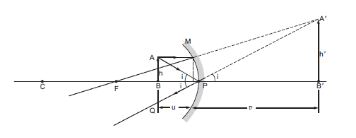
\(\triangle\) ABP is similar to \(\triangle\)A'B'P
So \(\frac { A'B' }{ AB } =\frac { B'P }{ BP } \)
Nor A'B' = I, AB = O, B'P = + v and BP = - u
So magnification \(m=\frac { I }{ O } =-\frac { v }{ u } \)
34.
The magnifying power of a telescope is equal to the ratio of the visual angle substended at the eye by final image formed at least distance of distinct vision to the visual angle subtended at naked eye by the object at infinity.

12th Standard CBSE Syllabus & Materials
12th Standard CBSE
CBSE 12th Computer Science Python Revision Tour I - New Previous year Question Papers Study Material - QB365 Set A
NEW12th Standard CBSE
CBSE 12th Business Studies Planning Important Questions And Answers Study Material - QB365 Set A
NEW12th Standard CBSE
CBSE 12th Business Studies Business Environment Important Questions And Answers Study Material - QB365 Set A
NEW12th Standard CBSE
CBSE 12th Business Studies Principles of Management Important Questions And Answers Study Material - QB365 Set A



NCERT Books

Syllabus

Exam Pattern

Sample Question Papers

Previous year Question Papers

Important Notes

MCQ Practice test

NCERT Exemplers

Case study Questions

Image Based Questions

Passage based Questions

HOT Questions

Value Based Questions

Model Questions Papers
NCERT ( Book Back ) Questions

Assertion and Reason
Important Questions And Answers

CBSE 12th Standard CBSE Subjects
CBSE Standards








