
 100% FREE ACCESS
12th Standard CBSE Syllabus & Materials
12th Standard CBSE
CBSE 12th Economics Government Budget and the Economy Previous year Question Papers Study Material - QB365 Set A
NEW12th Standard CBSE
CBSE 12th Computer Science Interface Python with MySQL - New Previous year Question Papers Study Material - QB365 Set A
NEW12th Standard CBSE
CBSE 12th Computer Science Database Concept - New Previous year Question Papers Study Material - QB365 Set A
NEW12th Standard CBSE
CBSE 12th Computer Science Data Communication - New Previous year Question Papers Study Material - QB365 Set A
NEW12th Standard CBSE
CBSE 12th Computer Science Data Structures - New Previous year Question Papers Study Material - QB365 Set A
NEW12th Standard CBSE
CBSE 12th Computer Science Functions - New Previous year Question Papers Study Material - QB365 Set A

Published on: 07/03/2026
Download CBSE Class 12th Standard CBSE Physics question papers, sample papers, important questions, and previous year solved papers in PDF format. Get free study materials, NCERT solutions, and exam preparation resources for Class 12th Standard CBSE Physics
Questions + Answers key
Take MCQ Physics Test
1.
In electromagnetic waves the phase difference between electric and magnetic field vectors are
zero
\(\frac{\pi}{4}\)
\(\frac{\pi}{2}\)
π
2.
Choose the correct statement.
A capacitor can conduct a dc circuit but not an inductor
In a de circuit the inductor can conduct but not a capacitor
In dc circuit both the inductor and capacitor cannot conduct
The inductor has infinite resistance in a dc circuit
3.
In an a.c. generator, a coil with N turns, all of the same area A and total resistance R, rotates with frequency ω in a magnetic field B the maximum value of emf generated in the coil is
NABR
NABω
NABRω
NAB
4.
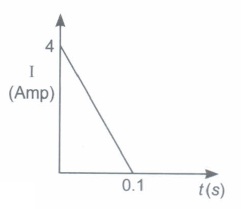
In a coil of resistance 10π, the induced current developed by changing magnitude of change in flux through the coil is weber is
8
2
6
4
5.
Let the magnetic field on earth be modelled by that of a point magnetic dipole at the centre of earth. The angle of dip at a point on the geographical equator
is always zero.
can be zero at specific points.
cannot be positive or negative
is not bounded.
6.
An electric dipole is kept in a non-uniform electric field. It experiences
a force and a torque
a force but not a torque
a torque but not a force.
neither a force nor a torque
7.
Advantage of reflecting telescopes are
no chromatic aberration
parabolic reflecting surfaces are used
weighs of mirror are much less than a lens of equivalent optical quality
All of the above
8.
A long solenoid has 20 turns cm-1. The current necessary to produce a magnetic field of 20 mT inside the solenoid is approximately
l A
2 A
4 A
8 A
9.
A potential difference of 100 V is applied to the ends of a copper wire one metre long. What is the average drift velocity of electrons?
(given. σ = 5.81 x 10⁷ Ω-1or ncu = 8.5 x 1028 m-3)
0.43 ms -1
0.83 ms -1
0.52 ms-1
0.95 ms-1
10.
Two protons are attracting each other, then separation between them is
10-10 m
10-2 m
10-8 m
10-15 m
11.
The resistance of a 10 m long wire is 10Ω. Its length is increased by 25%by stretching the wire uniformly. The resistance of wire will change to
12.5 Ω
14.5 Ω
15.6 Ω
16.6 Ω
12.
What is the value of capacitance if a very thin metallic plate is introduced between two parallel plates of area A and separated at distance d?
\(\varepsilon_{0} A / d\)
\(\frac{2 \varepsilon_{0} A}{d}\)
\(\frac{4 \varepsilon_{0} A}{d}\)
\(\frac{\varepsilon_{0} A}{2 d}\)
13.
Two charges 3 x 10⁻⁸ C and - 2 x 10⁻⁸ C located 15 cm apart. At what point on the line joining the two charges is the electric potential zero?
9 cm
45 cm
18 cm
Both (a) and (b)
14.
Total electric flux coming out of a unit positive charge put in air is
Eo
\(\varepsilon_{0}^{-1}\)
(4 pE0)-1
4\(\pi\) E0
15.
A magnifying glass of focal length 5 cm is used to view an object by a person whose smallest distance of distinct vision is 25cm. If he holds the glass close to eye, then the magnification is
5
6
2.5
3
16.
The de-Broglie wavelength of the tennis ball of mass 60g moving with a velocity of 10m/s is approximately: (Plank's constant h = \(h=6.63\times { 10 }^{ -34 }Js\)
\({ 10 }^{ -33 }m\)
\({ 10 }^{ -31 }m\)
\({ 10 }^{ -16 }m\)
\({ 10 }^{ -25 }m\)
17.
The relation \(\frac { { E }_{ s } }{ { E }_{ p } } =\frac { { n }_{ s } }{ { n }_{ p } } \) is applied only to
a.c. generator
d.c. generator
induction coil
step up/step down transformer
18.
In a sample of radioactive substance, what percentage decays in one mean life time?
69.3%
64%
50%
36%
19.
Polarizing angle for a medium is \(60°\) . Its refractive index is
1.732
1
1.414
2
20.
When an electric field is applied across a semiconductor
electrons move from lower energy level to higher energy level in the condition band
electrons move from higher energy level to lower energy level in the conduction band
holes in the valence band move from higher energy level to lower energy level
holes in the valence band move from lower energy level to higher energy level.
21.
22.
Assertion : The work function of a metal is the minimum energy required to release an electron from its surface.
Reason : For the photoelectric effect to occur, the energy of incident photons must be greater than or equal to the work function of the metal.
Codes:
(a) Both A and R are true and R is the correct explanation of A.
(b) Both A and R are true but R is not the correct explanation of A.
(c) A is true but R is false.
(d) A is false and R is also false.
23.
24.
25.
26.
27.
28.
29.
30.
31.
32.
Assertion (A) : Propagation of light through an optical fibre is due to total internal reflection taking place at the core-clade interface,
Reason (R) : Refractive index of the material of the core of the optical fibre is greater than that of air.
(a) Both Assertion and Reason are true and Reason is the correct explanation of Assertion.
(b) Both Assertion and Reason are true but Reason is not the correct explanation of Assertion.
(c) Assertion is true but Reason is false.
(d) Assertion is false but Reason is true.
33.
Assertion (A) : When the capacitor is connected to an AC source, it limits or regulates the current, but does not completely prevent the flow of charge.
Reason (R) : The capacitor is alternately charged and discharged as the current reverses each half-cycle.
(a) Both Assertion and Reason are true and Reason is the correct explanation of Assertion.
(b) Both Assertion and Reason are true but Reason is not the correct explanation of Assertion.
(c) Assertion is true but Reason is false.
(d) Assertion is false but Reason is true.
34.
Assertion (A) Electrons are ejected from the surface of zinc when it is irradiated by yellow light.
Reason (R) Energy associated with a photon of yellow light is more than the work function of Zinc.
(a) If both Assertion (A) and Reason (R) are true and Reason (R) is the correct explanation of Assertion (A).
(b) If both Assertion (A) and Reason (R) are true but Reason (R) is not the correct explanation of Assertion (A).
(c) If Assertion (A) is true and Reason (R) is false.
(d) If both Assertion (A) and Reason (R) are false.
35.
Assertion (A) : When number of turns in a coil doubled, coefficient of self inductance of the coil becomes four times.
Reason (R) : Coefficient of self inductance is proportional to the square of number of turns.
Codes:
(a) Both A and R are true and R is the correct explanation of A
(b) Both A and R are true but R is NOT the correct explanation of A
(c) A is true but R is false
(d) A is false and R is also false
36.
Assertion (A) : At neutral point, a compass needle point out in any arbitrary direction.
Reason (R) : Magnetic field of earth is balanced by field due to magnets at the neutral points
Codes:
(a) Both A and R are true and R is the correct explanation of A
(b) Both A and R are true but R is NOT the correct explanation of A
(c) A is true but R is false
(d) A is false and R is also false
37.
Assertion: Material used in the construction of a standard resistance is constant an or manganin.
Reason: Temperature coefficient of constantan is very small.
Codes:
(a) Both A and R are true and R is the correct explanation of A
(b) Both A and R are true but R is NOT the correct explanation of A
(c) A is true but R is false
(d) A is false and R is also false
38.
Assertion (A) : A capacitor is connected to a battery. If we move its plate further apart, work will be done against the electrostatic attraction between the plates and the energy of the capacitor gets decreased.
Reason (R) : The energy stored in capacitor is dissipated in the form of heat energy.
Codes:
(a) Both A and R are true and R is the correct explanation of A
(b) Both A and R are true but R is NOT the correct explanation of A
(c) A is true but R is false
(d) A is false and R is also false
39.
Assertion (A) : Charging is due to transfer of electrons.
Reason (R) : Mass of a body decreases slightly when it is negatively charged.
Codes:
(a) Both A and R are true and R is the correct explanation of A
(b) Both A and R are true but R is NOT the correct explanation of A
(c) A is true but R is false
(d) A is false and R is also false
40.
The nuclear charge(Ze) is non-uniformly distributed within a nucleus of radius R. The charge density p(r) [charge per unit volumne is dependent only on the radial distance r from the centre of the nucleus as shown in figure.The electric field is only along the radial direction.
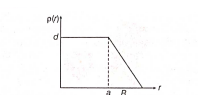
(i) The electric field at r= R is
(a) independent of a
(b) directly proportional to a
(c) directly proportional to \(a^2\)
(d) inversely proportional to a
(ii) Net charge on given system is
\(\text { (a) } Q=\int \rho_r\left(4 \pi r^2\right) d r\)
\(\text { (b) } Q=\int \rho_r\left(\pi r^2\right) d r\)
\(\text { (c) } Q=\int \rho_r \frac{r^2}{2} d r\)
\(\text { (d) } Q=\int \rho_r\left(4 \pi r^2\right)\)
(iii) For a =0, the value d (maximum value ofp as shown in the figure) is
\(\text { (a) } \frac{3 Z e^2}{4 \pi R^3}\)
\(\text { (b) } \frac{3 Z e}{\pi R^3}\)
\(\text { (c) } \frac{4 Z e}{3 \pi R^3}\)
\(\text { (d) } \frac{Z}{3 \pi R^3}\)
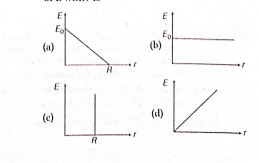
(iv) The correct graph representing the variation of E with r is
(v) The electricfield within the nucleus is generally observed to be linearly dependent on r. This implies
(a) a =0
\(\text { (b) } a=\frac{R}{2}\)
(c) a= R
\(\text { (d) } a=\frac{2 R}{3}\)
41.
To study photoelectric effect, an emitting electrode C of a photosensitive material is kept at negative potential and collecting electrode A is kept at positive potential in an evacuated tube. When light of sufficiently high frequency falls on emitting electrode, photoelectrons are emitted which travel directly to collecting electrode and hence an electric cusrent called photoelectric current starts flowing in the circuit, which is directly proportional to the number of photoelectrons emitted by emitting electrode C.
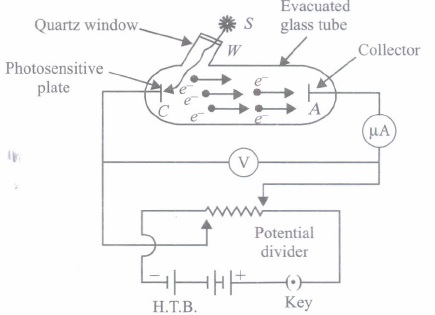
While demonstrating the existence of electromagnetic waves, Hertz found that high voltage sparks passed across the metal electrodes of the detector loop more easily when the cathode was illuminated by ultraviolet light from an arc lamp. The ultraviolet light falling on the metal surface caused the emission of negatively charged particles,which are now known to be electrons, into the surrounding space and hence enhanced the high voltage sparks.
(i) Cathode rays were discovered by
| (a) Maxwell Clerk James | (b) Heinrich Hertz |
| (c) William Crookes | (d) J. J. Thomson |
(ii) Cathode rays consists of
| (a) photons | (b) electrons | (c) pistons | (d) a-particles. |
(iii) Who discovered the charge on an electron for the frist time?
| (a) Millikan | (b) Thomson | (c) Kelvin | (d) Coulomb |
(iv) The dual nature of light is exhibited by
| (a) diffraction and photoelectric effect | (b) photoelectric effect |
| (c) refraction and interference | (d) diffraction and reflection |
(v) In the phenomenon of electric discharge through gases at low pressure, the coloured glow in the tube appears as a result of
| (a) collisions between the charged particles emitted from the cathode and the atoms of the gas |
| (b) collision between different electrons of the atoms of the gas |
| (c) excitation of electrons in the atoms |
| (d) collision between the atoms of the gas. |
42.
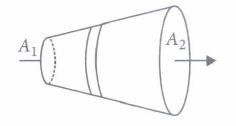
The flow of charge in a particular direction constitutes the electric current. Current is measured in Ampere. Quantitatively, electric current in a conductor across an area held perpendicular to the direction of flow of charge is defined as the amount of charge is flowing across that area per unit time.
Current density at a point in a conductor is the ratio of the current at that point in the conductor to the area of cross section of the conductor of that point.
The given figure shows a steady current flows in a metallic conductor of non uniform cross section. Current density depends inversely on area, so, here \(J_{1}>J_{2}, \text { as } A_{1}
(i) What is the current flowing through a conductor, if one million electrons are crossing in one millisecond through a cross-section of it ?
| (a) 2.5 x 10⁻¹⁰ A | (b) 1.6 x 10⁻¹⁰ A |
| (c) 7.5 X 10⁻⁹ A | (d) 8.2 x 10⁻¹¹ A |
(ii) SI unit of electric current is
| (a) Cs | (b) Ns-2 | (c) Cs-1 | C-1s-1 |
(iii) A steady current flows in a metallic conductor of non-uniform cross-section. Which of these quantities is constant along the conductor?
| (a) Electric field | (b) Drift velocity | (c) Current | (d) Current density |
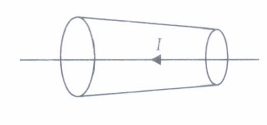
(iv) A constant current I is flowing along the length of a conductor of variable cross-section as shown in the figure. The quantity which does not depend upon the area of cross-section is
| (a) electron density | (b) current density |
| (c) drift velocity | (d) electric field |
(v) When a current of 40 A flows through a conductor of area 10 m2, then the current density is
| (a) 4 A/m2 | (b) 1 A/m2 | (c) 2 A/m2 | (d) 8 A/m2 |
43.
For the various charge systems, we represent equipotential surfaces by curves and line of force by full line curves. Between any two adjacent equipotential surfaces, we assume a constant potential difference the equipotential surfaces of a single point charge are concentric spherical shells with their centres at the point charge. As the lines of force point radially outwards, so they are perpendicular to the equipotential surfaces at all points.
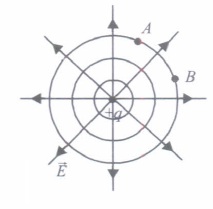
(i) Identify the wrong statement.
| (a) Equipotential surface due to a single point charge is spherical. |
| (b) Equipotential surface can be constructed for dipoles too. |
| (c) The electric field is normal to the equipotential surface through the point. |
| (d) The work done to move a test charge on the equipotential surface is positive |
(ii) Nature of equipotential surface for a point charge is
| (a) Ellipsoid with charge at foci | (b) Sphere with charge at the centre of the sphere |
| (c) Sphere with charge on the surface of the sphere | (d) Plane with charge on the surface |
(iii) A spherical equipotential surface is not possible
| (a) inside a uniformly charged sphere | (b) for a dipole |
| (c) inside a spherical condenser | (d) for a point charge |
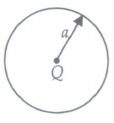
(iv) The work done in carrying a charge q once round a circle of radius a with a charge Q at its centre is
| \(\text { (a) } \frac{q Q}{4 \pi \varepsilon_{0} a}\) | \(\text { (b) } \frac{q Q}{4 \pi \varepsilon_{0} a^{2}}\) |
\(\text { (c) } \frac{q}{4 \pi \varepsilon_{0} a}\) |
(d) zero |
(v) The work done to move a unit charge along an equipotential surface from P to Q
| (a) must be defined as \(-\int_{P}^{Q} \vec{E} \cdot d \vec{l}\) | (b) is zero |
| (c) can have a non-zero value | (d) both (a) and (b) are correct |
1.
(a)
zero
2.
(b)
In a de circuit the inductor can conduct but not a capacitor
3.
(b)
NABω
4.
(b)
2
5.
(b)
can be zero at specific points.
6.
(a)
a force and a torque
7.
(d)
All of the above
8.
(d)
8 A
9.
(a)
0.43 ms -1
10.
(d)
10-15 m
11.
(c)
15.6 Ω
12.
(a)
\(\varepsilon_{0} A / d\)
13.
(d)
Both (a) and (b)
14.
(b)
\(\varepsilon_{0}^{-1}\)
15.
(b)
6
16.
(a)
\({ 10 }^{ -33 }m\)
17.
(d)
step up/step down transformer
18.
(b)
64%
19.
(a)
1.732
20.
(a)
electrons move from lower energy level to higher energy level in the condition band
21.
22.
(a) Both A and R are true and R is the correct explanation of A.
23.
24.
25.
26.
27.
28.
29.
30.
31.
32.
(b) Both Assertion and Reason are true but Reason is not the correct explanation of Assertion.
Optical fibre communication is based on the phenomenon of total internal reflection at core-clad interface.
The refractive index of the material of the cladding, hence light striking at core-cladding interface gets totally internally reflected. The light undergoes and reaches the other end of the fibre.
33.
(a) Both Assertion and Reason are true and Reason is the correct explanation of Assertion.
34.
(c) Assertion (A) is true and Reason (R) is false. Electrons are ejected from the surface of zinc metal when it is irradiated by yellow light of suitable frequency fall on them. Work function of zinc metal is 3.74 eV.
Energy associated with a photon of yellow light is 2.14 eV.
So, energy of photon is less than the work function of zinc.
35.
(a): The coefficient of self inductance of the coil is given by \(L=\frac{\mu_{0} N^{2} A}{l}\)
where N is number of turns, 1 is length of the coil and
A is area of coil, so \(L \propto N^{2}\)
36.
(a): A neutral point in the magnetic field of a bar magnet is that point, where the field due to magnet is completely neutralised by the horizontal component of earth's magnetic field. The net horizontal field is zero at such a point. If a compass needle is placed at such a point, it can stay in any position.
37.
(a): These alloys (constantan or manganin) are used for making standard resistance because they possess high resistivity and low temperature coefficient of resistance
38.
(b): When the plates of a capacitor are moved further apart, the capacitance gets decreased. As battery remains connected, hence charge q(= CV) on the plates is decreased and energy \(U=\left[1 / 2 C V^{2}\right]\).also decreases. Some charge from the plates flows to the battery i.e. some energy of capacitor is transferred to the battery. Work done against electrostatic attraction between plates is used in the transference of energy and is dissipated in the form of heat energy in connection wires.
39.
(c): A body becomes negatively charged only when some electrons are transferred to the body i.e. the body gains some electrons. Hence its mass increases slightly. Mass of a body decreases only when body gives some electrons to some other body.
40.
(i) a
(ii) a
(iii) b
(iv) d
(v) c
41.
(i) (c)
(ii) (b)
(iii) (a)
(iv) (a)
(v) (c): In discharge tube, collision between charged particles emitted from cathode and atoms of the gas results to colorless glow in the tube.
42.
(I) (b): \(q=10^{6} \times 1.6 \times 10^{-19} \mathrm{C}=1.6 \times 10^{-13} \mathrm{C}\)
t = 10-3 s
\(I=\frac{q}{t}=\frac{1.6 \times 10^{-13}}{10^{-3}}=1.6 \times 10^{-10} \mathrm{~A}\)
(ii) (C): C S-1
(iii) (C): The current flowing through a conductor of non-uniform cross-section remain same in the whole of the conductor.
(iv) (a): When a constant current is flowing through a conductor of non-uniform cross-section, electron density does not depend upon the area of cross section, while current density, drift velocity and electric field all vary inversely with area of cross-section.
(v) (a): Given, I = 40 A ;A = 10m2
\(\therefore\) Current density, \(J=\frac{I}{A} \text { or } J=\frac{40}{10}=4 \mathrm{~A} / \mathrm{m}^{2}\)
43.
(i) (d)
(ii) (b)
(iii) (b)
(iv) (d): The electrical potential at any (J) point on circle of radius a due to charge Qa Q.at Its centre I.S V = \(V=\frac{1}{4 \pi \varepsilon_{0}} \frac{Q}{a}\)
It is an equipotential surface.
Hence, work done in carrying a charge q round the circle is zero.
(v) (d): Work done to move a unit charge along an equipotential surface from P to Q,
\(W=-\int_{P}^{Q} \vec{E} \cdot d \vec{l}\)
On equipotential surface \(\vec{E} \perp d \vec{l}\)
\(W=-\int_{P}^{Q} E(d l) \cos 90^{\circ}=0\)

12th Standard CBSE Syllabus & Materials
12th Standard CBSE
CBSE 12th Computer Science Python Revision Tour I - New Previous year Question Papers Study Material - QB365 Set A
NEW12th Standard CBSE
CBSE 12th Business Studies Planning Important Questions And Answers Study Material - QB365 Set A
NEW12th Standard CBSE
CBSE 12th Business Studies Business Environment Important Questions And Answers Study Material - QB365 Set A
NEW12th Standard CBSE
CBSE 12th Business Studies Principles of Management Important Questions And Answers Study Material - QB365 Set A



NCERT Books

Syllabus

Exam Pattern

Sample Question Papers

Previous year Question Papers

Important Notes

MCQ Practice test

NCERT Exemplers

Case study Questions

Image Based Questions

Passage based Questions

HOT Questions

Value Based Questions

Model Questions Papers
NCERT ( Book Back ) Questions

Assertion and Reason
Important Questions And Answers

CBSE 12th Standard CBSE Subjects
CBSE Standards








