
 100% FREE ACCESS
12th Standard CBSE Syllabus & Materials
12th Standard CBSE
CBSE 12th Economics Government Budget and the Economy Previous year Question Papers Study Material - QB365 Set A
NEW12th Standard CBSE
CBSE 12th Computer Science Interface Python with MySQL - New Previous year Question Papers Study Material - QB365 Set A
NEW12th Standard CBSE
CBSE 12th Computer Science Database Concept - New Previous year Question Papers Study Material - QB365 Set A
NEW12th Standard CBSE
CBSE 12th Computer Science Data Communication - New Previous year Question Papers Study Material - QB365 Set A
NEW12th Standard CBSE
CBSE 12th Computer Science Data Structures - New Previous year Question Papers Study Material - QB365 Set A
NEW12th Standard CBSE
CBSE 12th Computer Science Functions - New Previous year Question Papers Study Material - QB365 Set A

Published on: 07/03/2026
Download CBSE Class 12th Standard CBSE Physics question papers, sample papers, important questions, and previous year solved papers in PDF format. Get free study materials, NCERT solutions, and exam preparation resources for Class 12th Standard CBSE Physics
Questions + Answers key
Take MCQ Physics Test
1.
Define the resolving power of a telescope.
2.
A glass prism is held in water. How is the angle of minimum deviation affected?
3.
Give one possible cause of hypermetropia.
4.
A ray incident along normal to the mirror retraces its path. Why?
5.
(a) When monochromatic light is incident on a surface separating two media, the reflected and refracted light both have the same frequency as the incident frequency. Explain why?
(b) When light travels from a rarer to a denser medium, the speed decreases. Does the reduction in speed simply a reduction in the energy caried by the light wave?
(c) In the wave picture of light, intensity of light is determined by the square of the amplitude of the wave What determines the intensity of light in the photon picture of light.
6.
In a double slit interference experiment, the two coherent beams have slightly different intensities I and \(I+\delta I(\delta I<
7.
(i) When monochromatic light is incident on a surface separating two media, the reflected and refracted lights both have the same frequency as the incident frequency. Explain, why?
(ii) When light travels from a rarer to a denser medium, the speed decreases. Does the reduction in speed imply a reduction in the energy carried by the light wave?
8.
Why do we not encounter diffraction effects of light in everyday observations?
In the observed diffraction pattern due to a single slit, how will the width of central maximum be affected, if the width of the slit is doubled the wavelength of the light used is increased?
Justify your answer in each case.
9.
(i) Calculate the distance of an object of height h from a concave mirror of radius of curvature 20cm, so as to obtain a real image of magnification 2. Find the location of image also.
(ii) using mirror formula, explain why does a convex mirror always produce 3 virtual image?
10.
(a) Using the phenomenon of polarisation, show how transverse nature of light can be demonstrated.
(b) Two polaroids P1 and P2 are placed with their pass axes perpendicular to each other. Unpolarised light of intensity 10 is incident on P1. A third Polaroid P3 is kept in between PI and P2 such that its pass axis makes an angle of 30° with that of P1. Determine the intensity of light transmitted through Pl' P2 and P3
11.
Assuming the mean wavelength of light as 555 nm, estimate the smallest angular separation of two stars which can be just resolved by the telescope. Given the diameter of objective of astronomical telescope is 25 cm.
12.
Discuss the intensity of Transmitted light when a polaroid sheet is rotated between two crossed polaroids?
13.
What is the shape of the wavefront in each of the following cases:
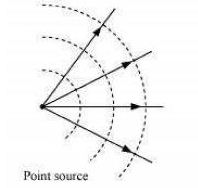
(a) Light diverging from a point source.
(b) Light emerging out of a convex lens when a point source is placed at its focus.
(c) The portion of the wavefront of light from a distant star intercepted by the Earth.
14.
Monochromatic light of wavelength 589 nm is incident from air on a water surface. What are the wavelength, frequency, and speed of
(a) reflected and
(b) refracted light? Refractive index of water is 1.33 ?
15.
A magician during a show makes a glass lens \(\mu =1.5\) disappear in a trough of liquid. What is the refractive index of the liquid? Is the liquid water?
16.
Figure shows a standard two slit arrangement with slits S1, S2, P1, P2 are the two minima points on either side of P (Figure). At P2 on the screen, there is a hole and behind P2 is a second 2- slit arrangement with slits S3, S4 and a second screen behind them
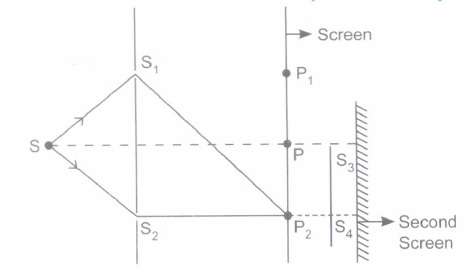
There would be no interference pattern on the second screen but it would be lighted.
The second screen would be totally dark.
There would be a single bright point on the second screen
There would be a regular two slit pattern on the second screen.
17.
In Young's double slit experiment, if the monochromatic source of yellow light is replaced by red light, the fringe width
increases
decreases
remains unchanged
the fringes disappear
18.
Resolving power of microscope depends upon
wavelength of light used (directly proportional)
wavelength of light used (inversely proportional
frequency of light used
focal length of objective
19.
What happens, if the monochromatic light used in Young's double slit experiment is replaced by white light?
No fringes are observed
All bright fringes become while
All bright fringes have colour between violet and red
Only the central fringe is white and all other fringes are coloured.
20.
Two coherent mono chromatic light beams of intensities I and 4I superimpose. The maximum and minimum possible intensities in the resulting beam are:
5I and I
5I and 3I
3I and I
9I and I
21.
From a single slit, the first diffraction minima is obtained at 30° for a light of 6500 \(\overset{o}{A}\) wavelength. The width of the slit is
3250 \(\overset{o}{A}\)
1.3 \(\mu\)
5.4 x 10- 4 km
1.2 x 10- 2 cm .
22.
When light is refracted into a denser medium
its wavelength and frequency both increases
its wavelength increases but frequency remains unchanged .
its wavelength decreases, but frequency remains the same
its wavelength and frequency both decreases
23.
The direction of wavefront of a wave with the wave motion is
parallel
perpendicular
opposite .
at an angle of \(\theta\)
24.
The focal length of a lens depends on
The radii of curvature of its surfaces
The refractive index of its material
The refractive index of the medium surrounding the lens
All the above facors
25.
A bi convex lens can form a virtual image if the object is placed
between f and lens
between f and 2f
beyond 2f
at infinity
26.
It is possible to observe total internal reflaction when a ray travels from
Air to water
Air into glass
Water into glass
Glass into water
27.
When light travels from an optically rarer medium to an optically denser medium, the velocity decreases because of change in
wave length
frequency
amplitude
phase
28.
The speed of light is
less in denser medium
more in denser medium
independent of the optical density of the medium
none of the above
29.
In a compound microscope, the distance between objective lens and eye lens is
fixed
variable
infinite
1 metre
30.
The relation governing refraction of light from rarer to denser medium at a spherical refracting surface is
\(-\frac { \mu _{ 1 } }{ u } +\frac { \mu _{ 2 } }{ \upsilon } =\frac { \mu _{ 2 }-\mu _{ 1 } }{ R } \)
\(\frac { \mu _{ 1 } }{ u } +\frac { \mu _{ 2 } }{ \upsilon } =\frac { \mu _{ 2 }-\mu _{ 1 } }{ R } \)
\(\frac { \mu _{ 1 } }{ u } -\frac { \mu _{ 2 } }{ \upsilon } =\frac { \mu _{ 2 }-\mu _{ 1 } }{ R } \)
none of these
31.
What is the refractive index of a medium in which light travels with a speed of \(2\times 10^{ 8 } \ m/s\) ?
3/2
2/3
1
none of these
32.
33.
Huygens Wave Theory of Light
1. According to wave theory, light from a source is propagated in the form of longitudinal waves with uniform velocity in a homogeneous medium.
2. To explain the propagation of waves through vacuum, Huygens assumed existance of a hypothetical medium called luminiferous ether. According to Huygens, ether particles are present and possess properties such as inertia, zero density and perfect transparency.
3. On the basis of Huygens wave theory, various colours of light are due to different wavelengths of the light of the waves.
(i) Write two merits and two demerits of Huygens wave theory of light.
(ii) Write Huygen's postulates to explain wave theory of light.
(iii) What are primary source and secondary source of light considered in wave theory?
1.
Resolving power of telescope is defined as the reciprocal of the smallest angular separation between two distant objects whose images are to be seen separately.
2.
When the prism is held in water
\({ ^{ w }\mu }_{ g }=Sin\left( A+m/2 \right) /SinA/2\)
As \(^{ w }{ \mu }_{ R }< { ^{ a }\mu }_{ g }\), so the angle of minimum deviation decreases in water
3.
Increase in focal length of eye lens when eye is fully relaxed.
4.
\(\angle i=\angle r=0^{\circ}\)
5.
(a) Reflection and refraction arise through interaction of incident light with the atomic constituents of matter. Atoms may be viewed as oscillators, which take up the frequency of the external agency (light) causing forced oscillations. The frequency of light emitted by a charged oscillator equals its frequency of oscillation. Thus the frequency of scattered light equals the frequency of incident light.
(b) No, Energy carried by a wave depends on the amplitude of the wave, not on the speed of wave propagation.
(c) For a given frequency, intensity of light in the photon crossing an unit area per uni time.
6.
The resultant intensity is given by
\( I_{R}=I_{1}+I_{2}+2 \sqrt{I_{1} I_{2}} \cos \phi, \)
\(\text { where } I_{1}=I, I_{2}=I+\delta I \)
\(At maxima, \cos \phi=1 \)
\( \therefore I_{\max }=I+I+\delta I+2 \sqrt{I(I+\delta I)} \)
\(\therefore I_{\max }=2 I+2 I=4 I \quad(\because \delta I<
\( At minima, \cos \phi=-1 \)
\(I_{\min }=I+I+\delta I-2 \sqrt{I(I+\delta I)} \)
\( I_{\min } =2 I+\delta I-2\left[I^{2}\left(1+\frac{\delta I}{I}\right)\right]^{1 / 2} \)
\( =2 I+\delta I-2 I\left[1+\frac{1}{2} \frac{\delta I}{I}-\frac{1}{8}\left(\frac{\delta I}{I}\right)^{2}+\ldots\right] \)
Neglecting the higher power, we get
\(I_{\min }=\frac{2 I}{8}\left(\frac{\delta I}{I}\right)^{2}=\frac{1}{4} \frac{(\delta I)^{2}}{I}\)
7.
(i) Reflection and refraction arises through interaction of incident light with the atomic constituents of matter. Atoms may be viewed as oscillators, which take up the frequency of the external agency (light) causing forced oscillations.
The frequency, of light emitted by a charged oscillator equals its frequency of oscillation. Thus, the frequency of scattered light equals the frequency of incident light.
(ii) No, the energy carried by a wave depends on the amplitude of the wave, not on the speed of wave propagation.
8.
Because wavelength of light wave is very small and obstacle of comparable size are not present around us.
The angular width of central maxima is given by, \(\theta={{2\lambda}\over{d}}\)
The width of central maxima is reduced to half when slit width is doubled increases with the increase of wavelength.
9.
(i) According to question
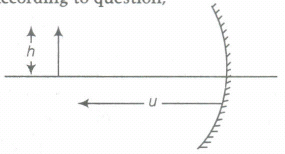
Given magnification ,(m) = -2R = -20cm
f = -10cm
i.e., \(\frac { h_{ 2 } }{ h_{ 1 } } =-2=\frac { -v }{ u } \Rightarrow u=\frac { v }{ 2 } v=2u\)
Now using mirror formula
\(\frac { 1 }{ v } +\frac { 1 }{ u } =\frac { 1 }{ f } \Rightarrow \frac { 1 }{ 2u } +\frac { 1 }{ u } =\frac { 1 }{ -10 } \)
\(\frac { 1+2 }{ 2u } =-\frac { 1 }{ 10 } \left( \therefore f=\frac { R }{ 2 } \right) \)
\(\frac { 3 }{ 2u } =-\frac { 1 }{ 10 } \Rightarrow u=\frac { -10\times 3 }{ 2 } =-15cm\)
v = 2xu = 2x-15 = -30cm
Hence the object distance and image distance are -15cm and -30 cm respectively in front of the mirror
(ii) According to mirror formula i.e. \(\frac { 1 }{ v } +\frac { 1 }{ u } =\frac { 1 }{ f } \)
And we know the value of u and f for a convex mirror are always negative and positive respectively So, the value of v will always be positive it means convex mirror always forms a virtual image.
10.
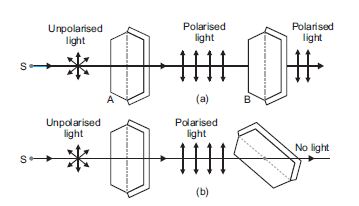
(a) Light from the sodium lamp passing through the single Polaroid sheet (P1) does not show any variation in intensity when this sheet is rotated. However, if the light, transmitted by P1 is made to pass through another Polaroid sheet (P2) the light intensity, coming out of P2 varies from a maximum to zero, and again to maximum, when P2 is rotated
These observations are consistent only with the transverse nature of light waves
(b) Intensity of light transmitted through
P1 = I0/2
Intensity of light transmitted through
P3 = (I0/2) x cos2 30°
= 3I0/8
Intensity of light transmitted through
P2 = P3 x cos2 (90° - 30°) = 3/8 I0cos2 60°
= 3/32 I0
11.
\(Here,\ \lambda =555nm=555\times { 10 }^{ -9 }m\)
\( D=25cm=25\times { 10 }^{ -2 }m; \ d\theta =?\)
\(d\theta =\frac { 1.22\lambda }{ D } =\frac { 1.22\times 555\times { 10 }^{ -9 } }{ 25\times { 10 }^{ -2 } }\)
\( =2.7\times { 10 }^{ -6 }rad\)
12.
Let I0 be the intensity of polarised light after passing through the first polariser P1. Then the intensity of light after passing through second polariser P2 will be
I = I0 cos 2 \(\theta\)
where \(\theta\) is the angle between pass axes of P1 and P2. Since P1 and P3 are crossed the angle between the pass axes of P2 and P3 will be ( \(\pi\) / 2 –\(\theta\) ). Hence the intensity of light emerging from P3 will be
\(I=I_{0} \cos ^{2} \theta \cos ^{2}\left(\frac{\pi}{2}-\theta\right)\)
\(=I_{0} \cos ^{2} \theta \sin ^{2} \theta=\left(I_{0} / 4\right) \sin ^{2} 2 \theta\)
Therefore, the transmitted intensity will be maximum when \(\theta\) = \(\pi\) / 4.
13.
(a) The shape of the wavefront in case of a light diverging from a point source is spherical. The wavefront emanating from a point source is shown in the given figure.
(b) The shape of the wavefront in case of a light emerging out of a convex lens when a point source is placed at its focus is a parallel grid. This is shown in the given figure.
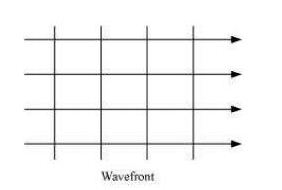
(c) The portion of the wavefront of light from a distant star intercepted by the Earth is a plane.
14.
\(Here, \ \lambda =589 \ nm,\ c=3\times { 10 }^{ 8 }m/s, \ \mu =1.33\)
(a) For reflected light
\(wavelength,\ \lambda =589\quad nm=589\times { 10 }^{ -9 }m,\quad v=\frac { c }{ \lambda } =\frac { 3\times { 10 }^{ 8 } }{ 589\times { 10 }^{ -9 } } =5.09\times { 10 }^{ 14 }hertz\)
\(speed,\ v=c=3\times { 10 }^{ 8 }m/s\)
(b) For refracted light \( \lambda '=\frac { \lambda }{ \mu } =\frac { 589\times { 10 }^{ -9 } }{ 1.33 } =4.42\times { 10 }^{ -7 }m\)
As frequency remains unaffected on entering another medium,
\(\\ therefore,\quad v'=v=5.09\times { 10 }^{ 14 }hertz\)
\(speed, \ v'=\frac { c }{ \mu } =\frac { 3\times { 10 }^{ 8 } }{ 1.33 } =2.25\times { 10 }^{ 8 }m/s\)
15.
From lens maker's formula,
\(\frac { 1 }{ f } =(\mu -1)\left( \frac { 1 }{ R_{ 1 } } -\frac { 1 }{ R_{ 2 } } \right) \)
where \(\mu =\frac { \mu _{ 2 } }{ \mu _{ 1 } } \)
If \(\mu _{ 2 }=\mu _{ 1 }, \ \frac { 1 }{ f } =0 \ or \ f=\infty \)
\(\therefore \) The lens in the liquid will act like a plane sheet of glass, when refractive index of the lens and the surrounding medium is the same. Therefore, refractive index of surrounding medium,
\(\mu _{ 2 }=\mu _{ 1 }=1.5\)
This liquid medium is not water because refractive index of water=1.33.
16.
(d)
There would be a regular two slit pattern on the second screen.
17.
(a)
increases
18.
(b)
wavelength of light used (inversely proportional
19.
(d)
Only the central fringe is white and all other fringes are coloured.
20.
(d)
9I and I
21.
(b)
1.3 \(\mu\)
22.
(c)
its wavelength decreases, but frequency remains the same
23.
(b)
perpendicular
24.
(d)
All the above facors
25.
(a)
between f and lens
26.
(d)
Glass into water
27.
(a)
wave length
28.
(a)
less in denser medium
29.
(a)
fixed
30.
(a)
\(-\frac { \mu _{ 1 } }{ u } +\frac { \mu _{ 2 } }{ \upsilon } =\frac { \mu _{ 2 }-\mu _{ 1 } }{ R } \)
31.
(a)
3/2
32.
33.
(i) Merits of Huygens Wave theory of light:
(a) Wave theory correctly predicted that velocity of light in an optically denser medium is less than that in the rarer medium which is in agreement with the experimental results.
(b) On the basis of wave theory phenomenon of reflection, refraction, interference, diffraction, polarization of light could be explained.
Demiritssof Huygens wave theory of light
(a) Huygens wave theory assumes the existence of luminiferous ether. However,experimentally it couldn't be proved.
(b) This theory couldn't explain rectilinear propagation of light.
(ii) (1) Each pointon a given primary wavefront acts as a source of secondary wavelets, sending out disturbances (waves) in all directions in a similar manner as the original source of light does.
(2) The new position of the wavefront at any instant (secondary wavefront) is given by the forward envelope to the secondary wavelets at that instant.
Huygens' construction
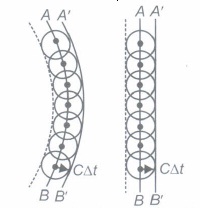
Using this principle the laws of reflection and refraction can be verified.
(iii) Primary source of light: It is a real source of light. It generates light itself and sends primary wavefronts in all directions.
Secondary source of light: It is a fictitious source of light presents on the wavefront and sends out secondary waves only in forward direction.

12th Standard CBSE Syllabus & Materials
12th Standard CBSE
CBSE 12th Computer Science Python Revision Tour I - New Previous year Question Papers Study Material - QB365 Set A
NEW12th Standard CBSE
CBSE 12th Business Studies Planning Important Questions And Answers Study Material - QB365 Set A
NEW12th Standard CBSE
CBSE 12th Business Studies Business Environment Important Questions And Answers Study Material - QB365 Set A
NEW12th Standard CBSE
CBSE 12th Business Studies Principles of Management Important Questions And Answers Study Material - QB365 Set A



NCERT Books

Syllabus

Exam Pattern

Sample Question Papers

Previous year Question Papers

Important Notes

MCQ Practice test

NCERT Exemplers

Case study Questions

Image Based Questions

Passage based Questions

HOT Questions

Value Based Questions

Model Questions Papers
NCERT ( Book Back ) Questions

Assertion and Reason
Important Questions And Answers

CBSE 12th Standard CBSE Subjects
CBSE Standards








