
 100% FREE ACCESS
12th Standard CBSE Syllabus & Materials
12th Standard CBSE
CBSE 12th Economics Government Budget and the Economy Previous year Question Papers Study Material - QB365 Set A
NEW12th Standard CBSE
CBSE 12th Computer Science Interface Python with MySQL - New Previous year Question Papers Study Material - QB365 Set A
NEW12th Standard CBSE
CBSE 12th Computer Science Database Concept - New Previous year Question Papers Study Material - QB365 Set A
NEW12th Standard CBSE
CBSE 12th Computer Science Data Communication - New Previous year Question Papers Study Material - QB365 Set A
NEW12th Standard CBSE
CBSE 12th Computer Science Data Structures - New Previous year Question Papers Study Material - QB365 Set A
NEW12th Standard CBSE
CBSE 12th Computer Science Functions - New Previous year Question Papers Study Material - QB365 Set A

Published on: 07/03/2026
Download CBSE Class 12th Standard CBSE Physics question papers, sample papers, important questions, and previous year solved papers in PDF format. Get free study materials, NCERT solutions, and exam preparation resources for Class 12th Standard CBSE Physics
Questions + Answers key
Take MCQ Physics Test
1.
Two convex lenses P and Q of an astronomical telescope having focal lengths 4 cm and 16 cm respectively are arranged as shown in the figure
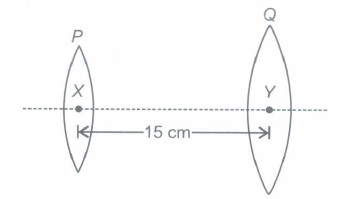
(i) Which one of the two lenses will you select to use as the objective lens and why?
(ii) What should be the change in the distance between the lenses to have the telescope in its normal adjustment position?
(iii) Calculate the magnifying power of the telescope in the normal adjustment position.
2.
An object is placed in front of a convex mirror of focal length 30 cm. If the image is a quarter of the size of the object, find the position of the image.
3.
A convex lens of focal length 20 cm is placed coaxially with a concave mirror of focal length 10 cm at a distance of 50 cm apart from each other. A beam of light coming parallel to the principal axis is incident on the convex lens. Find the position of the final image formed by this c.ombination. Draw the ray diagram showing the formation of the image
4.
A jar of height is filled with a transparent liquid of refractive index \(\mu \)(figure). At the centre of the jar on the bottom surface is a dot. Find the minimum diameter of a disc, such that when placed on the top surface symmetrically about the centre, the dot is invisible.

The problem is based on the principle of total inter reflection and area of visibility.
5.
A star is moving towards the earth with a speed of \(9\times { 10 }^{ 6 }m/s.\) . If wavelength of a particular spectral line emitted by star is 600 nm, find the apparent wavelength.
6.
A ray of light is incident at an angle of \(60°\) on a horizontal plane mirror. Through what angle should the mirror be titled to make the reflected ray horizontal?
7.
(i) At what distance should the lens be held from the card sheet in order to view the square distinctly with the maximum possible magnifying power?
(ii) What is the magnification in this case?
(iii) Is the magnification equal to magnifying power in this case? explain
8.
Can absolute value of refractive index of a medium be less than unity?
9.
Why are danger signals red in colour?
10.
The ratio of the intensities at minima to the maxima in the Young's double slit experiment is 9 : 25. Find the ratio of the widths of the two slits.
11.
Suppose that the lower half of the concave mirror’s reflecting surface in Fig. is covered with an opaque (non-reflective) material. What effect will this have on the image of an object placed in front of the mirror?
12.
How do the angle of minimum deviation of a glass prism vary, if the incident violet light is replaced by red light? Give reason.
13.
A diffraction grating has 5000 lines per cm. What is the grating element?
14.
Why cannot we obtain interference using two independent sources of light?
15.
Draw a ray diagram showing the image formation of a distant object by a refracting telescope. Define its magnifying power and write the two important factors considered to increase the magnifying power. Describe briefly the two main limitations and explain how far these can be minimized in a reflecting telescope.
16.
Define magnifying power of a telescope. Write its expression. A small telescope has an objective lens of focal length 150 cm and an eyepiece of focal length 5 cm. If this telescope is used to view a 100 m high tower 3 km away, find the height of the final image, when it is formed 25 cm away from the eyepiece.
17.
A prism is made of glass of unknown refractive index. A parallel beam of light is incident on a face of the prism. The angle of minimum deviation is measured to be 40°. What is the refractive index of the material of the prism? The refracting angle of the prism is 60°. If the prism is placed in water (refractive index 1.33), predict the new angle of minimum deviation of a parallel beam of light.
18.
(i) If f = 0.5 m for a glass lens, what is the power of the lens?
(ii) The radii of curvature of the faces of a double convex lens are 10 cm and 15 cm. Its focal length is 12 cm. What is the refractive index of glass?
(iii) A convex lens has 20 cm focal length in air. What is focal length in water? (Refractive index of air-water = 1.33, refractive index for air-glass = 1.5.)
19.
A beam of light consisting of two wavelengths 650 nm and 520 nm, is used to obtain interference fringes in Young's double-slit experiment.
(a) Find the distance of the third bright fringe on the screen from the central maximum for wavelength 650 nm.
(b) What is the least distance from the central maximum, where the bright fringes due to both the wavelengths coincide?
20.
A screen is placed 2m away from the single narrow slit. Calculate the slit width if the first minimum lies 5mm on either side of the central maximum. Incident plane waves have a wavelength of \(5000\mathring { A } \)
21.
Two lenses are in contact having powers of 5D and -3D. The focal length of this combination will be
50 cm
75 cm
25 cm
+20 cm
22.
An object is placed at a distance of 10 cm from a co-axial combination of two lenses A and B in contact. The combination forms a real image three times the size of the object. If lens B is concave with a focal length of 30 cm. The nature and focal length of lens A is
convex, 12 cm
concave, 12 cm
convex, 6 cm
convex, 18 cm
23.
The length of the compound microscope is 14 cm, The magnifying power for relaxed eye is 25. If the focal length of eye lens is 5 cm, then the object distance for objective lens will be
1.8 cm
1.5 cm
2.1 cm
2.4 cm
24.
When a prism is placed in the position of minimum deviation, the ray of light within the prism
Goes parallel to the base
Goes perpendicular to the base
Makes minimum angle with the base
Direction is not fixed relative to the base
25.
Which of the following cannot be polarized?
X-rays
radio waves
sound waves
light waves
26.
Huygens Wave Theory of Light
1. According to wave theory, light from a source is propagated in the form of longitudinal waves with uniform velocity in a homogeneous medium.
2. To explain the propagation of waves through vacuum, Huygens assumed existance of a hypothetical medium called luminiferous ether. According to Huygens, ether particles are present and possess properties such as inertia, zero density and perfect transparency.
3. On the basis of Huygens wave theory, various colours of light are due to different wavelengths of the light of the waves.
(i) Write two merits and two demerits of Huygens wave theory of light.
(ii) Write Huygen's postulates to explain wave theory of light.
(iii) What are primary source and secondary source of light considered in wave theory?
27.
An optical fibre is a thin tube of transparent material that allows light to pass through, without being refracted into the air or another external medium. It make use of total internal reflection. These fibres are fabricated in such a way that light reflected at one side of the inner surface strikes the other at an angle larger than critical angle. Even, if fibre is bent, light can easily travel along the length.
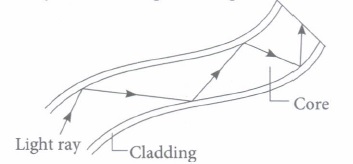
(i) Which of the following is based on the phenomenon of total internal reflection of light?
| (a) Sparkling of diamond | (c) Instrument used by doctors for endoscopy |
| (b) Optical fibre communication | (d) All of these |
(ii) A ray of light will undergo rotal internal reflection inside the optical fibre, if it
| (a) goes from rarer medium to denser medium |
| (b) is incident at an angle less than the critical angle |
| (c) strikes the interface normally |
| (d) is incident at an angle greater than the critical angle |
(iii) If in core, angle of incidence is equal to critical angle, then angle of refraction will be
| (a) 0° | (b) 45° | (c) 90 | (d) 180° |
(iv) In an optical fibre (shown), correct relation for refractive indices of core and cladding is
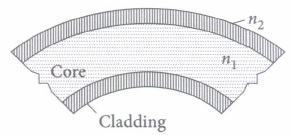
| (a) n1 = n2 | (b) n1 > n2 | (c) n1 < n2 | (d) n1 + n2 = 2 |
(v) If the value of critical angle is 30° for total internal reflection from given optical fibre, then speed of light in that fibre is
| (a) 3 x 10⁸ m S-1 | (b) 1.5 x 10⁸ m S-1 | (c) 6 x 10⁸ m s-1 | (d) 4.5 x 10⁸ m s-1 |
1.
(i) Magnifying power of a telescope \((m)=\frac{f_{o}}{f_{e}}\) so the lens of focal length 4 cm is used as an eyepiece
and the lens of focal length 16 cm is used for an objective lens.
(ii) The separation between the two lenses should be increased to 20 cm, because in normal adjustment, the length of a microscope is given by
\(
L=f_{o}+f_{e}=16+4=20 \mathrm{~cm}
\)
\(\text { (iii) Given: } f_{o}=16, f_{e}=4 \quad \therefore \quad m=\frac{f_{o}}{f_{e}}=\frac{16}{4}=4
\)
2.
Given, focal length, f = +30 cm
Magnification, \(m=\frac{1}{4}, v=?\)
From mirrors formula,
\(\frac{1}{f}=\frac{1}{u}+\frac{1}{v} \quad\left[\because m=-\frac{v}{u} \Rightarrow u=-\frac{v}{m}\right]\)
\( \Rightarrow \quad \frac{1}{f}=-\frac{m}{v}+\frac{1}{v} \)
\(\Rightarrow m=\frac{f-v}{f} \Rightarrow \frac{1}{4}=\frac{30-v}{30} \)
\(\Rightarrow 30=120-4 v \)
\(\Rightarrow \quad v=\frac{90}{4}=+22.5 \mathrm{~cm} \)
As, v is positive, therefore a virtual and erect image will be formed on other side of the object.
3.
Image formed by the lens will be f at focus.
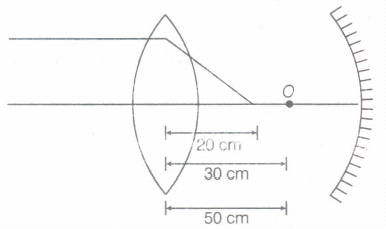
For mirror, U = - 30, f = - 10
According to lens formula
\(\frac { 1 }{ f } =\frac { 1 }{ v } +\frac { 1 }{ u } \Rightarrow \frac { 1 }{ -10 } =\frac { 1 }{ v } -\frac { 1 }{ 30 } \Rightarrow \frac { 1 }{ v } =\frac { 1 }{ 30 } -\frac { 1 }{ 10 } \)
\(\Rightarrow \frac { 1 }{ v } =\frac { 1 }{ 1-3 } \Rightarrow v=-15cm\),
4.
Let d be the diameter of the disc. The sopt shall be invisible, if the incident rays OA and OB suffer total internal reflection.
Let i be the angle of incidence

Using relationship between refractive index and critical angle, then
\(\sin { i=\frac { 1 }{ \mu } }\)
Using geometry and trigonometry,
Now,
\(\frac { d/2 }{ h } =\tan { i } \Rightarrow \frac { d }{ 2 } =h\tan { i } =h[\sqrt { { \mu }^{ 2 }-1{ ] }^{ -1 } }\)
\( [\because \ From \ the \ figure,\ tani=\frac { 1 }{ \sqrt { { \mu }^{ 2 } } -1 } ]\)
\( d=\frac { 2h }{ \sqrt { { \mu }^{ 2 } } -1 } \)
This is required expression of d.
5.
\(Here,\ \upsilon =9\times { 10 }^{ 6 }m/s,\ \lambda =600nm, \ { \lambda }^{ ' }=?\)
\(\Delta \lambda =-\frac { \upsilon }{ c } \lambda =-\frac { 9\times { 10 }^{ 6 } }{ 3\times { 10 }^{ 8 } } \times 600=-18nm\)
\( \therefore \ { \lambda }^{ ' }=\lambda +\Delta \lambda =600-18=582nm\)
6.
To make the reflected ray horizontal, it must be turned further through \(90°-60°=30°\), therefore the mirror must be turned through \(30/2=30°\)
7.
(i) Maximum magnifying power is obtained when the image is the near point (25)
\(\therefore \ v=-25 \ cmf=10 \ cm\)
\(\\ using\frac { 1 }{ v } -\frac { 1 }{ u } =\frac { 1 }{ f } \)
\( -\frac { 1 }{ 25 } -\frac { 1 }{ u } =\frac { 1 }{ f }\)
\(u= -\frac { 50 }{ 7 } =-7.14 \ cm\)
(ii) Magnitude of magnification
\(m=\frac { 25 }{ u } =\frac { 25 }{ 7.14 } =35\)
(iii) magnifying power \(=\left( 1+\frac { D }{ f } \right) =\left( 1+\frac { 25 }{ 10 } \right) =3.5\)
Yes, the magnifying power (when the image is produced at 25 cm) is equal to the magnitude of magnification.
8.
As the speed of light is maximum in vacuum, therefore absolute value of refractive index cannot be less than unity as it is given by the relation \(n=\frac{c}{v}\)
9.
position of object. The colour red is used for danger signals because red light is scattered the least by air molecules. The effect of scattering is inversely, related to the fourth power of the wavelength, i.e. \(I \propto \frac{1}{\sqrt{\lambda^4}}\) of colour, so red light is able to travel the longest distance through fog, rain and the alike.
10.
\(\frac{I_{\min }}{I_{\max }}=\frac{9}{25}=\frac{(a-b)^{2}}{(a+b)^{2}}\\ \Rightarrow \ \frac{a-b}{a+b}=\frac{3}{5}\\ \Rightarrow a = 4b\\ As, \frac{W_{1}}{W_{2}}=\frac{a^{2}}{b^{2}}=\frac{(4 b)^{2}}{b^{2}}=\frac{16}{1}\)
11.
You may think that the image will now show only half of the object, but taking the laws of reflection to be true for all points of the remaining part of the mirror, the image will be that of the whole object. However, as the area of the reflecting surface has been reduced, the intensity of the image will be low (in this case, half).
12.
Wavelength of violet light is smaller than that of red light. Also, angle of minimum deviation,
\(\delta _{ m }=\left( \mu -1 \right) A\Rightarrow \delta _{ m }=\mu \)
As \(\mu _{ R }< \mu _{ V }=\Rightarrow \left( \delta _{ m } \right) _{ E }< \left( \delta _{ m } \right) V\)
As, deviation is less for red light, hence, angle of deviation decreases.
13.
\(Grating \ element \ =\frac { 1 }{ 5000 } =2\times { 10 }^{ -4 }cm\)
14.
This is because two independent sources of light cannot be coherent, as their relative phases are changing randomly.
15.
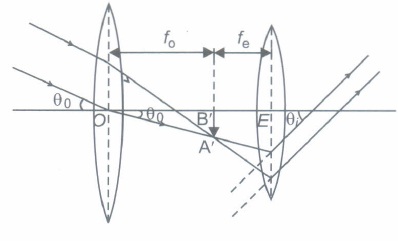
ray diagram of a refracting telescope
Magnifying power is the ratio of angle subtended at the eye by the final image to the angle subtended by the object at the eye.
\(m=\frac{f_{o}}{f_{e}}\)
We can increase the magnifying power by:
(i) increasing focal length of an objective.
(ii) decreasing focal length of an eyepiece.
Limitations:
(i) Refracting type telescope suffers from chromatic aberration.
(ii) They have small resolving power.
Advantages of reflecting typestelescope
(i) It is free from chromatic aberration as there is no refraction.
(ii) The aperture of mirror can be kept larger in comparison to the aperture of lenses, because their grinding/polishing is easier and they can easily be provided with mechanical support. With larger aperture the resolving power of telescope increases.
16.
The magnifying power of a telescope is equal to the ratio of the visual angle subtended at the eye by final image formed at least distance' of distinct vision to the visual angle subtended at naked eye by the object at infinity.
Magnification, m = \(\frac{I}{O}=\frac{v_{0}}{u_{0}}=\frac{f_{0}}{u_{0}}\)
\(\Rightarrow \ \frac{I}{100}=\frac{150 \times 10^{-2}}{3 \times 10^{3}}\)
⇒ I = 5 x 10⁻² m = 5 cm
17.
Angle of minimum deviation, \({ \delta }^{ ' }_{ m }\) = 40°
Angle of the prism, A = 60°
Refractive index of water, µ = 1.33
Refractive index of the material of the prism = µ'
The angle of deviation is related to refractive index (µ') as:
\({ \mu }^{ ' }=\frac { sin\frac { (A+{ \delta }_{ m }) }{ 2 } }{ sin\frac { A }{ 2 } }\)
\(=\frac { sin\frac { ({ 60 }^{ o }+{ 40 }^{ o }) }{ 2 } }{ sin\frac { { 60 }^{ o } }{ 2 } }\)\(=\frac { sin{ 50 }^{ o } }{ sin{ 30 }^{ o } } =1.532\)
Hence, the refractive index of the material of the prism is 1.532.
Since the prism is placed in water, let be the new angle of minimum deviation for the same prism.
The refractive index of glass with respect to water is given by the relation:
\({ \mu }_{ g }^{ w }=\frac { { \mu }^{ ' } }{ \mu } =\frac { sin\frac { (A+{ \delta }^{ ' }_{ m }) }{ 2 } }{ sin\frac { A }{ 2 } }\)
=\(sin\frac { (A+{ \delta }^{ ' }_{ m }) }{ 2 } =\frac { { \mu }^{ ' } }{ \mu } sin\frac { A }{ 2 }\)
= \(sin\frac { (A+{ \delta }^{ ' }_{ m }) }{ 2 } =\frac { 1.532 }{ 1.33 } \times sin\frac { { 60 }^{ o } }{ 2 } =\)0.5759
= \(\frac { (A+{ \delta }^{ ' }_{ m }) }{ 2 } ={ sin }^{ -1 }{ 0.5759=35.16 }^{ o }\)
= \({ 60 }^{ o }+{ \delta }^{ ' }_{ m }={ 70.32 }^{ o }\)
\(\therefore { \delta }^{ ' }_{ m }={ 70.32 }^{ o }-{ 60 }^{ o }={ 10.32 }^{ o }\)
Hence, the new minimum angle of deviation is 10.32°.
18.
(i) Power = +2 dioptre.
(ii) Here, we have f = +12 cm, R1 = +10 cm, R2 = -15 cm.
Refractive index of air is taken as unity.
We use the lens formula. The sign convention has to be applied for f, R1 and R2.
Substituting the values, we have
\(\frac { 1 }{ 12 } =(n-1)\left( \frac { 1 }{ 10 } -\frac { 1 }{ 15 } \right) \)
This gives n = 1.5.
(iii) For a glass lens in air, n2 = 1.5, n1 = 1, f = +20 cm. Hence, the lens formula gives
\(\frac { 1 }{ 20 } =0.5\left( \frac { 1 }{ { R }_{ 1 } } -\frac { 1 }{ { R }_{ 2 } } \right) \)
For the same glass lens in water, n2 = 1.5, n1 = 1.33. Therefore \(\frac { 1.33 }{ f } =(1.5-1.33)\left[ \frac { 1 }{ { R }_{ 1 } } -\frac { 1 }{ { R }_{ 2 } } \right] \)
Combining these two equations, we find f = + 78.2 cm.
19.
(a) Wavelength of the light beam, λ1 = 650 nm
Wavelength of another light beam, λ2 = 520 nm
Distance of the slits from the screen = D
Distance between the two slits = d
Distance of the nth bright fringe on the screen from the central maximum is given by the relation,
\(x=n \lambda_{1}\left(\frac{D}{d}\right)\)
For third bright fringe n = 3
\(\therefore x=3 \times 650 \frac{D}{d}=1950\left(\frac{D}{d}\right) n m\)
(b) Wavelength of the light beam, \(\lambda_1\) = 650 nm
Wavelength of another light beam, λ2 = 520 nm
Distance of the slits from the screen = D
Distance between the two slits = d
Let the nth bright fringe due to wavelength λ2 and (n − 1)th bright fringe due to wavelength lambda coincide on the screen. We can equate the conditions for bright fringes as:
\(n \lambda_{2}=(n-1) \lambda_{1}\)
520 n = 650 n -650
650 = 130 n
\(\therefore\) n = 5
Hence, the least distance from the central maximum can be obtained by the relation:
\(x=n \lambda_{2} \frac{D}{d}\)
\(=5 \times 582 \frac{D}{d}=2600 \frac{D}{d} n m\)
20.
Here, distance of the screen from the slit, D = 2m,
a = ?, x = 5 mm = \(5\times { 10 }^{ -3 }m\),
\(\lambda =5000\mathring { A } =5000\times { 10 }^{ -10 }m\)
\(For \ the \ first \ secondary \ minima,\)
\( sin\theta =\frac { \lambda }{ a } =\frac { x }{ D } \)
\(a=\frac { D\lambda }{ x } =\frac { 2\times 5000\times { 10 }^{ -10 } }{ 5\times { 10 }^{ -3 } } =2\times { 10 }^{ -4 }m\)
21.
(c)
25 cm
22.
(c)
convex, 6 cm
23.
(a)
1.8 cm
24.
(a)
Goes parallel to the base
25.
(c)
sound waves
26.
(i) Merits of Huygens Wave theory of light:
(a) Wave theory correctly predicted that velocity of light in an optically denser medium is less than that in the rarer medium which is in agreement with the experimental results.
(b) On the basis of wave theory phenomenon of reflection, refraction, interference, diffraction, polarization of light could be explained.
Demiritssof Huygens wave theory of light
(a) Huygens wave theory assumes the existence of luminiferous ether. However,experimentally it couldn't be proved.
(b) This theory couldn't explain rectilinear propagation of light.
(ii) (1) Each pointon a given primary wavefront acts as a source of secondary wavelets, sending out disturbances (waves) in all directions in a similar manner as the original source of light does.
(2) The new position of the wavefront at any instant (secondary wavefront) is given by the forward envelope to the secondary wavelets at that instant.
Huygens' construction
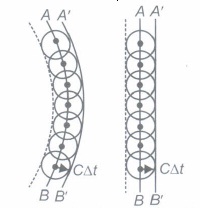
Using this principle the laws of reflection and refraction can be verified.
(iii) Primary source of light: It is a real source of light. It generates light itself and sends primary wavefronts in all directions.
Secondary source of light: It is a fictitious source of light presents on the wavefront and sends out secondary waves only in forward direction.
27.
(i) (d): Total internal reflection is the basis for following phenomenon:
(a) Sparkling of diamond.
(b) Optical fibre communication.
(c) Instrument used by doctors for endoscopy.
(ii) (d): Total internal reflection (TIR) is the phenomenon that involves the reflection of all the incident light off the boundary. TIR only takes place when both of the following two conditions are met:The light is in the more denser medium and approaching the less denser medium.The angle of incidence is greater than the critical angle.
(iii) (c) : If incidence of angle, i = critical angle e, then angle of refraction, r = \(90^{\circ}\)
(iv) (b): In optical fibres, core is surrounded by cladding, where the refractive index of the material of the core is higher than that of cladding to bound the light rays inside the core.
(v) (b): From Snell's law, \(\sin C={ }_{1} n_{2}=\frac{v_{1}}{v_{2}}\)
where, c = critical angle = 30° and V1 and V2 are speed oflight in medium and vacuum, respectively.
We know that, v2 = 3 x 10⁸ m s-l
\(\therefore \quad \sin 30^{\circ}=\frac{v_{1}}{3 \times 10^{8}} \)
\(\Rightarrow \quad v_{1}=3 \times 10^{8} \times \frac{1}{2} \Rightarrow v_{1}=1.5 \times 10^{8} \mathrm{~ms}^{-1} \)

12th Standard CBSE Syllabus & Materials
12th Standard CBSE
CBSE 12th Computer Science Python Revision Tour I - New Previous year Question Papers Study Material - QB365 Set A
NEW12th Standard CBSE
CBSE 12th Business Studies Planning Important Questions And Answers Study Material - QB365 Set A
NEW12th Standard CBSE
CBSE 12th Business Studies Business Environment Important Questions And Answers Study Material - QB365 Set A
NEW12th Standard CBSE
CBSE 12th Business Studies Principles of Management Important Questions And Answers Study Material - QB365 Set A



NCERT Books

Syllabus

Exam Pattern

Sample Question Papers

Previous year Question Papers

Important Notes

MCQ Practice test

NCERT Exemplers

Case study Questions

Image Based Questions

Passage based Questions

HOT Questions

Value Based Questions

Model Questions Papers
NCERT ( Book Back ) Questions

Assertion and Reason
Important Questions And Answers

CBSE 12th Standard CBSE Subjects
CBSE Standards








