
 100% FREE ACCESS
12th Standard CBSE Syllabus & Materials
12th Standard CBSE
CBSE 12th Economics Government Budget and the Economy Previous year Question Papers Study Material - QB365 Set A
NEW12th Standard CBSE
CBSE 12th Computer Science Interface Python with MySQL - New Previous year Question Papers Study Material - QB365 Set A
NEW12th Standard CBSE
CBSE 12th Computer Science Database Concept - New Previous year Question Papers Study Material - QB365 Set A
NEW12th Standard CBSE
CBSE 12th Computer Science Data Communication - New Previous year Question Papers Study Material - QB365 Set A
NEW12th Standard CBSE
CBSE 12th Computer Science Data Structures - New Previous year Question Papers Study Material - QB365 Set A
NEW12th Standard CBSE
CBSE 12th Computer Science Functions - New Previous year Question Papers Study Material - QB365 Set A

Published on: 15/11/2019
Current Electricity
Download CBSE Class 12th Standard CBSE Physics question papers, sample papers, important questions, and previous year solved papers in PDF format. Get free study materials, NCERT solutions, and exam preparation resources for Class 12th Standard CBSE Physics
Questions + Answers key
Take MCQ Physics Test
1.
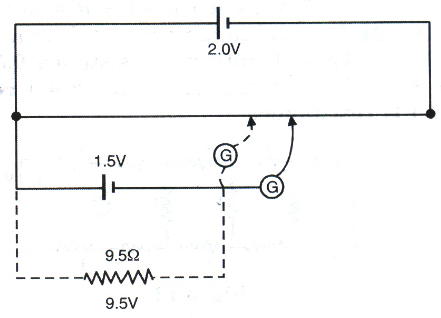
Figure shows a 2.0 V potentiometer used for the determination of internal resistance of 1.5V cell. The balance point of the cell in open circuit is 76.3 cm. When a resistor of \(9.5\Omega \) is used in external circuit of the cell, the balance point shifts to 64.8 cm length of the potentiometer wire. Determine the internal resistance of the cell.
2.
Choose the correct alternative:
(a) Alloys of metals usually have (greater/less) resistivity than that of their constituent metals.
(b) Alloys usually have much (lower/higher) temperature coefficients of resistance than pure metals.
(c) The resistivity of alloy manganin (is nearly independent of/increases rapidly) with increases of temperature.
(d) The resistivity of a typical insulator (e.g. amber) is greater than that of a metal by a factor of the order of \(\ ({ 10 }^{ 22 }/{ 10 }^{ 23 })\) .
3.
The potential difference across a potentiometer wire 8m long 2.5V. Calculate the e.m.f of the cell which is balanced by 100 cm long wire.
4.
Rajesh has an old two wheeler. One day he wanted to start his two wheeler but he could not do so. He observed carefully and found that its battery was defective. Then he arranged 6 V dry cell battery but it was also unable to start two wheeler. Then his friend Mahesh came and suggested him that this battery will not work because its internal resistance is more and it cannot give a desired current of 30 A which is required for starting the two wheelers. As per his suggestion, Rajesh got fitted a lead acid battery of 6 V and his problem was solved.
(a) According to you, what values were displayed by Mahesh?
(b) The storage battery of a car has an emf 12 V. If the internal resistance of the battery is 0.4 Ω, what is the maximum current that can be drawn from the battery?
5.
1. (a) State the principle of a potentiometer. Define potential gradient. Obtain an expression for a potential gradient in terms of resistivity of the potentiometer wire.
(b) Figure shows a long potentiometer wire AB having, a constant potential gradient. The null points for. the two primary cells of EMFs \(\varepsilon_1\) and \(\varepsilon_2\) connected in the manner shown are obtained at a distance of l1 = 120 cm and I2 = 300 cm from the end A. Determine
(i) \(\varepsilon_1\) /\(\varepsilon_2\) and
(ii) position of null point for the cell \(\varepsilon_1\) only.
.jpg)
6.
Vishwajeet purchased cells for his transistor. He felt that cells are not working properly. He wanted to check their emf. So, he took the cells to the physics lab and with the help of potentiometer found their emf. To his surprise, emf was less than the value claimed by the manufacturer. He lodged the complaint with consumer forum and received the deserving response.
Read the above passage and answer the following question.
(i) What values are displayed by Vishwajeet?
(ii) Why do you think Vishwajeet used potentiometer instead of voltmeter to find out emf of the cell? For more precise measurement, the potential gradient of the potentiometer should be high or low?
7.
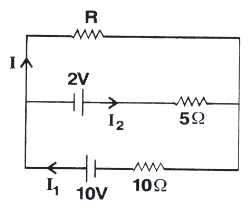
Two cells of voltages 10V and 2V and internal resistances \(10\Omega\ and\ 5\Omega \) respectively are connected in parallel with the positive end of 10V battery connected to negative pole of 2V battery. Find the effective voltage and effective resistance of the combination.
8.
Give any two applications super conductors
9.
Three resistance 3Ω, 6Ω and 9Ω are connected to a battery. In which of them will the power dissipation be maximum if
a) They are all connected in parallel
b) They are all connected in series Give reason.
10.
You are given 8 \(\Omega \) resistor. What length of wire of resistance 120 Ωm-1 should be joined in parallel with it to get a value of 6 \(\Omega \) ?
11.
A 10Ω thick wire is stretched so that its length becomes three times. Assuming that there is no change in its density on stretching. Calculate the resistance of new wire
12.
What is the end error in meter bridge? How do you remove it?
13.
What are superconductors? Write their two applications.
14.
Write the mathematical relation between mobility and drift velocity between mobility and drift velocity of charge carriers in a conductor. Name the mobile charge carriers responsible for conduction of electric current in (a) an electrolyte (b) an ionised gas.
15.
What is the resistance of carbon resistor on which the colour of rings in sequence is black, brown, black and gold.
16.
How can you keep a constant current inside a conductor?
17.
A steady current is flowing in a cylindrical conductor. Is there any electric field within the conductor?
1.
Internal resistance of the cell = r
Balance point of the cell in open circuit, l1 = 76.3cm
An external resistance (R) is connected to the circuit with R = 9.5Ω
New balance point of the circuit, l2 = 64.8cm
Current flowing through the circuit = l
Using the relation connecting resistance and emf is,
\(\mathrm{r}=\left(\frac{\mathrm{l}_{1}-\mathrm{l}_{2}}{\mathrm{l}_{2}}\right) \mathrm{R}\)
\(=\frac{76.3-64.8}{64.8} \times 9.5=1.68 \Omega\)
Therefore, the internal resistance of the cell is 1.68Ω.
2.
(a) Alloys of metals usually have greater resistivity than that of their constituent metals.
(b) Alloys usually have much lower temperature coefficients of resistance than pure metals.
(c) The resistivity of the alloy manganin is nearly independent of increase of temperature.
(d) The resistivity of a typical insulator is greater than that of a metal by a factor of the order of 1022.
3.
Potential gradient \(=\frac{2.5}{8}=0.3125 \mathrm{~V} / \mathrm{m}\). As potential drop across the balancing length is equal to the emf of the
cell, i.e. emf = 0.3125 x 1 = 0.3125 V.
4.
(a) (i) Presence of mind.
(ii) High degree of general awareness.
(iii) Helping and caring nature. 2
(b) For maximum current, external resistance,
R = 0
\(I=\frac{E}{R+r}=\frac{12}{0.4}=\frac{12}{0.4}=30A\)
5.
Principle : When a steady current flows through a wire of uniform cross-section, the potential drop across any segment is directly proportional to the length of the segment of the wire i.e. V a l
Potential gradient is the potential drop across the wire per unit length of the wire i.e
\(K=\frac{V}{l}\)
Potential gradient \(K=\frac{V}{l}=\frac{IR}{l}\)
\(K=\frac{\frac{I\times pl}{A}}{l}\)
\(K=\frac{IP}{A}\)
(b) (i) \(\frac{\varepsilon _1-\varepsilon _2}{\varepsilon _1-\varepsilon _2}=\frac{120}{300}=\frac{2}{5}\)
\(\frac{\varepsilon _1}{\varepsilon _2}=\frac{7}{3}\)
(iii) \(\frac{e_1+e_2}{\varepsilon _2}=\frac{300}{x}\Rightarrow \ \frac{300}{x}=\frac{10}{7}\)
\(\Rightarrow\ \ x=210\ cm\)
6.
(i) Values displayed by Vishwajeet are as follows
(a) General awareness
(b) Presence of mind
(c) Use of scientific knowledge
(ii) Potentiometer is based on null point method. Voltmeter draws current at the time of measurement of potential difference across the cell. So, it does not give the correct value of emf. For more precise measurements, it should be low.
7.
From Kirchhoff's junction rule, we have
\( { I }_{ 1 }={ I }+{ I }_{ 2 }\) ...........(i)
Applying Kirchhoff's loop rule to outer loop containing 10V cell, we get
\(10=IR+{ 10I }_{ 1 }\) ............(ii)
Applying Kirchhoff's loop rule to outer loop containing 2V cell, we get
\(2={ 5I }_{ 2 }-RI\)
\(2=5\left( { I }_{ 1 }-I \right) -RI\)
\(4={ 10I }_{ 1 }-10I-2RI\)
Subtracting eq (ii) from eq (i), we get
\(6=3RI+10I\)
\(2=I\left( R+\frac { 10 }{ 3 } \right) \)
From Ohm's law, we have
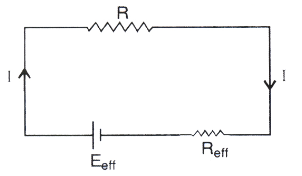
\(V=I\left( R+{ R }_{ off } \right) \)
Comparing eq (iii) and (iv), we get
\({ R }_{ ef }=\frac { 10 }{ 3 } \Omega \)
If \({ E }_{ eff }\) and \({ R }_{ eff }\) are the effective voltage and effective internal resistance of the combination, then the equivalent circuit is shown.
8.
Superconductors are the materials that lose all its resistance at very low temperature = 0 K
Applications of Super conductor are used
a) In making very strong electromagnets
b) In producing veru high speed computers
9.
a) in parallel, power dissipation \(\alpha\) 1/R
Therefore 3\(\Omega \) wire will dissipate more power
b) In series, power dissipation \(\alpha\) R
Therefore 9\(\Omega \) wire will dissipate more power
10.
Now, 1/R = 1R1 + 1R2
Because 1 = 48/240 = 0.2 m
11.
\(\mathrm{R}=\rho(1 / \mathrm{A})\)
\(
=\rho\left(1^2 / \mathrm{A} 1\right) \\
=\rho 12 / \mathrm{V}
\)
Since \(\rho\) and V are constans therefore
\(\rightarrow\left(R_2 / R_1\right)=\left(12 / l_1\right)^2=9\)
Because R2 = 9R1
\(=9 \times 10=90 \Omega\)
12.
The end error in the meter bridge is due to the following reasons:
(i) The zero mark of the scale provided along the bridge wire may not start from the position where the bridge wire leaves the copper strip and 100 cm mark of the scale may not be at position, where the bridge wire just touches the other copper strip.
(ii) The resistances of the connecting wires and copper strips of meter bridge have not been taken into account.
The end error can be removed by repeating the experiment by interchanging the known and unknown resistances and taking the mean of the resistances determined.
13.
As the temperature of certain metals and alloys decreases, their resistance also decreases. When the temperature reaches a certain critical value called critical temperature, the resistance of material completely disappears, i.e., it becomes zero. Then the material behaves as a superconductor.
Thus superconductors are those material conductors whose resistances disappear at critical temperature. The critical temperature is different materials.
Superconductors are used
(i) in power transmission
(ii) to produce very high speed computers.
14.
Mobility, \(\mu = \frac{drift \ \ velocity}{electric \ \ field}=\frac{v_d}{E}\)
(a) The charge carriers in an electrolyte are positive and negative ions.
(b) The charge carriers in an ionised gas are electrons and positively charged ions.
15.
Value of carbon resistance = \(01×10oΩ±5% = 1Ω±5%\)
16.
A constant current can be kept inside a conductor by maintaining a constant potential difference across the two ends of conductor.
17.
Yes. A steady current in a cylindrical conductor if electric force is acting on free electrons which make the electrons to move in a particular direction. It is possible due to electric field within the conductor.

12th Standard CBSE Syllabus & Materials
12th Standard CBSE
CBSE 12th Computer Science Python Revision Tour I - New Previous year Question Papers Study Material - QB365 Set A
NEW12th Standard CBSE
CBSE 12th Business Studies Planning Important Questions And Answers Study Material - QB365 Set A
NEW12th Standard CBSE
CBSE 12th Business Studies Business Environment Important Questions And Answers Study Material - QB365 Set A
NEW12th Standard CBSE
CBSE 12th Business Studies Principles of Management Important Questions And Answers Study Material - QB365 Set A



CBSE 12th Standard CBSE Subjects
CBSE Standards










