
 100% FREE ACCESS
12th Standard CBSE Syllabus & Materials
12th Standard CBSE
CBSE 12th Economics Government Budget and the Economy Previous year Question Papers Study Material - QB365 Set A
NEW12th Standard CBSE
CBSE 12th Computer Science Interface Python with MySQL - New Previous year Question Papers Study Material - QB365 Set A
NEW12th Standard CBSE
CBSE 12th Computer Science Database Concept - New Previous year Question Papers Study Material - QB365 Set A
NEW12th Standard CBSE
CBSE 12th Computer Science Data Communication - New Previous year Question Papers Study Material - QB365 Set A
NEW12th Standard CBSE
CBSE 12th Computer Science Data Structures - New Previous year Question Papers Study Material - QB365 Set A
NEW12th Standard CBSE
CBSE 12th Computer Science Functions - New Previous year Question Papers Study Material - QB365 Set A

Published on: 30/10/2019
Current Electricity
Download CBSE Class 12th Standard CBSE Physics question papers, sample papers, important questions, and previous year solved papers in PDF format. Get free study materials, NCERT solutions, and exam preparation resources for Class 12th Standard CBSE Physics
Questions + Answers key
Take MCQ Physics Test
1.
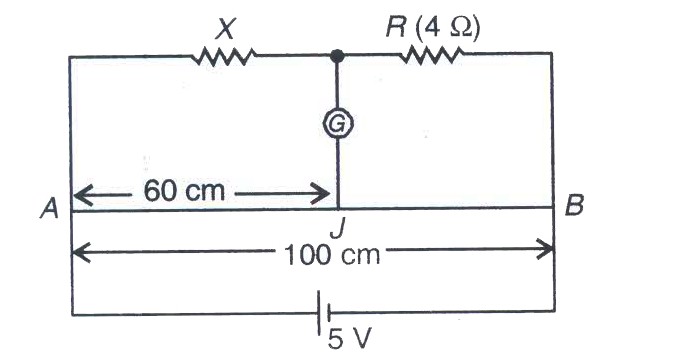
Calculate the value of unknown resistance X and the current drawn by the circuit assuming that no current flows through the galvanometer. Assume the resistance per unit length of the wire AB to be 0.01\(\Omega\)/cm.
2.
Four identical cells, each of emf 2V are joined in parallel providing supply of current to external circuit consisting of two 15\(\Omega\) resistors joined in parallel. The terminal voltage of the cells as read by an ideal voltmeter is 1.6V Calculate the internal resistance of each cell.
3.
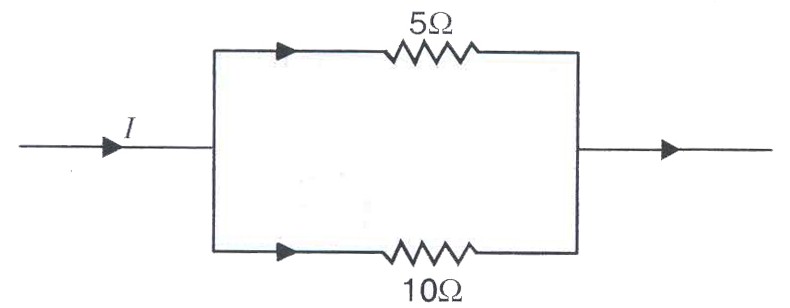
In the arrangement of resistors shown here, what fraction of I will pass through 5\(\Omega\) resistor?
4.
Two identical cells of e.m.f 1.5V each joined in parallel provide supply to an external circuit consisting of two resistors of 17\(\Omega\) each joined in parallel. A very high resistance voltmeter reads the terminal voltage of the cells to be 1.4V. What is the internal resistance of each cell?
5.
With a certain unknown resistance X in the left gap and a resistance of 8\(\Omega\) in the right gap, null point is obtained on the meter-bridge wire. On putting another 8\(\Omega\) resistor in parallel with the 8\(\Omega\) resistor in the right gap, the null point is found to shit by 15cm. Find the value of X from these observations.
6.
The length of the potentiometer wire is 600cm and it carries a current of 40mA. For a cell of e.m.f. 2V and internal resistance 10\(\Omega\) the null point is found to be at 500 cm. If a voltmeter is connected across the cell the balancing length is decreased by 10 cm. Find
(i) the resistance of whole wire
(ii) reading of voltmeter and
(iii) resistance of voltmeter.
7.
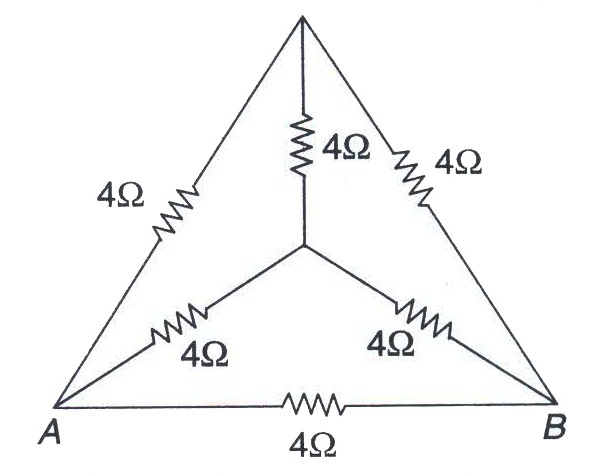
Calculate (i)the equivalent resistance between A and B of the electrical network given below and (ii)the current drawn by the network in a battery of e.m.f 8V internal resistance 1\(\Omega\) is connected across the points A and B.
1.
As no current is drawn by galvanometer, we can use the relation
\(\frac{X}{4}=\frac{60}{40} \Rightarrow X=6 \Omega\)
The resistance per unit length of the wire AB is 0.01 Ω cm-1.
Resistance of the wire,
AB = 0.01 x 100 = 1 Ω
Effective resistance in the circuit,
\(R_{e f f}=\frac{1 \times 10}{10+1}=\frac{10}{11} \Omega\)
Thus, \(I=\frac{5 \times 11}{10}=5.5 \mathrm{~A}\)
2.
According to the question, the circuit can be drawn as shown in the figure
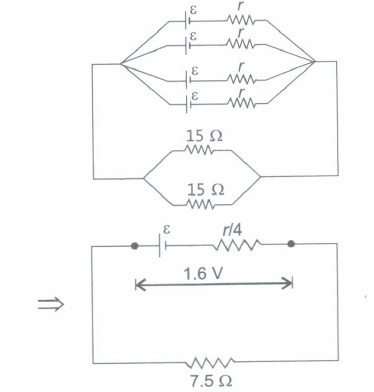
where ε = 2 V, and r = internal resistance of each cell
An equivalent circuit can be redraw as shown.
\(
\frac{r}{4} =\left[\frac{E-V}{V}\right] \times R
\)
\(=\left[\frac{2-1.6}{1.6}\right] \times 7.5
\)
\(r =7.5 \Omega
\)
3.
I1 = 2 I 3
4.
1.2\(\Omega\)
5.
At initial condition, let a null point is obtained at a length = I
\(\therefore \ \frac{X}{8}=\frac{l}{100-l}\) ...(i)
In second case, a new null point is obtained at a length
= 1 + 15, resistance in the right gap = \(\frac{8}{2}=4 \Omega\)
\(\frac{X}{4}=\frac{l+15}{85-l}\) .....(ii)
Dividing (i) by (ii), we get
\(\frac{4}{8}=\frac{l}{100-l} \times \frac{85-l}{l+15} \Rightarrow l^{2}-85 l+1500=0 \)
∴ I = 60 cm or 25 cm
Putting in (i), we get X = 12 Ω 2.67 Ω
6.
(i) When a voltmeter is not connected, the length of wire = 600 cm, J = 40 mA, balancing length (I)
= 500 cm and applied emf = 2 V.
\(\therefore \text { P.d. across wire }=\frac{6}{5} \times 2=2.4 \mathrm{~V}\)
∴ Resistance of wire = \(\frac{2.4}{40 \times 10^{-3}}=60 \Omega\)
(ii) Reading of voltmeter
= potential gradient x balancing length
\(=\frac{2}{500} \times 490=1.96 \mathrm{~V}\)
(iii) Current drawn by voltmeter
\(
I^{\prime} =\frac{2-1.96}{10}=4 \times 10^{-3} \mathrm{~A}
\)
\(\therefore \ R_{\mathrm{V}} =\frac{1.96}{4 \times 10^{-3}}=0.49 \times 10^{3}=490 \Omega
\)
7.
R = 2\(\Omega\)
I = 2.6A

12th Standard CBSE Syllabus & Materials
12th Standard CBSE
CBSE 12th Computer Science Python Revision Tour I - New Previous year Question Papers Study Material - QB365 Set A
NEW12th Standard CBSE
CBSE 12th Business Studies Planning Important Questions And Answers Study Material - QB365 Set A
NEW12th Standard CBSE
CBSE 12th Business Studies Business Environment Important Questions And Answers Study Material - QB365 Set A
NEW12th Standard CBSE
CBSE 12th Business Studies Principles of Management Important Questions And Answers Study Material - QB365 Set A



CBSE 12th Standard CBSE Subjects
CBSE Standards










