
 100% FREE ACCESS
12th Standard CBSE Syllabus & Materials
12th Standard CBSE
CBSE 12th Economics Government Budget and the Economy Previous year Question Papers Study Material - QB365 Set A
NEW12th Standard CBSE
CBSE 12th Computer Science Interface Python with MySQL - New Previous year Question Papers Study Material - QB365 Set A
NEW12th Standard CBSE
CBSE 12th Computer Science Database Concept - New Previous year Question Papers Study Material - QB365 Set A
NEW12th Standard CBSE
CBSE 12th Computer Science Data Communication - New Previous year Question Papers Study Material - QB365 Set A
NEW12th Standard CBSE
CBSE 12th Computer Science Data Structures - New Previous year Question Papers Study Material - QB365 Set A
NEW12th Standard CBSE
CBSE 12th Computer Science Functions - New Previous year Question Papers Study Material - QB365 Set A

Published on: 14/09/2019
Electromagnetic Induction and Alternating Currents
Download CBSE Class 12th Standard CBSE Physics question papers, sample papers, important questions, and previous year solved papers in PDF format. Get free study materials, NCERT solutions, and exam preparation resources for Class 12th Standard CBSE Physics
Questions + Answers key
Take MCQ Physics Test
1.
Show that the current leads the voltage in phase by \(\pi /2\) in an ac circuit containing an ideal capacitor.
2.
Prove that an ideal capacitor in an AC circuit does not dissipate power.
3.
An alternating voltage given by V = 70 sin 100 1tt is connected across a pure resistor of 25 \(\Omega.\) Find
(i) the frequency of the source.
(ii) the rms current through the resistor.
4.
An electric lamp having a coil of negligible inductance connected in series with a capacitor and an AC source is glowing with certian brightness. How does the brightness of the lamp change on reducing the (i) capacitance, and (ii) the frequency? Justify your answer.
5.
Why is the coil of dead beat galvanometer wound on a metal frame?
6.
Obtain the resonant frequency \(({ \omega }_{ r })\) of a series L-C-R circuit with L = 2.0 H, \(C=32\mu F \) and \(R=10\Omega \) . What is the Q-value of this circuit?
7.
A source of emf e is used to establish a current I through a coil of self-inductance L. Show that the work done by the source to build up the current I is \(\cfrac { 1 }{ 2 } { LI }^{ 2 }\)
8.
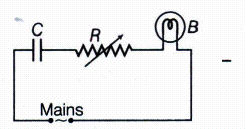
A capacitor C, a variable resistance R and a bulb B are connected in series to the AC mains in circuit as shown in the figure.The bulb glows of the bulb change, if
(i) a dielectric slab is introduced between the plates of the capacitor, keeping resistance R to be same;
(ii) the resistance R is increased keeping will capacitance?
9.
In an a.c. circuit, there is no power consumption in an ideal inductor. Explain
10.
A capacitor allows a.c. to pass through. Why?
11.
Define reactance X and impedance Z. Can these be negative? If yes, when and what does it imply?
12.
Distinguish between alternating current and direct current by giving two points.
13.
What are phase lines and neutral line in respect of a generator?
14.
A solenoid with an iron core and a bulb are connected to a.d.c source. How does the brightness of bulb change when iron core is removed from the solenoid ?
1.
\(v={ v }_{ o }sin \ \omega t\)
\(q=CV=c{ CV }_{ o } \ sin \ \omega t\)
\(I=\frac { dq }{ dt } =\omega C{ V }_{ o } \ cos \ \omega t\)
\(I=\omega C{ V }_{ o } \ sin(\omega t+\frac { \pi }{ 2 } )\)
so the current leads the applied voltage, in phase by\( \ \frac { \pi }{ 2 } \)
2.
Since, average power consumption in an AC circuit is given by
Pav = Vrms X Irms X cos
But in pure capacitive circuit, phase difference between voltage and current is given by
\(\phi={ { \pi}\over{2 } }\)
\(\therefore\) \({P}_{av}={V}_{rms}\times{I}_{rms}\times{{\pi}\over{2}}\)
\(\Rightarrow\) Pav = 0 \(\left( \because\ cos\ {{\pi}\over{2}}=0 \right)\)
Thus, no power is consumed in pure capacitive AC circuit.
3.
P = 150W, V = 220V
Resistance of the bulb, R = \({ { {V}^{2} }\over{ P } }\)
R = \({ { 220\times 220 }\over{150 } }=332.7\Omega\)
As, Ims = \({{{V}_{rms}}\over{R}}={ { 220 }\over{ 322.7 } }\) (Vrms = V = 220V)
\(\Rightarrow\) Irms = 0.68A
4.
\({ X }_{ c }=\frac { 1 }{ \omega C } =\frac { 1 }{ 2\pi vC } \)
AsC decreases, Xc will increase. Hence brightness will decrease.
(ii)
\({ X }_{ c }=\frac { 1 }{ \omega C } =\frac { 1 }{ 2\pi vC } \)
As frequence (v) decreases, Xc will increase. Hence brightness will decrease
5.
On switching on the current in a galvanometer, the coil of the galvanometer does not come to rest immediately. It oscillates about its equilibrium position but the coil of a dead beat galvanometer comes to rest immediately. It is due to the reason that the eddy currents are set up in the metallic frame, over which the coil is wound and the eddy currents oppose the oscillatory motion of the coil.
6.
Given, L = 2.0 H, C = 32 x 10-6 F,
\(R=10\Omega \)
\({ \omega }_{ r }\) = ? Q = ?
\({ \omega }_{ r }=\frac { 1 }{ \sqrt { LC } } =\frac { 1 }{ \sqrt { 2.0\times 32\times { 10 }^{ -6 } } } \)
\(\frac { { 10 }^{ 3 } }{ 8 } =125rad/s\)
\( Q=\frac { 1 }{ R } \sqrt { \frac { L }{ C } } =\frac { 1 }{ 10 } \sqrt { \frac { 2 }{ 32\times { 10 }^{ -6 } } } \)
\(\frac { 1 }{ 10\times 4\times { 10 }^{ -3 } } =25\)
7.
The magnitude of emf is given by \(\left| e \right| \ or\ e=L\cfrac { { dl }_{ 0 } }{ dt } \)
Multiplying by I0 to both sides, we get
\(\ e{ I }_{ 0 } \ dt={ LI }_{ 0 } \ { dI }_{ 0 }\)
\(But \ { I }_{ 0 }=\cfrac { dq }{ dt } \ or \ { I }_{ 0 }dt=dq\)
Also, work done = voltage x charge
or \(dW=e\times dq=e{ I }_{ 0 }\ dt\)
Substituting the value from Eq. (i) into Eq. (ii), we get
\(dW={ LI }_{ 0 }{ dI }_{ 0 }\)
total work done in increasing the current from zero to I, we have by integrating both sides of Eq. we get
\(\int _{ 0 }^{ w }{ dW } =\int _{ 0 }^{ I }{ L{ I }_{ 0 } } d{ I }_{ 0 }\Rightarrow W=\frac { 1 }{ 2 } { LI }^{ 2 }\)
This work done in increasing the current flowing through the inductor is stored as the potential energy U in the magnetic field of inductor,
\(U=\cfrac { 1 }{ 2 } { LI }^{ 2 }\)
8.
(i) As the electric slab is introduced between the plates of the capacitor, its capacitance. Hence, the potential drop across the capacitor will i.e \(V=\frac { Q }{ C } \)
As a result, the potential drop across the bulb will increase as they are connected in series. Thus its brightness will increase.
(ii) As a resistance R is increased, the potential drop across the resistor will increase. As a result, the potential drop across the bulb will decrease as they are connected in series. Thus, its brightness will decrease.
9.
Average power/cycle in an a.c. circuit is
\(P={ E }_{ \upsilon }{ I }_{ \upsilon }cos\phi \)
In an ideal inductor, which has no ohmic resistance, phase angle \(\phi ={ 90 }^{ \circ }\)
\(\therefore \ P={ E }_{ \upsilon }{ I }_{ \upsilon }cos{ 90 }^{ \circ }=Zero\)
Infact, power supplied during growth of current is retrieved during decay of current through the ideal inductor.
10.
The capacitative reactance is given by
\({ X }_{ C }=\frac { 1 }{ \omega C } =\frac { 1 }{ \omega C } =\frac { 1 }{ 2\pi vC }\)
\(For \ a.c.,v\neq 0.\therefore { X }_{ C }\neq \infty \)
Hence a condenser does not block a.c. It allows a.c. to pass through.
11.
For definitions, see text. As \(X={ X }_{ L }-{ X }_{ C }=\) negative, when \({ X }_{ C }{ >X }_{ L },\) i.e., reactance X can be negative.
It implies, alternating current leads the applied alternating voltage in the circuit. However, Z cannot be negative.
12.
(i) Alternating current is that current which shows periodic variation in its value with time. Direct current is that current whose magnitude and direction do not change.
(ii) The frequency of alternating current has some finite value. The frequency of direct current is zero.
13.
In a polyphase generator, one end of each coil is brought to a common point through shaft of the generator. The line wire from this point is called neutral line. The line wires from other ends of different coils through their slip rings and brushes are called phase lines.
14.
In a.d.c. circuit, reactance of inductor/solenoid is zero. Therefore, removal of iron core does not affect the brightness of bulb.

12th Standard CBSE Syllabus & Materials
12th Standard CBSE
CBSE 12th Computer Science Python Revision Tour I - New Previous year Question Papers Study Material - QB365 Set A
NEW12th Standard CBSE
CBSE 12th Business Studies Planning Important Questions And Answers Study Material - QB365 Set A
NEW12th Standard CBSE
CBSE 12th Business Studies Business Environment Important Questions And Answers Study Material - QB365 Set A
NEW12th Standard CBSE
CBSE 12th Business Studies Principles of Management Important Questions And Answers Study Material - QB365 Set A



CBSE 12th Standard CBSE Subjects
CBSE Standards










