
 100% FREE ACCESS
12th Standard CBSE Syllabus & Materials
12th Standard CBSE
CBSE 12th Economics Government Budget and the Economy Previous year Question Papers Study Material - QB365 Set A
NEW12th Standard CBSE
CBSE 12th Computer Science Interface Python with MySQL - New Previous year Question Papers Study Material - QB365 Set A
NEW12th Standard CBSE
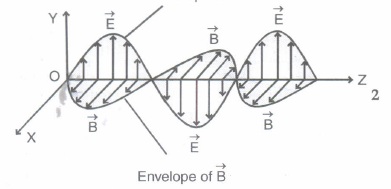
CBSE 12th Computer Science Database Concept - New Previous year Question Papers Study Material - QB365 Set A
NEW12th Standard CBSE
CBSE 12th Computer Science Data Communication - New Previous year Question Papers Study Material - QB365 Set A
NEW12th Standard CBSE
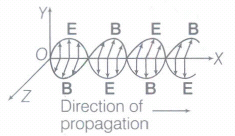
CBSE 12th Computer Science Data Structures - New Previous year Question Papers Study Material - QB365 Set A
NEW12th Standard CBSE
CBSE 12th Computer Science Functions - New Previous year Question Papers Study Material - QB365 Set A

Published on: 14/09/2019
Electromagnetic Waves
Download CBSE Class 12th Standard CBSE Physics question papers, sample papers, important questions, and previous year solved papers in PDF format. Get free study materials, NCERT solutions, and exam preparation resources for Class 12th Standard CBSE Physics
Questions + Answers key
Take MCQ Physics Test
1.
A e.m. wave, Y1, has a wavelength of 1cm while another e.m. wave, Y2, has a frequency of 1015 Hz. Name these two types of waves and write one useful application for each.
2.
How are infrared rays produced? Write their two important uses.
3.
Explain briefly how electromagnetic waves are produced by an oscillating charge. How is the frequency of EM waves produced related to that of the oscillating charge?
4.
Find the wavelength of electromagnetic waves frequency in 5 x 10¹⁹Hz in free space. Give its two application.
5.
How are microwaves produced? Why is it necessary in microwave ovens to select the frequency of microwaves to match the resonant frequency of water molecules?
Write two important uses of infra-red waves.
6.
Draw a sketch of a plane electromagnetic wave propagating along the z-direction. Depict clearly the directions of electric and magnetic fields varying sinusoidally with z.
7.
How does a charge q oscillating at certain frequency produce electromagnetic waves?
Sketch a schematic diagram depicting electric and magnetic fields for an electromagnetic wave propagating along the Z-direction.
8.
How are the magnitudes of the electric and magnetic fields related to the velocity of the EM wave?
9.
A capacitor of capacitance, C is being vharged by connecting it across a DC sourse along with an ammeter. Will the ammeter show a momentry deflection during the process of chargings? If so,how would you explain this momentry deflection and the resulting continuity of current in the circuit? Write the expression for the current inside the capacitor?
10.
A capacitor made of two parallel plates each of the plate A and separationd, is being chrged by an external AC source. Show that the displacement current inside the capacitor is capacitor.
11.
(i) An electromagnetic wave is travelling in a medium with a velocity v = \(\upsilon \overset { \wedge }{ i } \). Draw a sketch showing the propagation of the electromagnetic wave indicating the direction of the oscillating electric and magnetic fields.
(ii) How are the magnitudes of the electric and magnetic fields related to velocity of the electromagnetic wave?
12.
The electromagnetic waves are the radiations of the large range of wavelength. what are their velocities
(i) In vacuum and
(ii) In a medium?
13.
What happens to the intensity of light from a bulb if the distance from the bulb is doubled? As a laser beam travels across the length of a room, its intensity essentially remains constant. What geometrical characteristic of LASER beam is responsible for the constant intensity which is missing in the case of light from the bulb?
1.
Y1 Microwaves
Microwave oven, Aircraft Navigator or any other
Y2 Ultraviolet waves
Sterilize surgical instruments, food preservation or any other
2.
Source: Infrared waves are produced by hot objects and vibration of atoms and molecules.
Uses:
(i) In remote control of TV, VCR, etc.
(ii) In photography in thin mist.
3.
An oscillating charge is considered as the accelerating charge. This produces an oscillating electric field in space, which produces an oscillating magnetic field, that in turn again produces oscillating electric field. These oscillating and magnetic electric field, hence keep on regenerating each other and an electromagnetic wave.
The is produced. frequency of EM wave = frequency charge
4.
\(\lambda =\frac { c }{ v } =\frac { 3\times { 10 }^{ 8 } }{ 5\times { 10 }^{ 19 } } =6\times { 10 }^{ -12 }m=0.06\overset { o }{ A } \)
This wavelength corresponds to X-rays wchich are used:
(i) as a diagnostic tool
(ii) as s treatmenrt for certain forms of cancer.
5.
(i) Microwaves are produced by special vacuum tubes like the klystron, / Magnetron / Gunn diode.
The frequency of microwaves is selected to match the resonant frequency of water molecules, so that energy is transferred efficiently to the kinetic energy of the molecules.
(ii) (a) Associated with the green house effect.
(b) In remote switches of household electrical appliances.
6.
The direction of propagation of the electromagnetic wave is perpendicular to both electric field vector E and magnetic field vector B, i.e. In the direction of E x B.
This can be seen by the diagram given below.
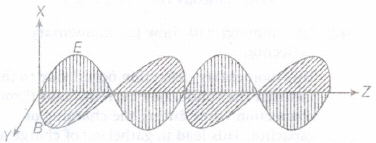
Here, electromagnetic wave is along the Z-direction which is given by the cross product of E and B
7.
An electric charge at rest has an electric field in the region around it, but no magnetic field. A moving charge, however, produces both electric and magnetic fields. If the charge is moving with constant velocity (that is, the current is not changing with time), the fields will not change with time and no electromagnetic wave can be produced. If, however, the motion of the charge is accelerated, the electric and the magnetic fields will change with space and time; then it produces electromagnetic waves. Hence we conclude that an accelerated charge emits electromagnetic waves.
In an oscillatory L-C circuit, charge oscillates across the capacitor plates. An oscillating charge has a non-zero acceleration; hence it emits electromagnetic wave of frequency same as that of the oscillating charge.
Shows the graphical representation of an electromagnetic wave in which the electric field.
vector \(\vec { E } \) and the magnetic field vector \(\vec { B } \) are vibrating along Y and X-directions respectively, and the wave is propagating along Z-direction. Both E and B vary with time and space and have the same frequency.
8.
\(\frac { { E }^{ 0 } }{ { B }^{ 0 } } =c\)
9.
Yes, the ammeter will show the momentary deflection.
This momentary deflection occurs due to the fact that the conducting current flows through connecting wires during the charging of capacitor. This leads to deposition of charge at two plates and hence, varying electric field of increasing nature is produced between the plates which in turn produces displacement current in space between two plates, which maintains the continuity with the conduction current.
\({ I }_{ c }={ I }_{ d }\)
i.e Current inside the capacitor=Displacement current Where,
\({ I }_{ d }=\varepsilon _{ 0 }\frac { d\phi _{ E } }{ dt }\)
10.
Let the alternating emf charging the plates of capacitor be V = V0 sin \(\omega\)t ....(i)
Charge on the capacitor,
q = CV = CV0 sin \(\omega\)t [from Eq.(i)]
and instantaneous current, \(I=\frac{d q}{d t}=\frac{d}{d t}\left(C V_0 \sin \omega t\right)\)
\(=\omega C V_0 \cos \omega t=I_0 \cos \omega t\)
where, \(I_0=\omega C V_0\)
Displacement current, \(I_d=\varepsilon_0 \frac{d \phi_E}{d t}\)
\(\begin{aligned} \Rightarrow \varepsilon_0 A \frac{d(E)}{d t} & =\varepsilon_0 A \frac{d}{d t}\left(\frac{q}{\varepsilon_0 A}\right)=\varepsilon_0 A \frac{d}{d t}\left(\frac{C V_0 \sin \omega t}{\varepsilon_0 A}\right) \end{aligned}\)
\(\begin{aligned} =\frac{d}{d t}\left(C V_0 \sin \omega t\right) \end{aligned}\)
\(\begin{aligned} =\omega C V_0 \cos \omega t=I_0 \cos \omega t \end{aligned}\)
Thus, the displacement current inside the capacitor is the same as the current charging the capacitor.
11.
(i) Given that velocity, v = \(\upsilon \overset { \wedge }{ i } \) , i.e. the wave is propagating along X-axis so electric field E is along Y-axis and magnetic field B is along Z-axis. The
propagation of electromagnetic wave is shown in the figure.
(ii) Speed of electromagnetic wave can be given as
\(c=\frac { { E }_{ 0 } }{ { B }_{ 0 } } =\frac { E }{ B } \)
where, E0 and B0 are peak values of E and B or instantaneous values of E and B.
12.
The wavelength of electromagnetic waves ranges from.\(6\times { 10 }^{ -14 }m \ to \ 6\times { 10 }^{ 6 }m\) These waves travel at the same velocity in a\((=3\times { 10 }^{ 8 }{ ms }^{ -1 })\) vacuum but with different velocity in a medium. In fact, the velocity of an electromagnetic wave is less in a medium than vacuum and a medium provides different values of refractive index to the electromagnetic waves of different wavelengths.
13.
Intensity of light is reduced to one fourth because the light beam spreads as it approaches into a spherical region of area \(4\pi { r }^{ 2 },i.e.,I\infty 1/{ r }^{ 2 }\) But laser beam does not spread, hence its intensity remains constant. Laser beam is unidirectional, monochromatic and coherent light, whereas the light from a bulb does not posses the above properties.

12th Standard CBSE Syllabus & Materials
12th Standard CBSE
CBSE 12th Computer Science Python Revision Tour I - New Previous year Question Papers Study Material - QB365 Set A
NEW12th Standard CBSE
CBSE 12th Business Studies Planning Important Questions And Answers Study Material - QB365 Set A
NEW12th Standard CBSE
CBSE 12th Business Studies Business Environment Important Questions And Answers Study Material - QB365 Set A
NEW12th Standard CBSE
CBSE 12th Business Studies Principles of Management Important Questions And Answers Study Material - QB365 Set A



CBSE 12th Standard CBSE Subjects
CBSE Standards










