
 100% FREE ACCESS
12th Standard CBSE Syllabus & Materials
12th Standard CBSE
CBSE 12th Economics Government Budget and the Economy Previous year Question Papers Study Material - QB365 Set A
NEW12th Standard CBSE
CBSE 12th Computer Science Interface Python with MySQL - New Previous year Question Papers Study Material - QB365 Set A
NEW12th Standard CBSE
CBSE 12th Computer Science Database Concept - New Previous year Question Papers Study Material - QB365 Set A
NEW12th Standard CBSE
CBSE 12th Computer Science Data Communication - New Previous year Question Papers Study Material - QB365 Set A
NEW12th Standard CBSE
CBSE 12th Computer Science Data Structures - New Previous year Question Papers Study Material - QB365 Set A
NEW12th Standard CBSE
CBSE 12th Computer Science Functions - New Previous year Question Papers Study Material - QB365 Set A

Published on: 30/09/2019
Electrostatics
Download CBSE Class 12th Standard CBSE Physics question papers, sample papers, important questions, and previous year solved papers in PDF format. Get free study materials, NCERT solutions, and exam preparation resources for Class 12th Standard CBSE Physics
Questions + Answers key
Take MCQ Physics Test
1.
Calculate the potential at the centre of a square of side \(\sqrt { 2 } m\), which carries at its four corners charges of +2nC, +1nC, -2nC and -3nC respectively.
2.
Four point charge 10-8 C,\(−2×{{10}^{−8}}C\) and \(-4\times {{10}^{-8}}C\) and \(6\times {{10}^{-8}}C\) are placed at the four corners of a square of side \(2\sqrt { 2 }cm. \) Calculate the electric potential at the centre of square.
3.
Two point charge of \(+3\times {{10}^{-8}}C\) and \(-2\times {{10}^{-8}}C\) are located 15cm apart in air. Find at what point on the joining these charge the electric potential is zero. Take potential at infinity to be zero.
4.
Two capacitors \(3\mu F\) and \(6\mu F\) are connected in series with a 6V battery. A cross which of the capacitors will there be larger potential difference?
5.
A regular hexagon of side 10 cm has a charge 5\(\mu\) C at each of its vertices. Calculate the potential at the centre of the hexagon.
6.
(i) If two similar large plates, each of area A having surface charge densities +σ and -σ are separated by a distanced in air, find the expression for
(a) field at points between the two plates and on outer side of the plates. Specify the direction of the field in each case.
(b) the potential difference between the plates.
(c) the capacitance of the capacitor so formed.
(ii) Two metallic spheres of radii R and 2R are charged, so that both of these have same surface charge density σ. If they are connected to each other with a conducting wire, in which direction will the charge flow and why?
7.
An electric dipole of dipole moment p consists of point charges +q and q separated by a distance 2a apart. Deduce the expression for the electric field E due to the dipole at a distance x from the centre of the dipole on its axial line in terms of the dipole moment p. Hence, show that in the limit
x >> a, E \(\longrightarrow\) 2P\((4\pi{\epsilon}_{0}{x}^{3})\).
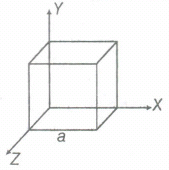
Given the electric field in the region E = 2x \(\hat{i}\), find the net electric flux through the cube and the charge enclosed by it.
8.
Use Gauss's theorem to find the electric field due to a uniformly charged infinitely large plane thin sheet with surface charge density \(\sigma\) .
(ii) An infinitely large thin plane sheet has a uniform surface charge density \(+\sigma\). Obtain the expression for the amount of work done in bringing a point charge q from infinity to a point, distant r, in front of the charged plane sheet.
9.
A physics teacher tells his students in the class that in paramagnetic materials, every atom has some permanent magnetic dipole moment. In the absence of an external magnetic field, the atomic dipoles are randomly oriented so that average magnetic moment per unit volume of the material behaves as a magnet. When an external magnetic field is applied, the torque developed tries to align the atomic magnetic dipoles in the direction of the field. That is why the specimen gets magnetized weekly in the direction of the field.
Read the above passage and answer the following questions:
(i) Name any three paramagnetic materials
(ii) Name any two ferromagnetic materials. How is their behavior different from that of paramagnetic materials?
(iii) The teacher asks the students how true is the famous saying: 'Spare the rod and spoil the child', comment.
10.
A rectangular coil of n turns each of area A, carrying current I, when suspended in a uniform magnetic field B, experiences a torque
\(\tau =nI \ BA \ sin\theta \)
Where is \(\theta \) the angle which a normal drawn on the plane of coil makes with the direction of magnetic field. This torque tends to rotate the coil and bring it in an equilibrium position. In the stable equilibrium state, the resultant force on the coil is zero. The torque on the coil is also zero and the coil has minimum potential energy.
Read the above passage and answer the following questions:
(i) In which position, a current carrying coil suspended in uniform magnetic field experiences
(a) minimum torque and
(b) maximum torque?
(ii) a circular coil of 200 turns, radius 5 cm carries a current of 2.0 A. It is suspended vertically in a uniform horizontal magnetic field of 0.20 T, with the plane of the coil making an angle with \(60°\) the field lines. Calculate the magnitude of the torque that must be applied on it to prevent it from turning.
(iii) what is the basic value displayed by the above study?
1.
Given; \(q_{1}=+2 \mathrm{nC}, q_{2}=+1 \mathrm{nC}, q_{3}=-2 \mathrm{nC}q_{4}=-3 \mathrm{nC}\)
\( \therefore \ V =\Sigma \frac{q}{4 \pi \varepsilon_{0} r} \)
\(=\frac{9 \times 10^{9}}{1}[2+1-2-3] \times 10^{-9} \)
\(V =-18 \times 10^{9} \times 10^{-9}=-18 \mathrm{~V}\)
2.
\(4.5\times {{10}^{3}}V\)
3.
\(x=0.09\)m from \(q=3\times {{10}^{-8}}C\)
4.
\(3\mu F\)
5.
ABCDEF is a regular hexagon of side 10 cm each. At each corner, the charge q =5 \(\mu\)C is placed. O is the centre of the hexagon.
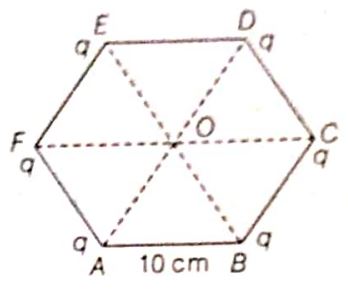
Given, AB = BC = CD = DE
= EF = FA = d = 10 cm
As, the hexagon has six equilateral triangles, so the distance of centre O from every vertex is 10 cm.
i.e. OA = OB = OC = OD
= OE = OF = d = 10 cm
\(\therefore\) Potential at point O = Sum of potentials at centre O due to individual point charge
i.e. VO = VA + VB + VC + VD + VE + VF
\(=\frac{1}{4\pi \varepsilon_{0}}.\left [ \frac{q}{OA}+\frac{q}{OB}+\frac{q}{OC}+\frac{q}{OD}+\frac{q}{OE}+\frac{q}{OF} \right ]\)
\(=\frac{1}{4\pi \varepsilon _{0}}.\frac{6q}{d}\) \(\left [ \because V=\frac{1}{4\pi \varepsilon _{0}.\frac{q}{r}} \right ]\)
Putting the values, we get
\(=9\times 10^{9}\times \frac{6\times 5 \times 10^{-6}}{10\times 10^{-2}}\)
= 2.7 \(\times\)106 V
6.
(i) According to question
s.png)
(a) Electric field due to a plate of positive charge at point P = \(\frac { \sigma }{ 2{ \varepsilon }_{ 0 } } \)
Electric field due to other plate = \(\frac { \sigma }{ 2{ \varepsilon }_{ 0 } } \)
Since, they have same direction, so
\(E=\frac { \sigma }{ 2{ \varepsilon }_{ 0 } } +\frac { \sigma }{ 2{ \varepsilon }_{ 0 } } =\frac { \sigma }{ { \varepsilon }_{ 0 } } \)
Outside the plate, electric field be zero because of opposite direction.
(b) Potential difference between the plates is given by
\(V=Ed=\frac { \sigma d }{ { \varepsilon }_{ 0 } } \quad \left( \because E=\frac { \sigma }{ { \varepsilon }_{ 0 } } \right) \)
(c) Capacitance of the capacitor is given by (\(\because\)Q = CV)
\(C=\frac { Q }{ V } =\frac { \sigma A }{ \sigma d } { \varepsilon }_{ 0 }=\frac { { \varepsilon }_{ 0 }A }{ d } \)
(ii) According to question,
s.png)
Potential at the surface of radius R,
\(=\frac { kq }{ R } \quad [\because q=\sigma \times { 4R }^{ 2 }]\)
\(\Rightarrow \frac { k\sigma 4\pi { R }^{ 2 } }{ R } =\sigma k4\pi R=4k\sigma \pi R\)
Potential at the surface of radius 2R,
\(=\frac { kq }{ 2R } \quad [\because q=\sigma \times { 4\pi (2R) }^{ 2 }=16\sigma \pi { R }^{ 2 }]\)
\(so,\ \frac { k\sigma 16\pi { R }^{ 2 } }{ 2R } =8k\sigma \pi R\)
Since, the potential of bigger sphere is more. So, charge will flow from sphere of radius 2R to sphere of radius R.
7.
Electric field on an axial line of an electric dipole
s.png)
Let P be at distance r from the centre of the dipole on the side of charge - q.
Then, the electric field at point P due to charge - q of the dipole is given by
E-q = \({ { q }\over{ 4\pi{\epsilon}_{0}(r+a)^{2} } }\hat{p}\)
where, \(\hat{p}\) is the unit vector along the dipole axis (from -q to q).
Also, the electric field at point P due to charge +q of the dipole is given by
E+q = \({ { q }\over{ 4\pi{\epsilon}_{0}(r-a)^{2} } }\hat{p}\)
The total field at point P is
E = E+q + E-q
= \({ {q }\over{4\pi }{\epsilon }_{0 } }\left[ {{1}\over{{(r-a)}^{2}}}-{{1}\over{{(r+a)}^{2}}} \right]\hat{p}\)
\(\Rightarrow\) E = \({ { q }\over{ 4\pi{\epsilon}_{0} } }.{{4ar}\over{({r}^{2}-{a}^{2})^{2}}}\hat{p}\)
\(\because\) r = x
E = \({ { q }\over{ 4\pi{\epsilon}_{0} } }.{{4ax}\over{({x}^{2}-{a}^{2})^{2}}}\hat{p}\)
For x >> a, E = \({ { 2\ P }\over{ 4\pi{\epsilon}_{0} {x}^{3}} }\)
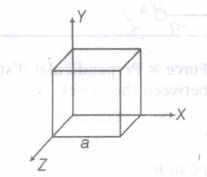
Since, the electric field has only x component, for faces normal to X - direction, the angle between E and \(\triangle\)S is \(\pm\ {{\pi}\over{2}}\)Therefore, the flux is separately
zero for each of the cube except the shaded ones.The magnitude of the electric field at the left face is
E1 = 0 (as, x = 0 at the left face).
face is ER = 3a (as, x = a at the right face).The corresponding fluxes are
The corresponding fluxes are
\({\phi}_{L}={E}_{L}.\triangle S=0\)
\({\phi}_{R}={E}_{R}.\triangle S = {E}_{R}\triangle S\ cos\ \theta={E}_{R}\triangle\ S\) \((\because \theta = 0°)\)
\(\Rightarrow\) \({\phi}_{R}={E}_{R}{a}^{2}\)
Net flux \((\phi) \) through the cube
\(={\phi}_{L}+{\phi}_{R}\)
= 0 + \({E}_{R}{a}^{2}.\)
= ERa2
q = 2a (a)2 = 2a3
We can use Gauss' law to find the total charge q inside the cube.
\(\phi={{q}\over{{\epsilon}_{0}}}\)
\(\therefore\) \(\phi=\phi{E}_{0}=2{a}^{3}{\epsilon}_{0}\)
8.
According to the question, o is the surface charge density of the sheet. From symmetry, E on either side of the sheet must be perpendicular to the plane of the sheet, having same magnitude at all points equidistant from the sheet. We take a cylinder of cross-sectional area A and length 2r as the Gaussian surface. On the curved surface of the cylinder, E and n are perpendicular to each other.
Therefore, the flux through the curved surface of the cylinder = 0.
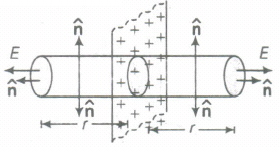
Flux through the flat surfaces = EA + EA = 2EA The total electric flux over the entire surface of cylinder.
\({\phi}_{E}=2EA\)
Total charge enclosed by the cylinder, q = \(\sigma A\) According to Gauss's law,
\(\oint E.dA={\phi}_{E}={{q}\over{{\epsilon}_{0}}}\)
\(\Rightarrow\) 2AE = \({{\sigma A}\over{{\epsilon}_{0}}}\)
E is independent of r, the distance of the point from the plane charged sheet. E at any point is directed away from the sheet for positive charge and directed towards the sheet in case of negative charge.
Surface charge density of the uniform plane sheet which is infinitely large = \(+\sigma\). The electric potential (V) due to infinite sheet of uniform charge density \(+\sigma\)
V = \({{-\sigma r}\over{2{\epsilon}_{0}}}\)
The amount of work done in bringing a point charge q from infinite to point, at distance r in front of the charged plane sheet.
W = q x V = \(q'={{-\sigma r}\over{2{\epsilon}_{0}}}=-{{\sigma r.q'}\over{2{\epsilon}_{0}}}\) joule
9.
(i) Examples of paramagnetic material are aluminum; chromium; oxygen.
(ii) Iron and cobalt are two ferromagnetic materials. The ferromagnetic substances, but to a much larger degree. For example, relative magnetic permeability of paramagnetic substances is slightly greater than 1
10.
As \(\tau =nIBA \ sin \ \theta ,\ therefore,\ (i) \ \tau =0, \ when \ sin\theta =0 \ or \ \theta =0°, \ i.e.\)when the plane of coil is perpendicular to the direction of magnetic field. (ii) \(\tau =\) maximum, when \(sin \ \theta \)=maximum=1 or \(\theta =90°\)
\({ \tau }_{ max }=nIBA\times 1=nIBA\)
It will be so when the plane of coil is parallel to the direction of magnetic field.
(ii) Here, n = 200; r = 0.05m; I = 2.0 A; B = 0.20 T; \(\theta =90°-60°\)=\(30°\)
\( \tau =nIBA \ sin \ \theta ,\ therefore,\ (i) \ \tau =0, \ when \ sin\theta =0 \ or \ \theta =30°-60°, \ i.e.,\)
\( \\ { \tau }_{ max }=nIBA\times 1=nIBA\)
\( \tau =nIBA \ sin \ \theta =nIB({ \pi r }^{ 2 })sin\theta =200\times 2.0\times 0.20\left[ (22/7)\times { \left( 0.05 \right) }^{ 2 } \right] \times sin30°\)
\(=0.314\quad N-m=0.31\ Nm\)
(iii) From the above study, we find that when potential energy of the coil is minimum, both force and torque acting on the coil are zero. The same is true in real life. a person who is humble and boasts of nothing, would be a happy person, with no pulls and pressure of life.

12th Standard CBSE Syllabus & Materials
12th Standard CBSE
CBSE 12th Computer Science Python Revision Tour I - New Previous year Question Papers Study Material - QB365 Set A
NEW12th Standard CBSE
CBSE 12th Business Studies Planning Important Questions And Answers Study Material - QB365 Set A
NEW12th Standard CBSE
CBSE 12th Business Studies Business Environment Important Questions And Answers Study Material - QB365 Set A
NEW12th Standard CBSE
CBSE 12th Business Studies Principles of Management Important Questions And Answers Study Material - QB365 Set A



CBSE 12th Standard CBSE Subjects
CBSE Standards










