
 100% FREE ACCESS
12th Standard CBSE Syllabus & Materials
12th Standard CBSE
CBSE 12th Economics Government Budget and the Economy Previous year Question Papers Study Material - QB365 Set A
NEW12th Standard CBSE
CBSE 12th Computer Science Interface Python with MySQL - New Previous year Question Papers Study Material - QB365 Set A
NEW12th Standard CBSE
CBSE 12th Computer Science Database Concept - New Previous year Question Papers Study Material - QB365 Set A
NEW12th Standard CBSE
CBSE 12th Computer Science Data Communication - New Previous year Question Papers Study Material - QB365 Set A
NEW12th Standard CBSE
CBSE 12th Computer Science Data Structures - New Previous year Question Papers Study Material - QB365 Set A
NEW12th Standard CBSE
CBSE 12th Computer Science Functions - New Previous year Question Papers Study Material - QB365 Set A

Published on: 30/10/2019
Electrostatics
Download CBSE Class 12th Standard CBSE Physics question papers, sample papers, important questions, and previous year solved papers in PDF format. Get free study materials, NCERT solutions, and exam preparation resources for Class 12th Standard CBSE Physics
Questions + Answers key
Take MCQ Physics Test
1.
Two Capacitors of capacitace 6\(\mu \)F and 12\(\mu \)F ae connnected in series with tha battery the volatage across the 6\(\mu \)F capacitor is 2 volt, Compute the total battery voltage.
2.
A charged Particle q is shot towards another charged particle Q which is fixed , with a speed v. It approaches Q up to a closet distance r and then returns, If q were given a speed 2 v the n find the closet distance of approach.
3.
An electric dipole with dipole moment \(4\times{{10}^{-9}}CM\) is aligned at 300 with direction of a uniform electric field of magnitude \(5\times{{10}^{4}}NC^{-1}.\)Calculate the magnitude of the torque acting on the dipole.
4.
Two point charges \(+4\mu C\) and \(-6\mu C\) are separated by a distance of 20cm in air. At what point on the line joining the two charges is the electric potential zero?
5.
The electric field intensity and potential at a point due to a point charge are 36 N/C and 18 J/C respectively. Calculate
(i) magnitude and
(ii) position of the charge from the point.
6.
There is a sphere of radius 20 cm. What charge should be given to the sphere so that it acquires a surface charge density of \({ 3 }/{ \pi }{ cm }^{ -2 }\)?
7.
A regular hexagon of side 10 cm has a charge 5\(\mu\) C at each of its vertices. Calculate the potential at the centre of the hexagon.
8.
The potential difference between a cloud and the Earth is 107V. Calculate the amount of energy dissipated when the charge of 100 is transferred from the cloud to the ground due to lighting bolt.
9.
Two charges \(+20\mu C\) and \(-20\mu C\) are held 1cm apart. Calculate the electric field at a point on the equatorial line at a distance of 50cm from the centre of the dipole.
10.
Two charges each of \(1\mu C\) but opposite in sign are 1cm apart. Calculate electric field at a point distant 10cm from the mid point on axial line of the dipole.
11.
Calculate the electric field strength which is required to just support a water drop of mass 10-3kg and having a charge \(1.6\times 10^{-19}C\)
1.
V = V1 + V2
Q = C1V = 6 x 10-6 x 2 = 12\(\mu \)C
As C2 is in series same amount of charge will also flow through it now V2 = Q/C2 = (12 x 10-6) /(12 x 10-6) = 1 volt
Total Battery voltage, V = 2 + 1 = 3 Volt
2.
q \(\rightarrow\)_______Q
1/2 mv2 = kQq/r
Or, v2 a1/r
Or, r a 1/v2
Or, r' = r/4
3.
10-4Nm
4.
Given: \(q_{1}=4 \mu \mathrm{C}=4 \times 10^{-6} \mathrm{C}\)
\(q_{2}=-6 \mu \mathrm{C}=-6 \times 10^{-6} \mathrm{C}, r=20 \mathrm{~cm}\)
Let the electric potential be zero at a point P, a distance x (in cm) from q1 Then
\(\frac{1}{4 \pi \varepsilon_{0}} \cdot \frac{q_{1}}{x}+\frac{1}{4 \pi \varepsilon_{0}} \frac{q_{2}}{(r-x)}=0\)
\( \therefore \frac{4}{x} =-\frac{(-6)}{(20-x)} \)
\(\Rightarrow 4(20-x=6 x \)
\(x =8 \mathrm{~cm}\)
i.e. 8 cm from 4 μC charge.
5.
(i) \({{10}^{-9}}C\)
(ii) r = 0.5 m
6.
q = 0.48C
7.
ABCDEF is a regular hexagon of side 10 cm each. At each corner, the charge q =5 \(\mu\)C is placed. O is the centre of the hexagon.
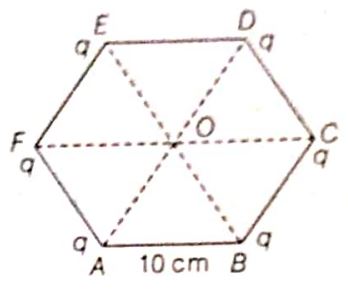
Given, AB = BC = CD = DE
= EF = FA = d = 10 cm
As, the hexagon has six equilateral triangles, so the distance of centre O from every vertex is 10 cm.
i.e. OA = OB = OC = OD
= OE = OF = d = 10 cm
\(\therefore\) Potential at point O = Sum of potentials at centre O due to individual point charge
i.e. VO = VA + VB + VC + VD + VE + VF
\(=\frac{1}{4\pi \varepsilon_{0}}.\left [ \frac{q}{OA}+\frac{q}{OB}+\frac{q}{OC}+\frac{q}{OD}+\frac{q}{OE}+\frac{q}{OF} \right ]\)
\(=\frac{1}{4\pi \varepsilon _{0}}.\frac{6q}{d}\) \(\left [ \because V=\frac{1}{4\pi \varepsilon _{0}.\frac{q}{r}} \right ]\)
Putting the values, we get
\(=9\times 10^{9}\times \frac{6\times 5 \times 10^{-6}}{10\times 10^{-2}}\)
= 2.7 \(\times\)106 V
8.
Here q = 100C
Potential difference between cloud and the earth V = 107V
Energy dissipated W = qV = 100 \(\times 10^7=10^9J\)
9.
\(Here, q=\pm20\mu C=\pm20\times10^{-6}C\)
\(2a=1 cm=10^{-2}m, r=50cm={1\over 2}m\)
As 2a<<r, therefore, intensity on equatorial line of short dipole is
\(E={1\over 4\pi\epsilon_o}{P\over r^3}={q\times 2a\over 4\pi\epsilon_or^3}\)
\(={9\times 10^9\times 20\times10^{-6}\times10^{-2}\over(1/2)^3}\)
\(E=1.44\times 10^4N/C\)
10.
Here, \(q=1\mu C=10^{-6}C\)
2a = 1cm = 10-2m , r = 10cm = 10-1m
On the axial line of dipole,
\(E={2|\overrightarrow { p } |r\over 4\pi\epsilon_o(r^2-a^2)^2}={2q\times 2a\times r\over 4\pi\epsilon_o(r^2-a^2)^2}\)
\(={9\times10^9\times 2\times 10^{-6}\times 10^{-2}\times 10^{-1}\over(10^{-2}-0.25\times 10^{-4})^2}\)
\(={18\over 10^{-4}(1-0.0025)^2}\)
\(E={18\times 10^4\over0.9975\times 0.9975}=18\times10^4N/C\)
11.
Here, m = 10-3kg, \(q=1.6\times 10^{-19}C\)
Force on water drop due to electric field = Weight of water drop
qE = mg
\(E={mg\over q}={10^{-3}\times9.8\over1.6\times 10^{-19}}=6.125\times 10^{16}N/C\)

12th Standard CBSE Syllabus & Materials
12th Standard CBSE
CBSE 12th Computer Science Python Revision Tour I - New Previous year Question Papers Study Material - QB365 Set A
NEW12th Standard CBSE
CBSE 12th Business Studies Planning Important Questions And Answers Study Material - QB365 Set A
NEW12th Standard CBSE
CBSE 12th Business Studies Business Environment Important Questions And Answers Study Material - QB365 Set A
NEW12th Standard CBSE
CBSE 12th Business Studies Principles of Management Important Questions And Answers Study Material - QB365 Set A



CBSE 12th Standard CBSE Subjects
CBSE Standards










