
 100% FREE ACCESS
12th Standard CBSE Syllabus & Materials
12th Standard CBSE
CBSE 12th Economics Government Budget and the Economy Previous year Question Papers Study Material - QB365 Set A
NEW12th Standard CBSE
CBSE 12th Computer Science Interface Python with MySQL - New Previous year Question Papers Study Material - QB365 Set A
NEW12th Standard CBSE
CBSE 12th Computer Science Database Concept - New Previous year Question Papers Study Material - QB365 Set A
NEW12th Standard CBSE
CBSE 12th Computer Science Data Communication - New Previous year Question Papers Study Material - QB365 Set A
NEW12th Standard CBSE
CBSE 12th Computer Science Data Structures - New Previous year Question Papers Study Material - QB365 Set A
NEW12th Standard CBSE
CBSE 12th Computer Science Functions - New Previous year Question Papers Study Material - QB365 Set A

Published on: 21/09/2019
Electrostatics
Download CBSE Class 12th Standard CBSE Physics question papers, sample papers, important questions, and previous year solved papers in PDF format. Get free study materials, NCERT solutions, and exam preparation resources for Class 12th Standard CBSE Physics
Questions + Answers key
Take MCQ Physics Test
1.
Can two balls having same kind of charge on them attract each other? Explain.
2.
Find the magnitude of electric field which just balances a deuteron of mass \(3.2\times { 10 }^{ -27 }kg.\)
3.
Calculate Coulomb's force between two \(\alpha -particles\) separated by a distance of \(3.2\times { 20 }^{ -15 }m.\)
4.
Two charges each of \(5\mu C,\) but opposite in sign are placed 4 cm apart. Calculate the electric field intensity at a point distant 4 cm from the mid-point on the axial line of the dipole.
5.
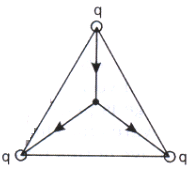
Three equal charges of + qC each placed at the three corners of an equilateral triangle. Find the total force experienced by a unit charge placed at the centroid of the triangle.
6.
(a) conductor A with a cavity as shown in figure.
(i) is given a charge Q. Show that the entire charge must appear on the outer surface of the conductor.
(ii) Another conductor B with charge q is inserted into the cavity keeping B insulated from A. Show that the total charge on the outside surface A is Q + q Figure.
(iii) A sensitive instrument is to be shifted from the strong electrostatic field in its environment. Siggest a possible way.
-Q.png)
-Q.png)
7.
Check that the ratio ke2/Gmemp is dimensionless. Look up a table of physical constants and determine the value of this ratio. What does the ratio signify?
8.
The electrostatic force on a small sphere of charge 0.4 \(\mu\)C due to another small sphere of charge -0.8 \(\mu\)C in air is 0.2 N.
(a) What is the distance between the two spheres?
(b) What is the force on the second sphere due to the first?
9.
What is the area of the plates of a 2F parallel plate capacitor given that the separation between the plates is 0.5 cm? You will realise from your answer why ordinary capacitors are in the range of\(\mu F\) or less.However, electrolytic capacitors do have a much larger capacitance (0.1F) because of very minute separation between the conductors.
10.
A 600 pF capacitor is charged by a 200 V supply. It is then disconnected from the supply and is connected to another uncharged 600 pF capacitor. How much electrostatic energy is lost in the process?
11.
A parallel plate capacitor with air between the plates has a capacitance of 8 pF (1pF = 10-12F). What will be the capacitance if the distance between the plates is reduced by half, and the space between them is filled with a substance of dielectric constant 6?
12.
In a Van de Graff type generator, a spherical metal shell is to be a \(15\times { 10 }^{ 6 }V\) electrode.The dielectric strength of the gas surrounding the electrode is \(5\times { 10 }^{ 7 }{ Vm }^{ -1 }\) .What is the minimum radius of the spherical shell required?
(You will learn from this exercise why one cannot build an electrostatic generator using a very small shell which requires a small charge to acquire a high potential)
13.
Two charged conducting spheres of radii a and b are connected to each other by a wire. What is the ratio of electric fields at the surface of the two spheres? Use the result obtained to explain why charge density on the sharp and pointed ends of a conductor is higher than on its flattened portions?
14.
A 12pF capacitor is connected to a 50V battery. How much electrostatic energy is stored in the capacitor?
15.
Three capacitors each of capacitance 9 pF are connected in series.
(a) What is the total capacitance of the combination?
(b) What is the potential difference across each capacitor, if the combination is connected to a 120 V supply?
1.
Yes, two balls having same kind of charge can attract each other if charge possessed by one ball is very large as compared to that on the other ball because when two charged balls are placed near each other, they induced opposite charges on the faces of each other. On the ball having small amount of charge, very large amount of induced charge is produced, two balls get attracted towards each other.
2.
\(m=3.2\times { 10 }^{ -27 }kg,\)
\({ q }=1.6\times { 10 }^{ -19 }C,\ g=10{ ms }^{ -2 }\)
F = mg
F = qE
qE = mg
\(E=\frac { mg }{ q } \)
\(\frac { 3.2\times { 10 }^{ -27 }\times 10 }{ 1.6\times { 10 }^{ -19 } } \)
\(E=2.0\times { 10 }^{ -7 }{ NC }^{ -1 }\)
3.
\(Given\quad r=3.2\times { 10 }^{ -15 }m,\)
\({ q }_{ 1 }={ q }_{ 2 }=2\times 1.6\times { 10 }^{ -19 }C\)
\(F=\frac { 1 }{ 4\pi { \varepsilon }_{ 0 } } \frac { { q }_{ 1 }{ q }_{ 2 } }{ { r }^{ 2 } } \)
\(\frac { 9\times { 10 }^{ 9 }\times { \left( 2\times 1.6\times { 10 }^{ -19 } \right) }^{ 2 } }{ { \left( 3.2\times { 10 }^{ -15 } \right) }^{ 2 } } \)
\(=90N\)
4.
\(E=\frac { 1 }{ 4\pi { \varepsilon }_{ 0 } } \frac { 2pr }{ { \left( { r }^{ 2 }-{ a }^{ 2 } \right) }^{ 2 } } \)
\(E=\frac { 9\times { 10 }^{ 9 }\times 2\times q\times 2a\times r }{ { \left( { r }^{ 2 }-{ a }^{ 2 } \right) }^{ 2 } } \)
\(=\frac { 9\times { 10 }^{ 9 }\times 2\times 5\times { 10 }^{ -6 }\times 4\times { 10 }^{ -2 }\times 4\times { 10 }^{ -2 } }{ { \left( 16\times { 10 }^{ -4 }-4\times { 10 }^{ -21 } \right) }^{ 2 } } \)
\(or\quad E=\frac { 144 }{ 144\times { 10 }^{ -8 } } ={ 10 }^{ 8 }{ NC }^{ -1 }\)
5.
Zero, because equal forces are inclined at angle of \(120°\) so resultant is Zero.
6.
(a) We know that the net field inside a charged conductor is zero i.e.
\(\overrightarrow { E } \) = 0, inside
Let us choose a gaussian surface lying wholly within the conductor and enclosing the cavity.
According to Gauss' law,
\(\oint \overrightarrow { E } .\overrightarrow { dS } =\frac { q }{ { \varepsilon }_{ 0 } } =0\) \((\because \overrightarrow { E } =0,inside)\)
\(\therefore \) q = 0 i.e. charge inside the cavity is zero. Hence the entire charge Q on the conductor must appear on the outer surface of the conductor.
(b) The conductor B carrying a charge + q inseted in the cavity induces a charge - q on the metal surface of cavity and + q on the outside surface of the conductor A [Fig (b)]. As the outer surface of A originally had a charge Q, the total charge on it would become (Q + q).
(c) To shift a sensitive instrument from the strong electrostatic fields in its environment, enclose the instrument fully by a metallic surface.
7.
Since \({ F }_{ e }=-\frac { { ke }^{ 2 } }{ { r }^{ 2 } } \)
So \({ ke }^{ 2 }={ -F }_{ e }{ r }^{ 2 }\)
And \({ F }_{ G }=-G\frac { { m }_{ p }{ m }_{ e } }{ { r }^{ 2 } } \)
So \({ Gm }_{ p }{ m }_{ e }={ -F }_{ G }{ r }^{ 2 }\)
So dimensions of \(\frac { { ke }^{ 2 } }{ { Gm }_{ e }{ m }_{ p } } =\frac { { F }_{ e }{ r }^{ 2 } }{ { F }_{ G }{ r }^{ 2 } } =\frac { { F }_{ e } }{ { F }_{ G } } \)
\(=\frac { { [MLT }^{ -2 }] }{ { [MLT }^{ -2 }] } =[{ M }^{ 0 }{ L }^{ 0 }{ T }^{ 0 }]\)
= No dimensions
The value of \(\frac { { ke }^{ 2 } }{ { Gm }_{ e }{ m }_{ p } } \)
\(=\frac { 9\times { 10 }^{ 9 }\times (1.6\times { 10 }^{ -19 })^{ 2 } }{ 6.67\times { 10 }^{ -11 }(1.67\times { 10 }^{ -27 })(9.1\times { 10 }^{ -31 }) } \)
\(=2.9\times { 10 }^{ 39 }\)
From Eq. (1) and (2), we have
\(\left| \frac { { F }_{ e } }{ { F }_{ G } } \right| =\frac { { ke }^{ 2 } }{ { Gm }_{ p }{ m }_{ e } } =2.9\times { 10 }^{ 39 }\)
The ratio of the two forces shows that electrical forces are enormously stronger than the gravitational forces.
8.
Given q1 = 0.4 \(\mu\)C = 0.4 \(\times\) 10-6C
q2 = -0.8 \(\mu\)C = -0.8 \(\times\) 10-6C
F = 0.2 N, r = ?
(a) Since \(F=9\times { 10 }^{ 9 }\times \frac { { q }_{ 1 }{ q }_{ 2 } }{ { r }^{ 2 } } \)
or \(0.2=\frac { 9\times { 10 }^{ 9 }\times (0.4\times { 10 }^{ -6 })(0.8\times { 10 }^{ -6 }) }{ { r }^{ 2 } } \)
or \({ r }^{ 2 }=\frac { 9\times { 10 }^{ 9 }\times 0.32\times { 10 }^{ -12 } }{ 0.2 } \)
or \(r=12\times { 10 }^{ -2 }m=12cm\)
(b) The second sphere will attract the first with the same force i.e. force of 0.2 N.
9.
Given, capscitance, C = 2 F
and separation between plates,
d = 0.5 cm = 0.5 \(\times\) 10-2 m
Capscitance of a parallel plate capacitor, C=\(\frac{\varepsilon_{0}A}{d}\)
or A=\(\frac{Cd}{\varepsilon_{0}}=\frac{2\times 0.5\times 10^{-2}}{8.854\times 10^{-12}}\)
= 1.13 \(\times\)109 m2 = 1130 km2
This area is very large, so it is not possible that the capacitance of a capacitor is too large as 2F. So, the capacitance of any capacitor should be the range of 2 \(mu\)F.
10.
Given, C1 = C2 = 600 pF
= 600 \(\times\)10-12F
= 6 \(\times\)10-10 F
V1 = 200 V, V2 = 0
\(\begin{aligned} \therefore \text { Energy lost } & =\frac{C_1 C_2\left(V_1-V_2\right)^2}{2\left(C_1+C_2\right)} \\ \end{aligned}\)
\(\begin{aligned} =\frac{\left(6 \times 10^{-10}\right)^2(200-0)^2}{2 \times 12 \times 10^{-10}} \end{aligned}\)
= 6 \(\times\)10-6 J
11.
Given,
Capacitance, C = 8pF.
In the first case, the parallel plates are at a distance ‘d’ and is filled with air.
Air has dielectric constant, k = 1
Capacitance, C\(=\frac{k \times \epsilon_{o} \times A}{d}=\frac{\epsilon_{o} \times A}{d}\) .......(i)
Here,
A = area of each plate
ϵo = permittivity of free space.
Now, if the distance between the parallel plates is reduced to half, then d1 = d/2
Given, dielectric constant of the substance, k1 = 6
Hence, the capacitance of the capacitor,
\(\mathrm{C}_{1}=\frac{k_{1} \times \epsilon_{o} \times A}{d_{1}}=\frac{6 \epsilon_{0} \times A}{d / 2}=\frac{12 \epsilon_{o} A}{d}\) .......(ii)
Taking ratios of eqns. (1) and (2), we get,
C1 = 2 x 6 C = 12 C = 12 x 8 pF = 96pF.
Hence, the capacitance between the plates is 96pF.
12.
Potential difference, V = 15 x 106 V
Dielectric strength of the surrounding gas = 5 x 10⁷ V/m
Electric field intensity, E = Dielectric strength = 5 x 10⁷ V/m
Minimum radius of the spherical shell required for the purpose is given by,
\(r=\frac{V}{E}\)
\(=\frac{15 \times 10^{6}}{5 \times 10^{7}}=0.3 \mathrm{~m}=30 \mathrm{~cm}\)
Hence, the minimum radius of the spherical shell required is 30 cm.
13.
Electric field of 1st spherical conductor on its surface
\({ E }_{ 1 }\propto \frac { 1 }{ a } \)
Electric field of 2nd spherical conductor on its surface
\({ E }_{ 2 }\propto \frac { 1 }{ b }\)
\(\frac { { E }_{ 1 } }{ { E }_{ 2 } } =\frac { b }{ a } \)
Since a flat portion may be considered as a spherical surface of large radius (i.e. lower charge density, as charge density \(=\left( \frac { charge }{ area } \right) \) and a pointed portion as of small radius (i.e. highest charge density).
14.
Given,
Capacitance of the capacitor, C = 12pF = 12 x 10-12 F
Potential difference, V = 50 V
Electrostatic energy stored in the capacitor is given by the relation,
\(\mathrm{E}=\frac{1}{2} \mathrm{CV}^{2}=\frac{1}{2} \times 12 \times 10^{-12} \mathrm{\times}(50)^{2} \mathrm{~J}=1.5 \times 10^{-8} \mathrm{~J}\)
Therefore, the electrostatic energy stored in the capacitor is 1.5 x 10⁻⁸ J. was disconnected.
15.
There are three capacitors cach of capacitance 9 pF.
\(\therefore\) C1 = C2 = C3 = 9 pF
and voltage, V = 120 V
(i) The total capcitance in series combination,
\(\frac{1}{C_{s}}=\frac{1}{C_{1}}+\frac{1}{C_{2}}+\frac{1}{C_{3}}=\frac{1}{9}+\frac{1}{9}+\frac{1}{9}\)
\(\Rightarrow \frac{1}{C_{s}}=\frac{3}{9} \Rightarrow C_{s}=3 pF\)
(ii) Let the charge across the system be q and potentials across C1, C2 and C3 be V1, V2 and V3, respectively.
Charge, q = Cs. V = 3 \(\times\)120 = 360 pC
Potential difference across C1,
\(V_{1}=\frac{q}{C_{1}}=\frac{360}{9}=40 V\)
Potential difference across C2,
\(V_{2}=\frac{q}{C_{2}}=\frac{360}{9}=40 V\)
Potential difference across C3,
\(V_{3}=\frac{q}{C_{3}}=\frac{360}{9}=40 V\)
Thus, the potential difference across each capacitor is 40 V.

12th Standard CBSE Syllabus & Materials
12th Standard CBSE
CBSE 12th Computer Science Python Revision Tour I - New Previous year Question Papers Study Material - QB365 Set A
NEW12th Standard CBSE
CBSE 12th Business Studies Planning Important Questions And Answers Study Material - QB365 Set A
NEW12th Standard CBSE
CBSE 12th Business Studies Business Environment Important Questions And Answers Study Material - QB365 Set A
NEW12th Standard CBSE
CBSE 12th Business Studies Principles of Management Important Questions And Answers Study Material - QB365 Set A



CBSE 12th Standard CBSE Subjects
CBSE Standards










