
 100% FREE ACCESS
12th Standard CBSE Syllabus & Materials
12th Standard CBSE
CBSE 12th Economics Government Budget and the Economy Previous year Question Papers Study Material - QB365 Set A
NEW12th Standard CBSE
CBSE 12th Computer Science Interface Python with MySQL - New Previous year Question Papers Study Material - QB365 Set A
NEW12th Standard CBSE
CBSE 12th Computer Science Database Concept - New Previous year Question Papers Study Material - QB365 Set A
NEW12th Standard CBSE
CBSE 12th Computer Science Data Communication - New Previous year Question Papers Study Material - QB365 Set A
NEW12th Standard CBSE
CBSE 12th Computer Science Data Structures - New Previous year Question Papers Study Material - QB365 Set A
NEW12th Standard CBSE
CBSE 12th Computer Science Functions - New Previous year Question Papers Study Material - QB365 Set A

Published on: 30/10/2019
Magnetic Effects of Current
Download CBSE Class 12th Standard CBSE Physics question papers, sample papers, important questions, and previous year solved papers in PDF format. Get free study materials, NCERT solutions, and exam preparation resources for Class 12th Standard CBSE Physics
Questions + Answers key
Take MCQ Physics Test
1.
When a galvanometer having 30 divisions scale and 100 \(\Omega \) resistance is connected in series with the battery of e.m.f. 3 volt through a resistance of 200 \(\Omega \) , it shows full scale deflection. Find the fogure of merit of the galvanometer in microampere.
2.
Calculate the force per unit length on a long straight wire carrying current 4 A due to parallel wire carrying 6 A current. if the distance between the wires is 3 cm.
3.
A long straight conductor C carrying a current of 3 A is placed parallel to a short conductor D of length 5 cm, carrying a current 4 A. The two conductors are 10 cm apart. Find
(i) the magnetic field due to C at D.
(ii) The approximate force on D.
4.
An electron of energy 2000 eV describes a circular path in magnetic field of flux density 0.2 T. What is the radius of the path ? take e = 1.6 x 10⁻¹⁹ C, m = 9 x 10 -31 kg.
5.
A proton enters a magnetic field of flux density 2.5 T with a speed of 1.5 x 10⁷ ms-1 at an angle of 30o with the field. Find the force on the proton.
6.
A wire of radius 0.8 cm carries a current of 100 A which is uniformly distributed over its cross-section. Find the magnetic field (a) at 0.2 cm from the axis of the wire (b) at the surface of the wire and (c) at a point outside the wire 0.4 cm from the surface of the wire. Neglect the permeability of the material of wire.
7.
A current element 3 dl is at (0,0,0) along y-axis. if dl =1 cm, find the magnetic field at a distance 20 cm on the x-axis.
8.
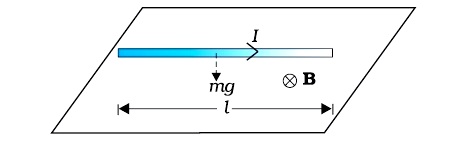
A straight wire of mass 200 g and length 1.5 m carries a current of 2 A. It is suspended in mid air by a uniform horizontal magnetic field B . What is the magnitude of the magnetic field?
9.
A solenoid of length 0.5 m has a radius of 1 cm and is made up of 500 turns. It carries a current of 5 A. What is the magnitude of the magnetic field inside the solenoid ?
1.
Here, n = 30, G = 100 \(\Omega \) , \(\varepsilon \) = 3 V,
R = 200, K = ?
Total resistance of the circuit
= G + R = 100 + 200 = 300 \(\Omega \)
Current in the circuit which produces full scale deflection in the galvanometer,
\({ I }_{ g }=\frac { \varepsilon }{ G+R } =\frac { 3 }{ 300 } =\frac { 1 }{ 100 } A\)
\(K=\frac { { I }_{ g } }{ n } =\frac { 1/100 }{ 30 } =\frac { 1 }{ 3 } \times { 10 }^{ -3 }A/division\)
\(=\frac { 1 }{ 3 } \times { 10 }^{ -3 }\times { 10 }^{ 6 }\mu \quad A/division\)
\(=333.3\mu \ A/division\)
2.
Given, I1 = 4 A, I2 = 6 A, r = 3 cm = 0.03 m
\(F=\frac{\mu_0}{4 \pi} \cdot \frac{2 I_1 I_2}{r}=\frac{10^{-7} \times 2 \times 4 \times 6}{0.03}\)
= 1.6 \(\times\)10-4 N/m
3.
(i) Magnetic field due to C at D is
\(B=\frac { { \mu }_{ o } }{ 4\pi } \frac { 2I }{ r } ={ 10 }^{ -7 }\times \frac { 2\times 3 }{ 0.10 } =6\times { 10 }^{ -6 }T\)
(ii) Force on D, F = BI1 lsin\(\theta \) = (6 x 10-6) x 4 x (5 x 10-2) x sin 90o
= 1.2 x 10⁻⁶ N
4.
Here, energy of electron,
E' = 2000 eV = 2000 x 1.6 x 10-19 J
= 3.2 x 10⁻¹⁶ J
B = 0.2 T ; r = ?
As, \(E'=\frac { 1 }{ 2 } { mv }^{ 2 }\) \(\therefore \ v=\sqrt { \frac { 2E' }{ m } } \)
Also, \(Bev=\frac { m{ v }^{ 2 } }{ r } \quad \)
or \(r=\frac { mv }{ Be } =\frac { m }{ Be } \sqrt { \frac { 2E' }{ m } } =\frac { \sqrt { 2E'm } }{ Be } \)
\(r=\frac { \sqrt { 2\times 3.2\times { 10 }^{ -16 }\times 9\times { 10 }^{ -31 } } }{ 0.2\times 1.6\times { 10 }^{ -19 } } \)
= 7.5 x 10⁻⁴ m
5.
Here, q = e = 1.6 x 10⁻¹⁹ C,
B = 2.5 T, v = 1.5 x 10⁷ ms-1, \(\theta \) = 30o
F = qv B sin \(\theta \) = (1.6 x 10-19) x (1.5 x 107) x 25 x sin 30o
= 3 x 10-12 N.
6.
Here, R = 0.8 cm = 8 x 10⁻³ m ;
I = 100 A
\((a) \ { B }_{ inside }=\frac { { \mu }_{ o } }{ 4\pi } \frac { 2Ir }{ { R }^{ 2 } } \)
\(={ 10 }^{ -7 }\times \frac { 2\times 100\times { \left( 0.2\times { 10 }^{ -2 } \right) }^{ 2 } }{ { \left( 8\times { 10 }^{ -3 } \right) }^{ 2 } } \)
= 6.25 x 10⁻⁴ T
\((b) \ { B }_{ surface }=\frac { { \mu }_{ o } }{ 4\pi } \frac { 2I }{ { R } } ={ 10 }^{ -7 }\times \frac { 2\times 100 }{ 8\times { 10 }^{ -3 } } \)
= 2.5 x 10⁻⁵ T
(c) When point is outside the wire,
r = 0.8 + 0.4 = 1.2 cm = 1.2 x 10⁻² m.
\({ B }_{ outside }=\frac { { \mu }_{ o } }{ 4\pi } \frac { 2I }{ { r } } ={ 10 }^{ -7 }\times \frac { 2\times 100 }{ 1.2\times { 10 }^{ -2 } } \)
= 1.67 x 10⁻⁵ T.
7.
Here, dl= 1 cm = 10-2 m,
r= (20 cm) = (0.20 m) and \(\overset { \rightarrow }{ r } =0.2\hat { i } \)
\(I\overset { \rightarrow }{ dl } =(3\times { 10 }^{ -2 })\hat { j } \)
\(\overset { \rightarrow }{ dB } =\frac { { \mu }_{ o } }{ 4\pi } \frac { I\overset { \rightarrow }{ dl } \times \overset { \rightarrow }{ r } }{ { r }^{ 3 } } \)
\(=\frac { { 10 }^{ -7 }\times \left( 3\times { 10 }^{ -2 }\hat { j } \right) \times \left( 0.20\hat { i } \right) }{ { \left( 0.20 \right) }^{ 3 } } \)
\(=7.5\times { 10 }^{ -8 }\left( \hat { j } \times \hat { i } \right) =7.5\times { 10 }^{ -8 }\left( -\hat { k } \right) \)
\(=-\left( 7.5\times { 10 }^{ -8 }T \right) \hat { k } \)
Thus magnitude of magnetic field is 7.5X10⁻⁸ T and its direction is along negative Z-axis.
8.
From Equation we find that there is an upward force F, of magnitude IlB,. For mid-air suspension, this must be balanced by the force due to gravity.
m g = I l B
\(B=\frac{m g}{I l}\)
\(=\frac{0.2 \times 9.8}{2 \times 1.5}=0.65 \mathrm{~T}\)
Note that it would have been sufficient to specify m / l, the mass per unit length of the wire. The earth’s magnetic field is approximately 4 x 10⁻⁵ T and we have ignored it.
9.
Given, total number of turns, N = 500
Length of solenoid, l = 0.5 m
Current, I = 5 A
Radius, r = 1 cm = 10-2 m
Here, \(\begin{aligned} \frac{l}{r} & =\frac{0.5}{10^{-2}}=50 \Rightarrow l>>r \\ \end{aligned}\)
\(\begin{aligned} \therefore B & =\mu_0 n I=\frac{\mu_0 N I}{l} \\ \end{aligned}\)
\(\begin{aligned} =4 \pi \times 10^{-7} \times \frac{500}{0.5} \times 5 \end{aligned}\)
= 6.28 \(\times\) 10-3 T

12th Standard CBSE Syllabus & Materials
12th Standard CBSE
CBSE 12th Computer Science Python Revision Tour I - New Previous year Question Papers Study Material - QB365 Set A
NEW12th Standard CBSE
CBSE 12th Business Studies Planning Important Questions And Answers Study Material - QB365 Set A
NEW12th Standard CBSE
CBSE 12th Business Studies Business Environment Important Questions And Answers Study Material - QB365 Set A
NEW12th Standard CBSE
CBSE 12th Business Studies Principles of Management Important Questions And Answers Study Material - QB365 Set A



CBSE 12th Standard CBSE Subjects
CBSE Standards










