
 100% FREE ACCESS
12th Standard CBSE Syllabus & Materials
12th Standard CBSE
CBSE 12th Economics Government Budget and the Economy Previous year Question Papers Study Material - QB365 Set A
NEW12th Standard CBSE
CBSE 12th Computer Science Interface Python with MySQL - New Previous year Question Papers Study Material - QB365 Set A
NEW12th Standard CBSE
CBSE 12th Computer Science Database Concept - New Previous year Question Papers Study Material - QB365 Set A
NEW12th Standard CBSE
CBSE 12th Computer Science Data Communication - New Previous year Question Papers Study Material - QB365 Set A
NEW12th Standard CBSE
CBSE 12th Computer Science Data Structures - New Previous year Question Papers Study Material - QB365 Set A
NEW12th Standard CBSE
CBSE 12th Computer Science Functions - New Previous year Question Papers Study Material - QB365 Set A

Published on: 14/09/2019
Magnetic Effects of Current
Download CBSE Class 12th Standard CBSE Physics question papers, sample papers, important questions, and previous year solved papers in PDF format. Get free study materials, NCERT solutions, and exam preparation resources for Class 12th Standard CBSE Physics
Questions + Answers key
Take MCQ Physics Test
1.
You are given a copper wire carrying current I of length L. Now the wire is turned into circular coil. Find the number of turns in the coil so that the torque at the centre of the coil is to maximum
2.
A charge particle moving in a magnetic field penetrates a layer of lead and thereby losses half of its kinetic energy. How does the radius of curvature of its path change?
3.
(i) Two long straight parallel conductors a and b carrying steady currents Ia and Ib respectively, are separated by a distance d. What is the nature and magnitude of the force between the two conductors?
(ii) Show with the help of a diagram, how the force between the two conductors would change when the currents in them flow in the opposite directions.
4.
Draw the magnetic field lines due to a current passing through a long solenoid. Use Ampere's circuital law, to obtain the expression for the magnetic field due to the current I in a long solenoid having n number of turns per unit length.
5.
Give two points to distinguish between a paramagnetic and a diamagnetic substance.
6.
The horizontal component of the earth's magnetic field at a place is \(\sqrt { 3 } \) times its vertical component here. Find the value of the angle of dip at that place. What is the ratio of the horizontal component to the total magnetic field of the earth at that place?
7.
How does a circular loop carrying current behave as a magnet?
8.
A rectangular coil of area \(2\times 10^{ -4 }m^{ 2 }\) and 40 turns is pivoted about one of its vertical sides. The coil is in a radial horizontal field of 60 G. What is the torsional constant of the hair springs connected to the coil, if a current of 4.0 mA produces an angular deflection of 16o?
9.
Which material is used to make electromagnets and why ?
10.
Identify the materials, which can be classified as paramagnetic and diamagnetic : Al, Bi, Cu, Na.
11.
What is an ammeter? How is it used in an electric circuit? How it differ from a voltmeter?
12.
A wire of length l metre carries a current I ampere along the Y-axis. A magnetic field, \(\overset { \rightarrow }{ B } ={ B }_{ o }\left( \hat { i } +\hat { j } +\hat { k } \right) \)tesla exists in space. Find the magnitude of the force on the wire.
13.
What is the magnetic effect of current? Describe the nature of the magnetic field related with the current in circular coil.
14.
What is magnetic flux density? Define its units and give its dimensions.
1.
Let the number of turns be = n
Radius = r
Length = l
Length of the wire = circumference of n turns of coil
L = n x 2\(\Pi \) r
r = L/2\(\Pi \) r
Maximum torque = nIBA = nIB \(\Pi \) r2
= nIB\(\Pi \) (2/2\(\Pi \) n)2
= 1/n
For maximum torque n should be minimum
i.e n = 1
2.
r = mv/qB .........(i)
Also P = mv = \(\sqrt { 2mE } \)..........(ii)
By equ (i) and equ (ii)
As the radius is \(r\frac { \sqrt { 2mE } }{ qB } \) proportional to square root of kinetic energy, so if the kinetic energy is halved the radius become \(\sqrt { 1 } /2\) times of its initial value
3.
(i) Let a and b be two long straight parallel conductors. Ia and Ib are the current flowing
through them and separated by a distance d. Magnetic field induction at a point P on a conductor b due to current Ia passing through Ia is
s.png)
\(B_1=\frac{\mu_02I_a}{4\pi d}\)
Now, unit length of b will experience a force as
\(F_2=B_1 I_b \times 1=B_1 I_B\)
\(\therefore F_2=\frac{\mu_0}{4\pi}\frac{2I_aI_b}{d}\)
Conductor a also experiences the same amount of force directed towards b. Hence, a and b attract each other.
(ii)
s.png)
Now, let the direction of current in conductor b be reversed. The magnetic field B2 at point P due to current Ia flowing through a will be downwards. Similarly, the magnetic field B1 at point Q due to current Ib passing through b will also be downward as shown. The force on a will be, therefore towards the left. Also, the force on b will be towards the right. Hence, the two conductors will repel each other as shown.
4.
Applying Ampere is circuital law for the rectangular loop abcda
\(\oint\overrightarrow B. \overrightarrow {dl}=\mu_0I\)
\(Bh=\mu_0I(nh)\)
\(B=\mu_0nI\)
5.
| Diamagnetic | Paramagnetic |
| 1. Weakly repelled by external magnetic field. | 1. Weakly attracted by magnetic field. |
| 2. Align perpendicular to the field. | 2. Align parallel to the field. |
| 3. Move from stronger to weaker region. | 3. Move from weaker to stronger region. |
| 4. Not affected by temperature. | 4. Affected by temperature. |
| 5. Susceptibility <0 | 5. Susceptibility >0 |
| 6. Permeability \(\mu\)r <1 | 6. Permeability \(\mu\)r>1 |
6.
As, vertical and horizontal components of magnetic fields are perpendicular to each other. so when their magnitudes are equal, resultant will divide their angle equally.
According to the question,
\(H=\sqrt { 3 } V\)
where, H and V are the horizontal and vertical components of the earth's magnetic field. If angle of dip at that place is , then
\(tan \ \delta =\frac { V }{ H } =\frac { V }{ \sqrt { 3 } V } \ [\therefore \quad H=\sqrt { 3 } V]\)
\(tan\quad \delta =\frac { 1 }{ \sqrt { 3 } } \Rightarrow \quad \delta =\frac { \pi }{ 6 } \)
\(\therefore \) Horizontal component of the earth's magnetic field,
\(H={ B }_{ e }\quad cos\delta \)
where, \({ B }_{ e }\)=Earth's magnetic field
\(\frac { H }{ { B }_{ e } } =cos\delta =cos\frac { \pi }{ 6 } =\frac { \sqrt { 3 } }{ 2 }\)
\(H:{ B }_{ e }=\sqrt { 3 } :2\)
7.
If the current round in the face of the coil is in anti-clockwise direction, then this behaves like a North pole whereas, when it is viewed from other side, then current round in it is in clockwise direction necessarily forming South pole of magnet.
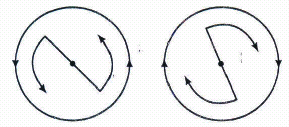
Hence, current loop have both magnetic poles and therefore, behaves like a magnetic dipole.
8.
Here \(B=60G,A=2\times 10^{ -4 }\quad m^{ 2 },N=40\)
\(\\ I=4mA=4\times 10^{ -3 }A,\theta =16^{ 0 }\)
\(\because\) \(\\ I=\frac { k }{ NBA } \theta =k=\frac { NBAI }{ \theta } \)
\(\\ =\frac { 40\times 60\times 2\times 10^{ -4 }\times 4\times { 10 }^{ -3 } }{ 16 }\)
\( \\ =1.2\times 10^{ -4 }\) N-m per degree
9.
Soft iron is used to make electromagnets, because hysteresis loop for soft iron is narrow. Therefore, energy loss/volume/cycle is small.
10.
Aluminium and sodium are paramagnetic Bismuth and copper are diamagnetic.
11.
Ammeter is a low resistance galvanometer. The resistance of ammeter is low and that of voltmeter is high. Ammeter is connected in series and voltmeter in parallel in the circuit.
12.
As the wire carries current I along the y-axis, so \(\overset { \rightarrow }{ l } =l\hat { j } .\) Magnitude force on wire is
\(\overset { \rightarrow }{ F } =I\left( \overset { \rightarrow }{ l } \times \overset { \rightarrow }{ B } \right) =I[l\hat { j } \times [{ B }_{ o }(\hat { i } +\hat { j } +\hat { k } )]]\)
\(=Il{ B }_{ o }\left[ \hat { j } \times \hat { i } +\hat { j } \times \hat { j } +\hat { j } \times \hat { k } \right] \)
\(=Il{ B }_{ o }\left[ -\hat { k } +0+\hat { i } \right] =Il{ B }_{ o }\left[ \hat { i } -\hat { k } \right] \)
Magnitude of the magnetic force is
\(F=Il{ B }_{ o }\left[ { \left( 1 \right) }^{ 2 }+{ \left( -1 \right) }^{ 2 } \right] ^{ 1/2 }=Il{ B }_{ o }\sqrt { 2 } N\)
13.
When a current is passed through a conductor, magnetic field is produced around the conductor. It is called magnetic effect of current. The magnetic field is in the form of concentric circular magnetic lines of force for a linear conductor carrying current. The magnetic field is in the form of parallel straight lines at the centre and concentric magnetic lines near the circular coil carrying current.
14.
Magnetic flux density at a point in a magnetic field means magnetic field induction at that point. It is defined as the force experienced by a unit charge while moving with a unit velocity, perpendicular to the direction of magnetic field at that point. Force experienced by the charged particle having charge q moving with velocity \(\overset { \rightarrow }{ v } \) through a magnetic field \(\overset { \rightarrow }{ B } \) is given by
\( \left| \overset { \rightarrow }{ F } \right| =q\left| \overset { \rightarrow }{ v } \times \overset { \rightarrow }{ B } \right| =qvBsin\theta\)
\(or \ B=\frac { F }{ qvsin\theta } \)
The SI unit of B is tesla, where 1 tesla is the magnetic flux density at a point if 1 coulomb charge while moving with a velocity of 1 ms-1, perpendicular to a magnetic field experiences a force of 1 N at that point.
The dimensional formula of B
\(=\frac { \left[ { MLT }^{ -2 } \right] }{ \left[ AT \right] \left[ { LT }^{ -1 } \right] } =\left[ { ML }^{ o }{ T }^{ -2 }{ A }^{ -1 } \right] \)

12th Standard CBSE Syllabus & Materials
12th Standard CBSE
CBSE 12th Computer Science Python Revision Tour I - New Previous year Question Papers Study Material - QB365 Set A
NEW12th Standard CBSE
CBSE 12th Business Studies Planning Important Questions And Answers Study Material - QB365 Set A
NEW12th Standard CBSE
CBSE 12th Business Studies Business Environment Important Questions And Answers Study Material - QB365 Set A
NEW12th Standard CBSE
CBSE 12th Business Studies Principles of Management Important Questions And Answers Study Material - QB365 Set A



CBSE 12th Standard CBSE Subjects
CBSE Standards










