
 100% FREE ACCESS
12th Standard CBSE Syllabus & Materials
12th Standard CBSE
CBSE 12th Economics Government Budget and the Economy Previous year Question Papers Study Material - QB365 Set A
NEW12th Standard CBSE
CBSE 12th Computer Science Interface Python with MySQL - New Previous year Question Papers Study Material - QB365 Set A
NEW12th Standard CBSE
CBSE 12th Computer Science Database Concept - New Previous year Question Papers Study Material - QB365 Set A
NEW12th Standard CBSE
CBSE 12th Computer Science Data Communication - New Previous year Question Papers Study Material - QB365 Set A
NEW12th Standard CBSE
CBSE 12th Computer Science Data Structures - New Previous year Question Papers Study Material - QB365 Set A
NEW12th Standard CBSE
CBSE 12th Computer Science Functions - New Previous year Question Papers Study Material - QB365 Set A

Published on: 03/10/2019
Ray Optics and Optical Instruments
Download CBSE Class 12th Standard CBSE Physics question papers, sample papers, important questions, and previous year solved papers in PDF format. Get free study materials, NCERT solutions, and exam preparation resources for Class 12th Standard CBSE Physics
Questions + Answers key
Take MCQ Physics Test
1.
A Cassegrain telescope uses two mirrors as shown in Fig.Such a telescope is built with the mirrors 20mm apart. If the radius of curvature of the large mirror is 220mm and the small mirror is 140mm, where will the final image of an object at infinity be?
2.
Answer the following questions:
(a) The angle subtended at the eye by an object is equal to the angle subtended at the eye by the virtual image produced by a magnifying glass. In what sense then does a magnifying glass provide angular magnification?
(b) In viewing through a magnifying glass, one usually positions one’s eyes very close to the lens. Does angular magnification change if the eye is moved back?
(c) Magnifying power of a simple microscope is inversely proportional to the focal length of the lens. What then stops us from using a convex lens of smaller and smaller focal length and achieving greater and greater magnifying power?
(d) Why must both the objective and the eyepiece of a compound microscope have short focal lengths?
(e) When viewing through a compound microscope, our eyes should be positioned not on the eyepiece but a short distance away from it for best viewing. Why? How much should be that short distance between the eye and eyepiece?
3.
At what angle should a ray of light be incident on the face of a prism of refracting angle 60° so that it just suffers total internal reflection at the other face? The refractive index of the material of the prism is 1.524.
4.
(a) Determine the ‘effective focal length’ of the combination of the two lenses in Exercise, if they are placed 8.0cm apart with their principal axes coincident. Does the answer depend on which side of the combination a beam of parallel light is incident? Is the notion of effective focal length of this system useful at all?
(b) An object 1.5 cm in size is placed on the side of the convex lens in the arrangement (a) above. The distance between the object and the convex lens is 40 cm. Determine the magnification produced by the two-lens system, and the size of the image.
5.
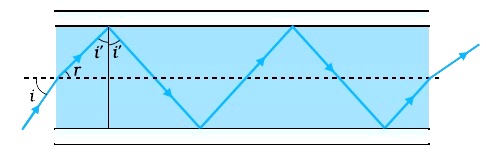
(a) Figure shows a cross-section of a ‘light pipe’ made of a glass fibre of refractive index 1.68. The outer covering of the pipe is made of a material of refractive index 1.44. What is the range of the angles of the incident rays with the axis of the pipe for which total reflections inside the pipe take place, as shown in the figure.
(b) What is the answer if there is no outer covering of the pipe?
6.
Use the mirror equation to deduce that:
(a) an object placed between f and 2f of a concave mirror produces a real image beyond 2f.
(b) a convex mirror always produces a virtual image independent of the location of the object.
(c) the virtual image produced by a convex mirror is always diminished in size and is located between the focus and the pole.
(d) an object placed between the pole and focus of a concave mirror produces a virtual and enlarged image.
[Note: This exercise helps you deduce algebraically properties of images that one obtains from explicit ray diagrams.]
7.
An object of size 3.0cm is placed 14cm in front of a concave lens of focal length 21cm. Describe the image produced by the lens. What happens if the object is moved further away from the lens?
8.
A beam of light converges at a point P. Now a lens is placed in the path of the convergent beam 12cm from P. At what point does the beam converge if the lens is (a) a convex lens of focal length 20cm, and (b) a concave lens of focal length 16cm?
9.
A tank is filled with water to a height of 12.5 cm. The apparent depth of a needle lying at the bottom of the tank is measured by a microscope to be 9.4 cm. What is the refractive index of water? If water is replaced by a liquid of refractive index 1.63 up to the same height, by what distance would the microscope have to be moved to focus on the needle again?
10.
A 4.5 cm needle is placed 12 cm away from a convex mirror of focal length 15 cm. Give the location of the image and the magnification. Describe what happens as the needle is moved farther from the mirror.
1.
The following figure shows a Cassegrain telescope consisting of a concave mirror and a convex mirror.
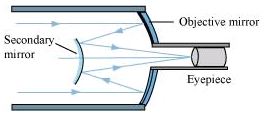
Distance between the objective mirror and the secondary mirror, d = 20 mm
Radius of curvature of the objective mirror, R1 = 220 mm
Hence, focal length of the objective mirror, \({ f }_{ 1 }=\frac { { R }_{ 1 } }{ 2 } =110\)
Radius of curvature of the secondary mirror, R1 = 140 mm
Hence, focal length of the secondary mirror, \({ f }_{ 2 }=\frac { { R }_{ 2 } }{ 2 } =\frac { 140 }{ 2 } \) = 70 mm
The image of an object placed at infinity, formed by the objective mirror, will act as a virtual object for the secondary mirror.
Hence, the virtual object distance for the secondary mirror, u = f1 - d
= 110 - 20
= 90 mm
Applying the mirror formula for the secondary mirror, we can calculate image distance (v) as:
\(\frac { 1 }{ v } +\frac { 1 }{ u } =\frac { 1 }{ { f }_{ 2 } } \)
\(\frac { 1 }{ v } =\frac { 1 }{ { f }_{ 2 } } -\frac { 1 }{ u } \)
\(\frac { 1 }{ 70 } -\frac { 1 }{ 90 } =\frac { 9-7 }{ 630 } =\frac { 2 }{ 630 } \)
∴ v = \(\frac{630}{2}\) = 315 mm
Hence, the final image will be formed 315 mm away from the secondary mirror.
2.
(a) Though the image size is bigger than the object, the angular size of the image is equal to the angular size of the object. A magnifying glass helps one see the objects placed closer than the least distance of distinct vision (i.e., 25 cm). A closer object causes a larger angular size. A magnifying glass provides angular magnification. Without magnification, the object cannot be placed closer to the eye. With magnification, the object can be placed much closer to the eye.
(b) Yes, the angular magnification changes. When the distance between the eye and a magnifying glass is increased, the angular magnification decreases a little. This is because the angle subtended at the eye is slightly less than the angle subtended at the lens. Image distance does not have any effect on angular magnification.
(c) The focal length of a convex lens cannot be decreased by a greater amount. This is because making lenses having very small focal lengths is not easy. Spherical and chromatic aberrations are produced by a convex lens having a very small focal length.
(d) The angular magnification produced by the eyepiece of a compound microscope is \(\left[ \left( \frac { 25 }{ { f }_{ e } } \right) +1 \right] \)
Where,
fe = Focal length of the eyepiece
It can be inferred that if fe is small, then angular magnification of the eyepiece will be large.
The angular magnification of the objective lens of a compound microscope is given as \(\frac { 1 }{ (|{ u }_{ o }|{ f }_{ o }) } \)
Where,
uo = Object distance for the objective lens
fo = Focal length of the objective
The magnification is large when uo > fo. In the case of a microscope, the object is kept close to the objective lens. Hence, the object distance is very little. Since uo is small, fo will be even smaller. Therefore, fe and fo are both small in the given condition.
(e) When we place our eyes too close to the eyepiece of a compound microscope, we are unable to collect much refracted light. As a result, the field of view decreases substantially. Hence, the clarity of the image gets blurred.
The best position of the eye for viewing through a compound microscope is at the eye-ring attached to the eyepiece. The precise location of the eye depends on the separation between the objective lens and the eyepiece.
3.
The incident, refracted, and emergent rays associated with a glass prism ABC are shown in the given figure.
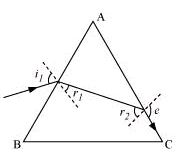
Angle of prism, ∠A = 60°
Refractive index of the prism, µ = 1.524
i1 = Incident angle
r1 = Refracted angle
r2 = Angle of incidence at the face AC
e = Emergent angle = 90°
According to Snell’s law, for face AC, we can have:
\(\frac { sin \ e }{ sin \ { r }_{ 2 } } =\mu \)
\(sin \ { r }_{ 2 }=\frac { 1 }{ \mu } \times sin \ { 90 }^{ o }\)
\(=\frac { 1 }{ 1.524 } =0.6562\)
\(\therefore { r }_{ 2 }={ sin }^{ -1 }0.6562\approx { 41 }^{ o }\)
It is clear from the figure that angle A = r1 + r2
∴ r1 = A - r2 = 60 - 41 = 19o
According to Snell’s law, we have the relation:
\(\mu =\frac { sin{ i }_{ 1 } }{ sin{ r }_{ 1 } } \)
\(sin{ i }_{ 1 }=\mu { sin }r_{ 1 }\)
= 1.524 x sin 19o = 0.496
∴ i1 = 29.75o
Hence, the angle of incidence is 29.75°.
4.
Focal length of the convex lens, f1 = 30 cm
Focal length of the concave lens, f2 = -20 cm
Distance between the two lenses, d = 8.0 cm
(a) When the parallel beam of light is incident on the convex lens first:
According to the lens formula, we have:
\(\frac { 1 }{ { v }_{ 1 } } -\frac { 1 }{ { u }_{ 1 } } =\frac { 1 }{ { f }_{ 1 } } \)
Where,
u1 = Object distance = ∞
v1 = Image distance
\(\frac { 1 }{ { v }_{ 1 } } =\frac { 1 }{ 30 } -\frac { 1 }{ \infty } =\frac { 1 }{ 30 } \)
∴ v1 = 30 cm
The image will act as a virtual object for the concave lens.
Applying lens formula to the concave lens, we have:
\(\frac { 1 }{ { v }_{ 2 } } -\frac { 1 }{ { u }_{ 2 } } =\frac { 1 }{ { f }_{ 2 } } \)
Where,
u2 = Object distance
= (30 - d) = 30 - 8 = 22 cm
v2= Image distance
\(\frac { 1 }{ { v }_{ 2 } } =\frac { 1 }{ 22 } -\frac { 1 }{ 20 } =\frac { 10-11 }{ 220 } =\frac { -1 }{ 220 } \)
∴ v2 = -220 cm
The parallel incident beam appears to diverge from a point that is \(\left( 220-\frac { d }{ 2 } =220-4 \right) 216\) cm from the centre of the combination of the two lenses.
(ii) When the parallel beam of light is incident, from the left, on the concave lens first:
According to the lens formula, we have:
\(\frac { 1 }{ { v }_{ 2 } } -\frac { 1 }{ { u }_{ 2 } } =\frac { 1 }{ { f }_{ 2 } } \)
\(\frac { 1 }{ { v }_{ 2 } } =\frac { 1 }{ { f }_{ 2 } } +\frac { 1 }{ { u }_{ 2 } } \)
Where,
u2 = Object distance = -∞
v2 = Image distance
\(\frac { 1 }{ { v }_{ 2 } } =\frac { 1 }{ -20 } +\frac { 1 }{ -\infty } =-\frac { 1 }{ 20 } \)
∴ v2 = -20 cm
The image will act as a real object for the convex lens.
Applying lens formula to the convex lens, we have:
\(\frac { 1 }{ { v }_{ 1 } } -\frac { 1 }{ { u }_{ 1 } } =\frac { 1 }{ { f }_{ 1 } } \)
Where,
u1 = Object distance
= -(20 + d) = -(20 + 8) = -28 cm
v1 = Image distance
\(\frac { 1 }{ { v }_{ 1 } } =\frac { 1 }{ 30 } +\frac { 1 }{ -28 } =\frac { 14-15 }{ 420 } =\frac { -1 }{ 420 } \)
∴ v2 = - 420 cm
Hence, the parallel incident beam appear to diverge from a point that is (420 - 4) 416 cm from the left of the centre of the combination of the two lenses
The answer does depend on the side of the combination at which the parallel beam of light is incident. The notion of effective focal length does not seem to be useful for this combination.
(b) Height of the image, h1 = 1.5 cm
Object distance from the side of the convex lens, u1 = -40 cm
|u1| = 40 cm
According to the lens formula:
\(\frac { 1 }{ { v }_{ 1 } } -\frac { 1 }{ { u }_{ 1 } } =\frac { 1 }{ { f }_{ 1 } } \)
Where,
v1 = Image distance
\(\frac { 1 }{ { v }_{ 1 } } =\frac { 1 }{ 30 } +\frac { 1 }{ -40 } =\frac { 4-3 }{ 120 } =\frac { 1 }{ 120 } \)
∴ v1 = 120 cm
\(m=\frac { { v }_{ 1 } }{ \left| { u }_{ 1 } \right| } \)
= \(\frac { 120 }{ 40 } =3\)
Hence, the magnification due to the convex lens is 3.
The image formed by the convex lens acts as an object for the concave lens.
According to the lens formula:
\(\frac { 1 }{ { v }_{ 2 } } -\frac { 1 }{ { u }_{ 2 } } =\frac { 1 }{ { f }_{ 2 } } \)
Where,
u2 = Object distance
= +(120 - 8) = 112 cm.
v2 = Image distance
\(\frac { 1 }{ { v }_{ 2 } } =\frac { 1 }{ -20 } +\frac { 1 }{ 112 } =\frac { -112+20 }{ 2240 } =\frac { -92 }{ 2240 } \)
∴ v2 = \(\frac { 2240 }{ 92 } \) cm
Magnification, \({ m }^{ ' }=\left| \frac { { v }_{ 2 } }{ { u }_{ 2 } } \right| \)
\(=\frac { 2240 }{ 92 } \times \frac { 1 }{ 112 } =\frac { 20 }{ 92 } \)
Hence, the magnification due to the concave lens is \(\frac { 20 }{ 92 } \)
The magnification produced by the combination of the two lenses is calculated as:
m x m'
\(=3\times \frac { 20 }{ 92 } =\frac { 60 }{ 92 } =0.652\)
The magnification of the combination is given as:
\(\frac { { h }_{ 2 } }{ { h }_{ 1 } } =0.652\)
h2 = 0.652 x h1
Where,
h1 = Object size = 1.5 cm
h2 = Size of the image
∴ h2 = 0.652 x 1.5 = 0.98 cm
Hence, the height of the image is 0.98 cm
5.
(a) Refractive index of the glass fibre, μ1 = 1.68
Refractive index of the outer covering of the pipe, μ2 = 1.44
Angle of incidence = i
Angle of refraction = r
Angle of incidence at the interface = i’
The refractive index (μ) of the inner core − outer core interface is given a
\(\mu =\frac { { \mu }_{ 1 } }{ { \mu }_{ 2 } } =\frac { 1 }{ sin \ i } \)
sin i' = \(\frac { { \mu }_{ 1 } }{ { \mu }_{ 2 } } \)
= \(\frac{1.44}{1.68}\) = 0.8571
∴ i' = 59o
For the critical angle, total internal reflection (TIR) takes place only wheni > i', i.e., i > 59°
Maximum angle of reflection, rmax = 90o - i' = 90o - 59o = 31o
Let, imax be the maximum angle of incidence.
The refractive index at the air - glass interface, μ1 = 1.68
We have the relation for the maximum angles of incidence and reflection as:
\({ \mu }_1\) = \(\frac { sin{ i }_{ max } }{ sin{ r }_{ max } } \)
sin imsx = μ1 sin rmax
= 1.68 sin 31o
= 1.68 x 0.5150
= 0.8652
∴ imax = sin-1 0.8652 ≈ 60o
Thus, all the rays incident at angles lying in the range 0 < i < 60° will suffer total internal reflection.
(b) If the outer covering of the pipe is not present, then:
Refractive index of the outer pipe, μ1 = Refractive index of air = 1
For the angle of incidence i = 90°, we can write Snell’s law at the air − pipe interface as:
\(\frac { sin \ i }{ sin \ r } ={ \mu }_{ 2 }\) = 1.68
\(sinr=\frac { { sin90 }^{ o } }{ 1.68 } =\frac { 1 }{ 1.68 } \)
r = sin-1 (0.5952)
= 36.5o
∴ i' = 90o - 36.5o = 53.5o
Since i' > r, all incident rays will suffer total internal reflection.
6.
(a) For a concave mirror, the focal length (f) is negative.
∴ f < 0
When the object is placed on the left side of the mirror, the object distance (u) is negative.
∴ u < 0
For image distance v, we can write the lens formula as:
\(\frac { 1 }{ v } -\frac { 1 }{ u } =\frac { 1 }{ f }\)
\(\frac { 1 }{ v } =\frac { 1 }{ f } -\frac { 1 }{ u } \) ....(1)
The object lies between f and 2f.
∴ 2f < u < f (∵ u and f are negative)
\(\frac { 1 }{ 2f } >\frac { 1 }{ u } >\frac { 1 }{ f } \)
\(-\frac { 1 }{ 2f } <-\frac { 1 }{ u } <\frac { 1 }{ f } \)
\(\frac { 1 }{ f } -\frac { 1 }{ 2f } <\frac { 1 }{ f } -\frac { 1 }{ u } <0\) ...(2)
Using equation (1), we get:
\(\frac { 1 }{ 2f } <\frac { 1 }{ v } \)
2f > v
-v > - 2f
Therefore, the image lies beyond 2f.
(b) For a convex mirror, the focal length (f) is positive.
∴ f > 0
When the object is placed on the left side of the mirror, the object distance (u) is negative.
∴ u < 0
For image distance v, we have the mirror formula:
\(\frac { 1 }{ v } +\frac { 1 }{ u } =\frac { 1 }{ f } \)
\(\frac { 1 }{ v } =\frac { 1 }{ f } -\frac { 1 }{ u } \quad \)
Using equation (2), we can conclude that:
\(\frac { 1 }{ v } \) < 0
v > 0
Thus, the image is formed on the back side of the mirror.
Hence, a convex mirror always produces a virtual image, regardless of the object distance.
(c) For a convex mirror, the focal length (f) is positive.
∴ f > 0
When the object is placed on the left side of the mirror, the object distance (u) is negative,
∴ u < 0
For image distance v, we have the mirror formula:
\(\frac { 1 }{ v } +\frac { 1 }{ u } =\frac { 1 }{ f } \)
\(\frac { 1 }{ v } =\frac { 1 }{ f } -\frac { 1 }{ u } \)
But we have u < 0
∴ \(\frac { 1 }{ v } >\frac { 1 }{ f } \)
v < f
Hence, the image formed is diminished and is located between the focus (f) and the pole.
(d) For a concave mirror, the focal length (f) is negative.
∴ f < 0
When the object is placed on the left side of the mirror, the object distance (u) is negative.
∴ u < 0
It is placed between the focus (f) and the pole.
∴ f > u > 0
\(\frac { 1 }{ f } <\frac { 1 }{ u } \)< 0
\(\frac { 1 }{ f } -\frac { 1 }{ u } \)< 0
For image distance v, we have the mirror formula:
\(\frac { 1 }{ v } +\frac { 1 }{ u } =\frac { 1 }{ f } \)
\(\frac { 1 }{ v } =\frac { 1 }{ f } -\frac { 1 }{ u } \)
∴\(\frac { 1 }{ v } \) < 0
v > 0
The image is formed on the right side of the mirror. Hence, it is a virtual image
For u < 0 and v > 0, we can write:
\(\frac { 1 }{ u } >\frac { 1 }{ v } \)
v > u
Magnification, m = \(\frac { u }{ v } \) > 1
Hence, the formed image is enlarged.
7.
Size of the object, h1 = 3 cm
Object distance, u = -14 cm
Focal length of the concave lens, f = -21 cm
Image distance = v
According to the lens formula, we have the relation:
\(\frac { 1 }{ v } -\frac { 1 }{ u } =\frac { 1 }{ f } \)
\(\frac { 1 }{ v } =-\frac { 1 }{ 21 } -\frac { 1 }{ 14 } =\frac { -2-3 }{ 42 } =\frac { -5 }{ 42 } \)
\(\therefore v=-\frac { 42 }{ 5 } =-84cm\)
Hence, the image is formed on the other side of the lens, 8.4 cm away from it. The negative sign shows that the image is erect and virtual.
The magnification of the image is given as:
\(m=\frac { Image \ height({ h }_{ 2 }) }{ Object \ height({ h }_{ 1 }) } =\frac { -8.4 }{ -14 } \)
\(\therefore { h }_{ 2 }=\frac { -8.4 }{ -14 } \times 3=0.6\times 3=1.8\) cm
Hence, the height of the image is 1.8 cm
If the object is moved further away from the lens, then the virtual image will move toward the focus of the lens, but not beyond it. The size of the image will decrease with the increase in the object distance.
8.
In the given situation, the object is virtual and the image formed is real.
Object distance, u = +12 cm
(a) Focal length of the convex lens, f = 20 cm
Image distance = v
According to the lens formula, we have the relation:
\(\frac { 1 }{ v } -\frac { 1 }{ u } =\frac { 1 }{ f } \)
\(\frac { 1 }{ v } -\frac { 1 }{ 12 } =\frac { 1 }{ 20 } \)
\(\frac { 1 }{ v } =\frac { 1 }{ 20 } +\frac { 1 }{ 12 } =\frac { 3+5 }{ 60 } =\frac { 8 }{ 60 } \)
\(\therefore v=\frac { 60 }{ 8 } =7.5\)
Hence, the image is formed 7.5 cm away from the lens, toward its right.
(b) Focal length of the concave lens, f = -16 cm
Image distance = v
According to the lens formula, we have the relation:
\(\frac { 1 }{ v } -\frac { 1 }{ u } =\frac { 1 }{ f } \)
\(\frac { 1 }{ v } =-\frac { 1 }{ 16 } +\frac { 1 }{ 12 } =\frac { -3+4 }{ 48 } =\frac { 1 }{ 48 } \)
\(\therefore v=84cm\)
Hence, the image is formed 48 cm away from the lens, toward its right.
9.
Actual depth of the needle in water, h1 = 12.5 cm
Apparent depth of the needle in water, h2 = 9.4 cm
Refractive index of water = μ
The value of μcan be obtained as follows:
\(\mu =\frac { { h }_{ 2 } }{ { h }_{ 1 } } \)
= \(\frac { 12.5 }{ 9.4 } \approx 1.33\)
Hence, the refractive index of water is about 1.33.
Water is replaced by a liquid of refractive index, μ' = 1.63
The actual depth of the needle remains the same, but its apparent depth changes. Let y be the new apparent depth of the needle. Hence, we can write the relation:
\({ \mu }^{ ' }=\frac { { h }_{ 1 } }{ y } \)
∴ y = \(\frac { { h }_{ 1 } }{ { \mu }^{ ' } } \)
= \(\frac { 12.5 }{ 1.63 } \) = 7.67 cm
Hence, the new apparent depth of the needle is 7.67 cm. It is less than h2. Therefore, to focus the needle again, the microscope should be moved up.
∴ Distance by which the microscope should be moved up = 9.4 - 7.67
= 1.73 cm
10.
Height of the needle, h1 = 4.5 cm
Object distance, u = -12 cm
Focal length of the convex mirror, f = 15 cm
Image distance = v
The value of v can be obtained using the mirror formula:
\(\frac { 1 }{ u } +\frac { 1 }{ v } =\frac { 1 }{ f } \)
\(\frac { 1 }{ v } =\frac { 1 }{ f } -\frac { 1 }{ u } \)
\(\frac { 1 }{ 15 } +\frac { 1 }{ 12 } =\frac { 4+5 }{ 60 } =\frac { 9 }{ 60 } \)
∴ v = \(\frac { 60 }{ 9 } \) = 6.7 cm
Hence, the image of the needle is 6.7 cm away from the mirror. Also, it is on the other side of the mirror.
The image size is given by the magnification formula:
\(m=\frac { { h }_{ 2 } }{ { h }_{ 1 } } =-\frac { u }{ v } \)
\(\therefore { h }_{ 2 }=-\frac { v }{ u } \times { h }_{ 1 }\)
\(=\frac { -6.7 }{ -12 } \times 4.5=+2.5\)cm
Hence, magnification of the image, \(m=\frac { { h }_{ 2 } }{ { h }_{ 1 } } =\frac { 2.5 }{ 4.5 } =0.56\)
The height of the image is 2.5 cm. The positive sign indicates that the image is erect, virtual, and diminished.
If the needle is moved farther from the mirror, the image will also move away from the mirror, and the size of the image will reduce gradually.

12th Standard CBSE Syllabus & Materials
12th Standard CBSE
CBSE 12th Computer Science Python Revision Tour I - New Previous year Question Papers Study Material - QB365 Set A
NEW12th Standard CBSE
CBSE 12th Business Studies Planning Important Questions And Answers Study Material - QB365 Set A
NEW12th Standard CBSE
CBSE 12th Business Studies Business Environment Important Questions And Answers Study Material - QB365 Set A
NEW12th Standard CBSE
CBSE 12th Business Studies Principles of Management Important Questions And Answers Study Material - QB365 Set A



CBSE 12th Standard CBSE Subjects
CBSE Standards










