
 100% FREE ACCESS
12th Standard CBSE Syllabus & Materials
12th Standard CBSE
CBSE 12th Economics Government Budget and the Economy Previous year Question Papers Study Material - QB365 Set A
NEW12th Standard CBSE
CBSE 12th Computer Science Interface Python with MySQL - New Previous year Question Papers Study Material - QB365 Set A
NEW12th Standard CBSE
CBSE 12th Computer Science Database Concept - New Previous year Question Papers Study Material - QB365 Set A
NEW12th Standard CBSE
CBSE 12th Computer Science Data Communication - New Previous year Question Papers Study Material - QB365 Set A
NEW12th Standard CBSE
CBSE 12th Computer Science Data Structures - New Previous year Question Papers Study Material - QB365 Set A
NEW12th Standard CBSE
CBSE 12th Computer Science Functions - New Previous year Question Papers Study Material - QB365 Set A

Published on: 04/12/2019
Ray Optics and Optical Instruments
Download CBSE Class 12th Standard CBSE Physics question papers, sample papers, important questions, and previous year solved papers in PDF format. Get free study materials, NCERT solutions, and exam preparation resources for Class 12th Standard CBSE Physics
Questions + Answers key
Take MCQ Physics Test
1.
The earth takes 24 h to rotate once about its axis. How much time does the sun take to shift by 1° when viewed from the earth?
2.
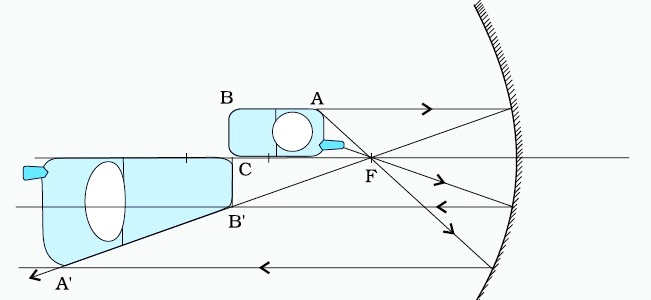
A mobile phone lies along the principal axis of a concave mirror, as shown in Fig. Show by suitable diagram, the formation of its image. Explain why the magnification is not uniform. Will the distortion of image depend on the location of the phone with respect to the mirror?
3.
Suppose that the lower half of the concave mirror’s reflecting surface in Fig. is covered with an opaque (non-reflective) material. What effect will this have on the image of an object placed in front of the mirror?
4.
An object of size 3.0cm is placed 14cm in front of a concave lens of focal length 21cm. Describe the image produced by the lens. What happens if the object is moved further away from the lens?
5.
A small bulb is placed at the bottom of a tank containing water to a depth of 80cm. What is the area of the surface of water through which light from the bulb can emerge out? Refractive index of water is 1.33. (Consider the bulb to be a point source.)
6.
A small candle, 2.5 cm in size is placed at 27 cm in front of a concave mirror of radius of curvature 36 cm. At what distance from the mirror should a screen be placed in order to obtain a sharp image? Describe the nature and size of the image. If the candle is moved closer to the mirror, how would the screen have to be moved?
7.
(i) If f = 0.5 m for a glass lens, what is the power of the lens?
(ii) The radii of curvature of the faces of a double convex lens are 10 cm and 15 cm. Its focal length is 12 cm. What is the refractive index of glass?
(iii) A convex lens has 20 cm focal length in air. What is focal length in water? (Refractive index of air-water = 1.33, refractive index for air-glass = 1.5.)
8.
Suppose while sitting in a parked car, you notice a jogger approaching towards you in the side view mirror of R = 2 m. If the jogger is running at a speed of 5 m s-1, how fast the image of the jogger appear to move when the jogger is (a) 39 m, (b) 29 m, (c) 19 m, and (d) 9 m away.
9.
An object is placed at (i) 10 cm, (ii) 5 cm in front of a concave mirror of radius of curvature 15 cm. Find the position, nature, and magnification of the image in each case.
10.
Double-convex lenses are to be manufactured from a glass of refractive index 1.55, with both faces of the same radius of curvature. What is the radius of curvature required if the focal length is to be 20cm?
11.
A ray of light travelling in a transparent medium of refractive index \(\mu\) on a surface separating the medium from air at an angle of incidence of 450 For which of the following value of \(\mu\) the ray can undergo total internal reflection?
\(\mu\) = 1.33
\(\mu\) = 1.40
\(\mu\) = 1.50
\(\mu\) = 1.25
12.
The angle of a prism is A. One of its refracting
2 sin A
2 cos A
1/2 cos A
tan A
13.
The r efracting angle of a prism is A and refractive index of the material of the prism is cot(A/2). The angle of minimum deviation is
180o-3A
180-2A
90o-A
180o+2A
14.
A thin glass prism ( \(\mu \) = 1.5) is immersed in water ( \(\mu \) = 1.3). If the angle of deviation in air for a particular ray be D, then in water will be
0.2 D
0.3 D
0.5 D
0.6 D
15.
If the critical angle for total internal reflection from a medium to vaccum is \({ 30 }^{ 0 }\), the velocity of light in the medium is
\(3\times { 10 }^{ 8 }m{ s }^{ -1 }\)
\(1.5\times { 10 }^{ 8 }m{ s }^{ -1 }\)
\(6\times { 10 }^{ 8 }m{ s }^{ -1 }\)
\(\sqrt { 3 } \times { 10 }^{ 8 }m{ s }^{ -1 }\)
16.
Two lamps of powers \({ P }_{ 1 }\)and \({ P }_{ 2 }\) are placed on either side of a paper having an oil spot. The lamps are at 1m and 2 m respectively, On either side of the paper and the oil spot is invisible. What is the value of \({ P }_{ 1 }/{ P }_{ 2 }\)?
0.25
0.40
0.50
0.60
17.
If in a plano-convex lens, radius of curvature of convex surface is 10 cm and the focal length of the lens is 30 cm. The refractive index of the material of the lens will be
1.5
1.66
1.33
3
18.
A 4 cm thick layer of water covers a 6 cm thick glass slab. Acoin placed at the bottom of the slab and is being observed from the air side along the normal to the surface. Find the apprent position of the coin from
7.0 cm
8.0 cm
10 cm
5 cm
19.
A Concave mirror form the real image of an object which is magnified 4 times. The object is moved 3 cm away, the magnification of the image is 3 times. What is the focal length of the mirror?
3 cm
12 cm
36 cm
1.
Time taken for 360° shift = 24 h
Time taken for 1° shift = 24/360 h = 4 min.
2.
The ray diagram for the formation of the image of the phone is shown in Fig. The image of the part which is on the plane perpendicular to principal axis will be on the same plane. It will be of the same size, i.e., B'C = BC. You can yourself realise why the image is distorted.
3.
You may think that the image will now show only half of the object, but taking the laws of reflection to be true for all points of the remaining part of the mirror, the image will be that of the whole object. However, as the area of the reflecting surface has been reduced, the intensity of the image will be low (in this case, half).
4.
Size of the object, h1 = 3 cm
Object distance, u = -14 cm
Focal length of the concave lens, f = -21 cm
Image distance = v
According to the lens formula, we have the relation:
\(\frac { 1 }{ v } -\frac { 1 }{ u } =\frac { 1 }{ f } \)
\(\frac { 1 }{ v } =-\frac { 1 }{ 21 } -\frac { 1 }{ 14 } =\frac { -2-3 }{ 42 } =\frac { -5 }{ 42 } \)
\(\therefore v=-\frac { 42 }{ 5 } =-84cm\)
Hence, the image is formed on the other side of the lens, 8.4 cm away from it. The negative sign shows that the image is erect and virtual.
The magnification of the image is given as:
\(m=\frac { Image \ height({ h }_{ 2 }) }{ Object \ height({ h }_{ 1 }) } =\frac { -8.4 }{ -14 } \)
\(\therefore { h }_{ 2 }=\frac { -8.4 }{ -14 } \times 3=0.6\times 3=1.8\) cm
Hence, the height of the image is 1.8 cm
If the object is moved further away from the lens, then the virtual image will move toward the focus of the lens, but not beyond it. The size of the image will decrease with the increase in the object distance.
5.
Actual depth of the bulb in water, d1 = 80 cm = 0.8 m
Refractive index of water, μ = 1.33
The given situation is shown in the following figure:
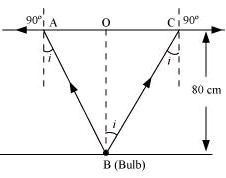
Where,
i = Angle of incidence
r = Angle of refraction = 90°
Since the bulb is a point source, the emergent light can be considered as a circle of radius, \(R=\frac { AC }{ 2 } =OA=OB\)
Using Snell’ law, we can write the relation for the refractive index of water as:
\({ \mu }=\frac { sin \ i }{ sin \ r } \)
\(1.33=\frac { sin{ 90 }^{ o } }{ sini } \)
\(\therefore i={ sin }^{ -i }\left( \frac { 1 }{ 1.33 } \right) =48.{ 75 }^{ o }\)
Using the given figure, we have the relation:
\(tan \ i=\frac { OC }{ OB } =\frac { R }{ { d }_{ 1 } } \)
∴ R = tan 48.75° × 0.8 = 0.91 m
∴ Area of the surface of water = πR2 = π (0.91)2 = 2.61 m2
Hence, the area of the surface of water through which the light from the bulb can emerge is approximately 2.61 m2.
6.
Size of the candle, h = 2.5 cm
Image size = h’
Object distance, u = -27 cm
Radius of curvature of the concave mirror, R = -36 cm
\(f=\frac { R }{ 2 } =-18\)cm
Image distance = v
The image distance can be obtained using the mirror formula:
\(\frac { 1 }{ u } +\frac { 1 }{ v } =\frac { 1 }{ f } \)
\(\frac { 1 }{ v } =\frac { 1 }{ f } -\frac { 1 }{ u } \)
\(\frac { 1 }{ -18 } =\frac { 1 }{ -27 } =\frac { -3+2 }{ 54 } =-\frac { 1 }{ 54 } \)
∴ v = -54 cm
Therefore, the screen should be placed 54 cm away from the mirror to obtain a sharp image.
The magnification of the image is given as:
\(m=\frac { { h }^{ ' } }{ h } =-\frac { v }{ u } \)
\(\therefore { h }^{ ' }=-\frac { v }{ u } \times h\)
\(=-\left( \frac { -54 }{ -27 } \right) \times 2.5=-5\)cm
The height of the candle’s image is 5 cm. The negative sign indicates that the image is inverted and real.
If the candle is moved closer to the mirror, then the screen will have to be moved away from the mirror in order to obtain the image.
7.
(i) Power = +2 dioptre.
(ii) Here, we have f = +12 cm, R1 = +10 cm, R2 = -15 cm.
Refractive index of air is taken as unity.
We use the lens formula. The sign convention has to be applied for f, R1 and R2.
Substituting the values, we have
\(\frac { 1 }{ 12 } =(n-1)\left( \frac { 1 }{ 10 } -\frac { 1 }{ 15 } \right) \)
This gives n = 1.5.
(iii) For a glass lens in air, n2 = 1.5, n1 = 1, f = +20 cm. Hence, the lens formula gives
\(\frac { 1 }{ 20 } =0.5\left( \frac { 1 }{ { R }_{ 1 } } -\frac { 1 }{ { R }_{ 2 } } \right) \)
For the same glass lens in water, n2 = 1.5, n1 = 1.33. Therefore \(\frac { 1.33 }{ f } =(1.5-1.33)\left[ \frac { 1 }{ { R }_{ 1 } } -\frac { 1 }{ { R }_{ 2 } } \right] \)
Combining these two equations, we find f = + 78.2 cm.
8.
From the mirror equation, Eq., we get \(v=\frac{f u}{u-f}\)
For convex mirror, since \(R=2 \mathrm{~m}, f=1 \mathrm{~m}\). Then for \(u=-39 \mathrm{~m}, v=\frac{(-39) \times 1}{-39-1}=\frac{39}{40} \mathrm{~m}\)
Since the jogger moves at a constant speed of \(5 \mathrm{~m} \mathrm{~s}^{-1}\), after 1 s the position of the image v (for \(u=-39+5=-34)\) is (34 / 35) m.
The shift in the position of image in 1 s is \(\frac{39}{40}-\frac{34}{35}=\frac{1365-1360}{1400}=\frac{5}{1400}=\frac{1}{280} \mathrm{~m}\)
Therefore, the average speed of the image when the jogger is between 39 m and 34 m from the mirror, is (1/280) m s–1 Similarly, it can be seen that for u = –29 m, –19 m and –9 m, the speed with which the image appears to move is
\(\frac{1}{150} \mathrm{~m} \mathrm{~s}^{-1}, \frac{1}{60} \mathrm{~ms}^{-1} \text { and } \frac{1}{10} \mathrm{~ms}^{-1} \text {, respectively. }\)
Although the jogger has been moving with a constant speed, the speed of his/her image appears to increase substantially as he/she moves closer to the mirror. This phenomenon can be noticed by any person sitting in a stationary car or a bus. In case of moving vehicles, a similar phenomenon could be observed if the vehicle in the rear is moving closer with a constant speed.
9.
The focal length f = -15/2 cm = -7.5 cm
(i) The object distance u = -10 cm. Then Eq gives
\(\frac { 1 }{ v } +\frac { 1 }{ 10 } =\frac { 1 }{ -7.5 } \)
or \(v=\frac { 10\times 7.5 }{ -2.5 } =-30\) cm
The image is 30 cm from the mirror on the same side as the object
Also, magnification m = \(\frac { v }{ u } =-\frac { (-30) }{ (-10) } =-3\)
The image is magnified, real and inverted.
(ii) The object distance u = -5 cm. Then from Eq
\(\frac { 1 }{ v } +\frac { 1 }{ -5 } =\frac { 1 }{ -7.5 } \)
or \(v=\frac { 5\times 7.5 }{ (7.5-5) } =15\) cm
This image is formed at 15 cm behind the mirror. It is a virtual image.
Magnification m = 15 \(-\frac { v }{ u } =-\frac { 15 }{ (-5) } =3\)
The image is magnified, virtual and erect.
10.
Refractive index of glass, μ
Focal length of the double-convex lens, f = 20 cm
Radius of curvature of one face of the lens = R1
Radius of curvature of the other face of the lens = R2
Radius of curvature of the double-convex lens = R The value of R can be calculated as:
∴ R1 = R and R2 = -R
The value of R can be calculated as:
\(\frac { 1 }{ f } =(\mu -1)\left[ \frac { 1 }{ { R }_{ 1 } } -\frac { 1 }{ { R }_{ 2 } } \right] \)
\(\frac { 1 }{ 20 } =(1.55)\left[ \frac { 1 }{ R } +\frac { 1 }{ R } \right] \)
\(\frac { 1 }{ 20 } =0.55\times \frac { 2 }{ R } \)
∴ R = 0.55 x 2 x 20 = 22 cm
Hence, the radius of curvature of the double-convex lens is 22 cm.
11.
(a)
\(\mu\) = 1.33
12.
(b)
2 cos A
13.
(b)
180-2A
14.
(b)
0.3 D
15.
(b)
\(1.5\times { 10 }^{ 8 }m{ s }^{ -1 }\)
16.
(a)
0.25
17.
(c)
1.33
18.
(a)
7.0 cm
19.
(c)
36 cm

12th Standard CBSE Syllabus & Materials
12th Standard CBSE
CBSE 12th Computer Science Python Revision Tour I - New Previous year Question Papers Study Material - QB365 Set A
NEW12th Standard CBSE
CBSE 12th Business Studies Planning Important Questions And Answers Study Material - QB365 Set A
NEW12th Standard CBSE
CBSE 12th Business Studies Business Environment Important Questions And Answers Study Material - QB365 Set A
NEW12th Standard CBSE
CBSE 12th Business Studies Principles of Management Important Questions And Answers Study Material - QB365 Set A



CBSE 12th Standard CBSE Subjects
CBSE Standards










