
 100% FREE ACCESS
12th Standard CBSE Syllabus & Materials
12th Standard CBSE
CBSE 12th Economics Government Budget and the Economy Previous year Question Papers Study Material - QB365 Set A
NEW12th Standard CBSE
CBSE 12th Computer Science Interface Python with MySQL - New Previous year Question Papers Study Material - QB365 Set A
NEW12th Standard CBSE
CBSE 12th Computer Science Database Concept - New Previous year Question Papers Study Material - QB365 Set A
NEW12th Standard CBSE
CBSE 12th Computer Science Data Communication - New Previous year Question Papers Study Material - QB365 Set A
NEW12th Standard CBSE
CBSE 12th Computer Science Data Structures - New Previous year Question Papers Study Material - QB365 Set A
NEW12th Standard CBSE
CBSE 12th Computer Science Functions - New Previous year Question Papers Study Material - QB365 Set A

Published on: 18/07/2019
Electrostatics
Download CBSE Class 12th Standard CBSE Physics question papers, sample papers, important questions, and previous year solved papers in PDF format. Get free study materials, NCERT solutions, and exam preparation resources for Class 12th Standard CBSE Physics
Questions + Answers key
Take MCQ Physics Test
1.
If Coulomb law involves 1/r3 instead of 1/r2 dependence , would Gauss law be still true?
2.
In a certain 1 m3 of space , electric potential is found to be V Volt throughout.What is the electric filed in this region?
3.
Find the dimension of 1/2\(\varepsilon \)0E2
4.
A Gaussian syrface encloses an electric dipole within it. What is the deal total flux across sphere?
5.
Where the energy of capacitor does resides?
6.
An attractive force of 5 N is acting between two charges of +2 \(\mu \ C\) and -2 \(\mu \ C\) placed at some distance. If the charges are mutually touched and placed again at the same distance, what will be the new force, between them?
7.
Two small balls having equal positive charge q coulomb are suspended by two insulating strings of equal length l metre from a hook fixed to a stand. The whole set up is taken in a satellite into space where there is no gravity. What is the angle between the two strings and the tension in each string?
8.
Dielectric constant of a medium is unity. What will be its primitivity?
9.
Give four properties of electric charges.
10.
A copper sphere of mass 2g contains nearly 2 x 10²² atoms. The charge on the nucleus of each atom is 29e. What fraction of the electrons must be removed from the sphere to give it a charge of +2 \(\mu \ C\)?
11.
What do you mean by additivity of electric charge?
12.
What is meant by quantization of charge?
13.
An ebonite rod is rubbed with fur or wool. What type of charges do they acquire?
14.
An isolated conducting sphere is given a positive charge. Does its mass increase, decrease or remain the same?
15.
What is the cause of charging?
16.
Two capacitors \(3\mu F\) and \(6\mu F\) are connected in series with a 6V battery. A cross which of the capacitors will there be larger potential difference?
17.
Three identical capacitors C1,C2 and C3 of capacitance \(6\mu F\) each are connected to a 12V battery as shown. Find charge on each capacitor
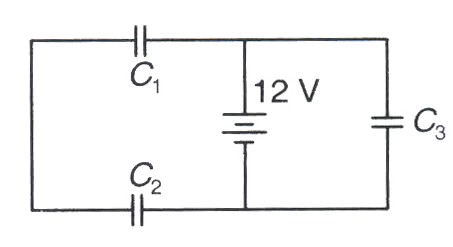
Find
(i) the charge on each capacitor
(ii) the equivalent capacitances of the network
(iii) the energy stored in the network of capacitors.
18.
Electric field intensity (E) due to an electric dipole varies with distance (r) of the point from the centre of dipole as:
\(E\alpha {1\over r}\)
\(E\alpha{1\over r^4}\)
\(E\alpha{1\over r^2}\)
\(E\alpha {1\over r^3}\)
19.
Electric dipole moment is
scalar
neither scalar vector
a vector directed from -q to +q
a vector directed from +q to -q
20.
Electric field due to a single charge is
asymmetric
cylindrically symmetric
spherically symmetric
None of the above
21.
The SI unit of electric field intensity is
N
N/C
C/m2
N/m2
22.
At a particular point, electric field depends upon
Source charge Q only
test charge qo only
both Q and q0
neither Q nor qo
1.
No
2.
Zero
3.
ML-1T-2
4.
0
5.
In the dielectric medium between the plates.
6.
On touching, charges neutralize. Therefore,
F = 0
7.
In a satellite, there is a condition of weightlessness. Therefore, mg = 0. On account of electrostatic force of repulsion between the balls, the strings would become horizontal. Therefore, angle between the strings = 180o.
Also, tension in each string = force of repulsion
\(T={1\over 4\pi\epsilon_o}{q^2\over(2l)^2}N\)
8.
We know that dielectric constant of a medium is
\(K=\epsilon_r={\epsilon\over\epsilon_o}\)
\(\epsilon=K\epsilon_o=1\times8.854\times10^{-12}\)
= \(8.854\times10^{-12}C^2N^{-1}m^{-2}\)
9.
(i) Like charges repel and unlike charges attract each other.
(ii) Charge is quantized
(iii) Charge is conserved
(iv) Charge on a body is not affected by its motion.
10.
Total number of electrons in the sphere = \(29\times2\times10^{22}\)
No of electrons removed = \({q\over e}={2\times10^{-6}\over1.6\times10^{-19}}=1.25\times10^{13}\)
Fraction of electrons removed = \({1.25 \times10^{13}\over 29\times2\times10^{23}}=2.16\times10^{-11}\)
11.
Additivity of charge means the total charge on a system is the algebraic sum (with proper signs) of all individual charges in the system.
12.
Charge on any body or particle can be integral multiple of charge on an electron (-e), i.e.,
q = \(\pm ne\), where n = 1, 2, 3,....
13.
The ebonite rod acquires a negative charge and fur/ wool acquires an equal positive charge.
14.
Its mass decreases slightly as it losses some electrons.
15.
The cause of charging is actual transfer of electrons from one body to the other.
16.
\(3\mu F\)
17.
(i) The equivalent capacitance of C1 and C2 connected in series
\(\frac { 1 }{ C' } =\frac { 1 }{ { C }_{ 1 } } +\frac { 1 }{ { C }_{ 2 } } \)
\(\Rightarrow C'=\frac { 6 }{ 2n } =3\mu F\)
∴ Charge, q' = C'V = (3μF)12 = 36μF
∴ Charge on each capadtor of C1 and C2 is 36 μC
∴ Charge on C3,
q3 = C3V = (6μF) x 12 = 72μC
q3 = 72μC
(ii) Equivalent capacitance of network,
\({ C }_{ eq }=\frac { { C }_{ 1 }{ C }_{ 2 } }{ { C }_{ 1 }+{ C }_{ 2 } } +{ C }_{ 3 }\)
\(=\frac { 6\times 6 }{ 6+6 } +6\)
= 3 + 6 = 9μF
Ceq = 9μF
(iii) Energy stored in the network of capacitors
U = U1 + U2 + U3 = \(\frac { { q' }^{ 2 } }{ { 2C }_{ 1 } } +\frac { { q }'^{ 2 } }{ { 2C }_{ 2 } } +\frac { { q }^{ 2 } }{ { 2C }_{ 3 } } \)
∵ C1 = C2 = C3 = 6μF
\(\therefore U=\frac { 1 }{ (12\mu F) } [{ q' }^{ 2 }+{ q' }^{ 2 }+{ q }^{ 2 }]\)
\(=\frac { 1 }{ (12\mu F) } [({ 36\mu C) }^{ 2 }+({ 36\mu C) }^{ 2 }+({ 72\mu C) }^{ 2 }]\)
\(U=648\mu J\)
18.
(d)
\(E\alpha {1\over r^3}\)
19.
(c)
a vector directed from -q to +q
20.
(c)
spherically symmetric
21.
(b)
N/C
22.
(a)
Source charge Q only

12th Standard CBSE Syllabus & Materials
12th Standard CBSE
CBSE 12th Computer Science Python Revision Tour I - New Previous year Question Papers Study Material - QB365 Set A
NEW12th Standard CBSE
CBSE 12th Business Studies Planning Important Questions And Answers Study Material - QB365 Set A
NEW12th Standard CBSE
CBSE 12th Business Studies Business Environment Important Questions And Answers Study Material - QB365 Set A
NEW12th Standard CBSE
CBSE 12th Business Studies Principles of Management Important Questions And Answers Study Material - QB365 Set A



CBSE 12th Standard CBSE Subjects
CBSE Standards










