
 100% FREE ACCESS
12th Standard CBSE Syllabus & Materials
12th Standard CBSE
CBSE 12th Economics Government Budget and the Economy Previous year Question Papers Study Material - QB365 Set A
NEW12th Standard CBSE
CBSE 12th Computer Science Interface Python with MySQL - New Previous year Question Papers Study Material - QB365 Set A
NEW12th Standard CBSE
CBSE 12th Computer Science Database Concept - New Previous year Question Papers Study Material - QB365 Set A
NEW12th Standard CBSE
CBSE 12th Computer Science Data Communication - New Previous year Question Papers Study Material - QB365 Set A
NEW12th Standard CBSE
CBSE 12th Computer Science Data Structures - New Previous year Question Papers Study Material - QB365 Set A
NEW12th Standard CBSE
CBSE 12th Computer Science Functions - New Previous year Question Papers Study Material - QB365 Set A

Published on: 20/11/2019
Wave Optics
Download CBSE Class 12th Standard CBSE Physics question papers, sample papers, important questions, and previous year solved papers in PDF format. Get free study materials, NCERT solutions, and exam preparation resources for Class 12th Standard CBSE Physics
Questions + Answers key
Take MCQ Physics Test
1.
(a) Good quality sun-glasses made of polaroids are preferred over ordinary coloured glasses. Justifying your answer.
(b) Two polaroids P1 and P2 are placed in crossed positions. A third polaroid P3 is kept between P1 and P2 such that pass axis of P3 is parallel to that of P1 How would the intensity of light 10 transmitted through P2 vary as P3 is rotated? Draw a plot of intensity '\(\theta\)' Vs the angle 'e', between pass axes of P1 and P3.
2.
Let us list some of the factors which could possibly influence the speed of wave propagation:
(i) nature of the source
(ii) direction of propagation
(iii) motion of the source and/or observer
(iv) wavelength
(v) intensity of the wave.
On which of these factors, if any, does
(a) the speed of light in vacuum
(b) the speed of light in a medium (say glass or water) depend?
3.
The bottom of a container is a 4.0 cm thick glass (n = 1.5) slab. The container contain two immiscible liquids A and B of depths 6.0 cm and 8.0 cm, respectively. what is the apparent position of a scratch on the outer surface of the bottom of the glass slab when viewed through the container? Refractive indices of A and B are 1.4 and 1.3 respectively.
4.
(a) A point object is placed in front of a double convex lens (of refractive index n =n2/n1 with respect air) with its spherical faces of radii of curvature R1 and R2.. Show the path of rays due to surface to obtain the formation of the real image of the object.
Hence obtain the lens maker's formula for a thin lens.
(b) A double convex lens having both faces of the same radius of curvature has refractive index 1.55. Find out the radius of curvature of the lens required to get the focal length of 20 cm.
5.
When an object is placed at a distance of 60 cm from a convex spherical mirror, the magnification produced is 1/2. Where should the object be placed to get a magnification of 1/3?
6.
Show that at polarising angle, the reflected and refracted beams of light are at \({ 90 }^{ \circ }\) to each other.
7.
A ray of light passes through an equilateral glass prism, such that the angle of incidence is equal to the angle of emergence. If the angle of emergence is ¾ times the angle of the prism, Calculate the refractive index of the glass prism
8.
A beam of white light on passing through a hollow prism gives no spectrum. Why?
9.
A microscope is focused on a dot at the bottom of a beaker. Some oil is poured into the beaker to a height of y cm and it is found necessary to raise the microscope through a vertical distance of x cm to bring the dot again into focus. Express refractive index of oil in terms of x and y
10.
The refractive index of diamond is much higher than that of glass. How does a diamond cutter make use of this fact?
11.
The 6463\(\mathring { A } H_{ \infty }\) -line emitted by hydrogen in a star is found to be red shifted by 15\(\mathring { A } \). Estimate the speed with which the star is receding from the earth.
12.
What is the wavelength region of visible spectrum?
13.
Why does a soap bubble show beautiful colours, when illuminated by white light?
14.
A myopic person prefers to remove his spectacles while reading a book. Why?
15.
If the wavelength of incident light on a concave mirror is increased, how will the focal length of the mirror change?
16.
Can we obtain the image formed by a convex mirror on a screen? If not, why?
17.
What is visual angle?
18.
An astronomical telescope has a magnifying power of 10. In normal adjustment, distance between the objective and eye piece is 22 cm. The focal length of objective lens is
10 cm
22 cm
20 cm
2 cm
19.
Refractive index of glass w.r.t. water is 9/8. What is the speed of light in water? Given speed of light in glass is \(2\times 10^{ 8 } \ m/s\) .
\(2\times 10^{ 8 } \ m/s\)
\(3\times 10^{ 8 } \ m/s\)
\(2.25\times 10^{ 8 } \ m/s\)
none of these
20.
Which is not true for the image formed in a plane mirror? The image is
virtual
erect
laterally inverted
closer to the mirror than the object
1.
(a) Polaroid sunglasses are preferred because they can be much more effective than coloured sunglasses in cutting off the harmful (UV) rays of the sun.
(b)
.png)
.png)
2.
(a) The speed of light in vacuum is a universal constant, independent of all the factors listed and anything else.
(b) Dependence of the speed of light in a medium:
(i) does not depend on the nature of the source
(wave speed is determined by the properties of the medium of propagation.This is also true for other waves e.g. sound waves etc.)
(ii) independent of the direction propagation for isotropic media.
(iii) Independent of the motion of the source relative to the medium.
(iv) depends on wavelength.
(v) independent of intensity.
3.
The total apparent shift in the position of the image due to all the three media is
given by
d = t1[1-1/(\({ \mu }\)1) + t2[1-1/(\({ \mu }\)2) + t3[1-1/(\({ \mu }\)3)
Given t1 = 4.0 cm, t2 = 6.0 cm , t3 = 8.0 cm
\({ \mu }\)1 = 1.5 , \({ \mu }\)2=1.4 , \({ \mu }\)3 = 1.3 cm
d = 4.0(1-1/1.5) + 6.0(1-1/1.4) + 8.0(1-1/1.3)
= 1.33 + 1.71 + 1.85 = 4.89 cm
4.
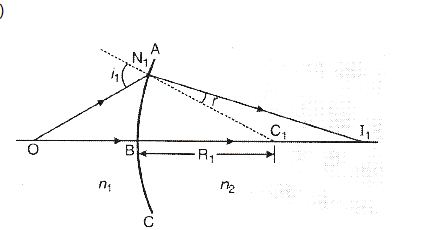
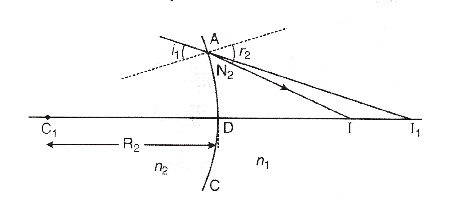
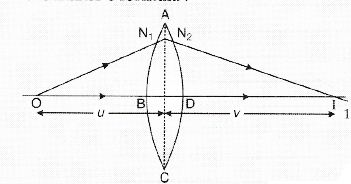
The first refracting ABC forms the image I1 of the object O. The image I1 acts as virtual object for the second refracting surface ADC, which forms the real image I as shown in the diagram
For refraction at ABC
\(\frac { { n }_{ 2 } }{ { v }_{ 1 } } -\frac { { n }_{ 1 } }{ u } =\frac { { n }_{ 2 }-{ n }_{ 1 } }{ { R }_{ 1 } } \)
For refraction at ADC
\(\frac { { n }_{ 1 } }{ v } -\frac { { n }_{ 2 } }{ { v }_{ 1 } } =\frac { { n }_{ 1 }-{ n }_{ 2 } }{ { R }_{ 2 } } \)
Adding equation (i) and equation (ii)
\(\frac { { n }_{ 1 } }{ v } -\frac { { n }_{ 2 } }{ u } =\left( { n }_{ 2 }-{ n }_{ 1 } \right) \left( \frac { 1 }{ { R }_{ 1 } } -\frac { 1 }{ { R }_{ 2 } } \right) \)
\(\frac { 1 }{ v } -\frac { 1 }{ u } =\left( \frac { { n }_{ 2 } }{ { n }_{ 1 } } -1 \right) \left( \frac { 1 }{ { R }_{ 1 } } -\frac { 1 }{ { R }_{ 2 } } \right) \)
We know, If \(u=\infty ,v=f\)
\(\frac { 1 }{ v } -\frac { 1 }{ u } =\frac { 1 }{ f } \)
\(\frac { 1 }{ f } =\left( \frac { { n }_{ 2 } }{ { n }_{ 1 } } -1 \right) \frac { 1 }{ { R }_{ 1 } } -\frac { 1 }{ { R }_{ 2 } } \)
\(\frac { 1 }{ f } =\left( { \mu }_{ 21 }-1 \right) \left( \frac { 1 }{ { R }_{ 1 } } -\frac { 1 }{ { R }_{ 2 } } \right) \)
\(\frac { 1 }{ f } =\left( { \mu }_{ 21 }-1 \right) \left( \frac { 1 }{ { R }_{ 1 } } -\frac { 1 }{ { R }_{ 2 } } \right) \)
\(\frac { 1 }{ f } =\left( 1.55-1 \right) \left( \frac { 1 }{ R } -\frac { 1 }{ -R } \right) \)
\(=0.55\times \frac { 2 }{ R } \)
\(R=0.55\times 2\times 20=22 \ cm\)
5.
Here,
\(u_{ 1 }=-60\ cm,\ m_{ 1 }=\frac { 1 }{ 2 }\)
\( u_{ 2 }=?,\ m_{ 2 }=\frac { 1 }{ 3 } \)
As \(m_{ 1 }=-\frac { \upsilon _{ 1 } }{ u_{ 1 } } \therefore \frac { 1 }{ 2 } =-\frac { \upsilon _{ 1 } }{ -(-60) } ,\upsilon _{ 1 }=30\quad cm\)
From \(\frac { 1 }{ f } =\frac { 1 }{ \upsilon _{ 1 } } +\frac { 1 }{ u_{ 1 } } =\frac { 1 }{ 30 } -\frac { 1 }{ 60 } =\frac { 1 }{ 60 } \)
\(f=60\ cm\)
Again, \(m_{ 2 }=-\frac { \upsilon _{ 2 } }{ u_{ 2 } } =\frac { 1 }{ 3 } ,\ \upsilon _{ 2 }=-\frac { u_{ 2 } }{ 3 } \)
From
\(\frac { 1 }{ \upsilon _{ 2 } } +\frac { 1 }{ u_{ 2 } } =\frac { 1 }{ f }\)
\( \frac { 1 }{ u_{ 2 } } =\frac { 1 }{ f } -\frac { 1 }{ \upsilon _{ 2 } } =\frac { 1 }{ 60 } +\frac { 3 }{ u_{ 2 } } \)
or \(\frac { 1 }{ u_{ 2 } } -\frac { 3 }{ u_{ 2 } } =\frac { 1 }{ 60 } ,\ u_{ 2 }=-120 \ cm\)
6.
Let \(\mu \) be refractive index of the transparent surface. If \({ i }_{ p }\)is polarising angle r is the angle of refraction as shown in Fig. then from Snell law, we have
\( \mu =\frac { \sin { { i }_{ p } } }{ \sin { { r } } } ....(1)\)
\(From \ Breester' \ law, \ we \ have\)
\(\mu =\tan { { i }_{ p } } =\frac { \sin { { i }_{ p } } }{ \sin { { i }_{ p } } } ....(2)\)
\(From \ Eqs.\ (1)\ (2), \ we \ have\)
\(\frac { \sin { { i }_{ p } } }{ \sin { r } } =\frac { \sin { { i }_{ p } } }{ { \cos { { i }_{ p } } } }\)
\(or \ \sin { r } =\cos { { i }_{ p } } \)
\(or \ \sin { r } =\sin { ({ 90 }^{ \circ } } -{ i }_{ p })\)
\(or \ r ={ 90 }^{ \circ }-{ i }_{ p }\)
\( or \ { i }_{ p }+r={ 90 }^{ \circ }\)
i.e. the reflected and refracted beams of light at polarising angle are perpendicular to each other.
7.
A = 600 , \(\delta \)m = 300
i = e = ¾ A = 450
as A + \(\delta \) = i + e
60 + \(\delta \) = 45 +45
or \(\delta \) = 300
Refractive index,
\(\mu \) = sin a + \(\delta \)m /2/sin A/2 = sin 600+300/2/sin 600/2
= sin 450/sin300 = 1\(\surd 2\) 1/2 = \(\surd 2\) = 1.414
8.
A hollow prism contains air which does not cause dispersion. The faes AB and AC of the hollow prism behave like parallel sides of glass plates. The beam is laterally deviated at each of the two refracting faces. However, the rays of different colours emerge parallel to each other. So there is no dispersion.
9.
Real depth = y cm
Apparent depth = y- x cm
Refractive index of oil,
\({ \mu }\) = real depth/ apparent depth = y / y-x
10.
The refractive index of diammond is much higher than that of glass. Due to high refractive index, the critical angle for diamond-air interface is low. The diamond is cut suitably, so that the light entering the diamond from any face suffers multiple total internal reflections at the various surfaces. This gives sparklingeffect to the diamonds.
11.
Here,
\(\lambda =6563\mathring { A } ,\Delta \lambda =+15\mathring { A }\)
\( \\ C=3\times { 10 }^{ 8 }{ ms }^{ -1 }\)
Since, the star is receding away,hence its velocity v is negative.
\(\Delta \lambda =\frac { v\lambda }{ c } or\quad v=-\frac { c\Delta \lambda }{ \lambda } \)
\(\\ =-\frac { 3+{ 10 }^{ 8 }\times 15 }{ 6563 } =-6.86\times { 10 }^{ 5 }{ 10 }ms^{ -1 }\)
Negative sign shows that star is receding away from the earth.
12.
\(3800\overset { \circ }{ A } \ to \ 7600\overset { \circ }{ A } \)
13.
Light waves reflected from outer and inner surface of soap bubble interfere. For different wavelengths, conditions for constructive interference are satisfied at different positions. That is why beautiful colours are seen.
14.
A myopic person has to use spectacles with concave lens.He may have normal near point (\(\approx\)25cm). To read with specs, he has o hold the book at a distance greater than 25cm. As angular size of object at a distance > 25 cm is less than angular size of object at 25 cm, therefore, the person prefers to remove his spectacles while reading.
15.
The focal length of mirror does not change on changing the wavelength of light incident on it. This is because f = R/2, i.e. f depends only on radius of curvature of the mirror.
16.
No, because the image formed by a convex mirror is virtual.
17.
Visual angle is the angle subtended by an object at the eye.
18.
(c)
20 cm
19.
(c)
\(2.25\times 10^{ 8 } \ m/s\)
20.
(d)
closer to the mirror than the object

12th Standard CBSE Syllabus & Materials
12th Standard CBSE
CBSE 12th Computer Science Python Revision Tour I - New Previous year Question Papers Study Material - QB365 Set A
NEW12th Standard CBSE
CBSE 12th Business Studies Planning Important Questions And Answers Study Material - QB365 Set A
NEW12th Standard CBSE
CBSE 12th Business Studies Business Environment Important Questions And Answers Study Material - QB365 Set A
NEW12th Standard CBSE
CBSE 12th Business Studies Principles of Management Important Questions And Answers Study Material - QB365 Set A



CBSE 12th Standard CBSE Subjects
CBSE Standards










